
A periodic tenancy is a rolling rental agreement that continues from one payment period to the next with no fixed end date, ending only when either party gives proper notice. For landlords, that means more flexibility to adjust strategy but less certainty on income and a different notice framework to manage than a fixed-term lease. Under South Australia's Residential Tenancies Act 1995, these arrangements are common, whether by design or by default, and disputes over them typically land at SACAT.
- Continues indefinitely until validly ended by notice
- Rent period (weekly, fortnightly, monthly) sets the tenancy period
- Can arise automatically when a fixed term expires
- HOSO Real Estate manages these transitions for Adelaide landlords daily
Key Takeaways
A periodic tenancy protects landlord flexibility only when notice, documentation, and bond records are managed with the same rigour as a fixed-term lease.
| Point | Details |
|---|---|
| No fixed end date | A periodic tenancy rolls from one rent period to the next until valid notice ends it. |
| Watch short fixed terms | SA presumes terms of 90 days or less are periodic unless a prescribed warning and acknowledgement were signed first. |
| Notice periods differ | Landlords generally need 90 days for a no-reason notice in SA; tenants need 21 days or one month if rent is monthly. |
| Bond doesn't reset | Bond obligations continue unchanged through a rollover unless a rent increase triggers a top-up. |
| Get professional support | HOSO Real Estate manages tenancy reviews, notice documentation, and SACAT-bound evidence for Adelaide landlords. |
Table of Contents
- How does a periodic tenancy work day to day?
- How does a periodic tenancy typically start?
- What rights and obligations apply during a periodic tenancy?
- How do you end a periodic tenancy correctly?
- What are the pros and cons of a periodic tenancy?
- What should landlords do right now?
- What happens to the bond during a periodic tenancy?
- What disputes commonly arise from periodic tenancies?
- What does a valid notice to end a periodic tenancy look like?
- What if notice isn't given properly?
- What do Adelaide landlords get wrong most often?
- Let HOSO Real Estate manage the transition for you
- Frequently asked questions about periodic tenancy
- Sources
How does a periodic tenancy work day to day?
The tenancy period usually mirrors the rent cycle. If your tenant pays rent monthly, the tenancy runs month to month; if weekly, it runs week to week. There's no calendar end date sitting in the background, just a rolling arrangement that keeps renewing itself until someone ends it properly.
A periodic tenancy can come about two ways. Either the landlord and tenant sign a periodic agreement from the outset, or the tenancy becomes periodic "by operation of law," meaning a fixed-term lease expired and nobody signed a new one, so the arrangement rolled over automatically. NSW's own housing guidance confirms this rollover principle applies broadly across residential tenancies frameworks.
Picture a townhouse in Norwood on a twelve-month lease. The term lapses, the tenant stays, rent keeps landing in your account. Unless you've actioned something, that lease is now periodic.

How does a periodic tenancy typically start?
Most periodic tenancies begin one of three ways:
- The original agreement was written as periodic from day one, with no fixed term at all
- A fixed-term lease expired and no new fixed term was signed, so the tenancy rolled over
- The tenant "held over" after the fixed term ended, continuing to pay rent that the landlord accepted
South Australia adds a wrinkle landlords often miss. Any fixed term of 90 days or less is presumed periodic unless the landlord issued a prescribed written warning and the tenant signed an acknowledgement before the agreement began. Check your lease wording, your rent receipts, and how the tenant has been behaving. If none of those confirm a fixed term is still active, you're almost certainly dealing with a periodic arrangement.
What rights and obligations apply during a periodic tenancy?
The core obligations don't disappear just because there's no end date. As a landlord, you still need to maintain the premises, comply with whatever written agreement exists, handle the bond correctly, and keep clear records of rent and communication. Our guide to landlord obligations in South Australia breaks these down in detail.
Tenants, in turn, must pay rent on time, take reasonable care of the property, and allow lawful entry for inspections and repairs under the agreement and the Residential Tenancies Act 1995 (SA).
Rent reviews work differently too. Fixed-term leases often lock in rent for the term; periodic arrangements generally allow rent changes with proper notice, subject to the rules on rent increases under state legislation. Bond handling and maintenance duties continue exactly as they would under a fixed term, just without a renewal date forcing a review.
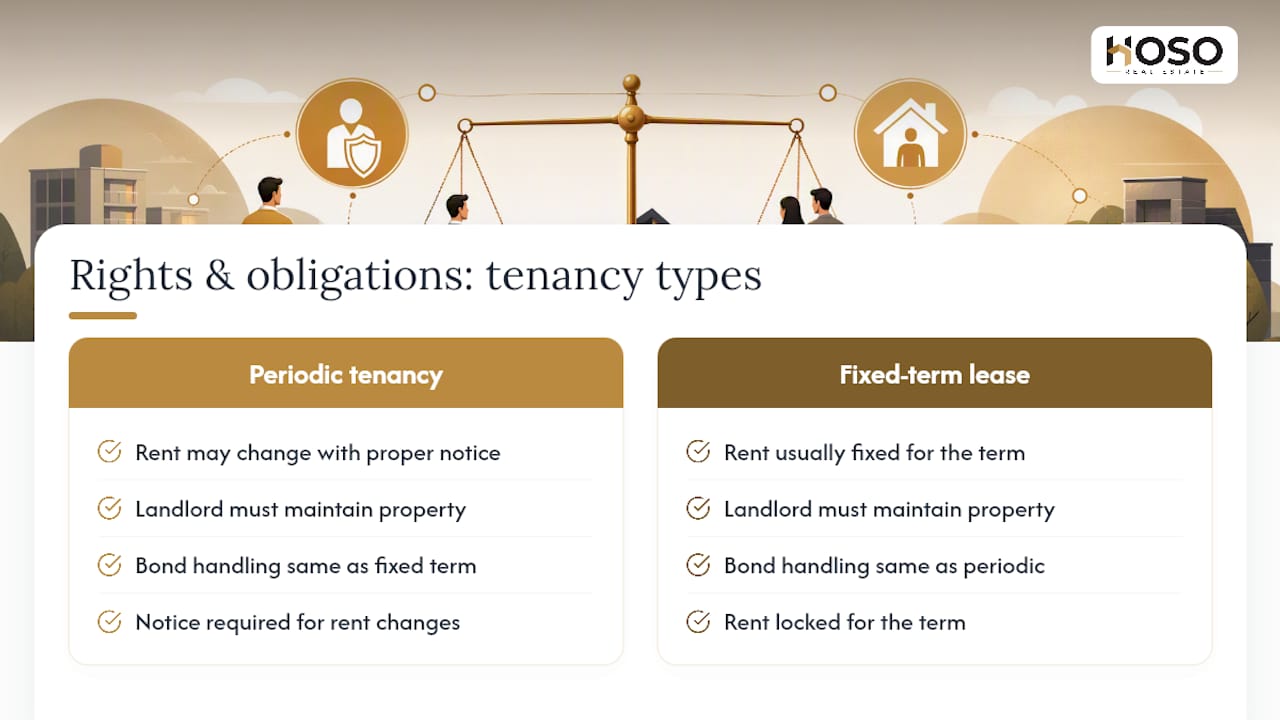
Disputes over any of this, from bond disagreements to maintenance failures, get resolved through SACAT in South Australia. It's worth scheduling regular proactive maintenance checks rather than waiting for a periodic tenancy to drift on unmanaged.
Pro Tip: Even a verbal periodic tenancy benefits from a written schedule of terms. If a dispute lands at SACAT, a documented agreement is far stronger evidence than a memory of what was agreed on move-in day.
How do you end a periodic tenancy correctly?
Ending a periodic tenancy runs down one of two paths: notice without a stated reason, or notice on a prescribed ground such as breach, sale, renovation, or a family member needing to move in.
In South Australia, a landlord ending a periodic tenancy without giving a reason must generally provide 90 days' notice, while tenants ending without cause typically owe a minimum notice period of three weeks, or about one month if rent is paid monthly. Notice periods and permitted grounds vary by state, so always confirm the current South Australian figures through the LSC handbook on landlord termination before acting.
- Check the lease for any special terms affecting notice
- Confirm which notice type applies to your situation and select the correct prescribed form
- Gather supporting evidence, such as rent history, correspondence, or breach documentation
- Serve the notice using a method that lets you prove delivery
- Record the date served and diary the response deadline
If the tenant refuses to leave once notice expires, the next step is a possession application through SACAT. HOSO Real Estate handles this evidence-gathering and tribunal liaison for landlords who'd rather not navigate it solo, drawing on our SA tenancy termination process guide as a working reference.
What are the pros and cons of a periodic tenancy?
Periodic tenancies suit landlords who want room to move. You can adjust rent more readily, sell without waiting out a lease term, or move a family member in without breaching a fixed contract. Tenants get similar flexibility, testing a suburb like Glenelg or Prospect before committing longer term.
The trade-off is real. Fixed-term v periodic comparisons consistently show periodic arrangements trade certainty for flexibility, and that cuts both ways:
- Landlord advantages: faster strategy changes, easier rent reviews, quicker possession for specific grounds
- Landlord disadvantages: less income certainty, sudden vacancy risk, more frequent notice administration
- Tenant advantages: flexibility to leave with standard notice, no lock-in to a full term
- Tenant disadvantages: less security, rent changes can arrive more often
For a premium asset in a tightly held pocket like Unley or Walkerville, that vacancy risk carries more weight than it would on a standard rental. If continuous occupancy matters more than flexibility, a fixed term is usually the safer play.
What should landlords do right now?
Work through this before your next rent cycle:
- Confirm whether the current tenancy is fixed-term or periodic by checking the lease and rent records
- Review the written agreement for any special conditions on notice or entry
- Verify the bond is lodged correctly and matches current rent
- Schedule a routine inspection if one hasn't happened recently
- Set diary reminders for any notice windows relevant to your plans
- Update your records with the latest rent receipts, correspondence, and inspection reports
If you're planning to serve notice, start collecting evidence now, photos, written communications, and a clean rent ledger all strengthen your position if the matter reaches SACAT.
Pro Tip: Landlords managing periodic tenancies alone often underestimate how much paperwork discipline it takes. Professional management closes that gap, and if your situation involves a breach or a contested notice, engaging a property manager or solicitor early is cheaper than fixing a botched notice later.
What happens to the bond during a periodic tenancy?
The bond doesn't reset or change just because a lease has become periodic. It sits exactly where it was lodged, held under the same rules that applied during the fixed term, and it continues to cover the same obligations: property damage, unpaid rent, or breach of agreement.
Where landlords get caught out is assuming a rolled-over tenancy means a fresh start on bond requirements. It doesn't. If the original bond was lodged with the correct South Australian authority at the amount tied to the original rent, that figure stands until a rent increase or new agreement changes it. A rent increase during a periodic tenancy can trigger a bond top-up requirement, so it's worth checking whether your bond still matches four weeks' rent (the standard multiple) after any adjustment.
Condition reports carry more weight in periodic arrangements too, precisely because there's no lease renewal moment forcing a fresh inspection and reset. Without that natural checkpoint, evidence of the property's condition can go stale. A landlord managing a periodic tenancy on a character home in Unley, for instance, should treat routine inspections as the substitute for that missing renewal trigger, refreshing photographic evidence regularly so any bond claim at the end of the tenancy holds up.
End-of-tenancy bond disputes, whether over cleaning, damage, or unpaid rent, follow the same claims process regardless of whether the tenancy was fixed-term or periodic. What changes is the paper trail available to support a claim, and that's squarely within the landlord's control.
What disputes commonly arise from periodic tenancies?
Periodic tenancies generate a particular flavour of dispute that fixed terms rarely see. The most common by far involves disagreement over whether a tenancy actually became periodic in the first place, particularly where a landlord offered a short fixed term without realising South Australia's presumption of periodicity applies to any term of 90 days or less unless the correct warning and acknowledgement were completed beforehand.
Notice validity is the second recurring flashpoint. Tenants challenge notices for using the wrong form, citing an invalid ground, or falling short of the required notice period. Landlords challenge tenants who vacate without giving proper notice, then dispute whether rent remains owing for the shortfall period.
Rent increase disputes also surface more in periodic tenancies than fixed terms, since periodic arrangements typically permit more frequent rent reviews. Tenants sometimes argue an increase wasn't served with correct notice or wasn't valid under the minimum interval rules.
Most of these disputes resolve through SACAT, where the tribunal examines the written agreement (if one exists), rent records, and any notices served. Cases turn heavily on documentation. A landlord who can produce a dated notice, proof of service, and a clean rent ledger is in a far stronger position than one relying on verbal recollection. For anything beyond a straightforward notice dispute, particularly where a breach or a contested ground for possession is involved, specialist legal advice through a firm such as Simons George Legal is worth the conversation before matters escalate to a hearing.
What does a valid notice to end a periodic tenancy look like?
A notice to end a periodic tenancy needs specific elements to hold up, whether it's coming from a landlord or a tenant. At minimum, it should state the address of the property, the names of both parties, the date the notice is given, the date possession is required, and the ground relied on if it isn't a no-reason notice.
For a landlord ending a tenancy without cause, the notice should reference the 90-day minimum period and simply state the tenancy is ending on that basis, no justification required. For a tenant giving notice, 21 days generally applies, extending to one month where rent is paid monthly.
Where a landlord is relying on a prescribed ground, such as a breach, sale of the property, or renovations, the notice needs to specify that ground clearly and reference the relevant section of the Residential Tenancies Act 1995 (SA). A vague or generic notice citing "personal reasons" without a recognised ground is a common way landlords lose a possession application before it even reaches a hearing.
Templates for these notices are available through the South Australian government's lease agreement guidance, which sets out the correct forms for each notice type. Using the wrong form, or a form from another state, is one of the most avoidable errors landlords make. Our guide on tenant communication standards covers how to document delivery so a notice can't be challenged on service grounds alone.
What if notice isn't given properly?
An improperly served notice is, in most cases, simply invalid, and the tenancy continues as if nothing happened. If a landlord serves a notice with the wrong form, insufficient notice period, or no valid ground where one is required, the tenant can remain in the property and the landlord has to start the process again correctly.
The same principle applies in reverse. A tenant who vacates without giving proper notice, or who gives notice but leaves before it expires, generally remains liable for rent through to the end of the required notice period, or until a new tenant is found, whichever comes first.
Where a landlord attempts to physically re-enter or lock out a tenant without a valid notice and, where necessary, a tribunal order, that's a serious breach with real legal exposure. South Australian process requires landlords to obtain possession lawfully, through expired notice followed by a SACAT order if the tenant doesn't leave voluntarily. Self-help eviction isn't a shortcut; it's a liability.
Tenants who dispute a notice's validity, or landlords chasing a tenant who's left without notice, both end up at SACAT if the matter can't be resolved directly. The tribunal will look closely at whether the notice met every formal requirement: correct form, correct period, correct ground, and proof it was actually served. That's precisely why documentation discipline matters more in periodic tenancies than in fixed terms, there's no lease document doing the heavy lifting; every notice has to stand on its own.
What do Adelaide landlords get wrong most often?
We see the same pattern repeatedly across our Adelaide portfolio: landlords offer a short fixed term to "test" a tenant, without realising South Australia's periodic presumption kicks in unless the warning and acknowledgement paperwork is done first. That single oversight has turned more short leases periodic than any other cause we manage.
Documentation discipline is what actually prevents disputes, not luck. Property owners across suburbs from Prospect to Glenelg who treat periodic tenancies with the same rigour as a fixed term, written schedules, diaried notice windows, logged maintenance, consistently avoid the SACAT hearings that catch out landlords managing solo.
Let HOSO Real Estate manage the transition for you
Periodic tenancies reward landlords who stay on top of paperwork and punish those who don't, and that's exactly where a dedicated property manager earns their place. HOSO Real Estate handles the parts landlords find hardest to keep up with: reviewing whether a tenancy has rolled over, preparing correct notice documentation, managing SACAT-bound evidence, and keeping bond and rent records audit-ready year-round.
Rather than tracking notice windows and presumption rules yourself, our team builds that discipline into how we manage every Adelaide property under our care, drawing on the same standards outlined in our guide to property manager accountability. You can see the outcomes we've delivered on our recently leased properties page.
If your periodic tenancy needs a proper review, or you're weighing whether to convert it to a fixed term, start with a conversation through our services overview and we'll walk you through the options for your property.
Frequently asked questions about periodic tenancy
What is a periodic tenancy explained simply? It's a rolling lease with no end date, continuing period to period until either party gives valid notice to end it.
How does periodic tenancy work compared to a fixed term? A fixed term has a set end date and locked conditions; a periodic tenancy continues indefinitely, with rent reviews and notice-based endings replacing the renewal moment.
Can a landlord end a periodic tenancy without a reason in SA? Yes, with 90 days' written notice under South Australian rules, no ground required for a no-reason termination.
Does a periodic tenancy need to be in writing? No, it can be verbal, but a written standard-form agreement is strongly recommended to reduce disputes and support any SACAT evidence.
What happens if a short fixed-term lease wasn't given the periodicity warning? The lease is treated as periodic from the start, regardless of what the fixed term stated, unless the landlord completed the prescribed warning and acknowledgement first.
This article is general information, not a substitute for advice from a qualified lawyer. Consult a qualified legal professional about your own circumstances before acting on anything here.
Sources
- Lease agreements
- Fixed term or periodic tenancies
- Residential Tenancies Act 1995 (SA) — AustLII
- Periodic lease, rent increases & Australian legal guidelines