
The role of landlord in a tenancy agreement is defined by a set of legal obligations that govern documentation, property maintenance, tenant safety, and dispute resolution from the first day of the lease to the last. In South Australia, these duties are not optional. They are enforceable under the Residential Tenancies Act 1995 (SA), and failure to meet them exposes landlords to penalties, compensation orders, and tribunal proceedings through SACAT. Understanding your responsibilities is the foundation of effective property management, not an afterthought.
What is the role of landlord in tenancy agreement?
The landlord's role in a tenancy agreement is to fulfil both contractual and statutory duties that protect the tenant's rights and the property's legal standing. Legislation increasingly uses the term "rental provider" to reflect evolving tenancy standards that place occupant safety and property condition at the centre of the relationship. The practical effect is the same: landlords carry obligations that go well beyond collecting rent.
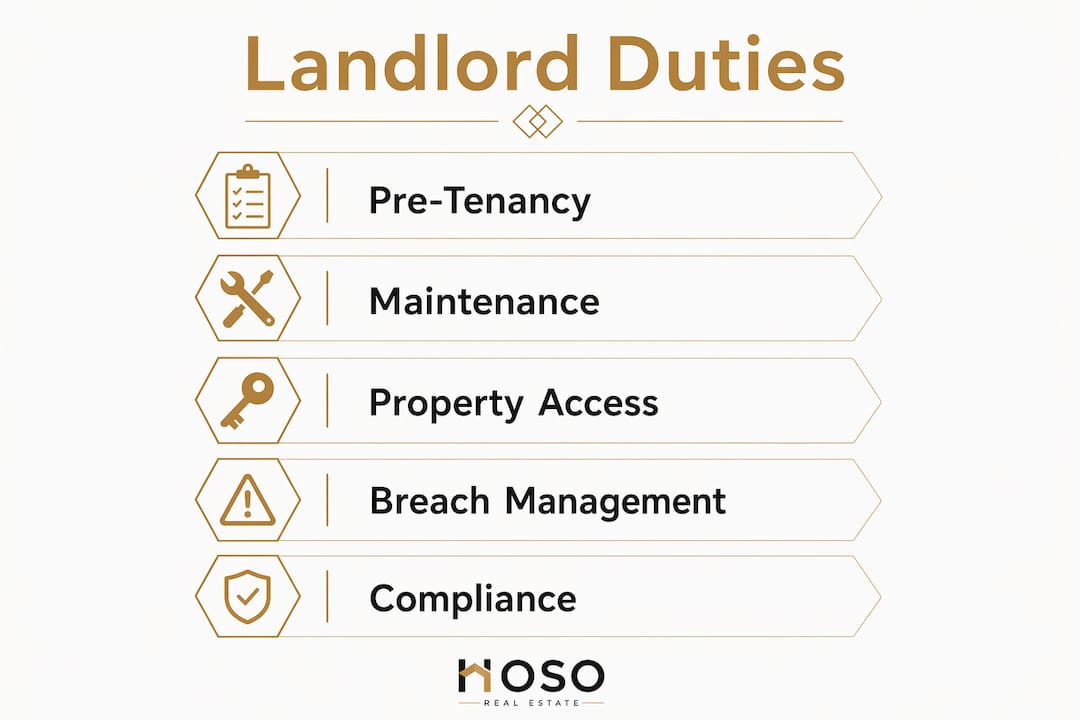
These obligations fall into four broad categories: pre-tenancy documentation, ongoing maintenance, property access, and rent and breach management. Each category carries specific legal requirements under South Australian law. Getting any one of them wrong creates risk, and that risk sits with the landlord, not the agent.

Landlord duties include both contractual obligations under the lease and a broader statutory duty of care to prevent foreseeable harm to tenants. That distinction matters because it means a landlord can be liable under tenancy law and under general civil law at the same time.
What documents must landlords provide before tenancy starts?
Pre-tenancy documentation is the first legal test a landlord faces. Providing these documents before the tenancy begins is a legal requirement, and failure to do so can result in penalties. The core documents a landlord must supply in South Australia are:
- Standard residential tenancy agreement. The written lease must be signed by both parties before the tenant takes possession. It sets out rent, bond, term, and the tenancy agreement rules that govern the relationship.
- Condition report. A completed condition report documents the state of the property at the start of the tenancy. It is the primary evidence used in bond disputes at the end of the lease.
- Landlord information statement. This document confirms the tenant has received and understood their rights. The landlord must obtain a signed acknowledgment.
- Landlord contact details. Landlords must provide direct contact details by telephone or email. These cannot be substituted with an agent's details, and any change must be notified to the tenant within 14 days.
Pro Tip: Photograph the condition report alongside the property on the day of the inspection. Time-stamped photos create a clear, defensible record that supports the written report if a bond dispute arises.
The condition report is often underestimated. A poorly completed report at the start of a tenancy is one of the most common reasons landlords lose bond claims at SACAT. Treat it as a legal document, not a formality.
What ongoing maintenance and repair responsibilities do landlords have?
Landlords must maintain rental properties in a reasonable state of repair throughout the tenancy. This is not a discretionary standard. It is a legal baseline, and repair disputes are consistently among the most frequent tenancy matters resolved by tribunals across Australia.
The distinction between urgent and non-urgent repairs determines the required response time:
- Urgent repairs require an immediate response. These include burst water services, gas leaks, electrical faults, broken heating in winter, and any fault that makes the property unsafe or uninhabitable. Landlords must act without delay.
- Non-urgent repairs must be addressed within a reasonable timeframe. The general benchmark applied by tribunals is 14 days from the date the request is received.
- Safety system checks are a separate category. Landlords carry a duty of care requiring the property to be free from foreseeable hazards. Smoke alarms must be tested annually, and faulty wiring must be rectified promptly.
- Tenant-caused damage is the tenant's responsibility to repair or compensate. Landlords must distinguish between fair wear and tear, which is their responsibility, and deliberate or negligent damage caused by the tenant.
- Documentation of every repair request is non-negotiable. Landlords must maintain detailed, time-stamped written records of all repair requests and actions taken. These records are the primary evidence in any tribunal claim.
Pro Tip: Use a dedicated email address or property management platform for all repair communications. A single, searchable thread for each property removes ambiguity and protects you if a dispute reaches SACAT.
Compliance failure can result in financial penalties and rent reduction orders. A rent reduction order means the tribunal formally reduces the rent payable because the property did not meet the required standard. That outcome directly affects your rental income and asset performance.
How do landlords manage property access legally?
Property access is one of the most common sources of conflict between landlords and tenants. The rights of landlord to enter the property are real, but they are not unlimited. In South Australia, landlords must comply with prescribed notice periods and permissible entry reasons under the Residential Tenancies Act 1995 (SA).
The key rules governing access are:
- Minimum notice period. Landlords must give at least 24 hours' notice before entering the property. Entering without proper notice is a breach of the tenancy agreement and can result in a tribunal order or compensation claim against the landlord.
- Permissible reasons for entry. Entry is permitted for routine inspections, repairs and maintenance, showing the property to prospective tenants or buyers, and emergency situations. Entry for any other reason is not lawful.
- Routine inspection frequency. In South Australia, routine inspections are limited to a maximum of four per year. The first inspection cannot occur within the first three months of the tenancy.
- Written communication. All entry notices should be provided in writing. Written records of when access was given and for what purpose protect both parties and reduce the risk of disputes.
Balancing the rights of landlord with the tenant's right to quiet enjoyment is a practical skill. Tenants who feel their privacy is respected are more likely to maintain the property well and renew their lease. Landlords who treat access as a right without boundaries create friction that often ends at SACAT.
What are landlord duties around rent and tenancy breaches?
Rent management and breach procedures are governed by specific rules under South Australian tenancy law. Landlords cannot improvise these processes. The Residential Tenancies Act 1995 (SA) and SACAT procedures set out exactly how rent must be collected and how breaches must be handled.
The core obligations in this area are:
- Legal rent collection. Landlords must offer payment methods that do not charge tenants transaction fees. Requiring a tenant to pay via a method that incurs a fee is a breach of landlord obligations in lease.
- Late payment process. If rent is unpaid for more than 14 days, landlords may issue a termination notice giving the tenant 14 days to vacate. This notice must follow the prescribed form and process under the Act.
- Breach notices. For non-rent breaches, such as property damage or unauthorised occupants, landlords must issue a formal breach notice before taking further action. The notice must specify the breach and give the tenant a reasonable period to remedy it.
- SACAT for disputes. SACAT governs tenancy dispute resolution in South Australia. Landlords must follow SACAT procedures for termination applications, bond claims, and compensation orders. Attempting to resolve disputes outside this process, such as changing locks or removing tenant belongings, is unlawful.
Proactive, documented communication with tenants about rent arrears reduces the risk of disputes escalating to tribunal. A phone call followed by a written record is often enough to resolve a short-term payment issue before it becomes a formal breach.
Key takeaways
A landlord's legal obligations under a tenancy agreement cover documentation, maintenance, access, and breach management, and all four areas carry enforceable consequences under South Australian law.
| Point | Details |
|---|---|
| Pre-tenancy documents are mandatory | Provide the tenancy agreement, condition report, and landlord information statement before the tenant moves in. |
| Repairs have legal timeframes | Urgent repairs require immediate action; non-urgent repairs must be addressed within 14 days. |
| Access requires written notice | Give at least 24 hours' notice in writing before entering the property for any permitted reason. |
| Rent collection has rules | Offer payment methods that do not charge tenants fees, and follow prescribed notice processes for arrears. |
| Records protect landlords | Keep time-stamped written records of all repair requests, access notices, and breach communications. |
The compliance gap most landlords don't see
Many landlords incorrectly assume that hiring a property manager removes their legal duties. It does not. Ultimate responsibility for compliance rests with the landlord, regardless of who manages the day-to-day relationship.
Working with Adelaide landlords across suburbs from Norwood to Glenelg, the pattern is consistent. The landlords who face the fewest disputes are not the ones with the newest properties. They are the ones who treat compliance as a system, not a reaction. They have their condition reports completed properly. They respond to repair requests in writing. They know their notice periods.
The landlords who end up at SACAT are usually not bad landlords. They are landlords who assumed their agent was handling everything, or who let documentation slip during a busy period. The Act does not make allowances for either situation.
Proactive maintenance is also a financial decision. A property kept in good repair retains its rental value and attracts tenants who treat it with care. A property where repairs are delayed accumulates deferred costs and creates grounds for rent reduction orders. The maths is straightforward.
If you use a property manager, understand what they are doing on your behalf. Review inspection reports. Ask about outstanding repairs. Know your own contact details are on file with the tenant. You signed the tenancy agreement. The obligations in it belong to you.
— HOSO
How HOSO Real Estate supports landlords with tenancy compliance
Managing tenancy obligations across documentation, maintenance, access, and breach procedures is a full-time responsibility. HOSO Real Estate works with Adelaide landlords to handle each of these areas with precision, from preparing compliant pre-tenancy paperwork to coordinating repairs and managing SACAT processes when disputes arise. If you want to understand what professional tenancy management looks like in practice, the full range of landlord services covers every stage of the rental relationship. For landlords who want a clearer picture of what compliance support looks like on the ground, the forms and guides available through HOSO Real Estate are a practical starting point.
FAQ
What documents must a landlord provide at the start of a tenancy?
Landlords must provide the standard residential tenancy agreement, a completed condition report, and a landlord information statement before the tenancy begins. Direct landlord contact details must also be supplied separately from any agent's details.
How much notice must a landlord give before entering a rental property in South Australia?
Landlords must give at least 24 hours' written notice before entering the property. Entry without proper notice is a breach of the tenancy agreement and can result in a SACAT order or compensation claim.
Are landlords still legally responsible if they use a property manager?
Yes. Landlords remain legally responsible for compliance with the Residential Tenancies Act 1995 (SA) even when a property manager handles day-to-day management. The obligation to comply cannot be delegated entirely to an agent.
What happens if a landlord does not carry out repairs?
Failure to maintain the property in a reasonable state of repair can result in financial penalties and rent reduction orders issued by SACAT. Urgent repairs must be addressed immediately; non-urgent repairs must be completed within a reasonable timeframe.
How does SACAT handle tenancy disputes in South Australia?
SACAT is the tribunal that resolves residential tenancy disputes in South Australia, including bond claims, breach notices, and termination applications. Landlords must follow prescribed SACAT procedures and cannot take unilateral action such as changing locks or removing tenant belongings outside this process.