
Property manager accountability is the legal and contractual obligation binding property managers to perform their duties with due care, skill, and transparency on behalf of property owners. In South Australia, this accountability sits within a framework built on the Residential Tenancies Act 1995 (SA), Australian Consumer Law, and the management agency agreement signed between the owner and the agency. Understanding what is property manager accountability gives you the foundation to protect your investment, enforce your rights, and avoid costly disputes. Landlords retain ultimate legal responsibility for tenancy compliance even when an agent manages the property, which means the standard your manager performs to directly affects your legal exposure.
What is property manager accountability in South Australia?
Property manager accountability is defined as the duty of a licensed agent to act within the scope of their authority, perform tasks with due care, and comply with all applicable laws on behalf of the landlord. The management agency agreement is the primary document that creates this accountability. It sets out exactly what the agent is responsible for, what authority they hold, and what standards they must meet. Without a precise agreement, accountability becomes difficult to enforce.
Australian Consumer Law reinforces this framework. Agents are liable for breaches of contract or negligence under section 236 of the Australian Consumer Law, meaning landlords can recover damages when an agent fails to perform with due care. This is not a theoretical protection. It is a practical legal mechanism that South Australian investors can use when a manager causes financial loss through negligence or misconduct.

The Residential Tenancies Act 1995 (SA) adds a further layer. It governs how tenancies must be managed, what disclosures are required, and how disputes are resolved. Property managers operating in South Australia must comply with this Act on the landlord's behalf. When they fail to do so, the accountability falls on both the agent and, in some cases, the owner.
What are the core duties of a property manager in South Australia?
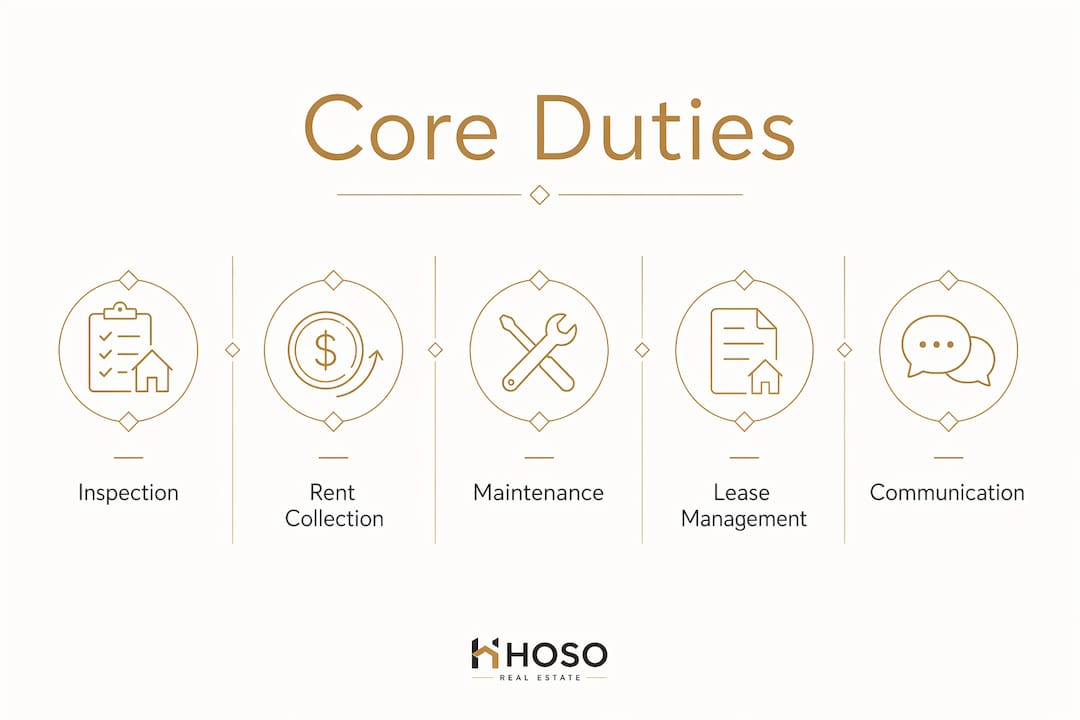
The scope of property manager duties in South Australia covers every stage of a tenancy, from listing to lease end. Understanding this scope is the first step in holding a manager to account.
Core property management responsibilities include:
- Listing and marketing the property to attract qualified tenants
- Tenant screening, including reference checks, rental history, and identity verification
- Preparing and executing the lease agreement in compliance with the Residential Tenancies Act 1995 (SA)
- Collecting rent and maintaining accurate financial records for the landlord
- Conducting routine inspections at agreed intervals and providing written reports
- Coordinating maintenance and repairs, including obtaining owner approval for non-urgent works above agreed thresholds
- Managing disputes between tenants and owners, including issuing breach notices
- Providing statutory disclosures, such as condition reports at the start of each tenancy
- Lodging and managing bonds in accordance with SA requirements
Each of these duties carries an accountability obligation. If a manager skips a routine inspection, fails to lodge a bond correctly, or approves a repair without owner consent, they have breached their duty. That breach creates a legal and financial risk for the owner. The role of a property manager in investment extends well beyond rent collection. It is active, ongoing asset stewardship.
How does the management agency agreement define accountability?
The management agency agreement is the single most important document in the owner-manager relationship. The precision of this agreement is critical for performance and managing disputes. Agents are only accountable for tasks explicitly listed in the agreement. Vague or incomplete agreements create gaps that are difficult to enforce.
A well-drafted agreement should specify:
- The full scope of services the agent will provide
- Financial authority limits, including the dollar threshold for emergency repairs without prior owner approval
- Communication and reporting obligations, including inspection frequency and financial statement schedules
- Notice periods and conditions for terminating the management arrangement
- How disputes between the owner and agent will be handled
Pro Tip: Set a written emergency repair threshold in your agreement, typically $500 to $1,000 in South Australia, above which the manager must seek your approval before proceeding. Defining financial thresholds in writing prevents disputes over repair costs and limits the manager's implied authority.
The termination clause deserves particular attention. Understanding contractual conditions upfront avoids financial and operational pitfalls when ending a management arrangement. Owners who do not read this clause carefully often face unexpected costs or notice periods when they try to change agencies.
What legal and regulatory standards govern property manager accountability?
South Australian property managers operate under a layered set of legal obligations. These standards create the accountability framework that owners can rely on and enforce.
-
Residential Tenancies Act 1995 (SA): This Act governs all residential tenancies in South Australia. Managers must comply with its requirements for condition reports, bond lodgement, rent increases, inspections, and termination notices. Non-compliance exposes both the agent and the owner to penalties.
-
Australian Consumer Law: Agents must perform their services with due care and skill. Failure to do so gives landlords the right to claim damages. This applies to negligent maintenance decisions, poor tenant screening, and failure to act on owner instructions.
-
Licensing requirements: Property managers in South Australia must hold the appropriate licence under the Land Agents Act 1994 (SA). You can verify a manager's licence status through Consumer and Business Services (CBS) SA. A property manager licence check is a basic due diligence step every owner should complete.
-
Licensee in Charge (LIC): Every property agency must appoint a Licensee in Charge who is legally responsible for supervising the agency's operations. Property agencies must appoint a Licensee in Charge who is accountable for trust account withdrawals and agency compliance. Owners can request proof of LIC appointment to confirm their funds are properly supervised.
-
Trust account management: Rental funds must be held in a dedicated trust account. The LIC authorises all withdrawals. This financial safeguard protects owners from misappropriation and provides a clear audit trail.
Penalties for breaches range from fines and licence suspension to civil liability for damages. The accountability is real, and the enforcement mechanisms exist. The key is knowing how to use them.
What are common accountability risks and how do you spot them?
Poor accountability rarely announces itself. It builds gradually through missed communications, incomplete records, and small decisions that compound into significant financial or legal problems.
Common warning signs include:
- Maintenance requests ignored or actioned without owner approval
- Routine inspection reports that are vague, infrequent, or missing entirely
- Rent arrears not addressed promptly or formally
- Failure to notify the owner of tenancy breaches or disputes
- Financial statements that are delayed, incomplete, or difficult to understand
- Verbal-only communications with no written record
Poor documentation and communication are leading causes of liability disputes. Unresponsiveness or concealing problems often triggers disputes between landlords and agents. The pattern is consistent: accountability breaks down when communication stops being documented.
Pro Tip: Request written confirmation of every significant decision, including maintenance approvals, inspection outcomes, and tenancy breach notices. A performance review process conducted annually gives you a structured way to assess whether your manager is meeting their obligations.
Owners who manage multiple properties face compounded risk. A single accountability gap across a portfolio can trigger cascading compliance failures. The role of property management in short-term rental investment shows that accountability standards apply equally across residential and short-term rental contexts, with documentation being the common thread.
How can South Australian investors enforce accountability and resolve disputes?
Enforcing accountability follows a clear sequence. Skipping steps or relying on informal conversations weakens your position significantly.
-
Review the management agreement first. Identify the specific obligation the manager has breached. Accountability claims must be grounded in the agreement's terms.
-
Issue a written complaint to the agency. Address it to the Licensee in Charge. State the breach clearly, reference the relevant agreement clause, and set a reasonable deadline for response.
-
Engage Consumer and Business Services SA. CBS SA handles complaints about licensed agents in South Australia. They can investigate conduct and take disciplinary action where warranted.
-
Apply to SACAT. The South Australian Civil and Administrative Tribunal handles tenancy and property management disputes. Tenancy disputes have strict filing deadlines, often 28 days for certain matters. Missing these deadlines forfeits your right to escalate. File formally and early.
-
Terminate the management agreement. When the relationship is irreparable, follow the termination clause precisely. Landlords must follow contract terms when ending management. Written notice is required, and specific financial conditions may apply.
Misunderstanding tribunal filing deadlines is one of the most common and costly mistakes owners make. Informal discussions with agents do not stop the clock. Formal legal steps must be anticipated early. If you are unsure about your landlord rights with property managers, seek advice before the deadline passes.
Key takeaways
Property manager accountability is defined by the management agency agreement and enforced through Australian Consumer Law, the Residential Tenancies Act 1995 (SA), and SACAT, making a precise, detailed agreement the most important protection a South Australian investor holds.
| Point | Details |
|---|---|
| Agreement defines accountability | Agents are only accountable for duties explicitly listed in the management agency agreement. |
| Australian Consumer Law applies | Landlords can recover damages from agents who breach their duty of care under section 236. |
| LIC supervises trust accounts | Every agency must have a Licensee in Charge legally responsible for financial oversight. |
| SACAT deadlines are strict | Many dispute applications must be filed within 28 days; informal complaints do not pause this deadline. |
| Documentation prevents disputes | Written records of maintenance, inspections, and communications are the owner's primary protection. |
What I have learned about accountability gaps in South Australian property management
The most common mistake I see South Australian investors make is signing a management agreement without reading the authority limits section. They assume the agent will act reasonably. Reasonable is not a legal standard. Explicit is.
Vague agreements produce vague accountability. When a manager approves a $3,000 repair without owner consent because the agreement did not specify a threshold, the owner has limited recourse. The agent acted within their implied authority. That is a preventable loss.
The second pattern I see consistently is owners who wait too long to formalise a complaint. They send emails, make phone calls, and accept verbal assurances. Meanwhile, the SACAT filing window closes. By the time they seek formal advice, their strongest claims are time-barred.
Clear agency agreements and documented communication are not administrative formalities. They are the mechanism through which accountability actually functions. Without them, the legal framework exists but cannot be activated. The owners who protect their assets most effectively are the ones who treat the agreement as a live document, review it annually, and insist on written records for every significant decision.
— HOSO
How HOSO Real Estate delivers accountable property management in Adelaide
HOSO Real Estate builds accountability into every stage of the management relationship. From the initial agency agreement through to routine inspections, maintenance approvals, and financial reporting, every process is documented and transparent. South Australian tenancy compliance is not an afterthought at HOSO Real Estate. It is the foundation of how properties are managed.
For investors across Adelaide and South Australia, including those managing properties from interstate or overseas, HOSO Real Estate provides the structure, communication, and legal knowledge that protects assets and reduces risk. If you want to understand exactly what a properly accountable management relationship looks like, explore our property management services to see how HOSO Real Estate approaches each obligation on your behalf.
FAQ
What is property manager accountability?
Property manager accountability is the legal and contractual obligation for a licensed agent to perform their duties with due care, skill, and transparency. It is defined by the management agency agreement and enforced through Australian Consumer Law and state tenancy legislation.
What does a property manager do in South Australia?
A property manager handles tenant screening, lease management, rent collection, routine inspections, maintenance coordination, and tenancy compliance under the Residential Tenancies Act 1995 (SA). Their duties are formally defined in the management agency agreement.
How do I hold my property manager accountable?
Start by reviewing the management agency agreement to identify the specific breach. Issue a written complaint to the Licensee in Charge, then escalate to Consumer and Business Services SA or SACAT if the issue is not resolved. File formal applications within the required deadlines, often 28 days for certain matters.
What is a Licensee in Charge and why does it matter?
A Licensee in Charge is the licensed individual legally responsible for supervising an agency's operations and trust accounts. Owners can request proof of LIC appointment to confirm their rental funds are properly managed and that the agency meets its legal obligations.
Can I terminate my property manager if they are not performing?
Yes, but you must follow the termination clause in your management agency agreement. Written notice is required, and specific financial or notice conditions may apply. Reviewing these terms before signing the original agreement avoids unexpected costs when ending the arrangement.