
Adopt a documented, auditable tenant-communication policy that meets CPPREP4123 record-keeping standards and SACAT evidentiary expectations. Three actions to take now:
- Document every contact. Record all tenant and landlord communications relating to property condition, repairs, lease changes, arrears and breaches in a searchable, timestamped system. CPPREP4123 requires demonstrated competency across at least two properties, and SACAT expects verifiable written evidence, not verbal accounts.
- Use prescribed SA forms. Issue Form 5 (notice to tenant), Form 11 (notice to landlord) and Section 48 tenant information using the correct service methods. Keep copies aligned with the Residential Tenancies Act 1995 (SA) retention minimums.
- Assign ownership and schedule audits. Name a responsible person for each communication task. HOSO Real Estate recommends a staged rollout over a few months with initial policy sign-off, followed by implementing templates and workflows, then audits and ongoing regular checks.
Table of Contents
- Why professional tenant communication standards matter in South Australia
- What SA law requires you to record and retain
- What every tenant-communication policy must include
- Practical workflows and templates for inspections, repairs and breaches
- How to handle breaches, notices and SACAT escalation
- How to train staff and audit communication standards
- What systems and data security your records need
- Key takeaways
- Why documented communication is the foundation of portfolio stewardship
- HOSO Real Estate's approach to compliance-first property management
- Useful SA sources and forms to download
Why professional tenant communication standards matter in South Australia
Consistent, auditable communication lowers SACAT risk, speeds dispute resolution and protects asset value. The consequences of getting it wrong are concrete.
An improperly served notice is invalid at SACAT regardless of the underlying breach. A landlord who cannot produce a written communication trail often loses a case they would otherwise win. Under section 48 of the Residential Tenancies Act 1995 (SA), landlords must provide their name and contact details at the start of tenancy and notify tenants in writing of any change within 14 days. Failing this can invalidate later notices and delay enforcement entirely.
On the commercial side, clear repair workflows reduce vacancy periods and prevent maintenance costs from escalating through delayed responses. The Property Agents Board Code of Conduct requires professionalism, skill, care and ongoing professional development. Communication conduct is not a soft skill — it is a compliance obligation.
- Improperly completed notices are invalid and harm tribunal prospects
- Missing landlord contact details can delay enforcement of valid breaches
- Poor repair communication increases vacancy risk and maintenance cost
- Non-compliant conduct exposes agents to Property Agents Board disciplinary action
What SA law requires you to record and retain
The legal baseline is clear: any communication relating to property condition, repairs, lease changes, arrears or breaches must be documented. CPPREP4123 formalises this as a national competency requirement for tenancy management.
Mandatory documents at key tenancy stages:
- Inspection sheet (entry condition report, signed by both parties)
- Section 48 tenant information guide (provided at lease commencement)
- Lease agreement copy (given to tenant when signed or within 21 days)
- Form 5 — notice to tenant (breach or termination notices)
- Form 11 — notice to landlord (tenant-initiated notices)
- Rent records and receipts
- Bond lodgement receipt
The SA government specifies what landlords must provide at the start of tenancy and limits on what information can be requested from prospective tenants. Landlords cannot request documents beyond what is reasonably necessary to assess a tenancy application.
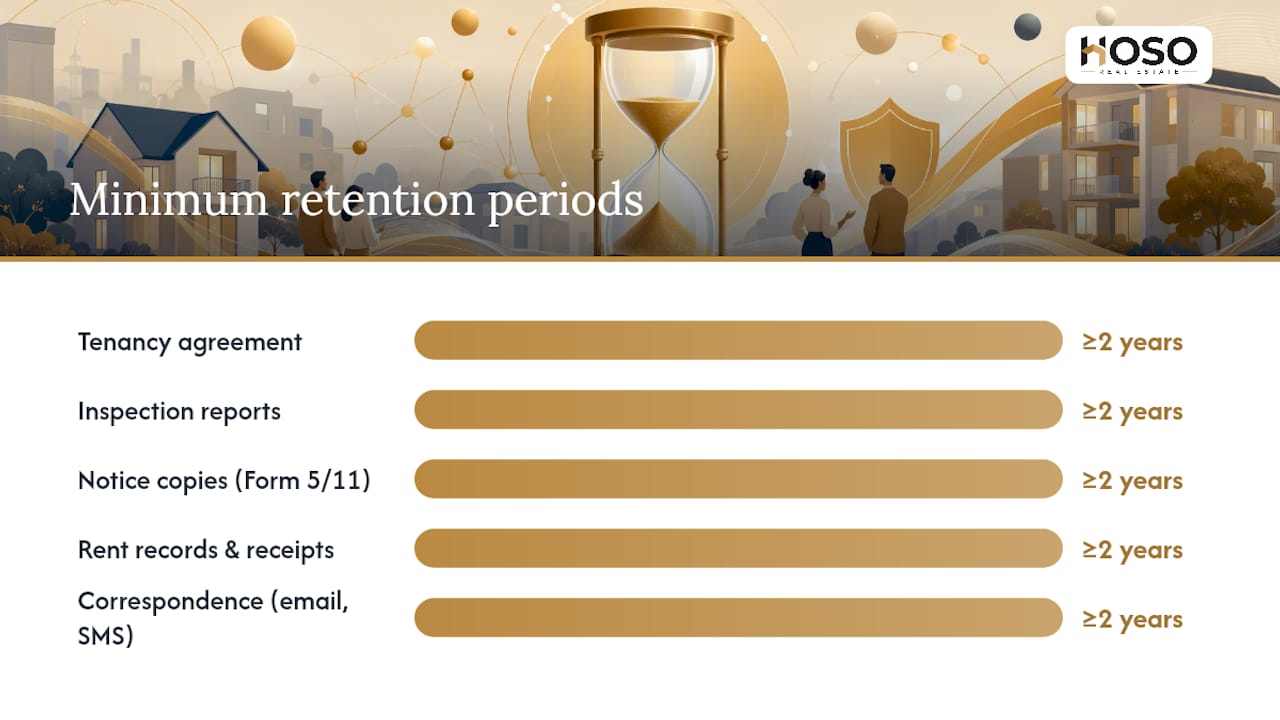
| Record type | Minimum retention period |
|---|---|
| Tenancy agreement | at least 2 years post-termination |
| Inspection reports | at least 2 years post-termination |
| Notice copies (Form 5, Form 11) | at least 2 years post-termination |
| Rent records and receipts | at least 2 years post-termination |
| Correspondence (email, SMS logs) | at least 2 years post-termination |
Valid service methods matter as much as the content of a notice. Personal delivery, post to the last known address, or email where the tenant has consented in writing are all accepted. Verbal-only records carry no weight at SACAT.
What every tenant-communication policy must include
Plain-language communications, documented consent, confidentiality and fairness are the foundation. Good-practice guidance confirms that plain-language tenant-facing documents reduce escalated disputes because expectations are clearer from the outset.
Suggested policy headings to copy and populate:
- Purpose and scope
- Approved communication channels and response obligations
- Record-keeping rules and file-naming conventions
- Notice templates and prescribed form usage
- Privacy and data handling
- Escalation and dispute steps
- Staff responsibilities and training requirements
The SLA table below gives measurable benchmarks to build into the policy and audit against.
| Communication type | Target response time | Audit checkpoint |
|---|---|---|
| Initial tenant enquiry | Within 1 business day | Weekly file check |
| Emergency repair notification | Within 4 hours | Immediate manager review |
| Routine maintenance update | Within 3 business days | Fortnightly log review |
| Notice service confirmation | Same day as service | Notice log entry |
Pro Tip: Include two or three plain-English phrasing examples for common notices in the policy itself. Staff who can see what "good" looks like produce fewer invalid documents.
Practical workflows and templates for inspections, repairs and breaches
Use standard templates and a consistent file-naming convention so every contact is traceable within 24 hours. This is the single most practical step toward proactive property management.
Inspection workflow:
- Send pre-inspection notice to tenant (correct notice period under RTA 1995 SA)
- Complete entry condition report using the prescribed inspection sheet
- Photograph all rooms and note any existing damage
- Upload report and photos to the tenancy file within 48 hours
- Obtain tenant signature or written acknowledgement
Repair request workflow:
- Tenant submits written repair request (email or portal)
- Log request with date, property ID and urgency classification
- Send landlord instruction request with cost estimate
- Engage contractor and confirm booking in writing
- Record completion date and obtain tenant sign-off
Breach handling workflow:
- Identify breach and confirm it is documented in the file
- Prepare Form 5 using the prescribed SA template
- Serve notice using a valid service method and log the date
- Record the remedy period and set a follow-up calendar reminder
- If unresolved, compile SACAT evidence package before applying
File naming convention: YYYYMMDD_PropertyID_TenantSurname_DocumentType (e.g. 20260315_SA042_Smith_Form5). Store all files in a folder structure by property, then tenancy year.
Pro Tip: Keep a service method log as a separate document. Record how, when and to whom each notice was delivered. This single page is often the most requested item in a SACAT hearing.
How to handle breaches, notices and SACAT escalation
Correct notice forms and complete evidence are not optional. SACAT is explicit: incorrectly completed or incorrectly served notices are invalid and will harm your tribunal prospects.
Evidence checklist for SACAT applications:
- Copies of all notices served (Form 5 or Form 11) with service dates
- Entry and exit inspection reports with photos
- Email and SMS threads in chronological order
- Contractor invoices and completion records
- Rent ledger showing arrears or payment history
- Tenant responses or acknowledgements
| Stage | Action | Timeframe |
|---|---|---|
| Breach identified | Serve Form 5 | Immediately |
| Remedy period | Allow tenant to remedy | As specified in notice |
| Repeat breach | Serve second notice or apply to SACAT | Per RTA 1995 SA rules |
| SACAT application | Lodge with full evidence package | Before remedy period expires |
SACAT's parties' rights guidance lists the types of evidence required for different orders, including unauthorised alterations and failure to repair. A communication timeline that maps each event to a timestamped document is the most effective way to present a case.
Pro Tip: Convert any informal agreement reached by phone or SMS into a written follow-up email the same day. Upload it with a timestamp. Without this, verbal agreements carry no weight at SACAT.
How to train staff and audit communication standards
Policy only works if staff are trained and audited regularly. The Property Agents Board Code of Conduct links ongoing professional development directly to how managers communicate — training is both a conduct and a compliance requirement under CPPREP4123.
Audit checklist items:
- Sample rate of record completeness (target: 100% of files have required documents)
- Correct form usage (Form 5, Form 11, inspection sheet)
- SLA adherence across repair and notice categories
- File naming compliance
- Evidence quality for any open disputes
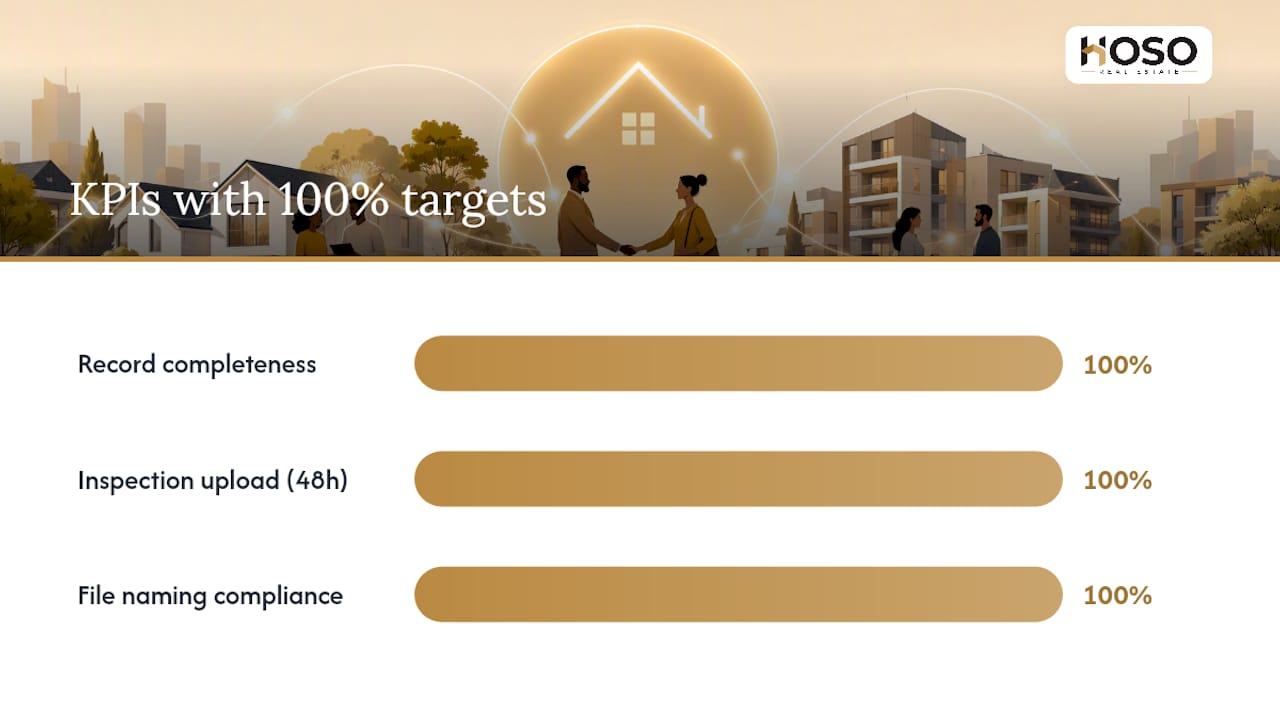
| KPI | Target | Review frequency |
|---|---|---|
| Repair requests acknowledged within SLA | — | Monthly |
| Inspection reports uploaded within 48 hours | 100% | After each inspection |
| Invalid notices issued | — | Quarterly |
| File naming compliance | 100% | Monthly |
Training plan outline:
- Induction module: RTA 1995 SA obligations, prescribed forms, service methods
- Quarterly refresher: SLA review, audit findings, updated templates
- Role-play session: breach notice preparation and service scenarios
- Manager sign-off protocol for all sensitive communications (breach, termination)
For guidance on reviewing property manager performance against these KPIs, HOSO Real Estate's published framework provides a practical starting point.
What systems and data security your records need
Use a secure, searchable record system with timestamping, role-based access and encrypted backups. Without these features, records may be complete but still inadmissible or inaccessible when needed.
System requirements checklist:
- Full audit trail with user and timestamp on every entry
- Exportable reports for SACAT evidence packages
- Attachment support for photos, invoices and signed documents
- Role-based user permissions (read-only vs. admin)
- Automated retention rules aligned to statutory minimums
Pro Tip: Enable two-step verification for all admin users and run a quarterly restore test on your backup copies. A backup that has never been tested is not a backup.
| Record category | Statutory minimum | Recommended archive window |
|---|---|---|
| Tenancy agreements | at least 2 years post-termination | 5 years |
| Inspection reports | at least 2 years post-termination | 5 years |
| Notices and correspondence | at least 2 years post-termination | 5 years |
| Financial records | at least 2 years post-termination | 7 years |
Deletion policies must be documented. Staff should not delete tenancy records without written approval from the responsible manager, and deletion dates should be logged.
Key takeaways
Professional tenant communication standards in South Australia require a documented policy, prescribed SA forms, auditable records retained for at least 2 years post-termination, and regular staff training tied to CPPREP4123 and the Property Agents Board Code of Conduct.
| Point | Details |
|---|---|
| Document every contact | Record all tenant and landlord communications in a timestamped, searchable system. |
| Use prescribed SA forms | Form 5, Form 11 and Section 48 must be used correctly; invalid notices fail at SACAT. |
| Retain records for 2 years | Tenancy agreements, inspection reports and correspondence must be kept for at least 2 years after termination. |
| Train and audit regularly | Quarterly refreshers and monthly KPI reviews keep the policy operational and staff accountable. |
| HOSO Real Estate | Provides policy templates, staff training and compliance audits for Adelaide landlords seeking a structured rollout. |
Why documented communication is the foundation of portfolio stewardship
The agencies that perform best at SACAT are rarely the ones with the most aggressive landlords or the most experienced solicitors. They are the ones with complete files. Every notice served correctly, every repair request logged, every informal agreement converted to a written follow-up — these are the details that determine outcomes.
What gets underestimated is how much the quality of communication records affects the landlord's position before a dispute even reaches a tribunal. A well-documented file changes the negotiation dynamic. Tenants and their representatives respond differently when they know the record is complete. Many disputes that would otherwise proceed to SACAT resolve at the notice stage because the evidence is clear.
For Adelaide landlords managing properties across suburbs like Norwood, Prospect or Burnside, the practical reality is that SACAT applications are not rare. The tribunal processes a high volume of residential tenancy matters. Landlords who treat communication documentation as a routine operational standard, rather than a reactive measure, consistently reach better outcomes.
HOSO Real Estate's approach to compliance-first property management
Adelaide landlords who want these standards in place without building the system from scratch work with HOSO Real Estate's property management services. The difference is a structured implementation rather than a policy document that sits in a folder.
HOSO Real Estate provides policy customisation, one-day staff training and a 30-day audit check for landlords ready to formalise their communication standards. Templates are SA-specific, forms are current, and the audit process maps directly to SACAT evidentiary expectations. For landlords weighing the value of professional management against self-managing, the compliance infrastructure alone justifies the shift.
Contact HOSO Real Estate to request a tailored implementation plan and an initial compliance audit for your Adelaide portfolio.
Useful SA sources and forms to download
Bookmark and save copies of each of the following in your tenancy file system:
- https://training.gov.au/Training/Details/CPPREP4123
- https://www.propertyagentsboard.com.au/uploads/7/8/3/8/78382648/2022_code_of_conduct_-_version_4.pdf
- https://www.vic.gov.au/sites/default/files/2021-02/Good-Practice-Guide-Code-of-Conduct-3-Feb-2020.pdf
- https://lsc.sa.gov.au/handbook/ch23s01s06s02.php?lscsa_prod=6
- https://www.sacat.sa.gov.au/case-type/housing-and-rentals/providing-documents-for-housing-disputes
- https://www.sacat.sa.gov.au/case-type/housing-and-rentals/parties-rights-disputes
Save a copy of each form in the relevant tenancy folder and link them to the corresponding template in your record system.