
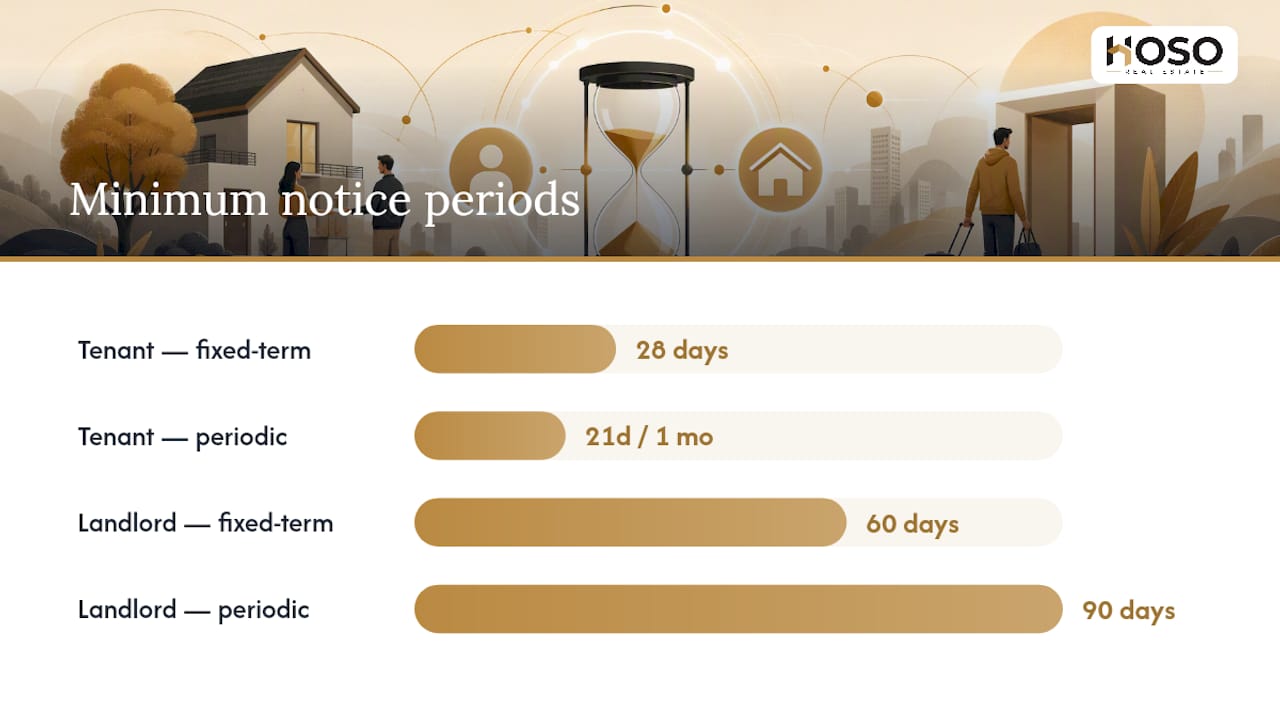
In South Australia, a tenancy can be ended by a tenant, a landlord, or the South Australian Civil and Administrative Tribunal (SACAT), and the process is strictly procedural under the Residential Tenancies Act 1995 (SA). Tenants ending a fixed-term lease at its conclusion must give 28 days' written notice; periodic tenants must give at least 21 days, or one calendar month if rent is paid monthly. Landlords face longer minimum notice periods to end leases, varying by lease type and grounds, typically requiring several months' notice. Every notice must use the correct Consumer and Business Services (CBS) form, and many landlord notices require supporting evidence approved by the Commissioner.
The principal CBS forms used in SA tenancy terminations are:
- Form 7 — notice of termination by a registered community housing provider
- Form 8 — landlord notice to end a periodic tenancy on a specified ground
- Form 9 — landlord notice to end a fixed-term tenancy at its conclusion
- Form 10 — tenant notice to terminate a tenancy
- Form 16 — notice of termination for a frustrated tenancy agreement (premises uninhabitable)
- Form 17 — notice of termination for drug-related contamination
Download all forms and the CBS evidence requirements checklist directly from CBS/sa.gov.au.
Key takeaways
The SA tenancy termination process is governed by prescribed CBS forms, statutory notice periods, and mandatory evidence requirements under the Residential Tenancies Act 1995 (SA), with post-2024 reforms requiring landlords to state a genuine reason for every termination.
| Point | Details |
|---|---|
| Notice periods vary by party and ground | Tenants: 28 days (fixed-term end) or 21 days/1 month (periodic); landlords: 60 days (fixed-term end) or 90 days (periodic grounds). |
| Correct CBS form is mandatory | Form 8, 9, 10, 16, or 17 must match the exact termination scenario; the wrong form invalidates the notice. |
| Evidence must accompany landlord notices | Sale contracts, demolition approvals, or contamination reports must be attached before serving; omitting them delays possession. |
| SACAT is the only enforcement path | Landlords cannot self-help evict; a SACAT possession order and bailiff are required if a tenant refuses to vacate. |
| Six-month re-letting restriction applies | After possession on sale, demolition, or renovation grounds, the property cannot be re-let for six months without SACAT consent. |
| HOSO Real Estate manages compliance end-to-end | HOSO Real Estate handles form selection, evidence preparation, notice service, and SACAT liaison for Adelaide landlords. |
Table of Contents
- How can a tenancy end in South Australia?
- What notice periods and forms apply to each termination scenario?
- How do you serve a termination notice correctly in SA?
- What can tenants do if they dispute a notice or face eviction?
- What happens after a termination notice is served?
- Practical compliance checklist for SA landlords
- The part most landlords get wrong about the 2024 reforms
- HOSO Real Estate: property management built for SA compliance
- Sources
How can a tenancy end in South Australia?
SA tenancy ending guidelines recognise six distinct legal routes. Knowing which one applies determines the form, the notice period, and the evidence required.
- End of fixed-term agreement. A fixed-term tenancy does not end automatically at the expiry date. If neither party gives valid notice, it converts to a periodic tenancy and continues on the same terms.
- Tenant-initiated notice. A tenant may give notice to end a fixed-term lease at its conclusion, to end a periodic tenancy, or in special circumstances such as domestic abuse, an unsafe or uninhabitable property, or a serious landlord breach.
- Landlord-initiated notice. From 1 July 2024, landlords must have a prescribed reason to end a tenancy. Accepted grounds include sale of the property, demolition, major renovation, owner or family occupation, and breach of the agreement.
- Mutual agreement. Both parties can agree in writing to end the tenancy on a date of their choosing. No prescribed form is required, but written evidence of the agreement is strongly recommended.
- Frustrated agreement. Where premises become uninhabitable through no fault of either party (fire, flood, structural failure), either party may serve Form 16 to terminate immediately.
- SACAT order. Where a notice is disputed, a party refuses to vacate, or statutory grounds apply, either party may apply to SACAT for a termination or possession order.
Special cases worth noting: where a sole tenant dies, the tenancy terminates automatically 30 days after the landlord receives written notice of the death. Registered community housing providers follow a parallel process using Form 7 rather than the standard landlord forms.
What notice periods and forms apply to each termination scenario?
The SA tenancy termination process maps each scenario to a specific CBS form and minimum notice period. Using the wrong form, or omitting required evidence, can render a notice invalid and delay possession.
| Scenario | Who gives notice | Minimum notice | CBS form | Key evidence |
|---|---|---|---|---|
| Tenant ends fixed-term at expiry | Tenant | 28 days | Form 10 | None required |
| Tenant ends periodic tenancy | Tenant | 21 days (or 1 month if monthly rent) | Form 10 | None required |
| Landlord ends fixed-term at expiry | Landlord | 60 days | Form 9 | Prescribed evidence per ground |
| Landlord ends periodic tenancy on specified ground | Landlord | 90 days | Form 8 | Prescribed evidence per ground |
| Immediate termination (uninhabitable/frustrated) | Either party | Immediate | Form 16 | Council order, structural report |
| Drug-related contamination | Landlord | Immediate | Form 17 | Contamination testing report |
| Tenant — domestic abuse | Tenant | Immediate or short | Form 10 + supporting docs | Evidence of domestic abuse |
Form-by-form summary
Form 10 is the standard tenant termination notice. It covers both fixed-term and periodic tenancies and requires no supporting evidence from the tenant in ordinary circumstances.
Form 9 is the prescribed notice for a landlord ending a fixed-term agreement at its conclusion. At least 60 days' notice is required, and the landlord must supply the evidence specified for the relevant ground.
Form 8 applies when a landlord ends a periodic tenancy on a specified ground. It requires at least 90 days' notice and lists permitted service methods alongside the evidence obligations for each ground.
Form 7 is reserved for registered community housing providers and mirrors the landlord process with its own prescribed grounds.
Form 16 ends a frustrated agreement where the premises are uninhabitable or unlawful to occupy. Either party may serve it, and it takes effect immediately upon valid service.
Form 17 is specific to drug-related contamination. It requires a contamination testing report and allows immediate termination.
Post-2026 regulatory changes
From 1 July 2024, the Residential Tenancies Act 1995 (SA) and the Residential Tenancies Regulations 2025 (SA) introduced a genuine-reason requirement for most landlord terminations. Landlords can no longer serve a no-grounds notice to end a periodic tenancy. Every Form 8 and Form 9 must state a prescribed reason, and tenants now have a statutory right to challenge notices they believe are retaliatory.
How do you serve a termination notice correctly in SA?
Valid service is as important as the correct form. A notice served by the wrong method, or without a record of delivery, can be challenged at SACAT regardless of its content.
Approved service methods under the Residential Tenancies Act 1995 (SA) include:
- Personal delivery to the recipient directly
- Post to the last known address (allow additional days for delivery time)
- Letterbox at the residential address
- Email, where the recipient has agreed in writing to receive notices electronically
For each method, record the date, time, and manner of service. For postal service, keep the proof of postage. For email, retain the sent-item confirmation and any read receipt.
Landlords serving notices for possession reasons must attach the evidence approved by the Commissioner. Common examples include:
- A signed contract of sale or sale instruction documentation (relevant where the ground is sale of the property)
- Demolition or renovation quotes and council approvals
- A compulsory acquisition notice from the relevant authority
- A contamination testing report for drug-related grounds
- Council orders or structural engineer reports for uninhabitable premises
Pro Tip: Keep a service log for every notice: the form number, the date served, the method, and the name of the person who served it. For contested notices, use registered post or personal delivery with a witness, and retain certified copies of all attached evidence. The CBS evidence requirements guidance sets out exactly what each ground requires.
Adelaide landlords managing properties in suburbs such as Norwood, Unley, or Prospect, where tenancy disputes are not uncommon, should treat the service log as a non-negotiable part of their rental compliance documentation.
What can tenants do if they dispute a notice or face eviction?
Tenants have clear statutory remedies under the SA tenancy termination process, and landlords need to understand them just as well.
Applying to SACAT
- Obtain the relevant SACAT application form from the SACAT website.
- File the application within the time limit stated on the notice or, for retaliatory-notice challenges, as soon as practicable after receiving the notice.
- Include a copy of the termination notice, any correspondence with the landlord, and evidence supporting the grounds for dispute.
- Pay the applicable filing fee and await a hearing date. SACAT typically lists urgent possession matters quickly.
- Attend the hearing. SACAT may make orders to terminate, reinstate, or vary the tenancy, or declare a notice ineffective.
Retaliatory notice protections
From 1 July 2024, tenants can apply to SACAT to have a termination notice declared ineffective if they can show it was served in retaliation for the tenant exercising a legal right, such as requesting repairs or contacting CBS. The 2024 reforms were specifically designed to curb this practice, and the burden shifts to the landlord to demonstrate the notice was served for a genuine prescribed reason.
A landlord cannot perform a self-help eviction. If a tenant refuses to vacate after a valid notice expires, the landlord must apply to SACAT for a possession order. Only a bailiff acting under a SACAT order can enforce physical possession. Attempting to change locks, remove belongings, or otherwise force a tenant out without a SACAT order is unlawful under the Residential Tenancies Act 1995 (SA).
Domestic abuse and breach remedies
Tenants experiencing domestic abuse may terminate immediately with supporting documentation, without the standard notice period. Where a landlord has breached the agreement, a tenant may serve a seven-day breach notice. If the breach is not remedied, the tenant can apply to SACAT for termination. Reinstatement is also available: where a tenant has remedied a breach before a SACAT hearing, the Tribunal may reinstate the tenancy rather than order termination.
Tenants who need guidance on escalating a dispute before reaching SACAT can review the steps outlined in how to escalate property management complaints in SA.
What happens after a termination notice is served?
Once a valid notice is served, both parties have obligations before and after the vacating date.
Vacating checklist for tenants
- Return all keys, remotes, and access devices on or before the vacating date
- Record final meter readings for electricity, gas, and water
- Leave the property in the condition documented in the original condition report, allowing for fair wear and tear
- Provide a forwarding address to the landlord or agent for bond and correspondence purposes
- Remove all personal belongings; items left behind may be treated as abandoned property
Bond claims and inspection evidence
The landlord or agent should conduct a final inspection on or immediately after the vacating date, comparing the property's condition against the entry condition report. Photograph every room, record any damage beyond fair wear and tear, and obtain repair quotes or invoices before lodging a bond claim with CBS.
Bond claims require written notice to the tenant. If the tenant disputes the claim, either party may apply to SACAT for a determination.
The six-month re-letting restriction
Where a landlord has ended a tenancy on grounds such as sale, demolition, major renovation, or owner occupation, the landlord cannot re-let the premises for six months after taking possession without SACAT consent. This restriction applies even if the sale falls through or renovation plans change. Landlords planning a re-letting strategy after possession, particularly in high-demand suburbs like Glenelg or Burnside, must factor this restriction into their timeline.
Practical compliance checklist for SA landlords
A structured approach to the SA rental agreement termination process reduces SACAT exposure and protects the asset.
- Confirm the tenancy type. Is it fixed-term or periodic? The answer determines which form applies and the minimum notice period.
- Select the correct CBS form. Cross-check the ground for termination against the CBS evidence requirements table before completing the form.
- Gather evidence before serving. For sale grounds, have a signed sale instruction or contract ready. For renovation or demolition, obtain council approvals and contractor quotes in advance.
- Serve the notice correctly. Use an approved method, record the date and method, and retain proof of service.
- Log all tenant communications. Written records of every exchange protect against retaliatory-notice claims. Review professional communication standards for guidance on maintaining a defensible paper trail.
- Schedule the final inspection. Book it for the vacating date or the day after, and complete it against the original condition report.
- Prepare bond claim evidence. Photographs, the condition report, and repair invoices must be ready before lodging any claim with CBS.
- Retain proof of disposal or re-letting steps. If the ground was sale or renovation, document the outcome to demonstrate compliance with the six-month re-letting restriction.
Pro Tip: For high-value properties in suburbs like Toorak Gardens or Hawthorn (SA), use registered post for all contested or possession notices and attach certified copies of every supporting document. A complete audit trail is the single most effective way to shorten a SACAT hearing.
When to escalate
Red flags that warrant immediate specialist advice or a SACAT application include: repeated rent arrears despite breach notices, serious property damage, a tenant who has indicated they will challenge the notice, or any situation where a retaliatory-notice claim is plausible. Landlords managing rent-arrears grounds should document every breach notice and every payment received, as SACAT requires evidence of the pattern before making a possession order.
The part most landlords get wrong about the 2024 reforms
The post-2024 changes to the Residential Tenancies Act 1995 (SA) are widely described as tenant-friendly reforms, and they are. But framing them only that way misses the practical implication for landlords: the reforms did not make termination harder for landlords who have genuine grounds and proper documentation. They made it harder for landlords who were relying on procedural shortcuts.
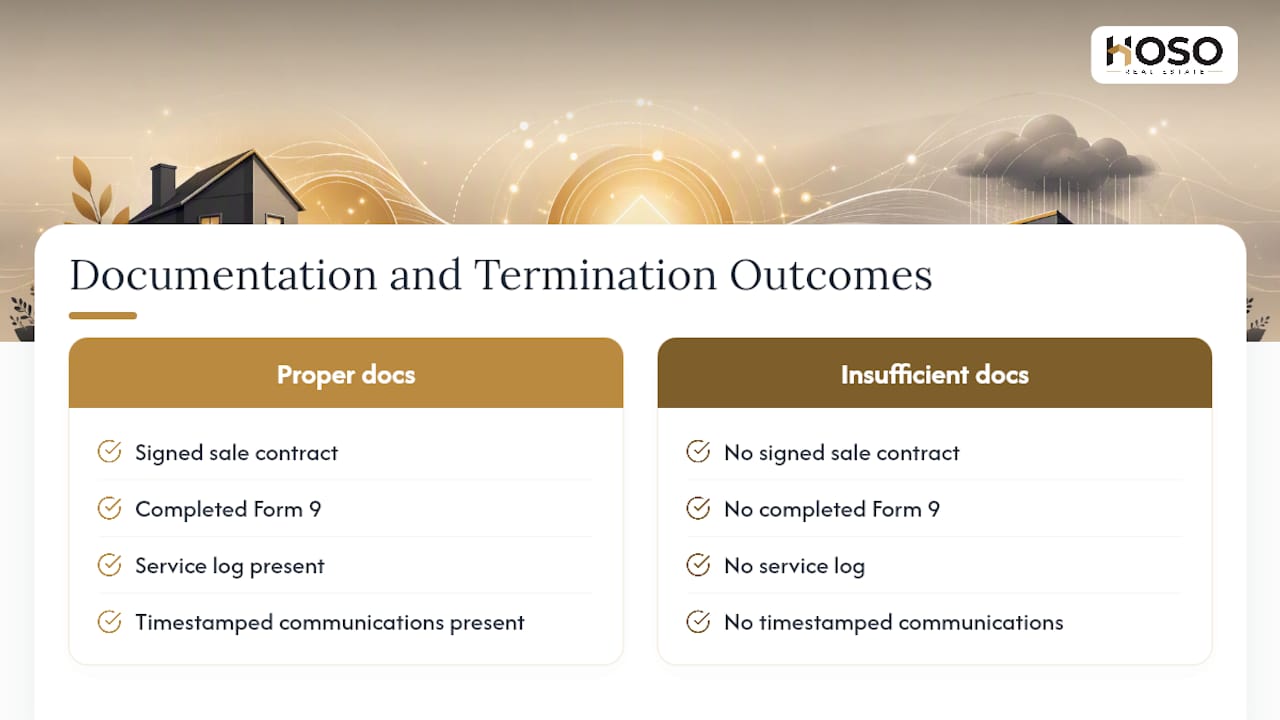
A landlord with a signed sale contract, a completed Form 9, and a service log has a straightforward path to possession. The same landlord without those documents faces a SACAT hearing that could have been avoided entirely. The retaliatory-notice provisions are a genuine risk, but only where a landlord cannot demonstrate that the termination ground predates any tenant complaint or repair request. Landlords who maintain a contemporaneous audit trail, including timestamped communications and pre-notice evidence, are largely insulated from that risk.
The conventional advice to "just use the right form" understates the problem. The form is the minimum. The evidence, the service record, and the communication log are what determine whether a possession order is granted quickly or contested for months. Landlords managing properties in Adelaide's inner suburbs, where tenancy disputes are more likely to proceed to SACAT, should treat documentation as the primary compliance task, not an afterthought.
HOSO Real Estate: property management built for SA compliance
Adelaide landlords who want the termination process handled correctly from the first notice to the final inspection can rely on HOSO Real Estate. HOSO Real Estate manages the full SA rental agreement termination process: selecting the correct CBS form for the ground, preparing and attaching the required evidence, serving notices through documented methods, coordinating final inspections against the original condition report, and managing SACAT applications where possession is contested.
For landlords with properties in suburbs like Norwood, Burnside, or Unley, where asset values are high and tenancy disputes carry real financial risk, professional management of the termination process is a direct form of asset protection. HOSO Real Estate's track record in Adelaide leasing and compliance is visible across its recently leased properties.
To discuss how HOSO Real Estate can manage your next tenancy termination or ongoing portfolio compliance, review the full range of property management services and get in touch.
This article is general information, not a substitute for advice from a qualified lawyer. Consult a qualified legal professional about your own circumstances before acting on anything here.
Sources
The following primary sources are the authoritative references for SA tenancy termination forms, statutory requirements, and Tribunal procedures.