
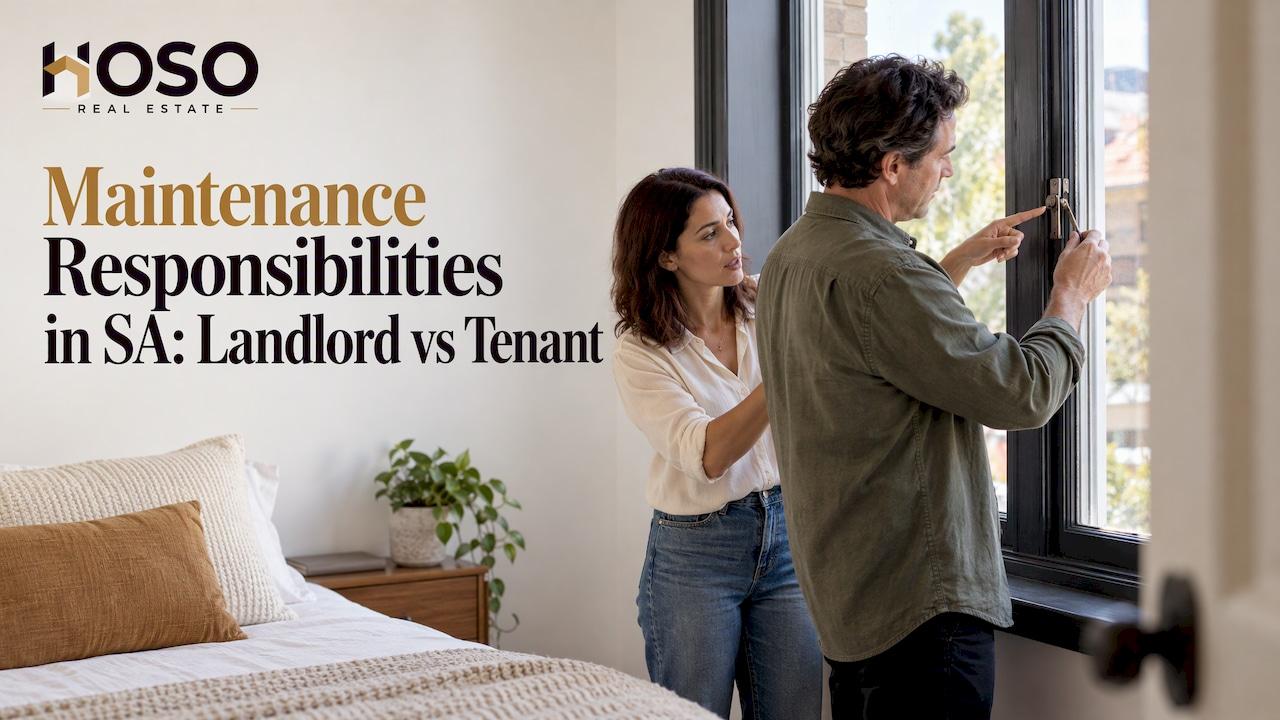
In South Australia, the landlord must provide the home in a reasonable state of repair and keep it that way. The tenant keeps it reasonably clean, looks after the routine upkeep and pays for damage they cause. The rules sit in the Residential Tenancies Act 1995 (SA), and disputes go to the South Australian Civil and Administrative Tribunal (SACAT). This guide sets out where each duty falls, what counts as urgent, and how to keep your asset protected.
TL;DR
- Landlords must keep the property in a reasonable state of repair, with security, safe fixtures and working essentials, having regard to its age, character and prospective life.
- Tenants handle routine tasks such as light globes, air conditioner filter cleaning, mowing and weeding, and they must repair damage they cause.
- Fair wear and tear and genuine accidents are not the tenant's responsibility.
- Urgent repairs need a fast response. Written requests and good records protect both parties if SACAT becomes involved.
- A clear schedule and documented inspections prevent most maintenance disputes before they start.
Table of Contents
- What the landlord is responsible for
- What the tenant is responsible for
- Damage, accidents and wear and tear
- Urgent repairs: what counts and how fast to act
- Entering the property to carry out repairs
- What happens if repairs are not done
- Safety and minimum housing standards
- A practical split for your property
- Keeping control of maintenance as an owner
- Our perspective
- Let us handle the maintenance for you
- FAQ
- Sources
What the landlord is responsible for
Your core duty comes from section 68(1)(a) of the Act. It is a term of every residential tenancy agreement that the landlord will ensure the premises are in a reasonable state of repair at the start of the tenancy and keep them that way, having regard to age, character and prospective life. A 1960s unit in Prospect is not held to the same standard as a new build in Mount Barker, but both must be sound and safe.
The Law Handbook for South Australia lists further landlord obligations:
- Provide and maintain the premises in a reasonable state of cleanliness (section 67).
- Provide and maintain locks and other devices that keep the premises reasonably secure (section 66).
- Pay all statutory rates, except charges for a separately metered water supply (section 73).
In practice, the Government of South Australia describes landlords as usually responsible for larger repairs such as electrical wiring or gas heaters, replacing items such as tap filters, and annual gardening work such as pruning fruit trees. They also maintain domestic appliances supplied with the property and make sure it is secure.
Problems the tenant knew about
A tenant moving in with a known defect does not take on the repair. The state government advises that landlords remain responsible for repairs even if the tenant knew about the problem when moving in. The exceptions are items noted in the tenancy agreement as excluded, and serious structural issues listed in a housing improvement notice. If a property is subject to an order under the Housing Improvement Act 2016 (SA), the statutory housing improvement process takes precedence over the general repair obligation.
Defects that arise during the tenancy
A recent SACAT decision draws a useful line. In Pucek v Tirimacco & Anor [2025] SACAT 86 (18 November 2025), the Tribunal held that section 68(1) requires a reasonable state of repair at the commencement of the tenancy. After that, the landlord is not responsible for defects that arise later unless they are aware of the defect or ought to be aware of it.
For investors, "ought to be aware" is the important phrase. Regular inspections and a prompt response to tenant reports are what keep you on the right side of it. A defect you could have found and did not is difficult to defend.
What the tenant is responsible for
Tenants carry the day-to-day load. According to SA.GOV.AU, they usually replace items such as light globes, clean air conditioner filters and handle general gardening such as mowing and weeding.
Under section 69, the tenant must keep and return the premises in a reasonable state of cleanliness. The Law Handbook notes that a popular lease term requiring professional carpet cleaning at the end of a tenancy is inconsistent with section 69(3) and unenforceable. A well-drafted agreement does not rely on that clause.
The Consumer and Business Services (CBS) brochure also tells tenants to report damage or needed repairs to the landlord. That duty to report is what starts the repair process, and it gives you a dated record.
Cleaning details that cause disputes
Fittings with a high presentation value are where cleaning disagreements tend to start. Plantation shutters are a good example. Dust builds up in the louvres and a harsh cleaner can mark the finish. A guide to cleaning plantation shutters sets out a simple weekly dust and monthly wipe routine. Spelling out a routine like this in your property condition report and inspection notes removes doubt about what "reasonably clean" means for premium fittings.

Damage, accidents and wear and tear
Three categories decide who pays.
| Situation | Who is responsible | Basis |
|---|---|---|
| Damage caused intentionally or through neglect by the tenant | Tenant | Section 69 of the Act |
| Damage caused by guests or other occupants | Tenant, unless they show they could not reasonably have prevented it | Section 69 of the Act |
| Genuine accident | Not the tenant | Section 69(3a) |
| Normal wear and tear | Not the tenant | Section 69(3a) |
| Damage from an appliance needing instructions the landlord did not supply | Not the tenant | Section 48(2) |
The table reflects the Law Handbook summary of repairs. The CBS brochure puts the wear and tear point simply: carpet and paint get older and worn, and that is not the tenant's responsibility.
This is why entry and exit condition reports with dated photographs matter. Without them, a claim that a scuffed floor in a Glenelg townhouse is damage rather than wear is hard to prove either way. Where a tenant does cause damage, the state government notes that if the landlord offers to repair it and the tenant agrees, the work can be done directly. Otherwise the matter can go to SACAT.
Urgent repairs: what counts and how fast to act
The state government gives a gas leak as an example of an urgent repair that must be reported as soon as possible. The landlord must carry out repairs within a reasonable time, and no entry notice is needed for urgent repairs.
CBS tells tenants that when something needs fixing quickly, such as hot water, heating and cooling, cooking appliances or plumbing, they should tell the landlord or agent straight away in writing, for example by email, and keep a copy.
A sensible internal triage for your portfolio:
- Immediate safety: gas leaks, electrical faults, no security on external doors, flooding. Same day response.
- Essential services: hot water, cooking, heating or cooling, working toilet. Urgent, with a licensed tradesperson booked promptly.
- Everything else: dripping taps, worn seals, minor fixtures. Scheduled, with the tenant updated. Our guide to non-urgent repairs in SA covers how to handle this tier.
Entering the property to carry out repairs
For routine repairs, the landlord can enter at the tenant's request or after giving at least 48 hours' notice, according to SA.GOV.AU. Urgent repairs need no notice. Entry for a Housing Assessment Order or Housing Improvement Order follows a stricter process, with written notice specifying a two-hour window between 8.00am and 8.00pm and seven to fourteen days' notice.
What happens if repairs are not done
The consequences of delay are real, so it pays to understand them.
- Tenant-arranged repairs. Where the disrepair is not the tenant's fault, is likely to cause undue inconvenience, injury or damage to belongings, and the tenant has notified the landlord, a tenant can arrange repairs by a suitably licensed person and recover the cost if that person provides a report on the apparent cause.
- SACAT applications. A tenant can ask SACAT to order the repairs, award compensation for losses, or end the tenancy, as set out by SA.GOV.AU. SACAT lists failure to carry out reported repairs as an example of a landlord breach.
- Compensation limits. In Pucek, the Tribunal confirmed it can award compensation for inconvenience or financial loss. It is a global amount rather than a set formula, and it is meant to reimburse the tenant, not punish the landlord. It cannot award compensation for personal injury such as stress or for distress or loss of enjoyment.
- Health and safety reports. Tenants can also report a substandard property to the Housing Safety Authority if there has been no action and defects pose a health or safety risk.
The lesson is consistent: a documented, timely response closes most disputes before they reach a tribunal.
Safety and minimum housing standards
Every rental must have a working smoke alarm. The state government notes that more than one may be needed to give enough warning, and that landlords should check alarms during routine inspections.
Minimum housing standards come from the Housing Improvement Act 2016 and the Housing Improvement Regulations 2017. CBS explains that they apply at the start of a tenancy, and if the premises do not meet them the tenant can request urgent repairs to meet the standards. The regulations require that premises and their fixtures are sound, in good repair and not a health hazard. Fittings must be properly installed and in good working order. A sufficient, continuous supply of hot and cold water must reach baths, showers, basins, the kitchen sink, the laundry and the washing machine outlet, with cold water to each toilet.
For the wider picture, see our explainer on Adelaide rental compliance requirements and the broader landlord obligations in South Australia.

A practical split for your property
Use this as a starting checklist, then confirm it against your tenancy agreement.
| Task | Usually |
|---|---|
| Electrical wiring, gas heaters, hot water systems | Landlord |
| Locks and security devices | Landlord |
| Provided appliances | Landlord |
| Smoke alarm working and checked | Landlord |
| Pruning fruit trees (annual) | Landlord |
| Light globes | Tenant |
| Air conditioner filter cleaning | Tenant |
| Mowing and weeding | Tenant |
| Routine cleaning, including fittings | Tenant |
| Damage caused by tenant, guests or neglect | Tenant |
| Ageing of carpet and paint | Landlord's cost of ownership |
This follows the state government's repairs guidance. Higher-spec homes may carry additional items such as pool equipment, ducted systems or irrigation. Name them in the agreement so no one has to guess. Our guide to luxury rental property maintenance standards covers these, and our piece on new build rental defects covers defects in recently completed homes.
Keeping control of maintenance as an owner
Most maintenance trouble comes from gaps in process, not from the law. Four habits close those gaps:
- Written requests only. Every repair request is logged with a date, a description and photos.
- Licensed trades. Repairs go to suitably licensed people, with a report on cause where the work follows a tenant request.
- Scheduled inspections. Regular inspections catch the defects you "ought to be aware of" before they become claims. A proactive maintenance schedule turns this into a calendar.
- A budget. Set aside funds so urgent work is never delayed by an approval loop. Our rental maintenance budget guide shows how Adelaide landlords plan it.
If a maintenance dispute turns into unpaid rent or a broken lease, the next steps are covered in our guides on recovering rent arrears and break lease steps in SA.
Our perspective
We manage Adelaide rentals for owners who want their asset protected and their time free. In our experience, maintenance disputes are rarely about who is right in law. They happen when a request goes unanswered, a photo was never taken, or a tradesperson was not briefed properly.
That is why we focus exclusively on property management, not sales. Our 24/7 owner portal gives you visibility of every request, quote and invoice. Routine inspections and maintenance coordination are built into how we run each property, so defects are found early and handled with the right licensed trade.
Our four-layer tenant screening system is designed to place tenants who look after a home. Good tenants report problems early and keep up their routine duties, which keeps your maintenance costs predictable. We see this as portfolio stewardship: your property, managed with care.
HOSO
Let us handle the maintenance for you
If you own in Adelaide and want repairs, inspections and compliance handled to a consistent standard, our team can coordinate it all. Explore our property management services, or start with a rental appraisal to see how we would position and manage your property.
FAQ
Who is responsible for replacing light globes in a South Australian rental?
The tenant. SA.GOV.AU lists light globes among the routine items tenants usually replace. Landlords remain responsible for larger electrical work such as wiring.
Is the tenant responsible for damage from normal wear and tear?
No. Under section 69(3a) of the Residential Tenancies Act 1995 (SA), a tenant is not responsible for damage caused by normal wear and tear or by a genuine accident. They remain responsible for damage they cause intentionally or through neglect. Condition reports with photos help show the difference.
How quickly must a landlord fix an urgent repair in SA?
The landlord must carry out repairs within a reasonable time, and urgent problems such as a gas leak should be reported and dealt with as soon as possible. No entry notice is required for urgent repairs. Tenants are advised to report urgent problems in writing and keep a copy.
Can a tenant arrange repairs themselves?
In some cases. If the disrepair is not the tenant's fault, the tenant has notified the landlord and the landlord fails to act, the tenant can arrange repairs by a suitably licensed person. The person must provide a report on the apparent cause. A tenant may also apply to SACAT for repair orders.
Does a landlord have to fix a defect that appears after the tenancy starts?
Yes, where the landlord is aware of it or ought to be aware of it. SACAT's 2025 Pucek decision confirmed that the landlord is not responsible for later defects they do not know about and could not reasonably have known about. Regular inspections and prompt responses to tenant reports keep you well placed.
Sources
- SA.GOV.AU: Repairs and maintenance in private rental
- CBS: Renting in SA, know your rights
- Law Handbook SA: The landlord's obligations
- Law Handbook SA: Repairs
- Law Handbook SA: Terms of the agreement
- Residential Tenancies Act 1995 (SA), section 68
- Pucek v Tirimacco & Anor [2025] SACAT 86
- SACAT: Parties' rights disputes
- Housing Safety Authority: Tenants
- CBS: Modifications and minimum standards
- Housing Improvement Regulations 2017 (SA)
- Cleaning plantation shutters