
A tenant who ends a fixed-term lease early in South Australia may owe you lost rent, a pro-rated reletting fee and advertising costs, but only up to the cap set by section 75A of the Residential Tenancies Act. This right disappears fast if you don't actively try to relet the property. Keep every advertisement, enquiry and inspection note time-stamped from day one, because SACAT decides these claims on paper trails, not on how badly the break inconvenienced you.
TL;DR:
- Claims for lost rent are limited to the earlier of re-letting or lease expiry date and cannot exceed the cap set by section 75A of the Residential Tenancies Act.
- Effective mitigation requires timely advertising, accurate pricing at market rent, prompt viewings, and proper documentation of all efforts, or claims may be reduced or rejected.
- SACAT relies heavily on objective evidence, such as dated advertisements and inspection notes, rather than just verbal accounts or memory.
- Overpricing, delayed advertising, rejecting suitable applicants without reason, or undocumented repairs can weaken a landlord’s claim and lead to disputes.
- Negotiated break-lease agreements should be confirmed in writing, using the statutory caps and mitigation standards, to avoid costly SACAT proceedings.
Table of Contents
- Break lease rules SA: what landlords can claim
- The landlord's duty to mitigate loss
- How SACAT weighs evidence in break-lease disputes
- Mistakes that quietly kill a landlord's claim
- Your first 48 to 72 hours when notice arrives
- How tenants must notify you of a lease break
- What happens if a tenant breaches the lease outright
- Does breaking a lease affect a tenant's rental history?
- Negotiating a break-lease exit without going to SACAT
- HOSO's perspective on managing break-lease events
- How HOSO Real Estate handles re-letting and SACAT preparation
- Sources
Break lease rules SA: what landlords can claim
South Australian law doesn't let you chase a tenant for the full remaining value of a lease. Section 75A caps rent liability, and understanding the cap is the first thing to get right before you calculate anything.
If the remaining fixed term was relatively short when the tenant broke the lease, their liability caps at one month's rent. If the remaining term was longer, the cap increases on a sliding scale up to a maximum rental liability. For example, a tenant early into a multi-year lease may face a capped liability corresponding to several months' rent, rather than the full remaining period.
Lost rent itself is calculated only up to the date you relet the property or the date the original fixed term would have ended, whichever comes first. You cannot claim rent for a period beyond the original lease's natural expiry, and you cannot claim rent for any stretch after a new tenant moves in and starts paying.
What's typically recoverable, subject to the cap and to proof of mitigation:
- Lost rent from the day the tenant vacated to the earlier of re-letting or the lease's natural end date
- A reletting fee, pro-rated against how much of the original lease term has actually elapsed
- Reasonable advertising costs incurred to find a replacement tenant
On bond, the rules are strict: you cannot unilaterally deduct break-lease costs from a bond. Any deduction needs either the tenant's written agreement or a SACAT order. Treat the bond as untouchable until one of those two things exists, because using it as a de facto penalty fund is one of the fastest ways to turn a straightforward claim into a dispute. For the broader mechanics of ending a tenancy in SA, HOSO Real Estate's guide to the SA tenancy termination process covers the surrounding obligations in more depth.
The landlord's duty to mitigate loss
Section 78 of the Residential Tenancies Act requires you to take reasonable steps to secure a new tenant once a lease breaks, and SACAT treats this duty as the hinge on which most claims swing. Mitigation isn't a courtesy you extend to a departing tenant. It's the legal price of admission for recovering anything at all.
The tribunal's test is whether you acted the way a sensible landlord would, pricing the property at fair market rent and moving quickly rather than sitting on the vacancy or holding out for a premium. Testing the market at an inflated rent, even briefly, tends to work against you if it extends the vacancy period.
Run through this sequence as soon as you know the tenancy is ending:
- Prepare advertising copy and photos that accurately reflect the property's current condition.
- Choose listing channels that match how tenants in that suburb actually search, not just your default platform.
- Price the listing at genuine market rent for the area, informed by recent comparable rentals.
- Book viewings within days of listing, not weeks.
- Accept suitable, qualified applicants promptly rather than holding out for a marginally better one.
- Reassess and adjust the rent if the property sits vacant longer than the local market would suggest is normal.
Recordkeeping is what turns a reasonable effort into a provable one. Log the date you started advertising, keep copies or screenshots of every ad, record enquiry numbers and dates, note inspection attendance, document any reason you rejected an applicant, and retain invoices for repairs completed during the vacancy.
Pro Tip: Screenshot your listing the day it goes live, and again if you adjust the price. A dated screenshot is far more persuasive to SACAT than a verbal claim that you "advertised straight away".
How SACAT weighs evidence in break-lease disputes
SACAT decides these matters on objective, documented evidence rather than on the landlord's account of events. The tribunal applies set formulas to pro-rate reletting and advertising costs against the portion of the lease term already served, and it expects landlords to show their working, not just their outcome.
Three tribunal outcomes illustrate how this plays out in practice:
- In Finamore v Jenkins [2026] SACAT 4, the tribunal reinforced that landlords must produce objective proof of advertising and applicant activity, and it does not award compensation for stress or time spent managing the dispute; awards stay confined to verifiable financial loss.
- Uren v Mattei [2020] SACAT 64 is commonly cited for the principle that delayed advertising or an above-market asking price can reduce or eliminate the amount a landlord recovers.
- Karamanlis v O'Sullivan [2024] reinforces that a landlord's pricing and timing decisions are scrutinised as closely as the tenant's conduct.
The documents SACAT expects for housing disputes include dated advertisements, any record of rent reductions, a log of applicants and the reasons any were declined, and a timeline of repairs completed during the vacancy. A landlord who can produce all four in chronological order is in a materially stronger position than one who relies on memory. HOSO Real Estate's notes on recovering lost rent arrears go into more detail on assembling this kind of evidence package.
Mistakes that quietly kill a landlord's claim
Overpricing the relist to test what the market will bear looks, to SACAT, like chasing a commercial gain, and a tenant shouldn't underwrite that risk through extra weeks of rent. Delaying advertising by even a week or two, or turning down a suitable applicant without good reason, tends to be treated as a failure to mitigate rather than a minor lapse.
Moving back into the property yourself, or leaving repairs undocumented, creates a presumption that you weren't genuinely trying to relet at all.
- Testing a higher rent before dropping to market value
- Advertising late or through the wrong channels for the suburb
- Rejecting suitable applicants without a documented reason
- Skipping repairs or leaving them unrecorded
- Treating the bond as available for deductions without agreement or a SACAT order
Pro Tip: If you genuinely need a short pause before reletting for repairs, document the repair timeline and invoices immediately. An undocumented delay reads as neglect; a documented one reads as reasonable.
Your first 48 to 72 hours when notice arrives
The window right after a tenant gives notice or abandons the property is where most claims are won or lost, and it starts with checking whether the tenant even owes you anything.
- Confirm the possession date and check whether the tenant's reason for leaving is a statutory ground, such as certain safety or domestic violence grounds, that waives their liability entirely.
- Prepare advertising materials, including photos and copy, and identify which channels suit the property's suburb and price point.
- Book an inspection to assess condition and identify any repairs needed before reletting.
- List the property as soon as you have a confirmed vacant possession date, and start logging every enquiry from day one.
- Begin reasonable, necessary repairs promptly and keep every invoice.
Skipping the first step is a common and costly error. If the tenant's departure fits a recognised statutory ground, pursuing a claim at SACAT will usually fail regardless of how well you document everything else.
How tenants must notify you of a lease break
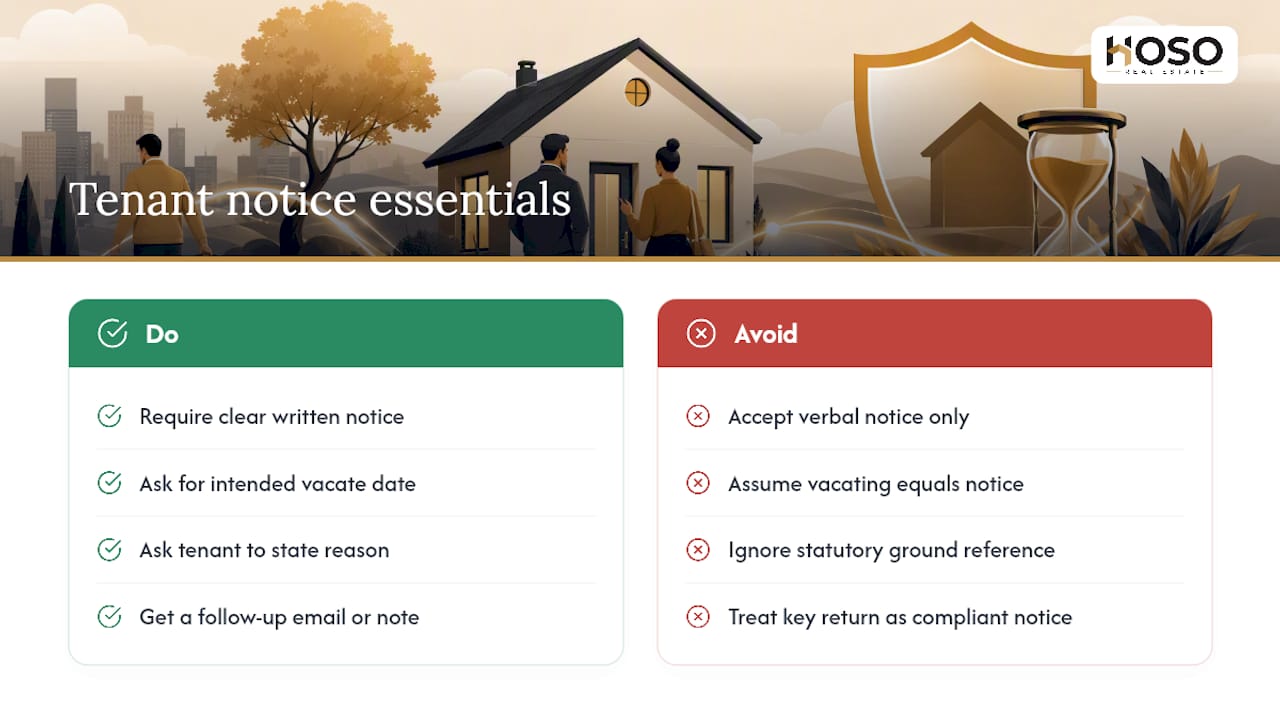
South Australian law expects a tenant breaking a fixed-term lease to give you clear written notice, not a verbal heads-up or an assumption that vacating the property is enough on its own. Proper process matters because the date notice is received often becomes the reference point for calculating lost rent and the rent-liability cap.
A tenant should notify you or your agent in writing, stating the date they intend to vacate and, ideally, the reason for leaving. If that reason relates to a statutory ground, such as a verified safety concern, they should reference it directly, since this determines whether they owe break costs at all. Where the notice is silent on a reason, you're entitled to treat it as a standard early termination subject to section 75A and 78.
Practically, insist on a written notice for your own records, even if you first hear about the departure by phone or text. A follow-up email from the tenant, or a written acknowledgement from you confirming the date and details discussed, gives both parties a clear reference point if the matter later goes to SACAT.
Where a tenant hands back keys and stops paying rent without any formal notice, treat that as abandonment rather than a compliant break, and start your possession and mitigation timeline from the date you reasonably established the property was vacant. HOSO Real Estate's overview of landlord obligations in South Australia sets out the corresponding responsibilities that sit alongside a tenant's notice duties.
What happens if a tenant breaches the lease outright
Breaking a lease properly, with notice and an acceptance of liability for capped costs, is different from breaching it outright by simply stopping payment or vacating without any communication. The consequences escalate depending on which situation you're facing.
For a straightforward early termination with notice, the tenant's exposure is limited to the section 75A caps: lost rent to the earlier of reletting or lease end, a pro-rated reletting fee, and advertising costs, provided you've mitigated. There's no separate "penalty" on top of these figures; South Australian tenancy law is compensatory, not punitive, and SACAT will not award damages beyond genuine, documented financial loss.
Where a tenant breaches more seriously, such as accumulating rent arrears while remaining in the property, you may pursue a notice to remedy the breach and, if unresolved, a termination order through SACAT. Ongoing arrears, property damage, or repeated breaches can support a claim beyond the break-lease framework specifically, but each of those still needs to be quantified and evidenced the same way, through invoices, condition reports and rent ledgers.
The consistent thread across every one of these pathways is that SACAT rewards documentation and rejects speculation. A landlord who can produce a clean paper trail from notice to resolution is in a stronger position, whether the dispute is a clean break-lease claim or a more contested breach matter.
Does breaking a lease affect a tenant's rental history?
A break-lease event, particularly one that ends in a contested SACAT hearing, can follow a tenant into their next tenancy application. Property managers routinely ask previous landlords or agents for a rental reference, and a lease broken without notice, with unpaid amounts owing, or with a tribunal order against the tenant, tends to surface in that conversation.
This matters to you as a landlord for a practical reason: it shapes how seriously you should weigh a tenant's stated intentions before agreeing to any negotiated exit, and it's also a point of leverage in a negotiation. A tenant who understands that an unresolved break-lease dispute could affect their next rental application has a genuine incentive to settle amicably, pay what's owed, and part on terms both sides can point to later as reasonable.
For you, a clean settlement record works both ways. A landlord who mitigates properly, keeps costs to the documented minimum, and avoids inflating claims tends to get faster cooperation from a departing tenant, and a smoother handover to the next one. Property managers and future landlords also look at how a previous landlord's claims were handled, since a pattern of aggressive or poorly evidenced claims can affect how referees and referral networks view a landlord over time. The incentives on both sides point the same way: settle on documented, reasonable terms rather than dragging a dispute to a contested hearing.
Negotiating a break-lease exit without going to SACAT
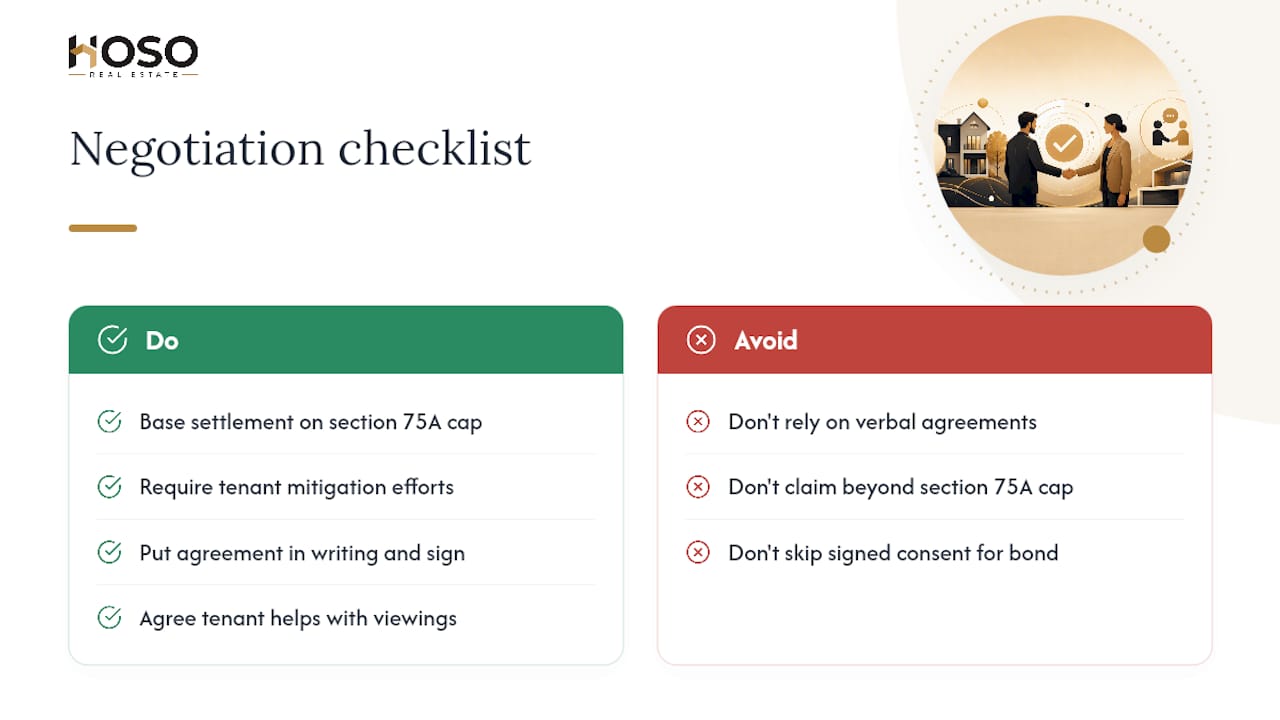
Most break-lease situations never need to reach a tribunal, and a negotiated agreement is usually faster and less costly for both sides than a hearing. The starting point for any negotiation is the same statutory framework: the section 75A cap sets the ceiling, and a genuine mitigation effort sets the floor of what you can reasonably ask for.
A common, fair structure is to agree the tenant pays lost rent up to the point a new tenant is confirmed, plus a pro-rated reletting fee and actual advertising spend, capped at whatever section 75A would allow in any case. Putting this in writing, signed by both parties, avoids any later dispute over what was agreed and gives you the documented consent needed to draw on the bond if that's part of the settlement.
Flexibility can work in your favour too. If a tenant is willing to help with viewings, keep the property presentable during the notice period, or agree to a slightly longer notice window before vacating, that cooperation shortens your vacancy and reduces the loss you'd otherwise need to claim. Some landlords agree to waive the reletting fee in exchange for the tenant covering full advertising costs upfront, which speeds up the process for everyone.
Whatever you agree, get it in writing before the tenant hands back keys. A verbal understanding that later gets disputed puts you back in the position of proving everything from scratch at SACAT, precisely the outcome a good-faith negotiation was meant to avoid.
HOSO's perspective on managing break-lease events
Break-lease disputes rarely turn on the law itself. They turn on whether a landlord treated mitigation as a formality or a discipline from the first day of vacancy. We see the same pattern across Adelaide's rental market: owners who list promptly, price to genuine market conditions, and document every step recover cleanly. Owners who hesitate, or hold out for a better rent, often end up funding the shortfall themselves.
Our approach when managing a break-lease event is to start the reletting process immediately, keep a running evidence file from the first advertisement onward, and prepare that file as though a SACAT hearing is a real possibility, even when it isn't. For a contested or high-value claim, professional support pays for itself in the strength of the documentation alone.
— HOSO
How HOSO Real Estate handles re-letting and SACAT preparation
HOSO Real Estate is the alternative to managing a break-lease claim alone. Where a landlord juggling advertising, viewings, applicant screening and evidence collection risks missing a step SACAT will later scrutinise, our team runs that entire process as a matter of course, so nothing that matters goes undocumented.
That means immediate re-listing across the channels that suit your property and suburb, thorough tenant screening to avoid a second vacancy, and a maintained file of advertising records, enquiry logs and inspection notes from the day a lease breaks. We know the section 75A caps, the section 78 mitigation standard, and what SACAT expects to see, because we prepare for it as routine practice, not as an exception.
If you're managing a break-lease event on an Adelaide property, or want a portfolio review before your next tenancy renewal, explore HOSO Real Estate's services or browse recently leased properties to see how quickly we typically turn a vacancy around. If a departing tenant needs somewhere to store belongings during the handover, StorageNest's rental storage is a practical option worth passing on.