
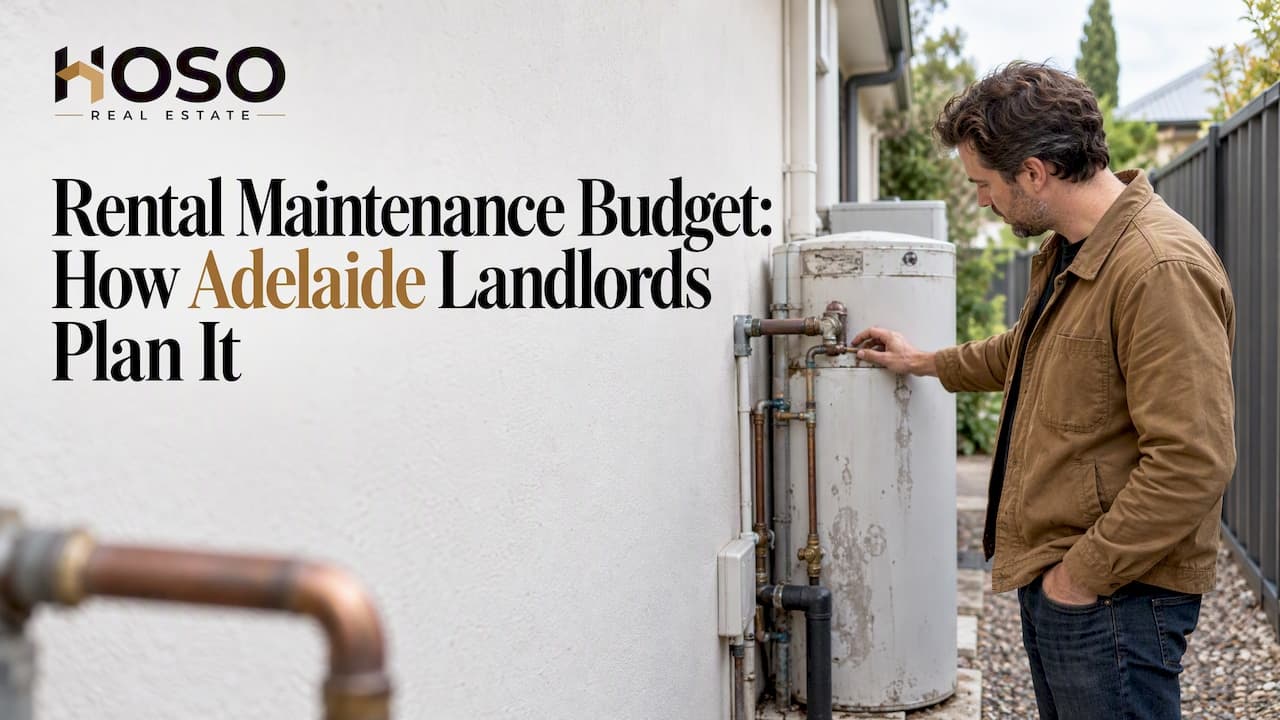
A sound rental maintenance budget starts at 1% to 2% of the property's value each year, then adjusts for age, construction, property type and tenant turnover. On a $700,000 Adelaide house, that is roughly $7,000 to $14,000 a year, spent unevenly. This guide shows how to set the figure, what to include, how South Australian repair duties shape the spend, and how the tax rules treat each type of work.
TL;DR
- Start with 1% to 2% of the property's value per year, then adjust for age, type and condition.
- Split the budget into routine, seasonal, emergency and major replacement costs. Spending is uneven, so hold the money in a separate reserve.
- South Australian landlords must complete repairs within a reasonable time. Urgent repairs cannot wait for a budget review.
- Repairs that restore original condition are generally deductible straight away. Improvements and initial repairs are treated as capital and claimed over time.
- Written approval limits, quotes and a documented schedule keep spending under your control.
Table of Contents
- What a rental maintenance budget should cover
- How much to budget: the percentage rules
- Factors that move your number
- Why spending is uneven, and what to do about it
- What South Australian landlords must repair
- Repairs, improvements and tax
- Planning for the big replacements
- Keeping costs down without lowering standards
- Approval limits and control of the spend
- Our perspective: budget for condition, not just cost
- Get a maintenance plan built around your property
- FAQ
- Sources
What a rental maintenance budget should cover
A maintenance budget is the money you set aside to keep the property in a condition that meets your legal duties and protects its value. It is separate from mortgage repayments, council and water rates, and insurance.
The Western Australian Consumer Protection factsheet notes that there are no set monthly maintenance rules, and that some lenders suggest allocating 2% of the property's value each year. The figures come from another state, but the logic holds in Adelaide: maintenance is a cost of holding the asset, not a surprise.
A useful budget has four layers:
- Routine maintenance. Smoke alarm checks, filter cleaning, minor plumbing and electrical faults, garden upkeep where it is the owner's duty, and small fixes found at inspections.
- Seasonal work. Gutter and downpipe cleaning before winter, drain clearing, reticulation checks, fence repairs and pruning.
- Emergency repairs. Burst pipes, hot water failure, electrical faults, storm damage and gas leaks.
- Major replacements. Carpets, repainting, appliances, hot water systems, air conditioners and refurbishment between long tenancies.
The WA factsheet lists the same categories. It suggests at least one annual outdoor clean-up covering gutters, drains, reticulation, fencing and pruning, plus allowance for emergency plumber or electrician call-outs, appliance replacement and longer-term carpet and paint work.
How much to budget: the percentage rules
Three reference points come up repeatedly in Australian guidance.
| Rule | Source | What it means |
|---|---|---|
| 1% of property value per year | Common landlord insurance guidance | A starting point for a well-kept property |
| 1% to 2% of property value per year | The Age | A prudent range, varying with property type and age |
| 2% of property value per year | WA Consumer Protection | A figure some lenders suggest allocating |
A percentage is a starting point, not a forecast. It ignores how old the building is, what has been replaced recently and what kind of tenant lives there.
Worked examples for Adelaide
These are illustrative calculations, not market valuations.
- Established house, $700,000. At 1%, the budget is $7,000. At 2%, it is $14,000. A 1960s brick home in an older suburb such as Unley or Prospect belongs towards the upper end. Original plumbing, older wiring and mature trees all add risk.
- Townhouse, $550,000. At 1%, the budget is $5,500. At 2%, it is $11,000. A newer townhouse with few original components can sit near the bottom of the range for the first years.
- Apartment, $450,000. At 1%, the budget is $4,500. At 2%, it is $9,000. A strata owner usually has narrower responsibilities than a house owner, but should add allowance for levies and interior items such as appliances and floor coverings.
The Age reports property expert guidance on why one number cannot fit everyone. A standalone house exposes the landlord to the structure and the land, while strata owners usually carry narrower internal responsibilities.
Factors that move your number
Start from the percentage, then adjust for what you actually know about the property.
Age and condition. Older homes tend to need more. Roof sheeting, switchboards, galvanised plumbing and ageing hot water systems all reach end of life at some point. A pre-purchase building and pest inspection tells you what is coming. If you already own, a condition report from an independent tradesperson does the same job.
Property type. A house with a garden, pool, fencing and large roof has more to maintain than a unit. Pools in particular add equipment, chemical, safety and compliance costs. Include them as their own line.
Tenant type and turnover. Every vacancy is a chance to repaint, clean carpets or replace worn items. High turnover raises the cost of making good between tenants. A longer, stable tenancy lowers it, but defers wear that eventually needs to be paid for.
Standard of presentation. A premium rental competes on condition. If you want the property to attract and keep strong tenants, budget for a higher standard. Our guide to luxury rental property maintenance standards in South Australia covers how that standard is set.
Recent work. A property with a new roof, new hot water system and fresh paint carries less near-term risk than one with none. Keep a record of every component and its age, and you can predict replacement years rather than guess.

Why spending is uneven, and what to do about it
Maintenance rarely arrives in tidy monthly amounts. One month may be nothing, the next a $2,400 hot water system. Averaged over several years the cost smooths out, but cash flow does not.
The practical answer is a dedicated maintenance reserve, held apart from your general savings or offset account. The WA factsheet recommends setting funds aside for emergency repairs, vacancies and capital replacements. A reserve also covers the case where an appliance failure and a plumbing fault land in the same month.
A simple way to size it:
- Review the last 12 to 24 months of actual repair spending on the property.
- Work out the average monthly cost.
- Hold at least three months of that average in the reserve, more for an older property.
- Add a separate sinking fund for known big items, such as a hot water system due in three years.
- Top the reserve up after every large job.
If you have no spending history because you have just bought, use the percentage range for the first year and replace it with real data from your first full year.
What South Australian landlords must repair
Your budget has to meet your legal duties first, because those are not optional. SA.GOV.AU states that landlords must carry out repairs within a reasonable time. It also confirms that tenants can arrange urgent repairs through a licensed professional and give the landlord the invoice and a report of the work. Urgent matters, such as a gas leak, should be reported to the landlord as soon as possible.
That has three budget consequences.
- Urgent repairs set their own timetable. A burst pipe or failed hot water service on a winter weekend cannot wait for quotes. A pre-approved spending limit with your property manager means work starts straight away.
- Delay can cost more. A small leak left for weeks becomes a ceiling, insulation and paint job. Quick response is usually the cheaper response.
- Disputes end up at SACAT. If a repair is neglected and the tenant escalates, the South Australian Civil and Administrative Tribunal can become involved. Keeping dated records of reports, quotes and completed work protects you in that process.
For the full list of duties, read our guide to landlord obligations in South Australia and the overview of Adelaide rental compliance requirements. If your property is a recent build, new build rental defects explains what to raise with the builder rather than pay for yourself.
Repairs, improvements and tax
How you classify spending affects when you can claim it, so it belongs in the budget.
The Australian Taxation Office says repairs that restore a property's original condition are generally deductible immediately. Improvements that add value, or replacement of an entire structure, are treated as capital works or assets, deductible over several years. The ATO also says initial repairs to fix damage or defects that existed when you bought the property are generally capital in nature, potentially claimed as capital works deductions over 40 years.
Some practical examples:
- Fixing a leaking tap or replacing a broken fence paling after a tenant moves in: usually a repair.
- Replacing a whole fence with a different style, or renovating a kitchen: likely an improvement.
- Repairing storm damage that existed before you settled: likely an initial repair, treated as capital.
Depreciation is separate again. Division 40 deductions may be available for the decline in value of a depreciating asset, and Division 43 allows 2.5% over 40 years for qualifying capital works. Neither replaces an immediate repair deduction, so ask a registered tax agent to apply them to your records.
The ATO also checks this area. It uses data-matching involving property managers, banks and rental bond authorities to find common errors, including claiming capital improvements as repairs. Keep invoices and photos that show what the work was and why it was needed. Our quick ATO tests for capital works versus repairs walks through the decision, and the Adelaide end of financial year landlord checklist helps you get the records ready.
Planning for the big replacements
The items that hurt a budget are the ones that were never planned. List each major component, its age and its expected remaining life, then convert it into an annual set-aside.
A basic schedule might look like this.
| Item | Typical review point | Planning action |
|---|---|---|
| Hot water system | Age and performance at each inspection | Add to sinking fund once past mid-life |
| Carpets and flooring | Wear at each lease end | Budget for replacement between tenancies |
| Interior paint | Condition at lease end | Plan a repaint cycle |
| Air conditioning | Annual service record | Service yearly, set aside for replacement |
| Roof and gutters | Annual outdoor clean-up and inspection | Clear before winter, get a quote before storm season |
| Appliances | Failure history | Keep a small buffer |
When a larger repair is needed, particularly roof or storm damage, get a written scope and quote before work starts. Understanding why insurers ask for a repair estimate helps you document damage properly before a claim. The WA factsheet also warns that neglected maintenance or an extended vacancy may affect insurance cover, so check your landlord policy wording.
Keeping costs down without lowering standards
Cutting maintenance spending usually moves the cost to a later, larger bill. These approaches reduce spend without letting the property decline.
- Prevent rather than react. Schedule seasonal work before problems appear. Our proactive maintenance scheduling guide sets out a calendar you can follow.
- Respond fast to tenant reports. Small faults are cheaper at day one than at day thirty. Quick responses also tend to keep good tenants longer.
- Use qualified tradespeople. The WA factsheet advises using qualified trades. Licensed work is safer, comes with accountability and is what a tenant or tribunal expects.
- Compare quotes on larger jobs. Set a threshold, for example any job above an agreed amount needs two quotes.
- Choose tenants carefully. Better screening is the cheapest maintenance strategy. Damage, neglect and unreported faults all fall when the tenant is a good fit.
- Buy for low maintenance. If you are still choosing a property, newer or lower-maintenance stock and a thorough pre-purchase inspection reduce the first years' exposure.
See examples of well-maintained rental properties for what a properly managed asset looks like over time.
Approval limits and control of the spend
A budget only works if someone enforces it. Agree these points with your property manager in writing:
- An urgent repair limit. The amount your manager can spend immediately, without waiting for you.
- A quote threshold. Above it, you approve before work starts.
- Itemised invoices. Each job shown by trade, location and reason, so you can sort repair from improvement at tax time.
- Photos before and after. They support insurance claims, tax records and any dispute.
- Year-end review. Compare actual spending with the budget and adjust the percentage.
Interstate and overseas owners benefit most from this structure, because they cannot inspect the property themselves. Clear limits, fast reporting and a single point of contact replace the need to be on site.
Our perspective: budget for condition, not just cost
We manage rental properties across Adelaide and we focus only on property management, not sales. That shapes how we think about maintenance.
A budget is a tool for protecting the asset's long-term performance. The cheapest year is not the best year if it leaves a $9,000 problem for the next owner or tenant. We prefer a steady, documented spending pattern over a lean year followed by a crisis.
We also see the budget as a communication tool. Owners who know their approval limits, see every invoice and can check progress in the owner portal tend to make calmer decisions. Our approach combines routine inspections, maintenance coordination and clear reporting, so repairs are timely, recorded and classified correctly for tax.
If you take one thing from this guide, make it this: set the percentage, hold the reserve, and review both after every full year of real spending.
— HOSO
Get a maintenance plan built around your property
If you want maintenance handled to a documented standard, our property management services cover routine inspections, maintenance coordination, rent collection and lease administration for Adelaide landlords. To understand what your property can earn before you set your budget, request a rental appraisal.
FAQ
How much should I budget for rental property maintenance each year?
A common range is 1% to 2% of the property's value per year. Use the lower end for newer, well-kept properties and the upper end for older houses. Replace the estimate with your own spending data after the first full year.
Are rental maintenance costs tax deductible in Australia?
Repairs that restore a property's original condition are generally deductible in the year you incur them. Improvements and initial repairs on defects present at purchase are treated as capital and claimed over time. A registered tax agent can confirm the treatment for your situation.
Who pays for urgent repairs in South Australia?
The landlord must carry out repairs within a reasonable time. Tenants can arrange urgent repairs through a licensed professional and give the landlord the invoice and a report of the work. Agreeing an urgent spending limit with your property manager avoids delays.
Should I keep a separate maintenance fund?
Yes. Maintenance costs arrive unevenly, and a dedicated reserve stops one bad month from disrupting your cash flow. Size it from 12 to 24 months of past spending, then add a sinking fund for known big replacements.
Is depreciation the same as a maintenance deduction?
No. Depreciation covers the decline in value of assets and qualifying capital works over time. Repair deductions cover work that restores the property to its earlier condition. Both may apply to the same property, but to different spending.
Sources
- Investment property ownership factsheet, WA Consumer Protection
- The hidden costs of being a landlord, The Age
- Repairs and maintenance in private rental, SA.GOV.AU
- Repair and maintenance expenses, Australian Taxation Office
- Rental expenses legal database entry, Australian Taxation Office
- Rental property data matching, Australian Taxation Office