
Specialist management is not optional for high-end properties. It is the mechanism that protects capital, sustains premium rental yield, and reduces legal and reputational risk. A generalist agency managing a high-value home in Burnside or Medindie the same way it manages a standard rental in the outer suburbs is not a neutral choice. It is a liability.
The core reasons specialist management matters for high-value assets:
- Asset protection: premium finishes, bespoke systems and high-replacement-cost fixtures require proactive care, not reactive repairs.
- Tenant quality: high-net-worth tenants expect discretion, professionalism and a curated experience from day one.
- Preventative maintenance: scheduled, specialist-led maintenance lowers lifecycle costs and prevents sudden capital expenditure.
- Legal compliance: South Australian tenancy law, SACAT processes and documentation standards carry real consequences when mishandled.
- Vendor access: premium properties need vetted trades, not the cheapest available contractor.
If you own or invest in a high-value residential property in Adelaide or South Australia, the immediate next step is to request an asset assessment from a specialist manager who can demonstrate local regulatory knowledge and a documented service standard.
Table of Contents
- What specialist property management actually means for high-end assets
- 1. Tailored maintenance and preventive care for premium finishes
- 2. Tenant acquisition and screening for high-net-worth tenants
- 3. Financial stewardship: reporting, capex planning and yield protection
- 4. Risk, compliance and security for luxury homes in South Australia
- 5. Access to premium vendors, specialists and concierge services
- 6. When should a high-end owner hire a specialist manager?
- 7. How to choose the right specialist property manager in Australia
- 8. How a specialist agency protects and enhances high-end properties
- Key takeaways
- The gap most owners do not see until it costs them
- HOSO Real Estate: specialist management for Adelaide's high-value properties
What specialist property management actually means for high-end assets
The term "specialist management" is used loosely in the industry. In practical terms, it means the manager treats your property as a capital asset requiring active stewardship, not a rent-collection exercise. Property management has evolved into a multifaceted role combining technology, tenant experience, predictive maintenance and legal compliance. Specialist managers act as asset custodians, not administrators.
For high-end properties, that distinction shows up in concrete operational differences.
| Dimension | Generalist management | Specialist management |
|---|---|---|
| Inspection cadence | Quarterly, standard template | Scheduled by asset type, detailed condition reporting |
| Vendor selection | Lowest available quote | Vetted trades with materials knowledge and insurance |
| Tenant screening | Income check and ID | Income verification, professional references, background check, privacy protocols |
| Reporting | Monthly rent statement | Cashflow, maintenance ledger, capex forecast, vacancy analysis |
| Compliance | Reactive to notices | Documented, proactive, SACAT-ready |
| Communication | Email updates | Principal-level involvement, direct owner contact |
In South Australia, this distinction also has a regulatory dimension. Property managers must meet registration and supervision requirements set by the SA government. Owners appointing a manager should verify that registration before signing any agreement. In suburbs like Toorak Gardens, Springfield or Hawthorn, where property values and tenant expectations are both elevated, the gap between generalist and specialist service is not marginal. It is measurable in condition, yield and risk exposure.
What specialist management delivers, in practical terms:
- Asset stewardship with documented maintenance and inspection records
- Concierge-grade vendor coordination for premium finishes and systems
- Bespoke reporting aligned to the owner's investment objectives
- Proactive compliance management calibrated to SA tenancy law
1. Tailored maintenance and preventive care for premium finishes
High-end properties contain systems and finishes that standard maintenance schedules simply do not account for. Hydronic heating, home automation, bespoke joinery, polished concrete, stone benchtops, resort-style pools and specialist HVAC all require trades with specific materials knowledge. A generalist manager sending a general handyman to address a fault in a Crestron home automation system or a limestone-clad bathroom is not a cost-saving measure. It is a risk to the asset.

Specialist maintenance programmes reduce unexpected capital expenditure by catching deterioration before it becomes structural. Documented vendor quality assurance and preventative schedules materially lower lifecycle costs for premium properties. The role of maintenance in protecting real estate value is well established in industry commentary: deferred maintenance on premium finishes compounds quickly and disproportionately affects resale and rental value.
Minimum maintenance expectations for a high-end property:
- Quarterly internal inspections with photographic condition reports
- Bi-annual specialist HVAC service and filter replacement
- Annual pool and spa equipment audit by a licensed technician
- Six-monthly check of home automation, security and AV systems
- Seasonal gutter and roof inspection (critical in Adelaide's summer heat)
- Annual review of joinery, stone surfaces and specialist flooring for wear
Pro Tip: Ask your manager for a written preventative maintenance schedule specific to your property's finishes and systems before signing a management agreement. A generic schedule is a red flag.
2. Tenant acquisition and screening for high-net-worth tenants
The tenant profile for a premium property in Unley Park or Walkerville is fundamentally different from the broader rental market. High-net-worth tenants are often privacy-conscious, professionally mobile and accustomed to a high standard of service. Attracting them requires targeted marketing, professional presentation and discreet outreach, not a listing on a general portal with a smartphone photo.
Luxury property management uses premium marketing channels, professional photography, staging and targeted outreach to suitable tenant cohorts, including corporate relocation networks, professional associations and referral pipelines. That approach shortens vacancy periods in the top rent band and attracts tenants who treat the property with corresponding care.
Screening criteria for a high-value property should include:
- Verified income at a minimum multiple of the weekly rent
- Two professional references (employer and prior landlord)
- National tenancy database check
- Background and identity verification
- Written privacy protocol for inspections and communications
A practical example: a property in Glenelg North managed by a specialist agency experienced a tenancy transition that a generalist manager had previously handled poorly, resulting in a disputed bond and a SACAT application. Under specialist management, the new tenancy was established with a fully documented entry condition report, verified references and a clear communication protocol. The subsequent tenancy ran for two years without a single breach notice.
3. Financial stewardship: reporting, capex planning and yield protection
Self-management is time-intensive and frequently produces lower net yields than professionally managed properties. The Letto analysis notes that professional management uses dynamic pricing and enterprise tools to lift revenue in ways that offset management costs. For high-end residential properties, the financial case for specialist management rests on three pillars: detailed reporting, forward-looking capex planning and active yield protection.
Owners should expect the following from a specialist manager's reporting:
- Monthly cashflow statement (rent received, disbursements, maintenance costs)
- Maintenance ledger with itemised costs and vendor details
- Vacancy analysis with market comparison
- Capex forecast with priority matrix and estimated timing
- Annual depreciation schedule aligned to the owner's accountant's requirements
- Rental appraisal review against current market conditions
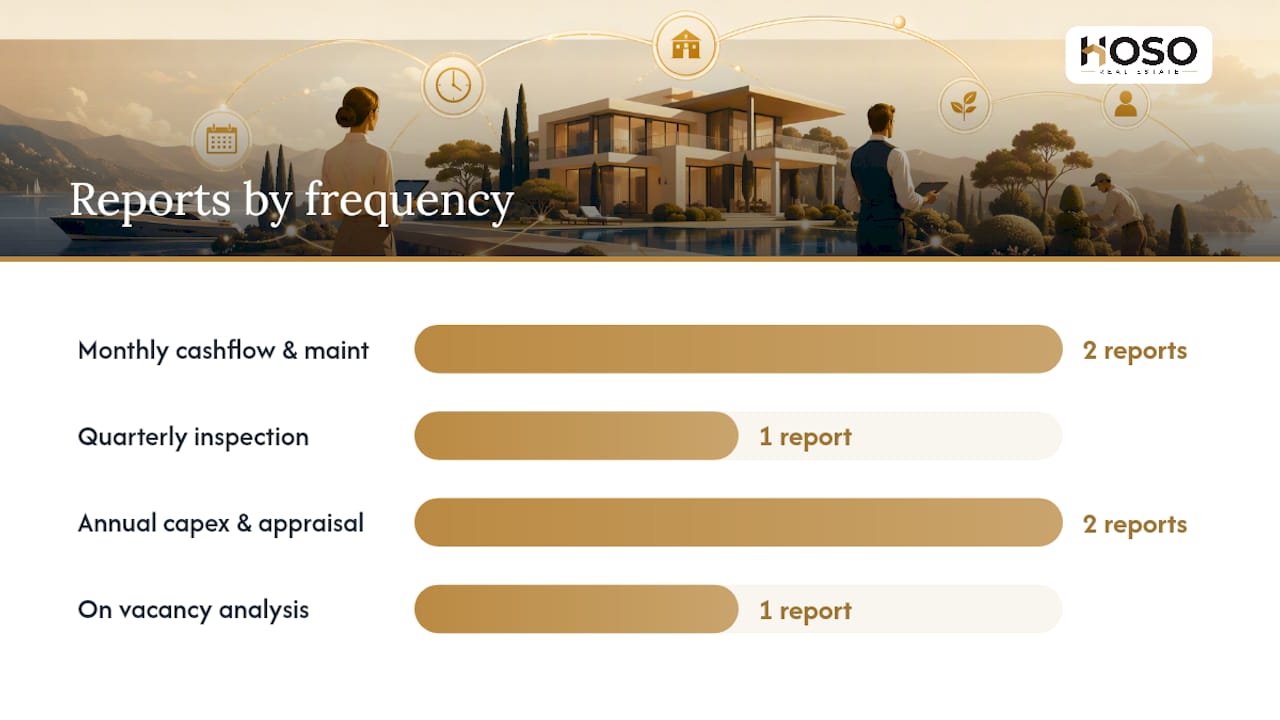
Sample reporting items by frequency:
| Report | Frequency | Purpose |
|---|---|---|
| Cashflow statement | Monthly | Income and expenditure tracking |
| Maintenance ledger | Monthly | Cost control and vendor accountability |
| Inspection report | Quarterly | Condition monitoring and early fault detection |
| Capex forecast | Annually | Capital planning and budget preparation |
| Rental appraisal | Annually (or on market shift) | Yield optimisation |
| Vacancy analysis | On vacancy | Leasing strategy and market positioning |
Capex planning is where specialist management creates the most visible financial value. A manager who identifies that a pool pump is approaching end-of-life during a routine inspection allows the owner to budget and schedule replacement. A generalist manager who misses it until failure creates an emergency repair at premium cost, a potential tenancy dispute and a period of reduced amenity.
4. Risk, compliance and security for luxury homes in South Australia
South Australian tenancy law places specific obligations on landlords and their agents. Entry condition reports, bond lodgement, notice periods, maintenance response timeframes and privacy requirements are all governed by the Residential Tenancies Act 1995 (SA). When these obligations are mishandled, the South Australian Civil and Administrative Tribunal (SACAT) is the forum for dispute resolution. Inexperienced managers and poor recordkeeping create real compliance and financial risks for landlords managing high-value assets.
For high-end properties, the compliance stakes are higher. A disputed bond on a $2,000-per-week tenancy, or a SACAT application arising from an inadequate entry condition report, carries financial and reputational consequences that a standard rental dispute does not.
Risk-mitigation checklist for SA high-value property owners:
- Confirm your manager holds current SA registration (verify via Consumer and Business Services)
- Require a fully documented entry condition report with photographs at every tenancy commencement
- Confirm bond lodgement with Consumer and Business Services within the statutory timeframe
- Establish a written vendor NDA protocol for trades accessing the property
- Maintain a key register with documented issue and return records
- Review your landlord insurance policy annually with a broker familiar with high-value residential assets
- Confirm your manager has documented SACAT experience and can produce examples of dispute resolution outcomes
Security and privacy are not peripheral concerns for high-net-worth owners. Vendor NDAs, discreet inspection scheduling, key control registers and strata or owners corporation liaison (where applicable) are standard expectations at the specialist level. How property management protects landlords in South Australia depends heavily on documentation quality and the manager's familiarity with SA-specific processes.
This article provides general information about property management and tenancy obligations in South Australia. It is not legal advice. Confirm current requirements with Consumer and Business Services SA or a qualified legal practitioner.
5. Access to premium vendors, specialists and concierge services
A specialist manager's vendor network is one of the most tangible differentiators from generalist management. Professional cleaning is one component of a broader presentation standard that supports tenant satisfaction and protects long-term income. For high-end properties, the vendor list extends well beyond cleaning and general maintenance.
Typical vendor categories for a luxury residential property:
- Specialist trades (stone restoration, timber floor refinishing, heritage plasterwork)
- Licensed pool and spa technicians
- Home automation and AV specialists
- Landscape architects and premium garden maintenance contractors
- Art handling and installation professionals
- Security system technicians
- Specialist HVAC engineers
- Professional cleaning services with experience in premium finishes
Vendor-vetting checklist for owners assessing a manager's network:
- Current public liability and professional indemnity insurance (request certificates)
- Demonstrated portfolio of work in comparable properties
- Materials knowledge relevant to the property's specific finishes
- References from other premium property managers or owners
- Documented quality assurance process (sign-off on completed works)
- Clear escalation process when work does not meet standard
A manager who cannot produce vetted vendor references on request is not operating at the specialist level, regardless of how the agency markets itself.
6. When should a high-end owner hire a specialist manager?
Several clear triggers indicate that specialist management is warranted, or overdue.
Signs that specialist management is needed now:
- Repeated maintenance issues involving inappropriate trades or materials
- Extended vacancy in the top rent band with no clear leasing strategy
- Tenant privacy complaints or security concerns during inspections
- Remote ownership (interstate or overseas) with no local oversight
- Rising compliance complexity (strata, heritage overlay, short-term rental regulations)
- Incomplete or inconsistent inspection reports
- No documented capex forecast or maintenance schedule
Decision checklist:
- Is the property valued above $1 million replacement cost?
- Does the property contain specialist finishes or systems requiring specific trades?
- Is the owner based interstate or overseas?
- Has there been a tenancy dispute or SACAT application in the past two years?
- Is the current manager unable to produce a sample capex forecast or vendor reference list?
A "yes" to any two of these questions is a practical threshold for engaging a specialist manager. Self-management at this asset level is rarely cost-effective when the time cost, compliance exposure and maintenance risk are properly accounted for.
7. How to choose the right specialist property manager in Australia
The interview process for a specialist manager should be structured and specific. Generic questions about "service" and "communication" do not reveal whether a manager can actually protect a high-value asset.
Interview questions to ask:
- Can you provide a sample monthly and annual report from a comparable property?
- What is your inspection cadence for high-value properties, and what does the report include?
- Who are your specialist vendors for stone, timber, home automation and pool maintenance?
- Can you describe a SACAT matter you have managed and its outcome?
- How do you handle vendor access and privacy for high-net-worth tenants?
- Is the principal directly involved in managing high-value portfolios, or is it delegated to junior staff?
- What is your process for capex forecasting and maintenance scheduling?
Red flags to watch for:
- Vague or templated answers to vendor and compliance questions
- No documented inspection process or sample reports available
- Junior staff assigned as the primary contact for a high-value property
- Inability to name specialist vendors with verifiable references
- No demonstrated SACAT experience or knowledge of SA tenancy law
- High portfolio volume per manager (a signal of insufficient attention per property)
Trust signals that matter:
- Principal-level involvement in high-value accounts
- Documented processes for inspections, vendor management and reporting
- Local SA regulatory knowledge, including Consumer and Business Services registration
- Anonymised performance examples from comparable properties
- Performance review frameworks with clear KPIs and reporting cadence
Boutique agencies that limit portfolio size and prioritise principal involvement consistently produce stronger outcomes for premium assets than high-volume operations. That is not a marketing claim. It is a structural reality: attention per property is finite, and high-value assets require more of it.
8. How a specialist agency protects and enhances high-end properties
Anonymised client scenario: An owner of a four-bedroom property in Norwood, valued at approximately $1.8 million, had been with a generalist agency for three years. Inspection reports were templated and infrequent. A specialist stone benchtop had been cleaned with an inappropriate product by a contractor, causing permanent surface damage. The bond dispute at tenancy end was unresolved for four months.
HOSO Real Estate's process on taking over management:
- Conducted a full asset audit within the first week, documenting all existing condition issues with photographic evidence
- Replaced the general maintenance contractor with a specialist stone and joinery trade
- Established a quarterly inspection schedule with a bespoke condition report template for the property's specific finishes
- Implemented a vendor NDA and key register protocol
- Produced a 12-month capex forecast identifying the pool pump and HVAC unit as priority items
- Reported monthly with a cashflow statement, maintenance ledger and market rent comparison
Within 12 months, the property was re-leased to a verified professional tenant at a rent above the previous tenancy, with a fully documented entry condition report and no outstanding maintenance items.
HOSO Real Estate's approach aligns with SA registration requirements and documented compliance processes. Owners can review HOSO's service standards and request a sample reporting package before committing to management.
Key takeaways
Specialist management protects high-end properties by combining proactive maintenance, rigorous tenant screening, detailed financial reporting, and SA-compliant documentation to preserve capital and sustain premium yield.
| Point | Details |
|---|---|
| Asset protection is the primary case | Specialist managers prevent value erosion through vetted vendors, documented maintenance and proactive compliance. |
| Tenant quality determines yield stability | Rigorous screening, professional presentation and discreet management attract and retain high-net-worth tenants. |
| Reporting must include capex forecasting | Monthly cashflow and an annual capex forecast are minimum expectations from a specialist manager. |
| SA compliance carries real consequences | SACAT exposure, bond disputes and documentation failures are preventable with the right manager and processes. |
| HOSO Real Estate offers specialist management in Adelaide | HOSO provides asset audits, bespoke reporting, vetted vendor networks and principal-level involvement for high-value SA properties. |
The gap most owners do not see until it costs them
The most common mistake high-value property owners make is treating management as a commodity. They compare agencies on surface signals — responsiveness, website presentation, a friendly first call — and miss the operational depth that actually determines whether a high-value asset in Springfield or College Park is protected or quietly deteriorating.
What rarely gets examined before signing a management agreement: the vendor list, the inspection template, the capex forecast methodology, and the manager's actual SACAT track record. These are the variables that determine whether a tenancy dispute costs the owner $800 or $18,000. They are also the variables that a specialist manager can demonstrate with documentation, and a generalist manager typically cannot.
Adelaide's premium suburbs have a relatively small pool of genuinely qualified tenants at the top rent band. A poor tenancy experience, a privacy breach during an inspection, or a maintenance failure that damages a premium finish does not stay contained. Word travels in professional networks. The reputational cost of a mismanaged high-value property is not recoverable with a rent reduction.
The argument for specialist management is not that it eliminates risk. It is that it systematically reduces the risks that matter most for high-value assets, and it does so through documented processes rather than good intentions.
HOSO Real Estate: specialist management for Adelaide's high-value properties
HOSO Real Estate is the alternative to generalist management for owners of premium residential properties in Adelaide and South Australia. Where a high-volume agency assigns a junior property manager to your $1.8 million asset and sends a templated quarterly report, HOSO provides principal-level involvement, a bespoke inspection and reporting framework, and a vetted vendor network built for premium finishes and specialist systems.
Owners who engage HOSO receive an initial asset audit, a sample reporting package and a vendor review before committing to management. The process is transparent, documented and calibrated to SA tenancy law and SACAT expectations.
To request an asset assessment or review HOSO's property management services, contact the team directly. Owners with multiple high-value properties can also review HOSO's approach to portfolio management for investors managing more than one asset in Adelaide.
Useful sources and further reading
- Property management has changed — and smart investors need to pay attention
- The true cost of self‑management | Letto Insights
- Luxury property management services in Marrickville explained
- Need a property manager? Who you choose could make or break your investment
- HOSO Real Estate | Premium Property Management Adelaide