
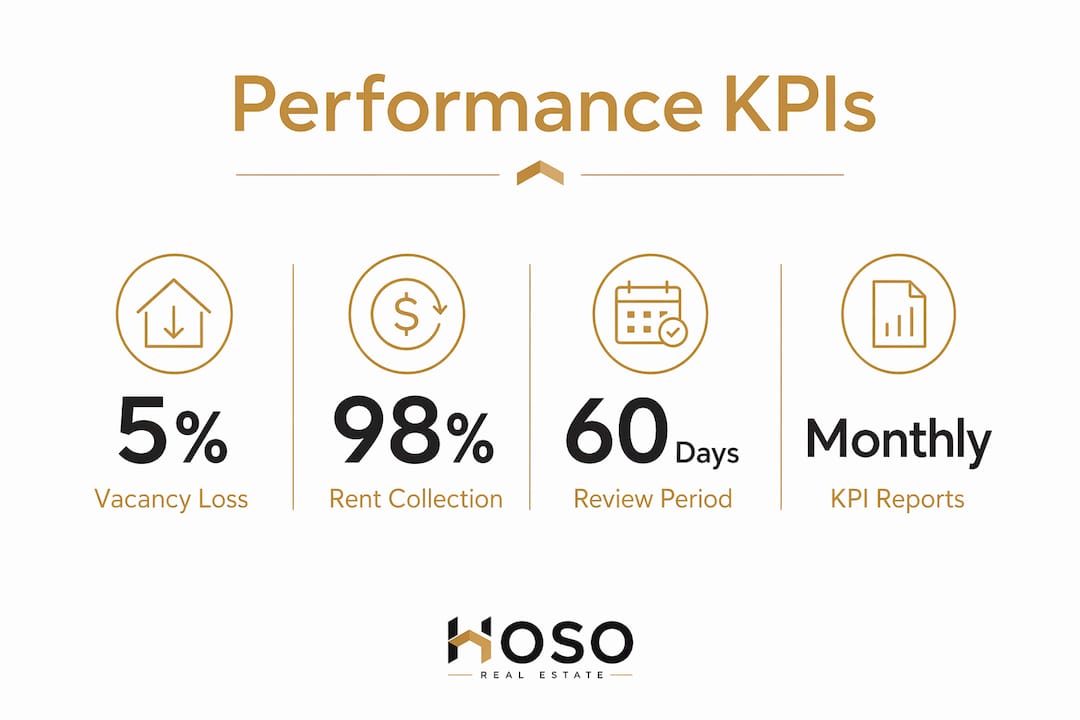
A property manager performance review is a structured evaluation measuring six core domains to determine whether your investment is being managed to a professional standard. Those domains are tenant relations, maintenance responsiveness, leasing effectiveness, financial accuracy, regulatory compliance, and communication transparency. The industry term for this process is a property management appraisal, and it goes well beyond asking whether your manager returns calls promptly. Clear benchmarks define the standard: vacancy loss under 5% of gross rents and a rent collection rate at 98% or higher. HOSO Real Estate applies this framework across its Adelaide portfolio to give owners measurable, objective insight into how their asset is performing.
What measurable criteria should you use in a performance review?
A scorecard format produces more objective results than subjective feedback alone. Scorecards assign a rating to each performance domain, which removes the bias that comes from judging a manager on personality or communication style.
The table below sets out the key metrics and target thresholds for a property management evaluation.

| Metric | Target threshold | Red flag |
|---|---|---|
| Vacancy loss | Under 5% of gross rents | Over 10% of gross rents |
| Rent collection rate | 98% or higher | Persistent delinquency above 2% |
| Maintenance response time | Urgent: within 24 hours | Open backlogs older than 14 days |
| Lease renewal rate | 75% or higher | Frequent unpredictable turnover |
| Financial reporting accuracy | Variance under 2% | Unexplained discrepancies |
| SA tenancy compliance | Zero breaches | Any unresolved SACAT matters |
Financial reporting accuracy matters because unexplained variances signal either poor record keeping or, in the worst cases, mismanagement of funds. Compliance with South Australian tenancy law, including obligations under the Residential Tenancies Act 1995, is non-negotiable. A single unresolved SACAT matter can expose an owner to significant liability.
Pro Tip: Request a written KPI report at least monthly. If your manager cannot produce one, that absence of data is itself a performance issue.
Leasing pipeline data tells you how quickly vacant properties are being filled and at what rent. Tenant retention rates reveal whether the manager is maintaining relationships that reduce your re-leasing costs. Both metrics connect directly to vacancy loss and rent collection as the two most visible indicators of portfolio health.
How to prepare for a property manager performance review session
Formal reviews work best when both parties arrive prepared. The recommended cadence is a quarterly formal review, supported by weekly operational check-ins and monthly financial reviews. This structure means issues surface early rather than accumulating into a crisis.
Preparation steps for an effective review session include:
- Gather documentation. Collect financial statements, maintenance logs, leasing activity reports, and any tenant correspondence from the review period.
- Build a scorecard. Rate each of the six performance domains against the agreed benchmarks before the meeting begins.
- Request a self-assessment. Ask the manager to rate their own performance in each domain. This surfaces blind spots and creates shared ownership of the results.
- Set a clear agenda. A structured 30-minute meeting is more productive than an open-ended conversation. Allocate time for each domain.
- Align on targets. Use the session to confirm or renegotiate KPI thresholds for the next quarter, particularly if market conditions in Adelaide have shifted.
- Document everything. Record agreed actions, responsible parties, and deadlines in writing before the meeting ends.
The tone of the session matters. Reviews conducted as collaborative problem-solving sessions produce better outcomes than those framed as disciplinary meetings. Structured reviews foster continuous improvement rather than defensiveness, which means the manager is more likely to surface problems proactively in future.
How to conduct an effective property manager performance review
Executing the review systematically produces results that are defensible and comparable across quarters. The steps below apply whether you manage one property in Norwood or a portfolio spread across Prospect, Unley, and Glenelg.
- Collect and verify all KPIs. Pull financial statements, maintenance logs, leasing records, and tenant feedback. Cross-check figures rather than accepting a summary at face value.
- Assess each domain against the scorecard. Work through tenant relations, maintenance, leasing, financials, compliance, and communication in sequence. Rate each one before moving to the next.
- Quantify the overall result. Total the scorecard ratings to produce a single performance score for the quarter. This number gives you a trend line across multiple reviews.
- Discuss strengths first. Acknowledge what is working before raising concerns. This approach keeps the conversation constructive and maintains the manager's engagement.
- Identify root causes for underperformance. Operational inefficiencies often trace back to knowledge gaps, poor workflow design, or software misconfiguration rather than deliberate neglect. Diagnosing the cause determines the right fix.
- Agree on corrective actions. Document specific actions, who is responsible, and the deadline for each. Vague commitments produce vague results.
- Set a follow-up date. Measurable improvement should be visible within 60 to 90 days of corrective actions being implemented. Schedule a check-in at the 60-day mark.
- Improve reporting going forward. If the review revealed data gaps, agree on new reporting formats before the session closes.
Pro Tip: Trace every underperformance symptom to its root cause before agreeing on a fix. A maintenance backlog caused by a software issue requires a different solution than one caused by a staffing shortage.
Understanding how timely maintenance affects both tenant satisfaction and asset condition is part of the owner's responsibility in this process. The review is not a one-way assessment. Owners who provide clear expectations and timely approvals give their managers the conditions needed to perform well.
How to identify early warning signs of underperformance
Early warning signs appear in operational data well before they show up in monthly financial statements. Leading indicators like maintenance backlogs and delinquency ageing predict failure 60 to 90 days before financial reports confirm the problem. Waiting for the statement means you are already behind.
Watch for these red flags:
- Vacancy losses exceeding 10% of gross rents. This threshold signals a leasing or pricing problem that is costing you real money.
- Rising delinquency. Any upward trend in unpaid rent requires immediate investigation, not a wait-and-see approach.
- Maintenance backlogs. Open work orders older than 14 days indicate either poor prioritisation or a breakdown in contractor relationships.
- Unpredictable tenant turnover. Frequent, unplanned vacancies suggest tenant relations issues or poor screening at the leasing stage. Reviewing the tenant screening process can reveal where the breakdown is occurring.
- Absent or delayed reporting. A manager who cannot produce timely KPI data lacks operational visibility. Communication alone is not performance.
- Unresolved compliance matters. Any open SACAT matter or unaddressed breach notice is a liability that compounds over time.
When red flags appear, act on data rather than anecdotal feedback. Give the manager a documented corrective action plan with a 60-day review point. If improvement is not visible by then, escalation or replacement becomes the rational next step. A 30-day no-cause termination clause in your management agreement is the most important contractual protection you can hold. Without it, removing an underperforming manager becomes a drawn-out process that costs you time and rental income.
What best practices improve ongoing property manager evaluations?
Consistent data collection is the foundation of any effective evaluation process. Reviews that rely on memory or anecdote produce inconsistent results. Reviews built on documented KPIs produce trends you can act on.
| Review frequency | Format | Primary purpose |
|---|---|---|
| Weekly | Operational check-in | Catch maintenance and leasing issues early |
| Monthly | Financial review | Verify rent collection, arrears, and expenditure |
| Quarterly | Formal appraisal | Score all six domains and set next-quarter targets |
| Annually | Portfolio audit | Assess long-term asset performance and strategy |
Integrating tenant satisfaction data adds a dimension that internal KPIs can miss. Tenant feedback on inquiry handling effectiveness and maintenance responsiveness reveals service quality from the perspective of the person living in your property. That perspective directly affects lease renewal rates.
Technology and reporting dashboards give owners real-time visibility without requiring constant contact with the manager. Owners who can see vacancy status, maintenance queues, and rent collection data independently are better positioned to spot problems early.
Pro Tip: Avoid the common mistake of weighting personality over results. A manager who is easy to deal with but consistently misses KPI targets is underperforming. A manager who is direct but delivers strong numbers is doing the job.
Periodic operational audits go deeper than quarterly reviews. An audit traces symptoms to root causes across workflows, knowledge gaps, and software configuration. Audits are particularly useful when a portfolio grows or when a new manager takes over an existing property. Owners who vet their property management agency thoroughly before signing are less likely to need corrective action later.
Key takeaways
A property manager performance review is most effective when it measures all six performance domains against defined benchmarks, follows a consistent quarterly cadence, and traces underperformance to its root cause before any corrective action is agreed.
| Point | Details |
|---|---|
| Use a scorecard, not gut feel | Rate all six domains objectively to produce a comparable score each quarter. |
| Know your benchmarks | Target vacancy loss under 5% and rent collection at 98% or higher as minimum standards. |
| Act on leading indicators | Maintenance backlogs and rising delinquency signal problems 60 to 90 days before financials confirm them. |
| Protect yourself contractually | A 30-day no-cause termination clause is the most important safeguard in any management agreement. |
| Root cause before remedy | Operational underperformance usually traces to workflow, knowledge, or software issues, not laziness. |
What I have learned from reviewing property managers in Adelaide
Most owners I speak with conflate communication with performance. A manager who responds to messages quickly feels like a good manager. But responsiveness is a baseline expectation, not a performance metric. The real question is whether the numbers hold up.
Adelaide's rental market has tightened considerably across suburbs like Prospect, Norwood, and Henley Beach. In that environment, a vacancy rate creeping above 5% is not a market problem. It is a leasing problem. Owners who track that number quarterly catch it early. Owners who rely on their manager to raise the alarm often find out too late.
The most common mistake I see is owners avoiding the review conversation because it feels confrontational. A well-structured appraisal is not confrontational. It is a professional conversation between two parties with aligned interests. The manager wants to retain the account. The owner wants the asset to perform. A scorecard gives both parties a shared language for that conversation.
Compliance with SA tenancy law is the domain owners most frequently underweight in their evaluations. A single unresolved SACAT matter can result in orders that cost far more than a year of management fees. That risk belongs in every review, every quarter.
The owners who get the best results are not the ones who apply the most pressure. They are the ones who set clear expectations, review consistently, and treat the process as a professional partnership rather than a compliance exercise.
— HOSO
Property management in Adelaide done with full transparency
HOSO Real Estate manages residential properties across Adelaide with a focus on measurable outcomes and clear reporting at every stage. Owners receive regular performance data across all six evaluation domains, so there is never a gap between what is happening and what you know.

Whether you are reviewing your current arrangement or looking for a management partner who builds performance accountability into the relationship from day one, HOSO Real Estate offers premium property management services tailored to the Adelaide market. Every management agreement is backed by transparent reporting, routine inspections, and a commitment to protecting your asset for the long term. Contact HOSO Real Estate to discuss how a structured, metrics-driven approach can work for your portfolio.
FAQ
What is a property manager performance review?
A property manager performance review is a structured appraisal measuring a manager's results across six domains: tenant relations, maintenance, leasing, financials, compliance, and communication. A scorecard format is recommended for objectivity.
How often should I review my property manager?
Conduct a formal appraisal quarterly, supported by monthly financial reviews and weekly operational check-ins. This cadence catches problems early and gives corrective actions time to show results within 60 to 90 days.
What are the key benchmarks for property manager performance?
A high-performing manager maintains vacancy loss under 5% of gross rents and a rent collection rate at 98% or higher. Vacancy losses exceeding 10% are a clear red flag requiring immediate action.
What should I do if my property manager is underperforming?
Issue a documented corrective action plan with specific targets and a 60-day review point. If improvement is not visible, exercise the no-cause termination clause in your management agreement to transition to a new manager.
Can I evaluate my property manager without a formal scorecard?
You can, but subjective assessments are inconsistent and difficult to compare across quarters. A scorecard assigns ratings to each performance domain, producing a trend line that makes improvement or decline visible over time.