
Professional property management is defined as the systematic oversight of a rental property on behalf of its owner, covering tenant screening, lease enforcement, compliance, maintenance, and dispute resolution. For landlords in South Australia, this is not a convenience. It is the primary mechanism for protecting a rental investment from financial loss, regulatory penalties, and legal exposure. With 2026 tenancy regulation updates increasing compliance obligations across the board, the gap between self-managed and professionally managed properties has never been wider.
How property management protects landlords from tenant and legal risk
Consistent processes across screening and lease enforcement are the most effective protection mechanisms available to landlords, reducing legal claims before they arise. Tenant screening is the first line of defence. A professional property manager assesses each applicant against documented criteria including credit history, income verification, rental references, and prior eviction records. This is not simply good practice. It is a legal requirement under fair housing obligations, and inconsistency in how those criteria are applied creates direct liability for landlords.

Uniform application of written screening policies with documented business rationale lowers discrimination risk and supports fair housing compliance. This matters in South Australia because SACAT (the South Australian Civil and Administrative Tribunal) adjudicates tenancy disputes, and any evidence of inconsistent treatment can undermine a landlord's position in a hearing. A property manager maintains a documented screening file for every applicant, accepted or declined, creating a defensible record.
Lease enforcement follows the same logic. Written policies for rent arrears, breach notices, and lease violations must be applied consistently and on time. A missed notice deadline or an informal arrangement with a tenant can void a landlord's right to pursue a claim. Property managers issue formal notices under the Residential Tenancies Act 1995 (SA), track response timelines, and escalate to SACAT when required.
- Screening criteria applied uniformly across all applicants
- Written policies for rent arrears and breach notices
- Formal notice processes aligned with SA tenancy legislation
- SACAT escalation managed by the property manager, not the landlord
Pro Tip: Document every communication with tenants in writing, including verbal conversations followed up by email. This creates a timestamped record that is admissible in SACAT proceedings and removes ambiguity from any dispute.
Does compliance with tenancy laws reduce landlord financial risk?
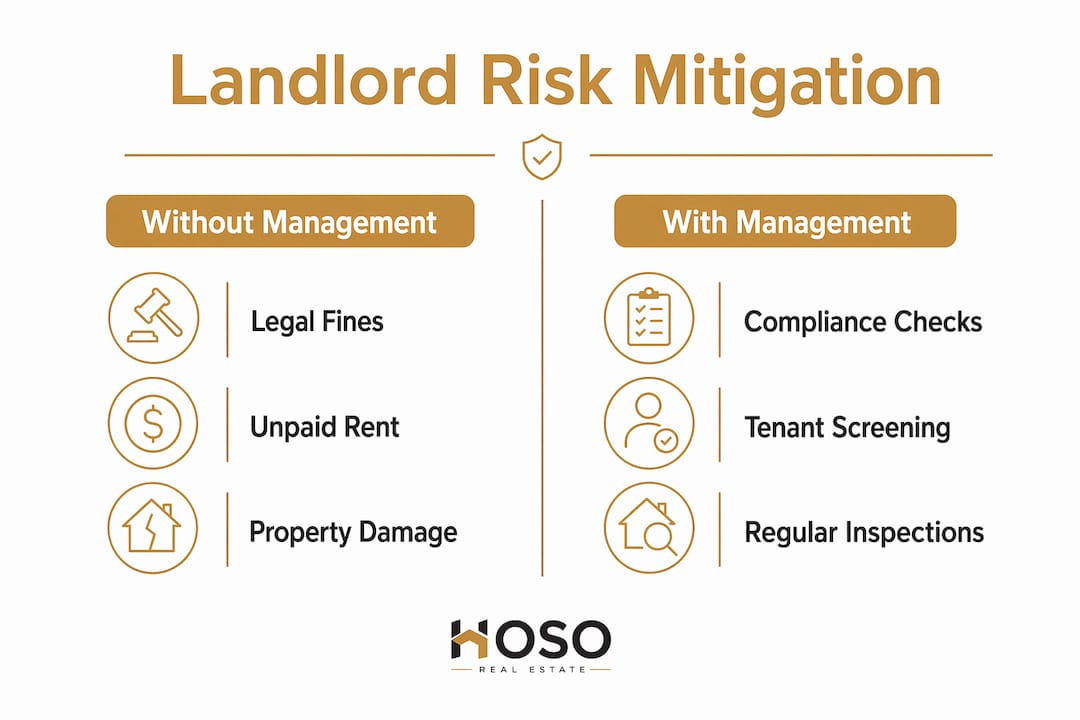
Compliance is where self-managing landlords most frequently expose themselves to serious financial consequences. Deposit protection must be completed within 30 days, and failure to meet this deadline or serve the required prescribed information can result in penalties and blocked possession claims. In South Australia, bond lodgement with Consumer and Business Services (CBS) is a parallel obligation. Missing it does not just create a fine risk. It can prevent a landlord from making a bond claim at the end of a tenancy.
Failure to protect deposits or provide prescribed information can result in fines up to three times the deposit value under comparable UK regulation. The principle applies equally in Australian jurisdictions where non-compliance with bond lodgement and disclosure obligations carries financial penalties and reputational consequences. Professional property managers track these deadlines as a standard operational function, not an afterthought.
Fee compliance is a second area of exposure. Landlords cannot charge tenants for items outside the permitted list under SA tenancy law. Prohibited charges, even when collected informally, can be recovered by tenants through CBS or SACAT. Transparent fee disclosure reduces prohibited payment risk and builds tenant trust, which in turn reduces complaints and disputes.
| Compliance area | Risk without management | How property managers mitigate it |
|---|---|---|
| Bond lodgement | Fines, blocked bond claims | Lodged with CBS within required timeframe |
| Prescribed information | Penalties, possession claim delays | Served to tenant with documented proof |
| Fee charging | Tenant recovery claims, SACAT orders | Fees aligned with permitted schedule |
| Tenancy disclosures | Regulatory penalties | Written disclosures issued at lease commencement |
Pro Tip: Ask any prospective property manager to show you their compliance checklist for new tenancies. If they cannot produce one, that is a clear signal of how they operate.
How do regular inspections protect a landlord's property value?
Inspections such as move-in, move-out, quarterly, and annual walk-throughs document property condition and identify repair needs before they escalate into costly damage. A property manager conducts these inspections on a defined schedule, produces written reports with photographs, and retains signed condition checklists. This documentation is the foundation of any bond claim at the end of a tenancy.
The practical value of routine inspections extends beyond dispute resolution. A property manager who identifies a minor roof leak during a quarterly inspection can arrange a repair for a few hundred dollars. Left undetected for six months, the same leak can cause structural damage costing tens of thousands. In suburbs like Norwood, Unley, and Prospect, where older housing stock is common, this kind of early detection is particularly relevant to maintaining property value.
Contractor oversight is the other side of maintenance protection. A property manager coordinates licensed tradespeople, obtains quotes, and verifies that work meets regulatory standards. Landlords who manage their own maintenance often use unlicensed contractors to save money, which creates liability if the work fails or causes injury. A professional manager removes that risk entirely.
- Move-in and move-out condition reports with photographs
- Quarterly inspections with written findings and follow-up actions
- Licensed contractor coordination with documented quotes and sign-off
- Maintenance records retained as part of the property file
Tenant satisfaction is also a direct outcome of responsive maintenance. Tenants who receive timely repairs are more likely to renew their lease, reducing vacancy periods and the cost of re-letting. This is a measurable financial benefit of professional property management, not a soft one.
Why does documentation create the strongest landlord protection?
Digital documentation decreases the risk of lost records and supports legal defence in tribunal proceedings. A property manager maintains a complete file for every tenancy, including the original application, screening records, the signed lease, condition reports, all correspondence, maintenance requests, payment history, and notice records. This file is the landlord's evidence base in any dispute.
Audit-ready documentation supports eviction processes and reduces the risk of legal challenges by providing clear, timestamped evidence. SACAT adjudicators rely on written records. A landlord who cannot produce a signed condition report, a copy of the issued breach notice, or a record of the bond lodgement is at a significant disadvantage, regardless of the merits of their claim.
Modern property management platforms use e-signatures, cloud storage, and automated timestamping to create records that are both complete and tamper-evident. This is not a luxury feature. It is a core operational requirement for any property manager handling tenancies in 2026.
| Documentation type | Managed property | Self-managed property |
|---|---|---|
| Condition reports | Signed, photographed, filed | Often informal or absent |
| Breach notices | Formally issued, tracked, archived | Frequently verbal or inconsistent |
| Bond records | Lodged with CBS, receipts retained | Sometimes delayed or incomplete |
| Maintenance history | Logged with contractor details | Typically unrecorded |
For landlords with rental property oversight responsibilities across multiple properties, a centralised documentation system managed by a professional agency is the only practical way to maintain audit readiness across an entire portfolio.
What should landlords look for in a property management service?
Selecting the right property manager is itself a landlord protection strategy. The wrong choice transfers risk rather than removing it. These are the criteria that matter most.
-
SA tenancy law expertise. Your property manager must have direct experience with the Residential Tenancies Act 1995 (SA) and SACAT processes. Interstate experience does not transfer directly. Ask for specific examples of how they have handled SA tenancy disputes.
-
Transparent fee structures. Review the property management contract carefully. Management fees, letting fees, inspection fees, and maintenance markups should all be disclosed upfront and aligned with what SA law permits.
-
Documented screening processes. Request a copy of their tenant screening criteria and ask how they document decisions. A manager who cannot explain their screening process is unlikely to defend it in a SACAT hearing. The tenant application review checklist from RentTrust provides a useful benchmark for what thorough screening looks like.
-
Technology and communication systems. Cloud-based platforms, e-signature tools, and owner portals are now standard in professional property management. They create the documentation trail that protects landlords and give you real-time visibility into your property.
-
Proactive owner reporting. A property manager should contact you before problems escalate, not after. Regular inspection reports, financial statements, and maintenance updates are the minimum standard. Silence is not a sign of smooth operations.
Keeping up with local regulations and leveraging technology for compliance and communication is critical for effective property management in 2026. This is the standard you should hold any prospective manager to.
Key takeaways
Professional property management protects landlords through documented screening, compliance monitoring, regular inspections, and audit-ready record-keeping that collectively reduce financial and legal exposure.
| Point | Details |
|---|---|
| Tenant screening reduces risk | Documented, consistent screening criteria lower discrimination claims and improve tenant quality. |
| Compliance prevents penalties | Bond lodgement, prescribed information, and fee compliance must meet strict SA deadlines. |
| Inspections protect asset value | Routine inspections catch damage early and support bond claims with photographic evidence. |
| Documentation wins disputes | Complete tenancy files with timestamped records are the strongest defence in SACAT proceedings. |
| Manager selection matters | SA law expertise, transparent fees, and technology use are non-negotiable criteria. |
The case for professional management has never been stronger
From where HOSO Real Estate sits, the landlords who face the most stress and financial loss are almost never the ones with the worst tenants. They are the ones who managed their properties themselves until something went wrong, and then discovered how much they did not know about SA tenancy law.
The regulatory environment in South Australia has grown more detailed, not less. Bond obligations, disclosure requirements, permitted fees, and inspection standards all carry consequences for non-compliance. A landlord who misses a bond lodgement deadline or issues an informal breach notice is not just making an administrative error. They are potentially forfeiting their right to make a claim or pursue possession through SACAT.
What I have observed consistently is that professional property management pays for itself through avoided losses, not just through time saved. A single bond dispute resolved in a landlord's favour because the condition report was thorough and signed covers years of management fees. A tenancy that does not proceed to SACAT because the breach notice was issued correctly and on time is a cost that never appears on a spreadsheet but is very real.
The technology side of this is also moving quickly. Property managers who use cloud-based platforms, automated inspection scheduling, and digital lease execution are not just more efficient. They are producing the kind of audit trail that holds up in tribunal. Landlords who self-manage with paper files and text messages are operating at a structural disadvantage.
For Adelaide landlords with properties in growth corridors like Bowden, Prospect, or the inner south-east, the rental market is competitive and the regulatory stakes are high. Professional management is not an optional extra at this level. It is the operating standard.
— HOSO
Protect your investment with HOSO Real Estate
HOSO Real Estate provides landlords across Adelaide with property management built around compliance, documentation, and tenant quality. Every tenancy is managed against a structured process covering screening, bond lodgement, routine inspections, maintenance coordination, and SACAT-ready record-keeping.

If you own a rental property in South Australia and want to understand exactly how professional management reduces your exposure, HOSO Real Estate offers a direct, no-obligation conversation about your portfolio. Our property management services are designed for landlords who take their investment seriously and want a manager who does the same. Visit HOSO Real Estate to learn more or to speak with our team about your property.
FAQ
What does property management do to protect landlords legally?
Property management protects landlords legally by maintaining compliance with SA tenancy legislation, issuing formal notices under the Residential Tenancies Act 1995 (SA), and producing audit-ready documentation that supports SACAT proceedings. Consistent processes across screening and lease enforcement are the most effective legal protection available.
How does tenant screening reduce landlord risk?
Tenant screening reduces risk by assessing applicants against documented criteria including credit history, income, and rental references, applied consistently to avoid discrimination claims. Uniform application of screening policies with written rationale lowers fair housing liability and improves tenant quality.
What happens if a landlord does not comply with bond lodgement rules in SA?
Failure to lodge a bond with Consumer and Business Services within the required timeframe can result in financial penalties and may prevent the landlord from making a bond claim at the end of the tenancy. A property manager handles this as a standard compliance function at the start of every tenancy.
How often should a rental property be inspected?
A professionally managed property is typically inspected at move-in, move-out, and on a quarterly basis, with an annual detailed inspection also recommended. Each inspection produces a written report with photographs, which forms the evidentiary basis for any bond or damage claim.
What should I look for in a property manager in Adelaide?
Prioritise direct experience with SA tenancy law and SACAT processes, transparent fee structures, documented screening procedures, and technology systems that produce a complete audit trail. Review the renter screening documents they use and ask how they handle breach notices and bond lodgement to assess their compliance standards.