
Deciding between property management vs self managing is one of the most consequential financial decisions a landlord makes. It looks simple on the surface: pay a fee or keep the money. But the real calculation is far more complex. Self managing rental properties can work well for some landlords and quietly drain others. This guide breaks down costs, compliance obligations, maintenance realities, and the practical systems required to do either approach properly, so you can make a clear-headed decision about which path actually serves your investment.
Table of Contents
- Key takeaways
- Property management vs self managing: the real cost comparison
- Tenant screening, compliance and risk
- Maintenance coordination: reactive versus planned
- Portfolio scale and your management fit
- Financial systems and record keeping
- My honest take on this decision
- Managing your Adelaide investment properly
- FAQ
Key takeaways
| Point | Details |
|---|---|
| Fees are not the full cost | Management fees of 8%–12% are often offset by hidden losses in self-managed rentals. |
| Compliance carries real risk | South Australian tenancy law and SACAT processes require consistent, documented management practices. |
| Time has a dollar value | Self-management consumes 5–10 hours monthly per property, a cost most landlords underestimate. |
| Portfolio size matters | Managing fewer than three to five local properties suits self-management; larger portfolios favour professional services. |
| Systems determine success | Whether you self-manage or hire out, structured processes protect income and reduce vacancy. |
Property management vs self managing: the real cost comparison
The standard argument for self managing rental properties is straightforward: avoid paying a property manager 8% to 12% of monthly rent and keep that money yourself. At face value, that is a reasonable position. On a $2,500 per month rental in suburban Adelaide, you are looking at roughly $200 to $300 saved each month. Over a year, that looks like $2,400 to $3,600 back in your pocket.
But property management fees in 2026 rarely stop at the headline percentage. Leasing fees, lease renewal fees, maintenance coordination charges, and inspection fees stack on top. The effective total cost is higher than the advertised rate. That matters when you are doing a genuine comparison.
What most landlords do not factor in is the cost on the other side of the ledger. Self-managing landlords lose money in at least seven recurring areas: poor tenant selection, extended vacancies, reactive maintenance, untracked expenses, missed rent reviews, incorrect lease documentation, and non-compliance penalties. None of these show up as an obvious fee, which makes them easy to overlook.

The time factor compounds this further. Self-management consumes 5–10 hours monthly per property. At a conservative $50 to $80 per hour equivalent, that is $3,000 to $9,600 per year in personal time. A landlord managing two properties in Glenelg or Norwood is not saving money if they are spending every weekend on maintenance calls and lease paperwork.
Pro Tip: To calculate your true cost basis, add management fees on one side and then honestly estimate vacancy days, maintenance overspend, and your hourly time on the other. Most landlords find the gap is far smaller than they assumed.
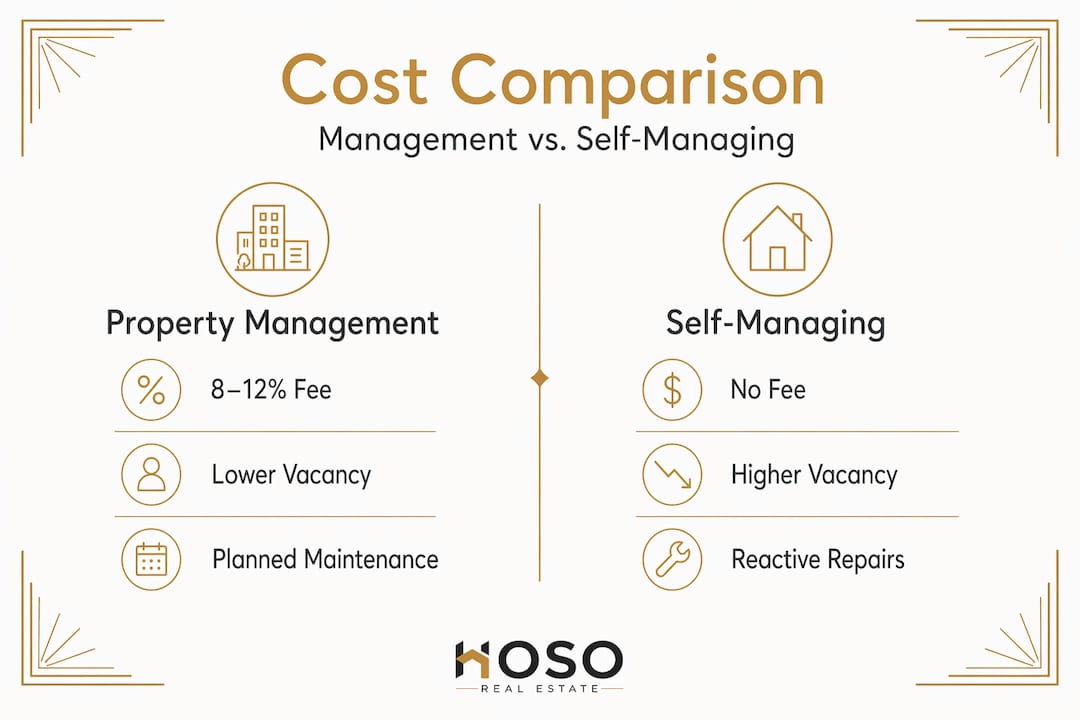
| Cost category | Professional management | Self-management |
|---|---|---|
| Management fee (monthly) | 8%–12% of rent | Nil |
| Leasing and renewal fees | Yes, additional | Nil (but time intensive) |
| Vacancy exposure | Lower, faster re-letting | Higher without active marketing |
| Maintenance coordination | Vendor networks, benchmarked pricing | Retail or unknown pricing |
| Landlord time cost | Minimal | 5–10 hours/property/month |
| Compliance penalties | Absorbed by manager | Full landlord liability |
Tenant screening, compliance and risk
Tenant selection is where self-managing landlords take on the most unpriced risk. A poor tenancy in a property at Prospect or Modbury does not just cost a bond. It costs vacancy time, cleaning, repairs, and potentially an appearance at SACAT (the South Australian Civil and Administrative Tribunal). That process takes time and money regardless of who is at fault.
Professional property managers maintain consistent, audit-ready screening documentation across every application. This matters because inconsistent screening practices expose landlords to discrimination claims, even when the landlord's intentions are sound. The risk is not just from tenants behaving badly. It also comes from your own process being poorly documented.
Using automated tenant screening tools does not eliminate this risk. Landlord liability applies regardless of whether a third-party tool made the decision. If your screening policy is not written down, applied consistently, and backed by vendor indemnification clauses, you carry that exposure directly.
In South Australia, compliance obligations include specific timeframes for condition reports, rent increases, routine inspections, repairs, and entry notices under the Residential Tenancies Act 1995. SACAT handles disputes and non-compliance matters, and the documentation requirements are precise. Missing a notice period or failing to lodge a bond correctly can result in penalties, loss of bond claims, or unfavourable tribunal decisions.
Key compliance areas where self-managing landlords commonly fall short:
- Condition report completion and storage at the start and end of each tenancy
- Entry notice requirements (minimum 7 to 14 days depending on purpose)
- Rent increase procedures and required notice periods
- Bond lodgement with Consumer and Business Services within required timeframes
- Keeping records of all maintenance requests and responses
Pro Tip: If you choose to self-manage, use dedicated property management software such as Console Cloud or Managed App to automate notice scheduling and document storage. Generic spreadsheets are not a system. They are a liability waiting to surface.
Maintenance coordination: reactive versus planned
The difference between how a professional property manager and a self-managing landlord handle maintenance is largely a difference in timing. Managers schedule routine inspections every three to six months, identify issues early, and coordinate repairs through established trade networks. Self-managing landlords typically respond when something breaks.
Reactive maintenance is almost always more expensive. A slow leak ignored for two months becomes a plaster replacement and a mould remediation job. A worn hot water unit flagged at a routine inspection gets replaced on schedule. The same unit failing on a Friday night in winter costs a premium callout fee and an urgent replacement at retail price.
Preventative maintenance scheduling keeps tenants satisfied and properties in better condition. Tenant satisfaction directly affects turnover rates. A well-maintained property in a suburb like Unley or Burnside retains good tenants for longer, reducing vacancy costs and reletting fees.
Here is a practical framework for self-managing landlords who want to shift from reactive to planned maintenance:
- Schedule a full property condition assessment at the start of each year.
- Create a maintenance calendar covering HVAC servicing, gutter cleans, smoke alarm testing, and hot water unit checks.
- Build a shortlist of at least two trusted tradespeople in each category: plumbing, electrical, general maintenance, and air conditioning.
- Log every maintenance request in writing and record the date and outcome.
- Set a spending threshold, for example $500, below which you authorise work directly and above which you review quotes before approving.
| Maintenance approach | Typical outcome |
|---|---|
| Reactive (self-managed) | Higher repair costs, tenant dissatisfaction, increased turnover |
| Preventative (professional) | Lower repair costs, better tenant retention, protected rental income |
Portfolio scale and your management fit
There is no universal answer to whether property management vs DIY is the better choice. The right answer depends significantly on how many properties you own, where they are, and how much of your personal time and energy you are willing to commit.
Managing under ten units locally can suit a structured self-manager who treats the role seriously. A landlord with one or two properties in the same Adelaide suburb, who has the time and temperament for it, can genuinely succeed without a manager. However, the moment your portfolio spans multiple suburbs, different property types, or interstate locations, the complexity compounds quickly.
Consider which profile fits your situation:
- Self-management is viable if you own fewer than three to five local properties, you live within 30 minutes of your rental, you have reliable trade contacts, and you can respond to maintenance or tenant issues within 24 hours.
- Professional management makes more sense if you work full time, travel regularly, own properties across multiple locations, or have a high-value property where compliance risk and asset protection outweigh the fee cost.
- A hybrid model is worth considering for landlords who want to retain control over certain decisions but delegate leasing, inspections, and compliance. Some agencies, including those operating in the Adelaide market, offer flexible management structures rather than all-or-nothing arrangements.
Personal temperament is also a real factor. Managing tenants requires patience, clear communication, and the ability to enforce lease terms without becoming emotionally invested. Some landlords are well suited to this. Others find it stressful and time-consuming in ways that affect both their wellbeing and the quality of their decisions.
Financial systems and record keeping
Professional property managers operate under trust accounting obligations. This means tenant funds, rental income, and maintenance disbursements are held and reported separately from the agency's own accounts. Trust accounting practices include monthly owner statements, rent rolls, delinquency reports, and annual financial summaries, all formatted for tax and lending purposes.
Self-managing landlords need to replicate these controls independently. That means:
- Keeping a dedicated bank account for rental income and property expenses
- Recording every transaction with dates, amounts, and categories
- Reconciling accounts monthly and retaining receipts for at least five years
- Producing an annual income and expense summary for your accountant
- Tracking outstanding rent separately from paid rent to identify arrears early
Without this structure, self-managing landlords face tax filing complications, errors in depreciation tracking, and difficulties securing finance when lenders require proof of rental income history. Investors preparing to grow their portfolio from one property to three or four find that poor financial records become a real barrier.
My honest take on this decision
I have seen landlords succeed at self-management and I have seen others quietly lose thousands while convinced they were ahead. The difference was never about effort. It was always about systems.
The biggest misconception in the self-management debate is that the savings are primarily about avoiding fees. They are not. The savings only materialise if you replicate the systems a professional manager uses: consistent screening, documented compliance, scheduled maintenance, and structured accounting. Without those, you are not self-managing. You are self-exposing.
What I have found is that most landlords who burn out from self-management do so not because the tasks are impossible, but because the tasks never stop. There is no off switch. A tenant dispute at 9pm on a Saturday does not wait for business hours. Compliance deadlines do not move because you are busy at work.
Where professional management wins most clearly is in compliance and vacancy reduction. Regulatory changes happen regularly, and professional managers track and implement them as standard practice. Most self-managing landlords find out about changes when they are already behind.
My practical recommendation: if you are genuinely committed to self-managing, treat it as a part-time business role with defined hours, written processes, and proper software. If you cannot commit to that, the fee is worth paying.
— HOSO
Managing your Adelaide investment properly
Whether you are reconsidering self-management after reading this or confirming what you already suspected, the next step is getting clarity on what professional support would actually cost and deliver for your property.

HOSO Real Estate works with Adelaide landlords across suburbs including Norwood, Glenelg, Unley, Burnside, and Prospect. The property management services cover tenant screening, leasing, compliance management, routine inspections, maintenance coordination, and full financial reporting. There are no hidden add-ons and no vague promises.
If you are self-managing and finding certain areas difficult to keep on top of, HOSO Real Estate can also discuss selective or hybrid support arrangements. The goal is protecting your asset and your time. Reach out through the website to arrange a no-obligation consultation and find out what the right management structure looks like for your portfolio.
FAQ
What do property managers typically charge in South Australia?
Property management fees in South Australia generally range from 8% to 12% of weekly rent, with additional charges for leasing, renewal, and inspections. Total effective costs are higher than the headline percentage, so always review the full fee schedule before comparing.
Is self-managing rental properties worth it financially?
Self-management can be worth it financially if you have strong systems, local access, and reliable trade contacts. Without these, hidden costs including vacancy drag, poor tenant selection, and reactive maintenance often exceed what you would pay in management fees.
What compliance obligations apply to South Australian landlords?
South Australian landlords must comply with the Residential Tenancies Act 1995, including bond lodgement with Consumer and Business Services, condition reports, entry notices, and repair timeframes. Disputes and non-compliance matters are handled through SACAT.
How many properties can you realistically self-manage?
Most landlords can realistically self-manage up to three to five local properties if they live nearby and have the time and systems in place. Beyond that, or across multiple locations, the administrative and compliance load generally favours professional management.
What financial records do self-managing landlords need to keep?
Self-managing landlords should maintain a dedicated rental account, record all income and expenses monthly, retain receipts for five years, and produce an annual financial summary. These records are required for accurate tax filing and lender assessments.