
A property management contract is a legally binding agreement that defines the duties, fees, authority limits, and termination rights between a property owner and their appointed manager. For landlords and investors in South Australia, understanding every clause in this document is not optional. It is the foundation of your asset protection strategy, your financial exposure, and your ability to exit an arrangement that is not performing.
The agreement delegates authority over your property to a third party. That delegation must be precise. Vague language, missing clauses, or poorly negotiated terms create the conditions for disputes, unexpected costs, and operational gaps that affect your tenants, your property, and your returns.
What are the key terms and clauses in property management contracts?
A well-structured property management agreement covers six core areas: parties and property identification, scope of services, fee structure, maintenance authority, insurance and indemnification, and termination provisions. Each area carries legal and financial weight.
Parties and property identification establishes who is legally responsible for what. The contract must name the owner, the agency, and the specific property address. In South Australia, this also sets the framework for obligations under the Residential Tenancies Act 1995 and any relevant SACAT proceedings.
Scope of services defines exactly what the manager will do. This typically includes rent collection, tenant screening, routine inspections, lease renewals, maintenance coordination, and compliance management. Contracts that use broad language like "general property management" without itemising duties leave owners exposed. You need to know precisely what tasks are delegated and which remain your responsibility.

Maintenance authority is one of the most consequential clauses. Spending limits of $250 to $1,500 per incident are standard, authorising managers to approve repairs without explicit owner approval. This threshold must also specify timelines for owner notification after emergency repairs are carried out, to prevent unchecked spending.
Insurance and indemnification clauses allocate liability between you and the manager. Your contract should confirm the manager holds professional indemnity insurance and that your landlord insurance remains valid under the management arrangement. Indemnification clauses should be mutual, not one-sided.
Fiduciary duties require managers to act in the owner's best interest, avoid conflicts of interest, and maintain accurate financial records. This is a legal obligation, not a courtesy, and your contract should state it explicitly.
Pro Tip: Ask your property manager to provide a clause-by-clause summary before you sign. Any manager who resists this request is signalling a problem.
How do property management fees and compensation models work in SA?
Fee structures in South Australian property management follow a consistent pattern, but the detail within that pattern varies significantly between agencies. Understanding the full cost picture before signing protects you from surprises that erode your net return.
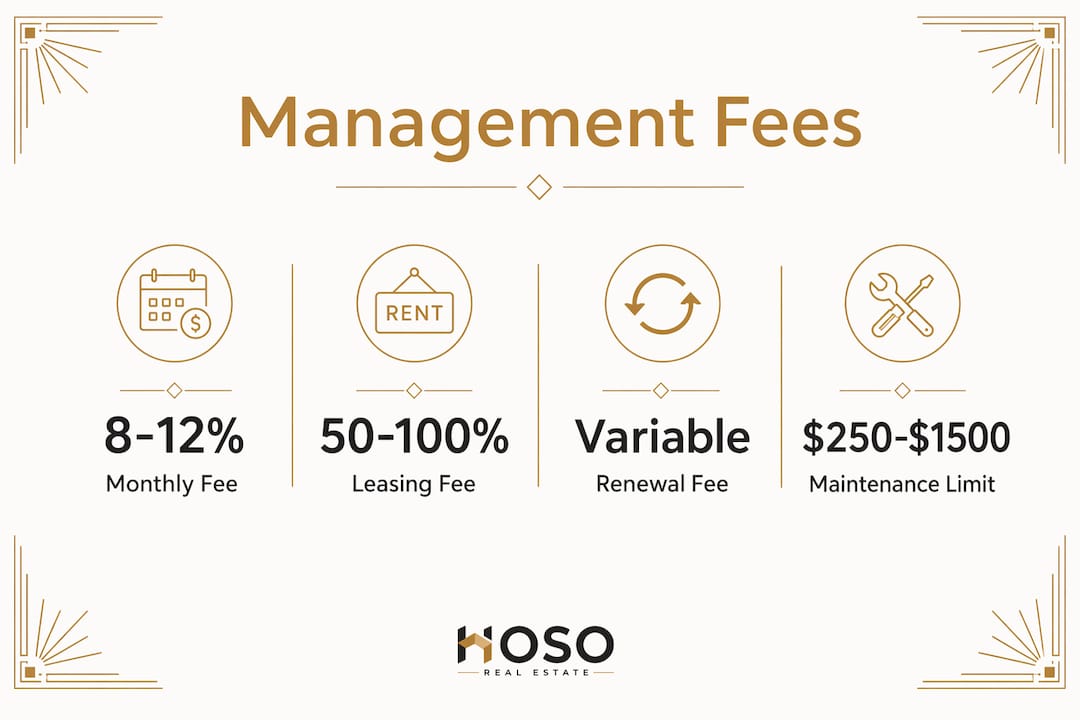
Monthly management fees range from 8% to 12% of gross collected rent, with leasing fees commonly sitting at 50% to 100% of one month's rent. These two figures represent the bulk of your management costs, but they are rarely the only charges. The gap between an 8% and a 12% management fee on a $600 per week rental in Norwood or Prospect translates to over $1,200 per year. That difference must be justified by service quality, not assumed.
Additional charges to watch for include lease renewal fees, routine inspection fees, maintenance coordination markups, advertising costs, and account administration fees. Vague fee language such as "additional fees may apply" is a financial risk. Every charge must be itemised in the contract schedule.
The table below summarises typical fee ranges for the South Australian market:
| Fee type | Typical SA range |
|---|---|
| Monthly management fee | 8% to 12% of rent collected |
| Leasing fee | 50% to 100% of one month's rent |
| Lease renewal fee | $100 to $300 per renewal |
| Routine inspection fee | $50 to $120 per inspection |
| Maintenance coordination markup | 5% to 15% above invoice cost |
For investors comparing agencies, the cost versus return comparison between managed and self-managed properties often comes down to how well fees are structured and disclosed upfront.
Pro Tip: Request a full fee schedule as a standalone document, separate from the main contract. If the agency cannot produce one, treat that as a red flag.
What are the standard contract duration, renewal, and termination terms?
Contract duration and exit terms are where many landlords encounter the most friction. Standard agreements run for 12 months with automatic renewal, requiring 30 to 60 days written notice to cancel without cause. This structure is reasonable when the manager is performing. It becomes a trap when they are not.
The key provisions to review in this section of your agreement include:
- Initial term: Confirm the start and end date. A 12-month initial term is standard, but some agencies use rolling monthly arrangements after the first year.
- Auto-renewal clause: Understand whether the contract renews automatically and what triggers the renewal. Some agreements renew for a further 12 months unless notice is given within a specific window.
- Termination notice period: A 30 to 60 day notice period is standard in South Australia. Anything beyond 60 days without cause should be negotiated down.
- Termination for cause: Your contract should allow immediate termination if the manager breaches their obligations, including failure to comply with the Residential Tenancies Act 1995 or SACAT orders.
- Exit fees: Some contracts include fees payable on early termination. These should be capped and clearly defined, not open-ended.
- Transition obligations: The contract must specify how tenant files, bond records, financial statements, and maintenance histories are transferred to you or a new manager on exit.
Contracts with auto-renewal and penalty-laden termination clauses often signal management companies lacking confidence in their service quality. A manager who is delivering results has no reason to lock you in with punitive exit terms.
Owners should demand easy-out provisions that allow termination without cause on proper notice. This keeps your manager accountable throughout the engagement, not just in the first few months.
How can owners identify and avoid risks from vague contract terms?
Vague contract language is the single most common source of disputes between property owners and managers. The risks are financial, operational, and legal. Identifying them before signing is far less costly than resolving them after a dispute has escalated to SACAT.
The most common risk areas are:
- Undefined maintenance authority: If the contract does not specify a spending threshold, the manager can authorise repairs of any value without your approval. Set a clear dollar limit and require written notification within 24 hours of any emergency repair.
- Unclear fee schedules: Contracts must itemise all charges clearly to avoid hidden costs. "Additional fees may apply" is not an acceptable clause. Request deletion or replacement with a specific schedule.
- Vague scope of services: If the contract does not list specific duties, the manager can argue that any task outside their interpretation of "general management" is outside scope. Every service must be named.
- Weak termination provisions: Vague termination clauses cause costly disputes over security deposits, record transfers, and vendor contracts. Specify exactly what must be handed over, in what format, and within what timeframe.
- Missing record retention clauses: Contracts should specify transfer of digital logs, tenant communications, and maintenance history on termination. Without this, you may lose critical documentation needed for SACAT proceedings or insurance claims.
- One-sided indemnification: If the indemnification clause only protects the manager, you carry all liability for their decisions. Insist on mutual indemnification with clear carve-outs for negligence.
Reviewing contracts with a property lawyer or experienced adviser is worth the cost, particularly for high-value properties in suburbs like Unley, Burnside, or Glenelg where asset values and tenancy complexity are elevated. For guidance on spotting vague contract terms, independent legal resources provide a useful external reference point.
Pro Tip: Treat property management contracts as negotiated risk allocation tools, not standard forms. Every clause is negotiable before you sign.
What steps should SA property owners take to negotiate effective management contracts?
Negotiating a property management agreement is a structured process. Approaching it systematically protects your interests and sets clear expectations from day one.
- Read the entire contract before any discussion. Do not rely on a verbal summary from the agency. Read every clause, including the schedules and annexures.
- Itemise all fees in writing. Request a standalone fee schedule that lists every charge, its trigger, and its amount. Confirm there are no charges outside this schedule.
- Set a maintenance spending threshold. Agree on a dollar limit per incident, typically between $250 and $500 for standard residential properties in Adelaide. Require written notification within 24 hours of any emergency expenditure above this limit.
- Define reporting obligations. Specify how often you receive financial statements, inspection reports, and maintenance updates. Monthly financial reporting and quarterly inspection reports are reasonable minimums.
- Confirm record access. You should have the right to access all tenant files, financial records, and maintenance logs at any time, not just on termination.
- Negotiate the notice period. If the contract requires more than 60 days notice for termination without cause, push back. Thirty days is a fair standard for both parties.
- Verify insurance coverage. Confirm the manager holds current professional indemnity and public liability insurance. Verify your own landlord insurance remains valid under the management arrangement.
- Review annually. Set a calendar reminder to review the contract and service quality at least once per year, before any auto-renewal window closes.
For a detailed walkthrough of the negotiation process, the contract negotiation guide from HOSO Real Estate covers fee structures, notice periods, and authority limits in depth. Understanding how management protects landlords in the current market also provides useful context for what a well-structured agreement should deliver.
Pro Tip: If an agency refuses to negotiate any clause, that rigidity reflects how they will manage disputes later. Flexibility at the contract stage is a quality signal.
Key takeaways
A property management contract is only as strong as the precision of its clauses. Vague language, undefined fees, and weak termination terms are the primary sources of financial and legal exposure for South Australian landlords.
| Point | Details |
|---|---|
| Fee transparency is non-negotiable | Every charge must be itemised; reject any contract with open-ended fee language. |
| Maintenance authority needs a dollar limit | Set a clear spending threshold between $250 and $500 and require prompt notification of emergency repairs. |
| Termination terms define your flexibility | Insist on a 30 to 60 day notice period and easy-out provisions without penalty. |
| Record transfer must be contractually specified | Require digital handover of all tenant files, financial records, and maintenance logs on exit. |
| Fiduciary duty is a legal standard | Your contract should explicitly state the manager's obligation to act in your best interest and disclose conflicts. |
Why precise contract terms matter more than most landlords realise
Most landlords I work with in Adelaide sign their first property management agreement without reading past the fee schedule. That is understandable. The document is long, the language is dense, and the agency presents it as standard. But "standard" is not the same as "in your interest."
The clauses that cause the most damage are rarely the obvious ones. They are the maintenance authority thresholds with no notification requirement, the termination provisions that reference "reasonable costs" without defining them, and the indemnification clauses that quietly shift all liability to the owner. These are not accidents. They are defaults that favour the manager, and they remain in the contract until an owner pushes back.
What I have observed in the South Australian market is that the agencies most resistant to contract negotiation are also the ones most likely to generate disputes. A confident, competent manager welcomes a well-negotiated agreement because it sets clear expectations for both parties. The resistance itself is information.
The other pattern worth noting is that contracts rarely get updated to reflect changes in tenancy law or SACAT processes. If you have been with the same manager for three or more years and have not reviewed your agreement, the document may no longer reflect current obligations under the Residential Tenancies Act 1995. That gap is your exposure, not theirs.
Treat your management contract as a living document. Review it annually, negotiate it thoroughly at the outset, and do not accept vague language as a standard practice. Your property is a significant asset. The contract governing its management should reflect that.
— HOSO
Work with a property manager who puts your contract first
HOSO Real Estate structures every management agreement around owner protection, fee transparency, and clear operational authority. Our contracts itemise every charge, define maintenance thresholds, and include straightforward termination provisions that reflect confidence in our service quality.

Based in Adelaide and operating across South Australia, HOSO Real Estate aligns every agreement with the Residential Tenancies Act 1995 and current SACAT processes. Landlords in suburbs from Norwood to Glenelg trust us to manage their assets with precision and accountability. If you are reviewing your current arrangement or appointing a manager for the first time, explore our property management services to see how a well-structured contract protects your investment from day one.
FAQ
What is a property management contract?
A property management contract is a legally binding agreement between a property owner and a management agency that defines duties, fees, authority limits, and termination rights. It governs how the manager operates on the owner's behalf under South Australian tenancy law.
What fees should I expect in a SA property management agreement?
Monthly management fees typically range from 8% to 12% of rent collected, with leasing fees at 50% to 100% of one month's rent. Additional charges for inspections, lease renewals, and maintenance coordination should be itemised separately in the contract.
How long is a standard property management contract?
Standard agreements run for 12 months with automatic renewal. Termination without cause requires 30 to 60 days written notice, and the contract should specify exactly what records and funds are transferred on exit.
Can I negotiate the terms of a property management contract?
Yes. Every clause in a property management agreement is negotiable before signing, including fee schedules, maintenance spending thresholds, notice periods, and termination conditions. Agencies that refuse any negotiation should be approached with caution.
What happens to my records when I change property managers?
Your contract should specify that all tenant files, financial records, bond documentation, and maintenance histories are transferred to you or your new manager within a defined timeframe. Without this clause, record transfer disputes are common and can disrupt ongoing tenancy management.