
Property management remote access is the digital capability that allows landlords to manage every aspect of their rental properties from any location through secure, cloud-based platforms and automated systems. The industry term for this practice is remote property management, and it covers everything from rent collection and maintenance coordination to tenant communication and routine inspections. For South Australian landlords managing properties in suburbs like Norwood, Prospect, or Glenelg, this approach removes the need for physical presence while maintaining full oversight. Cloud-based property management software centralises tenant requests, owner updates, inspections, and financials in one place, making remote oversight practical and reliable.
What is property management remote access and how does it work?
Remote property management is defined as the use of cloud software, mobile applications, and automated workflows to manage rental properties without being physically present. It is not simply logging into an email account from home. The system integrates tenant portals, owner dashboards, digital lease signing, automated rent collection, maintenance ticketing, and financial reporting into a single platform accessible from any device.
The core architecture relies on three components. First, a cloud-based property management platform stores all data and processes transactions in real time. Second, tenant and owner portals provide structured communication channels that replace ad hoc phone calls and paper forms. Third, automated workflows trigger actions based on rules, such as sending a rent reminder three days before the due date or escalating a maintenance request to a licensed tradesperson after 24 hours without a response.
For South Australian landlords, this structure also supports compliance with the Residential Tenancies Act 1995 (SA). Digital records of notices, inspections, and correspondence create an audit trail that holds up at SACAT if a dispute arises. That audit trail is one of the most underappreciated advantages of remote management.
How does remote access transform property management operations?
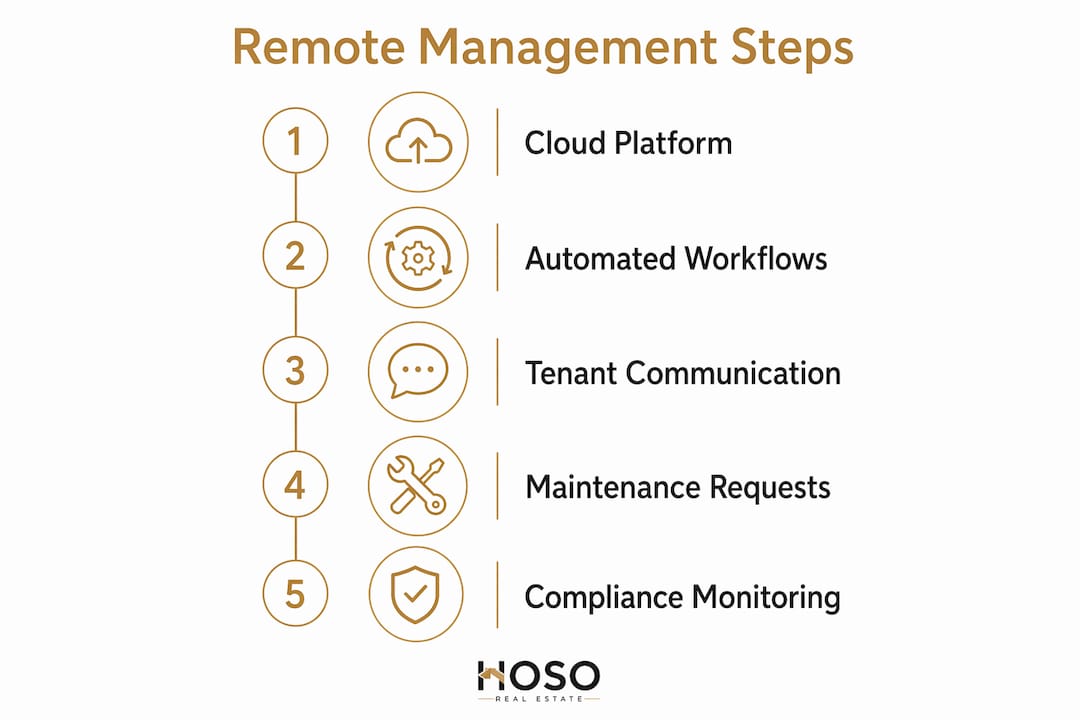
Remote property management shifts the landlord's role from reactive problem-solver to systems manager. The day-to-day work changes significantly when manual processes are replaced by automated triggers and digital documentation.
Key operational changes include:
- Rent collection: Automated payment systems collect rent on schedule without manual follow-up. Achieving over 95% tenant enrolment in automated rent payments virtually eliminates manual rent collection. That figure means a landlord with ten tenants can expect fewer than one manual rent transaction per month.
- Maintenance coordination: Tenants log requests through a portal. The system timestamps the request, notifies the property manager, and routes it to the appropriate tradesperson. Treating maintenance as a data workflow rather than a series of phone calls reduces response times and creates a clear record of every action taken.
- Inspections: Mobile inspection apps and digital reporting enable landlords to review photo documentation and standardised reports without attending the property. This is particularly useful for interstate investors managing Adelaide properties from Sydney or Melbourne.
- Financial reporting: Owners access real-time income and expense statements through their portal at any time, removing the need to wait for monthly paper statements.
- Document management: Lease agreements, entry condition reports, and compliance certificates are stored digitally and retrievable within seconds.
Pro Tip: Set automated escalation rules in your maintenance portal so that any request not acknowledged within 24 hours is automatically forwarded to a backup tradesperson. This single rule prevents the most common remote management failure: a tenant waiting days for a response.
Rental advertising automation also reduces the manual effort involved in vacancy management, which is a further benefit for landlords who cannot attend open inspections in person.
What are the key benefits of remote property management access for landlords?
The advantages of remote property management are concrete and measurable. They are not limited to convenience. They directly affect asset performance, tenant retention, and compliance outcomes.
-
Full oversight without physical presence. Landlords in Burnside or Unley can monitor their property's financial performance, maintenance history, and tenancy status from an interstate office or overseas. The owner portal provides the same information a property manager sees, updated in real time.
-
Reduced manual effort. Standardised, automated workflows replace ad hoc communication for handling requests and maintenance. A landlord no longer needs to chase rent, coordinate tradespeople by phone, or manually reconcile bank statements.
-
Improved rent payment reliability. Auto-pay systems reduce late payments and the associated administrative burden. Consistent cash flow is the single most important factor in investment property performance, and automation protects it.
-
Better maintenance outcomes. Digital workflows create accountability. Every request has a timestamp, an assigned party, and a resolution record. This protects the landlord from liability claims and supports the property's long-term condition.
-
Enhanced transparency. Consistent digital communication and clear documentation maintain the perception of active management even when the landlord or manager is not physically present. Tenants who receive prompt, structured responses are more likely to renew their lease.
-
Support for interstate and international investors. South Australia attracts investors from across Australia and overseas. Remote access means a landlord based in Singapore or Brisbane can manage a Glenelg investment property with the same level of oversight as a local owner.
-
Compliance documentation. Digital records of all notices, inspections, and correspondence satisfy SA tenancy law requirements and provide clear evidence if a matter proceeds to SACAT.
What security and access control measures protect remote property management systems?
Remote access creates a new attack surface in property management that requires dedicated security policies. Sensitive data including tenant financial records, lease agreements, and bank account details are stored and transmitted digitally, making them a target for cybercriminals.
The primary risks are:
- Phishing attacks: Fraudulent emails impersonating property managers or tenants to extract login credentials or redirect rent payments.
- Unauthorised access: Weak passwords or shared login credentials allowing third parties to access tenant and financial data.
- Unsecured devices: Laptops or mobile phones without encryption providing an entry point if lost or stolen.
- Insecure connections: Accessing management platforms over public Wi-Fi without a VPN.
Multi-Factor Authentication and role-based access control are mandatory to protect remote systems from phishing and unauthorised access. Simple passwords alone are not sufficient. Role-based access control means a maintenance coordinator can log and update work orders but cannot view tenant financial records or lease terms.
Endpoint security, device encryption, and secure VPN connections are the technical controls that protect remote property management access at the device level. Multiple access points across phones, tablets, and laptops each represent a potential vulnerability.
Small and medium portfolios are equally vulnerable to cyberattacks. Even a landlord with two or three properties must enforce Multi-Factor Authentication and role-based controls. The assumption that small portfolios are not worth targeting is incorrect and costly.
Pro Tip: Conduct a quarterly access audit. Remove login credentials for any tradesperson, former tenant, or staff member who no longer needs system access. Dormant accounts are a common entry point for unauthorised access.
How can landlords implement remote access systems in South Australia?
Implementing remote property management in South Australia requires a structured approach. The technology is only as effective as the processes built around it.
The following table outlines the key implementation areas and what each requires in practice:
| Implementation area | What it requires |
|---|---|
| Platform selection | Choose a cloud-based platform that supports SA tenancy law compliance, digital lease signing, and SACAT-ready documentation |
| Rent automation | Enrol tenants in direct debit or auto-pay at the start of the tenancy, not after problems arise |
| Communication setup | Configure tenant and owner portals with clear response time expectations and automated acknowledgement messages |
| Local vendor network | Build relationships with licensed tradespeople in your suburb before you need them, not during an emergency |
| Security protocols | Activate Multi-Factor Authentication, assign role-based access, and encrypt all devices used to access the platform |
| Remote inspections | Use a mobile inspection app with photo documentation and standardised report templates aligned with SA entry condition report requirements |
The property management portal is the operational centre of this system. Landlords who treat it as a passive reporting tool miss its full value. The portal is where maintenance is triaged, communications are logged, and compliance records are maintained.
Building a local support network is the element most often overlooked by landlords who focus entirely on the technology. Not all property management functions can be digitalised. A burst pipe in Prospect at 11pm requires a licensed plumber on the ground, not a portal notification. The technology coordinates the response. The local tradesperson delivers it.
Key takeaways
Remote property management is most effective when cloud-based systems, automated workflows, and a local support network operate together under consistent security controls.
| Point | Details |
|---|---|
| Remote access defined | Cloud platforms, portals, and automated workflows replace physical presence in day-to-day property management. |
| Rent automation is critical | Achieving high auto-pay enrolment at tenancy start eliminates manual rent collection and protects cash flow. |
| Security is non-negotiable | Multi-Factor Authentication and role-based access control are the minimum standard for any remote system. |
| Local support remains essential | Digital tools coordinate tasks, but licensed local tradespeople and on-the-ground support are still required. |
| SA compliance is supported | Digital records of notices, inspections, and communications satisfy SA tenancy law and SACAT requirements. |
The shift I have seen in how landlords manage their portfolios
Remote property management has moved from a workaround for interstate investors to the standard operating model for well-run portfolios. The landlords who manage their properties most effectively are not the ones who visit the property most often. They are the ones who have built the tightest systems.
What I have observed working in Adelaide's property management market is that the technology itself is rarely the obstacle. The obstacle is the mindset shift. Landlords who grew up managing properties through phone calls and paper receipts often resist moving to a portal-based model because it feels less personal. The data says otherwise. Tenants who receive structured, timely digital communication report higher satisfaction than those managed through informal channels.
The security dimension is where I see the most complacency. Landlords who would never leave a property unlocked routinely share login credentials or skip Multi-Factor Authentication because it adds thirty seconds to their login process. That thirty seconds is the difference between a secure system and an exposed one.
The future of property management in South Australia is digital by default. The landlords who build their systems now, with proper security and local support networks in place, will manage their portfolios with less effort and better outcomes than those who delay. Remote access is not a feature. It is the foundation.
— HOSO
How HOSO Real Estate supports remote property management in Adelaide
HOSO Real Estate works with landlords across Adelaide and South Australia who want professional oversight of their investment properties without being tied to the day-to-day. The property management services HOSO Real Estate provides include tenant leasing, routine inspections, maintenance coordination, compliance management, and full financial reporting through a structured digital system. Landlords based interstate or overseas receive the same level of active management as local owners. HOSO Real Estate combines modern cloud-based systems with an established local vendor network, so every maintenance request is handled by a qualified tradesperson with accountability built into the process. If you are considering professional management for your Adelaide property, a free rental appraisal is the practical first step.
FAQ
What is remote property management?
Remote property management is the practice of managing rental properties through cloud-based software, automated workflows, and digital communication tools without requiring physical presence at the property.
How does property management access control work?
Access control in property management systems uses Multi-Factor Authentication and role-based permissions to ensure each user can only view or edit the data relevant to their role, protecting sensitive tenant and financial information.
Can remote property management meet SA tenancy law requirements?
Digital records of notices, inspections, lease agreements, and correspondence satisfy the documentation requirements of the Residential Tenancies Act 1995 (SA) and provide clear evidence for SACAT proceedings if needed.
What tools are used for remote property inspections?
Mobile inspection apps with photo documentation and standardised report templates allow property managers to conduct and record routine inspections remotely, with reports accessible to landlords through their owner portal.
Is remote property management suitable for small portfolios?
Remote management is effective for portfolios of any size. Even landlords with one or two properties benefit from automated rent collection, digital maintenance tracking, and structured communication through a tenant portal.