
Property management software is a digital platform that centralises rental property operations by integrating tenant management, financial tracking, maintenance coordination, and owner reporting into one system. The role of property management software is to replace fragmented spreadsheets, phone calls, and manual processes with automated, connected workflows. Platforms like Buildium, PropertyMe, and TenantCloud each approach this differently, but the core function is the same: give landlords and investors a single source of operational truth. Research shows these platforms reduce administrative tasks by 30% and improve data accuracy by up to 40% compared to spreadsheets. For South Australian landlords managing properties across suburbs like Norwood, Prospect, or Glenelg, that efficiency gain translates directly into better asset control and fewer compliance risks.
What are the primary benefits of property management software?
The core advantage is time recovery. Automation handles rent reminders, lease renewals, and maintenance follow-ups without manual input. That frees property managers and self-managing landlords to focus on decisions that actually affect portfolio performance.
The benefits of property management software extend across four key areas:
- Financial accuracy. Integrated accounting tools track rent receipts, outgoings, and owner disbursements in real time. Centralised data eliminates fragmented spreadsheets and email chains, giving owners and managers accurate figures at any point in the month.
- Tenant communication. Self-service portals let tenants submit maintenance requests, view their ledger, and access lease documents without calling the office. Tenant portals reduce inbound administrative calls by 60–80%. That is a significant reduction in reactive workload.
- Compliance documentation. Software stores inspection reports, entry notices, breach letters, and SACAT-related correspondence in one place. This matters in South Australia, where documentation requirements under the Residential Tenancies Act 1995 are specific and auditable.
- Operational visibility. Dashboards show vacancy rates, outstanding maintenance, rent arrears, and upcoming lease expirations across every property in a portfolio. Owners with properties in both Adelaide's inner east and outer northern suburbs can monitor performance without switching between systems.
The most common mistake landlords make is adopting software but ignoring the reporting features. The dashboard is not decorative. It is where you spot a rent arrears trend before it becomes a SACAT application.
Pro Tip: Set a monthly calendar reminder to review your software's arrears and maintenance reports. Most platforms generate these automatically. The landlords who get the most value are the ones who actually read them.
How does property management software connect different functions?
Property management software works by linking modules that would otherwise operate in isolation. Lease tracking, maintenance ticketing, rent ledgers, and owner reporting all feed into the same database. When a tenant's lease is updated, the rent ledger adjusts automatically. When a maintenance job is logged, it links to the property record and the relevant tenancy.

The table below shows how integrated software compares to manual processes across key management functions.
| Function | Manual Process | Software-Integrated Process |
|---|---|---|
| Rent collection | Manual bank reconciliation | Automated receipting and arrears alerts |
| Lease management | Spreadsheet with manual reminders | Structured data with automated renewal triggers |
| Maintenance tracking | Phone calls and email threads | Logged work orders linked to property and tenant records |
| Owner reporting | Monthly PDF prepared manually | Auto-generated statements with real-time figures |
| Compliance documentation | Filed paper copies or email folders | Centralised digital records with audit trail |
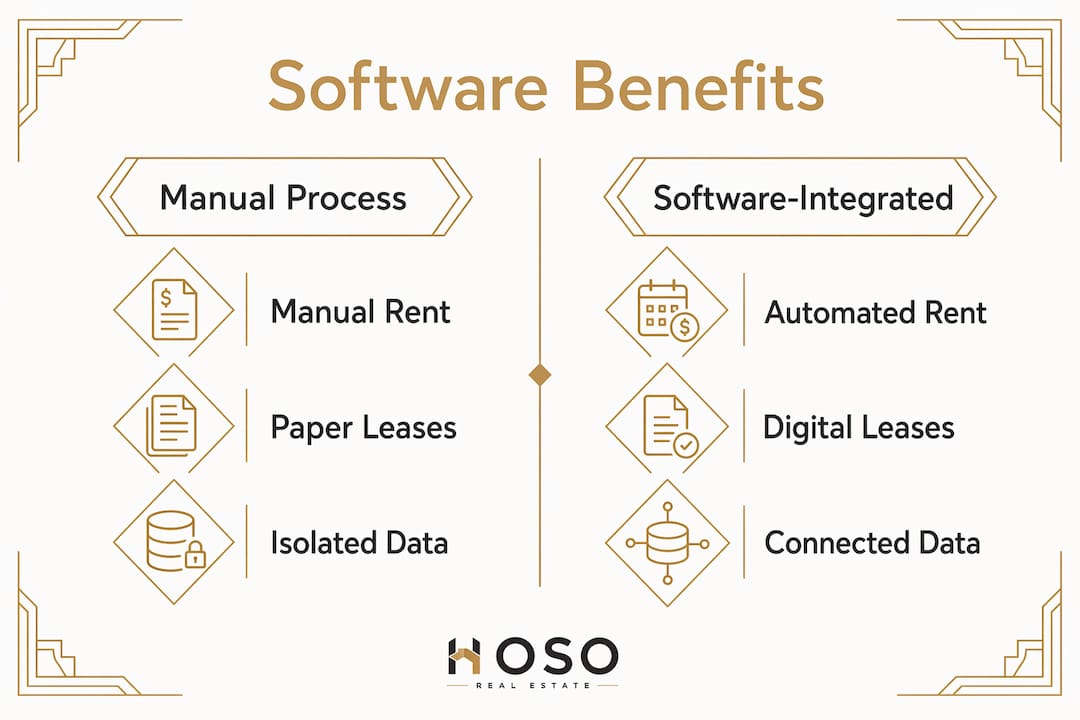
Integrated platforms reduce manual errors and data silos by connecting all modules natively. The alternative, using separate tools for accounting, maintenance, and leasing, creates re-entry points where errors occur.
Lease management deserves specific attention. Treating leases as structured data with automated triggers for rent escalations and renewals prevents revenue leakage. A missed rent increase on a Prospect property leased at $480 per week, when the market has moved to $530, is a direct financial loss. Software prevents that by flagging the renewal window and applying the scheduled increase automatically.
Trust accounting is another non-negotiable function. Trust accounting features keep client funds separate from operating accounts, which is a legal requirement in South Australia and a critical protection during audits. Any platform used by a licensed SA property manager must support compliant trust accounting.
Pro Tip: Before selecting a platform, confirm it supports SA-specific trust accounting requirements. Not all platforms marketed in Australia are configured for South Australian legislation. Ask the vendor directly.
What impact does software have on maintenance and tenant experience?
Reactive maintenance is one of the most expensive habits in property management. A landlord who waits for a tenant to report a problem pays more than one who schedules preventive work. Proactive maintenance planning reduces costly emergency interventions and extends property lifespan. Software makes this shift practical by enabling scheduled work orders, contractor management, and maintenance history records for each property.
The tenant experience improvement is equally concrete. When a tenant in a Glenelg unit can log a maintenance request through a portal at 9pm and receive an automated acknowledgement, the perception of service quality rises. They do not need to call the office the next morning to confirm the request was received. That single change in process accounts for a large portion of the 60–80% reduction in inbound calls that tenant portals deliver.
For South Australian landlords, the documentation benefits extend directly to SACAT proceedings. If a dispute reaches the South Australian Civil and Administrative Tribunal, the quality of your records determines your position. Software that logs every maintenance request, every entry notice, and every communication creates an audit trail that paper-based systems cannot replicate. This is not a theoretical benefit. It is a practical protection that becomes relevant the moment a tenancy goes wrong.
Key maintenance and tenant experience outcomes from using property management software:
- Scheduled preventive maintenance reduces emergency call-out costs
- Work orders link directly to contractor records and invoices
- Tenants receive status updates without requiring staff intervention
- Maintenance history supports insurance claims and SACAT evidence
- Inspection reports stored digitally with photos and timestamps
For investors with properties across multiple SA suburbs, from Unley to Salisbury, centralised maintenance records mean you can compare contractor performance and maintenance frequency across your portfolio. That data informs decisions about which properties need capital works and which are performing well.
How does software support portfolio growth for investors?
Scaling a property portfolio without software creates a predictable problem. Each new property adds administrative load. At some point, the manual systems break. At around 20 units, software pays for itself within months. Beyond 50 units, manual management causes revenue leaks that compound over time.
The global property management software market reflects this reality. The market was valued at $3.61 billion in 2025 and is projected to reach $5.89 billion by 2033 at a 6.4% compound annual growth rate. That growth is driven by landlords and investors recognising that digital transformation is no longer optional in competitive rental markets.
For SA investors managing properties across Adelaide's growth corridors, including Mawson Lakes, Lightsview, and the inner south, software provides real-time dashboards that show portfolio-wide KPIs. Vacancy duration, average days to lease, rent arrears as a percentage of total rent roll, and maintenance cost per property are all visible without manual calculation.
The scalability benefit is structural. When routine tasks are automated, adding a new property to a portfolio does not require adding staff hours at the same rate. An investor who moves from five properties to fifteen does not need to triple their administrative capacity. The software absorbs the volume. This is why digital tools for SA investors are increasingly central to investment strategy, not just operational convenience.
Regulatory adaptability is also relevant here. South Australian tenancy legislation changes periodically. Software vendors update compliance templates, notice periods, and reporting formats when legislation shifts. That keeps landlords current without requiring them to manually track every legislative update.
Key takeaways
Property management software delivers its greatest value when all modules, including leasing, maintenance, accounting, and communication, operate from a single integrated platform rather than separate tools.
| Point | Details |
|---|---|
| Integration over isolation | All modules must connect natively to prevent data re-entry errors and operational silos. |
| Automation prevents revenue loss | Structured lease data with automated triggers stops missed rent escalations and renewals. |
| Tenant portals reduce workload | Self-service portals cut inbound calls by 60–80%, freeing staff for higher-value tasks. |
| SA compliance requires documentation | SACAT proceedings and SA trust accounting rules make digital record-keeping a legal necessity. |
| Scalability is the long-term return | Software absorbs portfolio growth without proportional increases in administrative overhead. |
What HOSO real estate has observed about software adoption
The landlords who get the most from property management software are not necessarily the ones with the largest portfolios. They are the ones who treat the platform as a management system, not just a filing cabinet.
The most common failure pattern is partial adoption. A landlord or agency installs the software, uses it for rent receipting, and ignores the lease management, maintenance scheduling, and reporting modules. The result is a system that costs money but delivers a fraction of its potential value. The siloed approach is worse than useless in some cases because it creates a false sense of control.
What actually works is full integration from day one. Every lease loaded as structured data. Every maintenance request logged through the system. Every inspection report filed digitally with photos. When that discipline is in place, the software becomes the single source of truth for every stakeholder, owner, tenant, contractor, and property manager.
The South Australian market has specific needs that generic platforms do not always address well. Trust accounting compliance, SACAT documentation standards, and SA-specific tenancy notice requirements are not universal. Choosing a platform that is configured for the SA market, or working with a property manager who has configured it correctly, is the difference between compliance and exposure.
The future direction of property management software is toward predictive analytics and AI-assisted maintenance scheduling. These features are already appearing in platforms like PropertyMe and Buildium. For Adelaide landlords, the practical implication is that the gap between well-managed and poorly managed properties will widen as software capability increases. Adopting now, and adopting properly, is the lower-risk position.
— HOSO
How HOSO real estate uses software to protect your investment
HOSO Real Estate combines local Adelaide market expertise with property management systems that give landlords full visibility over their portfolio.
Every property managed by HOSO Real Estate is supported by integrated software covering lease tracking, maintenance coordination, trust accounting, and owner reporting. Tenants access a self-service portal for maintenance requests and lease documents, which reduces administrative friction and improves satisfaction. Owners receive accurate, timely statements without chasing their property manager for updates. For landlords managing properties across suburbs like Norwood, Prospect, Glenelg, or Mawson Lakes, HOSO's property management services deliver the operational control and compliance confidence that protects long-term asset value. To see what a well-managed portfolio looks like in practice, explore HOSO's recently leased properties.
FAQ
What is the role of property management software?
Property management software centralises tenant management, rent collection, maintenance, and financial reporting into one platform. Its primary role is to automate routine tasks and give landlords accurate, real-time data across their portfolio.
How does property management software work for landlords?
The software connects modules including lease tracking, maintenance ticketing, and accounting so that data flows between functions automatically. When a lease is updated or a maintenance request is logged, all related records update without manual re-entry.
What features should SA landlords look for in property management software?
SA landlords should prioritise trust accounting compliance, SACAT-compatible documentation storage, automated lease renewal triggers, and tenant self-service portals. These features address both local legal requirements and day-to-day operational efficiency.
At what portfolio size does property management software become worthwhile?
Research indicates that at around 20 properties, software pays for itself within months through reduced errors and time savings. Beyond 50 properties, manual systems create revenue leaks that compound over time.
How does property management software improve tenant satisfaction?
Tenant portals allow self-service access to maintenance requests, lease documents, and payment history, which reduces the need to contact the property manager directly. This transparency and responsiveness is a direct driver of tenant retention and satisfaction.