

Negative gearing means your rental expenses exceed rent, producing a tax-deductible loss; positive gearing means rental income exceeds expenses, producing taxable cash surplus. The real trade-off is cash flow now versus reliance on capital growth and tax timing later. From 1 July 2027, Budget reforms reshape which new purchases can be negatively geared, so timing now matters more than ever.
TL;DR:
- Future negative gearing will only be available for new builds after July 2027, affecting investors planning purchases in the next 18 months.
- Negative gearing benefits high-income earners with strong cash reserves who seek capital growth, but risks include rising interest rates and vacancies.
- Positive gearing provides regular cash surplus, making it easier to hold multiple properties, but the surplus is taxed and often linked to slower growth in certain suburbs.
- Maintaining operational resilience through professional property management reduces the risk of cash flow shortfalls regardless of the gearing strategy chosen.
- Long-term wealth relies more on capital appreciation than rental yield, so strategy choice should align with market conditions, risk tolerance, and holding period.
Table of Contents
- Negative gearing vs positive: what the ATO actually means by each
- Weighing the pros and cons of each strategy
- Tax rules and the 2026–27 Budget reforms you need to plan around
- A checklist for deciding which strategy suits you
- Worked examples: one negative, one positive
- Why cash flow, not tax return, is the number that matters day to day
- How investors switch between negative and positive gearing over time
- What history shows about long-term wealth built through each strategy
- Common risks and pitfalls with each approach
- HOSO's view: what actually protects Adelaide landlords
- Sources
- FAQ
Negative gearing vs positive: what the ATO actually means by each
The Australian Taxation Office draws a clean line: a property is negatively geared when deductible expenses (loan interest, council rates, insurance, agent costs, repairs) exceed the rent you collect. Flip that ratio and the property is positively geared. Neither term describes the property itself. It describes the relationship between what a property earns and what it costs to hold, in a given financial year.
Common deductible expenses landlords claim include:
- Loan interest on the investment mortgage
- Council rates, water rates, and land tax
- Landlord insurance premiums
- Repairs and maintenance (not capital improvements)
- Property management costs and advertising for tenants
- Depreciation on eligible plant and equipment
Under current ATO rules, a net rental loss can be offset against your other income, such as salary or business earnings, when you lodge your return. If your other income isn't enough to absorb the full loss, the shortfall carries forward to future years rather than disappearing. For Adelaide landlords holding property in suburbs like Prospect or Glenelg, this treatment hasn't changed. What has changed is which future purchases qualify, covered in detail further down. Once you understand which side of the ledger your property sits on, the worked calculations later in this article show exactly how the numbers play out.
Weighing the pros and cons of each strategy
Negative gearing appeals to investors chasing long-term capital growth who can absorb a short-term cash shortfall. The loss reduces your taxable income today, and the strategy has historically suited high-income earners in areas with strong growth trajectories. The risk is real: if rents soften or interest rates climb, that shortfall widens, and you're funding it from your own pocket every month regardless of whether the property's value is moving.
Positive gearing flips the risk profile. You receive surplus cash monthly, which strengthens your borrowing capacity for a second or third property. The surplus is taxable income, though, so your marginal rate eats into the benefit, and positively geared properties in Adelaide's outer growth corridors sometimes trade slower capital appreciation for that steady yield.
- Negative gearing pros: tax offset against other income, exposure to higher-growth markets, useful when income is high and cash reserves are solid.
- Negative gearing cons: ongoing cash shortfall, exposure to rate rises, no benefit if your taxable income is already low.
- Positive gearing pros: immediate cash surplus, easier to hold multiple properties, lower stress during rate cycles.
- Positive gearing cons: surplus is taxed, often means slower capital growth suburbs, less tax-shielding value.
For Adelaide landlords, vacancy periods and unexpected maintenance bills hit negatively geared properties hardest, because there's no buffer already built into the cash flow now versus reliance on capital growth.
Pro Tip: Run your numbers assuming one month of vacancy every year and a 10% buffer for unplanned repairs before deciding which strategy actually suits your risk tolerance.
Tax rules and the 2026–27 Budget reforms you need to plan around
Current ATO practice hasn't shifted: rental losses remain deductible against other income, with any excess carried forward to future years. What's changing is the eligibility of future purchases. From 1 July 2027, the Government will limit negative gearing to new builds and replace the current 50% capital gains tax discount with cost base indexation plus a 30% minimum tax rate on gains.
The Budget factsheet sets out three windows that matter for planning:
- Properties held at 7:30pm AEST on 12 May 2026 are grandfathered entirely and untouched by the change.
- Properties bought between that announcement and 30 June 2027 can still be negatively geared under existing rules until the cutover date.
- Purchases from 1 July 2027 onward can only be negatively geared if they're new builds.
This is a narrower reform than early reporting suggested. It preserves the position of existing Adelaide investors while steering new negative gearing activity toward new housing supply, which is the stated policy goal. If you already own established property in suburbs like Norwood or Unley, this changes nothing about your current tax treatment. If you're weighing a purchase in the next 18 months, timing against these dates could materially affect whether negative gearing is even available to you.
None of this replaces personal advice. Your marginal tax rate, income stability, and portfolio structure all interact with these rules differently, and a registered tax agent should sign off before you commit to a purchase timed around the 2027 cutover.
A checklist for deciding which strategy suits you
Before running any numbers, gather these inputs: expected weekly rent, loan interest rate, annual holding costs, your marginal tax rate, a realistic capital growth assumption for the suburb, your intended holding period, and a vacancy buffer of at least two to four weeks a year.
- Calculate annual rental income using realistic occupancy, not 52 weeks of rent.
- Total annual deductible expenses, including interest, rates, insurance, and management costs.
- Subtract expenses from income to find your gearing position, positive or negative.
- Apply your marginal tax rate to any loss to estimate the actual tax benefit, since a loss is worth more to a higher earner, as MoneySmart's guidance on marginal rates makes clear.
- Compare the after-tax cash position against your capacity to fund a shortfall for the expected holding period.
Investors with strong cash reserves, high marginal tax rates, and a long horizon typically lean toward negative gearing in growth suburbs. Investors prioritising monthly cash flow, or those with lower taxable income, usually do better with positively geared property. If your calculations show a shortfall you can't comfortably sustain through a rate rise or a vacancy, that's your signal to speak with an accountant before settling on either strategy.
Pro Tip: Recalculate your numbers every time the cash rate moves. A gearing position built on last year's interest rate can flip from manageable to painful within a single rate cycle.
Worked examples: one negative, one positive
- Annual rent: $27,040
- Annual interest: $28,800
- Other holding costs (rates, insurance, management, maintenance): $6,500
- Total expenses: $35,300
- Result: a loss of $8,260, meaning this property is negatively geared
At that marginal rate, the loss delivers a tax benefit of roughly $3,056, meaning the real out-of-pocket cost is closer to $5,200 a year, before accounting for any capital growth.
Now compare a $450,000 property in a higher-yield suburb, renting for $480 a week with the same cost structure scaled down: rent of $24,960 against expenses of roughly $23,600. That leaves a surplus of $1,360, taxed at the owner's marginal rate, producing positive cash flow even after tax.
The break-even point sits where rental yield roughly matches your interest rate plus holding costs as a percentage of the loan. HOSO Real Estate's detailed cash-flow walkthrough includes a downloadable calculator if you want to run your own property through the same steps with your actual figures.
Why cash flow, not tax return, is the number that matters day to day
The tax outcome only lands once a year. Cash flow lands every month, and that's the practical difference NAB's explainer on gearing highlights: negative gearing creates an immediate shortfall you fund from your own income, while positive gearing hands you a surplus you can redirect immediately.
For a landlord servicing a mortgage on a rental in Mawson Lakes, the monthly reality is simple. A negatively geared property demands a top-up transfer from your salary account every month, tax refund or not. A positively geared property deposits cash into your account, which you can use to pay down debt faster, save toward a deposit, or absorb a bad month elsewhere in your portfolio.
This is why serious investors track both numbers separately: the annual tax position and the monthly cash position. They rarely move together. A property can be tax-effective on paper and still stretch a landlord's household budget uncomfortably thin if the shortfall runs longer than expected, particularly through a rate-hike cycle or an unplanned vacancy stretch over an Adelaide summer.
How investors switch between negative and positive gearing over time
Gearing position isn't fixed. Rent grows over time, loan balances shrink as principal gets paid down, and a property that starts negatively geared often crosses into positive territory five to ten years in without any active intervention. This is the natural life cycle most buy-and-hold investors experience.

You can also switch deliberately. Making extra repayments to reduce interest costs shifts the gearing position faster. Refinancing to a lower rate has the same effect. Some investors sell a negatively geared asset once its growth phase matures and redeploy the equity into a positively geared property to rebalance portfolio cash flow, particularly as they approach retirement and want income rather than tax offsets.
The reverse move, buying a new negatively geared property to offset a positively geared portfolio's taxable surplus, is common among investors still in peak earning years. Under the 2027 reforms, that strategy will only work with new-build purchases going forward, which is a meaningful planning shift for anyone running a multi-property portfolio with a mix of gearing positions.
What history shows about long-term wealth built through each strategy
Long-run data on Australian property consistently shows capital growth, not rental yield, has driven most investor wealth over multi-decade holding periods. This is the core argument for negative gearing: accept a cash cost now in exchange for a larger untaxed (or concessionally taxed) gain later.
Positive gearing builds wealth differently, through compounding cash surplus reinvested into debt reduction or additional deposits. An investor collecting steady positive cash flow across two properties can often service a third loan faster than an investor whose portfolio ties up income in ongoing shortfalls.
Neither path is automatically superior over a full cycle. The investor who bought negatively geared property in a growth corridor and held for fifteen years likely built more equity than one who bought pure positive-yield property in a flat market. But the investor who couldn't sustain the negative cash flow through a downturn, and was forced to sell early, often ends up worse off than the steady positive-cash investor who never faced that pressure. Holding power matters as much as the strategy itself.
Common risks and pitfalls with each approach
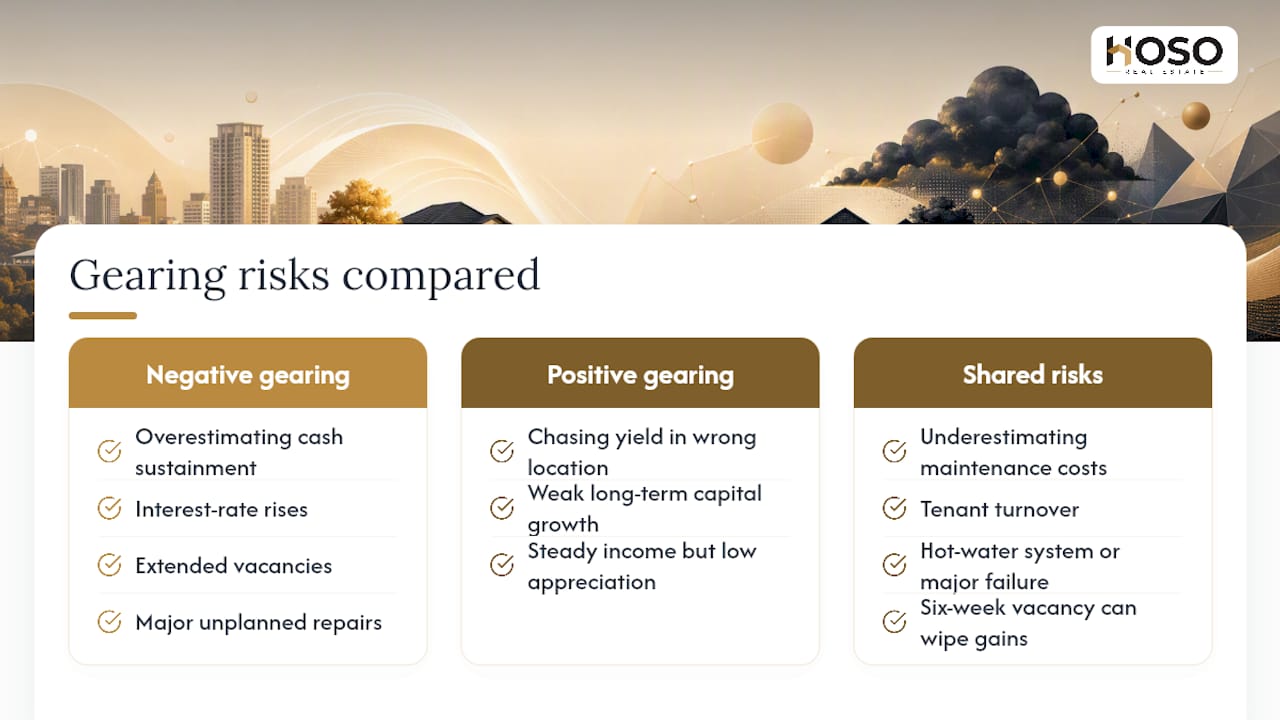
Negative gearing's biggest pitfall is overestimating your ability to sustain the cash shortfall through a bad stretch. Rate rises, extended vacancies, or a major unplanned repair can turn a manageable loss into a genuine financial strain, especially for investors who bought at the top of their borrowing capacity.
Positive gearing carries a different trap: chasing yield in the wrong location. Properties that produce strong rental returns are sometimes in suburbs with weaker long-term growth prospects, and investors can end up with steady income but a portfolio that barely appreciates over a decade.
Both strategies share a pitfall that catches out plenty of Adelaide landlords: underestimating maintenance costs and tenant turnover. A property that looks positively geared on paper can slip into loss the moment a hot water system fails or a tenancy runs vacant for six weeks. Active maintenance planning and careful tenant selection materially reduce this downside, which is precisely where well-maintained property examples show the difference between a smooth-running asset and one that bleeds cash unpredictably.
HOSO's view: what actually protects Adelaide landlords
Gearing strategy is a spreadsheet decision. Cash-flow resilience is an operational one, and that's where most Adelaide landlords underestimate the gap between the two. A negatively geared property in Norwood can perform exactly as modelled for years, then get derailed by a six-week vacancy or a tenant who stops paying rent, not by a change in tax policy.
Professional property management reduces that operational risk directly: tighter tenant screening, faster re-leasing, and proactive maintenance scheduling all narrow the gap between your modelled cash flow and your actual bank balance. Whether you're negatively or positively geared, that gap is what determines whether you can hold through a full market cycle. Compare the maths on self-managing versus professional management before assuming either path saves you more than it costs you in risk.
— HOSO
This article is general information, not a substitute for advice from a qualified financial advisor. Consult a qualified financial professional about your own circumstances before acting on anything here.
Sources
- Tax reform – Boosting home ownership – Reforming negative gearing and capital gains tax | Australian Taxation Office
- Budget 2026–27 tax explainer: negative gearing and capital gains tax (factsheet)
- Negative gearing vs. positive gearing (NAB)
FAQ
Is it better to be positively or negatively geared?
Neither is universally better. Negative gearing suits investors with high marginal tax rates chasing capital growth who can sustain a cash shortfall; positive gearing suits investors prioritising monthly cash flow and portfolio serviceability.
Is Australia the only country with negative gearing?
No, several countries including the United States and New Zealand have allowed similar loss offsetting at various times, though the rules and eligibility differ significantly by jurisdiction.
Will Australia stop negative gearing entirely?
No. From 1 July 2027, the Government will limit negative gearing to new builds rather than abolishing it, and properties held before the announcement are grandfathered under existing rules.
Is negative gearing actually worth it?
It depends on your marginal tax rate, capital growth expectations, and ability to sustain the cash shortfall; the ATO's guidance confirms the deduction is real, but the tax saving rarely covers the full cash cost.