
South Australian law requires at least 60 days' written notice for a rent increase, and rent cannot rise more than once in any 12-month period under the Residential Tenancies Act 1995. Fixed-term leases can only include an increase if the agreement specifically allows it. Tenants who believe an increase is excessive have 90 days from the notice to apply to SACAT.
TL;DR:
- Rent increases in South Australia can only occur once every 12 months, and the notice must be at least 60 days in advance with clear documentation requirements.
- Fixed-term leases cannot be increased mid-contract unless explicitly permitted by the lease, with well-defined calculation methods and specific dates outlined.
- Tenants must apply to SACAT within 90 days if they believe a rent increase is excessive, with SACAT evaluating comparables, property condition, and whether pressure was applied.
- Landlords should maintain detailed records, including recent comparable listings, condition photos, and explicit lease clauses, to defend against dispute applications effectively.
- Breaching SACAT orders by charging above the tribunal-fixed maximum rent can result in legal offenses, and common mistakes include serving notices without proper timing or missing calculation details.
Table of Contents
- How often can rent be increased in South Australia?
- Fixed-term leases: when can rent go up mid-agreement?
- What must a valid rent-increase notice include?
- How do tenants challenge a rent increase at SACAT?
- Landlord checklist: reducing SACAT dispute risk
- What should a tenant do after receiving a rent-increase notice?
- Penalties and common compliance mistakes
- HOSO Real Estate's perspective on rent reviews
- How HOSO Real Estate supports landlords through rent reviews
- Sources
How often can rent be increased in South Australia?
Rent increases may only occur 12 months after the tenancy begins or since the last increase, whichever is more recent. This rule prevents landlords from raising rent multiple times in a year in smaller increments to lessen the impact.
Recent rental reforms from Consumer and Business Services made that kind of staggered approach unambiguously off limits, even where the tenant agrees to it informally. A verbal handshake on a mid-year top-up doesn't override the statutory 12-month gap.
A few situations complicate the timeline:
- Successive fixed-term agreements with the same tenant, signed back to back, are generally treated as one continuous tenancy for the 12-month count.
- Rooming houses and some community housing arrangements sit under different rules and shouldn't be assumed to follow the standard private rental timeline.
- A change of landlord or managing agent doesn't reset the clock. The 12-month period follows the tenancy, not the property manager.
Fixed-term leases: when can rent go up mid-agreement?
Rent cannot be increased during a fixed term unless the lease itself specifically allows it. Silence in the contract means no increase, full stop, no matter how the rental market moves in the meantime.
A clause that survives scrutiny typically includes:
- The exact calculation method (a fixed percentage, a dollar figure, or a named index such as CPI)
- The specific date or dates the increase can take effect
- Any cap on how much or how often the rent can move within the term
Clauses that simply say rent "may be reviewed periodically" invite disputes, because they give SACAT nothing concrete to test the increase against. Vague wording is a genuine liability once a tenant pushes back.
Pro Tip: Write the calculation method into the lease before signing, not into a side letter later. A clause added after the fact carries far less weight if it's ever tested at SACAT.
What must a valid rent-increase notice include?
A notice needs to do more than announce a number. It has to meet the form and timing requirements set out under section 55 of the Act, or it risks being unenforceable.
- State the current rent and the new rent amount in dollar figures.
- Specify the exact date the new rent takes effect, which must be at least 60 days from the date the notice is given.
- Include the tenant's name, the property address, and the landlord's or agent's signature.
- Be delivered in writing, with a record of how and when it was served (post, email, or in person).
- If a lease renewal or extension is offered alongside the increase, keep the two documents separate. Bundling them can blur the notice date and undermine the 60-day requirement.
Consumer and Business Services publishes a standard notice of rent increase form that covers all these fields, and using it removes most of the guesswork.
How do tenants challenge a rent increase at SACAT?
A tenant has 90 days from the date the notice is given to lodge an application under section 56, asking SACAT to declare the increase excessive. Miss that window and the increase generally stands, regardless of how steep it is.
There's no dollar or percentage cap on what a landlord can propose. What SACAT weighs instead is whether the figure is defensible.
- Rents charged for comparable properties in the same or a nearby suburb
- The property's condition, age and any capital improvements
- Whether the increase is disproportionate to those comparables
- Whether the tenant was placed under undue pressure to accept it
SACAT's assessment is holistic. A high asking rent isn't automatically excessive if the comparables and property condition support it, and a modest increase can still be knocked back if it was pushed through with pressure tactics or no supporting evidence at all. Where the tribunal agrees the rent is excessive, it can fix a maximum rent payable for up to 12 months.
Landlord checklist: reducing SACAT dispute risk
Landlords who keep a paper trail rarely lose these applications. The tribunal wants dated, specific evidence, not a general sense that "rents have gone up around here."
- Pull recent comparable listings and settled rents for the same suburb, not just the metro average.
- Photograph the property's condition at each inspection and keep dated records of any upgrades or repairs.
- Use a clear, named calculation method in every notice and lease clause, never a discretionary figure.
- Keep all tenant communication in writing and courteous in tone, even where the conversation gets tense.
If the increase coincides with maintenance works or a tenant needing to relocate belongings temporarily, a short-term option like storage rental through StorageNest can keep a transition tidy without disrupting the tenancy timeline.
Pro Tip: Screenshot or save comparable listings the day you set the new rent, not weeks later. SACAT weighs evidence from around the time the notice was issued, not evidence gathered in hindsight.
What should a tenant do after receiving a rent-increase notice?
- Check the notice gives at least 60 days and confirm it's been at least 12 months since the tenancy began or the last increase. Keep proof of when you received it.
- Ask the landlord or agent for the comparable evidence behind the figure before assuming the worst; many increases are negotiable once a conversation opens.
- If negotiation doesn't land somewhere workable, gather your own comparables, condition notes and correspondence.
- Lodge the SACAT application within the 90-day window, attaching that evidence rather than a bare objection.
Tenants genuinely stretched by an increase have room to move before it reaches a tribunal: a payment plan, a delayed start date, or a shorter-term compromise are all things a reasonable landlord will usually discuss.
Penalties and common compliance mistakes
There's no cap on the size of a rent increase, but breaching a SACAT order carries real consequences. A landlord who charges above a tribunal-fixed maximum rent while an order is in force may commit an offence under section 56(5).
The mistakes that trigger disputes are rarely exotic:
- Attempting a second increase inside the 12-month window
- Increase clauses with no stated method or cap
- Notices missing the effective date or served with no proof of delivery
- Sparse or undated maintenance records when condition becomes relevant
Professional, documented property management closes most of these gaps before they ever reach SACAT.
HOSO Real Estate's perspective on rent reviews
We treat every rent review as evidence-first: comparable data, dated condition photos, and a clause that states its method plainly. Adelaide's presentation standards vary by suburb, from character homes in Unley to newer stock in Mawson Lakes, and a review that ignores that context is a review built to be challenged. Our recently leased properties reflect what disciplined, documented rent reviews look like in practice.
— HOSO
How HOSO Real Estate supports landlords through rent reviews
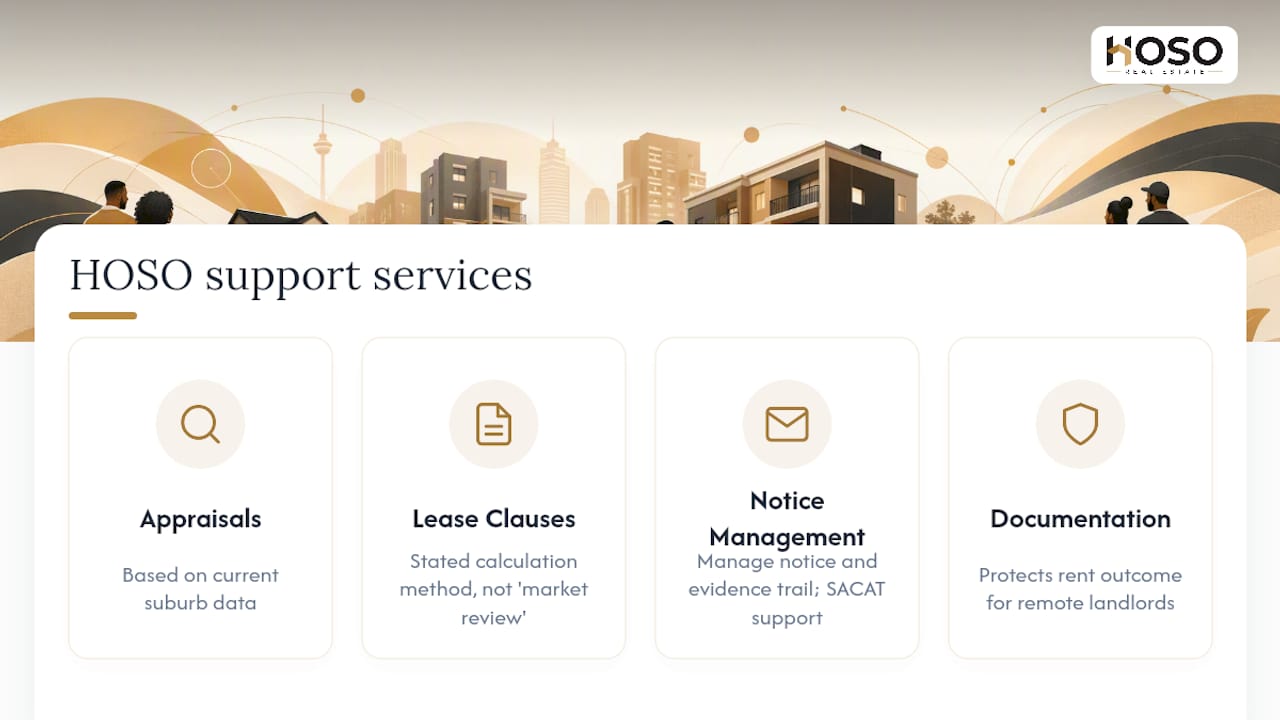
Getting the notice right is only half the job. The harder part is building a rent figure that holds up if a tenant pushes back, and that's where a managing agent earns their place. HOSO Real Estate handles rent appraisals grounded in current suburb data, drafts lease clauses with a stated calculation method rather than vague "market review" language, and manages the notice and evidence trail end to end, including support if a matter reaches SACAT.
For landlords juggling a portfolio from overseas or interstate, that documentation discipline is what protects the rent outcome rather than just the paperwork. Explore what's covered under our property management services and get in touch to talk through your next rent review.