

Pre-tax cash flow equals annual gross rent, minus a vacancy allowance, minus every operating expense, minus your loan repayments. That single formula tells you whether a property puts money in your pocket or pulls it out. For after-tax cash flow, add back the tax benefit of any deductible rental loss, calculated as that loss multiplied by your marginal tax rate, then subtract tax owed on any net rental income.
Before you open a calculator or spreadsheet, gather these minimum inputs:
- Weekly rent, annualised, plus a realistic vacancy allowance of 2 to 4 weeks
- Every operating cost: management, rates, insurance, strata, maintenance
- Full loan details: interest rate, balance, term, and whether it is interest-only or principal and interest
- Depreciation and capital works figures, if you have a quantity surveyor report
Skip any one of these and the number you get back is fiction dressed up as analysis.
Key Takeaways
Accurate investment property cash flow depends on realistic vacancy and maintenance assumptions, exact loan figures, and correctly separating tax deductions from actual cash outflows.
| Point | Details |
|---|---|
| Use the core formula | Pre-tax cash flow equals gross rent minus vacancy allowance, operating expenses, and loan repayments. |
| Budget vacancy realistically | Apply 2 to 4 weeks vacancy and 0.5% to 1% of property value for maintenance rather than optimistic full-year assumptions. |
| Separate deductions from cash | Interest and depreciation reduce tax; only interest and principal actually leave your bank account. |
| Test sensitivity before deciding | Shift interest rates by 0.5% and vacancy by 1 to 2 weeks to see how exposed a property is to market moves. |
| Get local input on assumptions | HOSO Real Estate helps Adelaide landlords stress-test rent, expense, and vacancy assumptions against current local leasing data. |
Table of Contents
- Exact inputs every cash flow calculator needs
- How to use an online investment property calculator
- Worked example: gross rent to net cash flow
- After-tax cash flow, negative gearing, and ATO rules
- Interpreting your results: what the number actually means
- Recommended calculators, ATO tools, and a spreadsheet template
- Frequently asked questions
- Sources
Exact inputs every cash flow calculator needs
A calculator is only as reliable as what you feed it. Miss one line item and your pre-tax cash flow estimate can swing by thousands of dollars a year, which is exactly how landlords end up surprised six months into ownership.
Start with income: weekly rent, annualised, using achievable market rent rather than an optimistic advertised figure. Then work through the expense side systematically:
- Property management fees
- Council rates and water charges
- Landlord insurance
- Strata or body corporate levies (if applicable)
- Maintenance allowance, typically 0.5% to 1% of property value per year
- Land tax, where it applies to your holding
- Legal and advertising costs for tenant placement
- Loan interest and, on principal and interest loans, the principal component
- Borrowing costs and depreciation or capital works deductions
If the property was rented for only part of the year, or you used it privately at times, expenses need to be apportioned by days rented and by your ownership percentage for co-owned properties.
Pro Tip: Keep every invoice, tenancy ledger, and piece of correspondence with your property manager for the financial year. If the ATO ever queries an apportionment, a clean paper trail settles the matter in minutes rather than months.

How to use an online investment property calculator
Most calculators, and any spreadsheet you build yourself, follow the same logical sequence. Get the order wrong and the output looks plausible but means nothing.
- Enter gross annual rent. Use weekly rent multiplied by 52, not an assumption of full-year occupancy.
- Apply a vacancy allowance. Subtract 2 to 4 weeks of rent to reflect realistic turnover between tenancies.
- Subtract operating expenses. This gives you net rental income before loan costs, which is a genuinely useful figure on its own for comparing properties.
- Enter loan details. Interest rate, outstanding balance, loan term, and whether repayments are interest-only or principal and interest.
- Subtract loan repayments. What remains is your pre-tax cash flow, the number that determines whether the property is self-funding.
Use the exact repayment figure from your most recent loan statement wherever possible, not a rough estimate. Interest-only and principal and interest loans produce materially different cash flow outcomes even at the same interest rate, because principal repayments are a real cash outflow that is not tax-deductible. Once you have pre-tax cash flow, layer in depreciation and capital works to work out your taxable position for the after-tax figure.
Worked example: gross rent to net cash flow
Numbers make this concrete. Take a hypothetical Adelaide investment property renting for $520 a week, purchased with an $85,000 deposit against a $450,000 principal and interest loan at a variable rate.
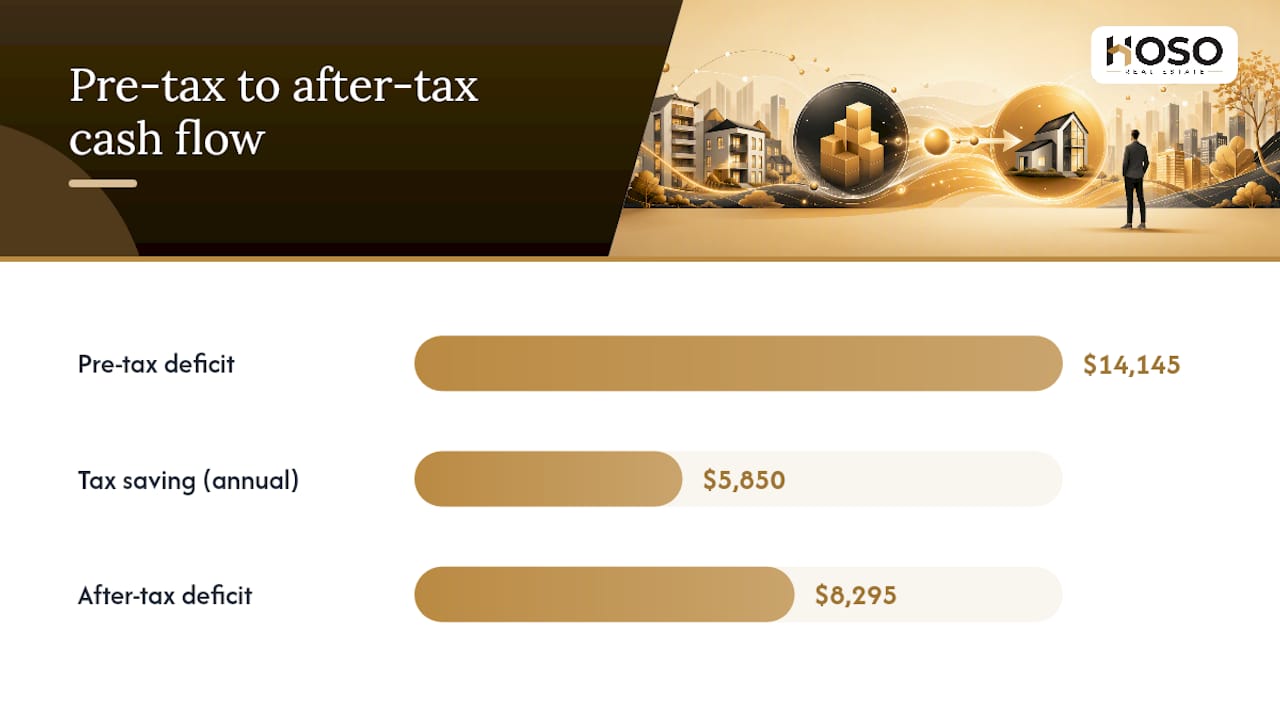
That property runs a pre-tax cash flow deficit of $14,145 a year. Now the after-tax adjustment. Only interest, depreciation, and capital works count as deductible against taxable income, not the principal repayment. Say the net rental loss for tax purposes (interest plus depreciation, minus rental income) comes to $18,000, and the investor sits on a 32.5% marginal tax rate. The tax saving equals $18,000 multiplied by 32.5%, or $5,850. Add that to the pre-tax figure and after-tax cash flow lands at roughly negative $8,295 for the year, still a real outflow, just a smaller one.
Build your own version using the ATO's own rental income and loss worksheet, which includes a full itemised example and a blank template ready to copy into a spreadsheet.
After-tax cash flow, negative gearing, and ATO rules
A tax deduction is a partial refund on a loss, not a reward for good investing. That distinction gets lost constantly, and it leads people to chase deductions instead of properties that actually perform.
Deductible items and cash outflows are not the same thing. Interest, depreciation, and capital works reduce your taxable income without necessarily leaving your bank account (depreciation is a paper deduction). Principal repayments and many repairs leave your account but do not reduce tax. Confuse the two and your after-tax cash flow estimate will be wrong in one direction or the other.
Negative gearing works through one calculation: net rental loss multiplied by your marginal tax rate gives your annual tax saving, which you add back to pre-tax cash flow to reach the after-tax figure. Australian marginal rates for individuals currently span roughly 19% to 45% depending on income, so the same rental loss produces a very different saving for a landlord on a lower income compared to one at the top bracket.
The ATO's depreciation and capital allowances tool helps investors work out legitimate capital claims, and the rental expenses guidance sets out what is immediately deductible versus claimed over several years.
Pro Tip: If you rent the property intermittently, such as a holiday home, keep advertising records and booking communications on file. The ATO wants evidence the property was genuinely held to produce income, not just occasionally offered for rent.
Interpreting your results: what the number actually means
Cash flow and yield are not the same measurement, and mixing them up is the single most common error in property investment analysis. Gross yield is a ratio; cash flow is the actual dollars left in your account once every real cost is accounted for. A property advertised at a 5% yield can still run a cash flow deficit once vacancy, maintenance, and loan repayments are factored in.
Frequent mistakes worth checking for in your own modelling:
- Ignoring vacancy entirely and assuming 52 weeks of paid rent every year
- Under-budgeting maintenance, especially on older housing stock
- Using advertised asking rent rather than achievable market rent for the suburb
- Forgetting the principal component on a principal and interest loan
- Applying an optimistic depreciation figure without a proper quantity surveyor report
Interest rate movement and deposit size are the two biggest swing factors in any cash flow model. Run a quick sensitivity check: shift your interest rate by plus or minus 0.5% and your vacancy allowance by 1 to 2 weeks, then see how far the result moves either way.
Recommended calculators, ATO tools, and a spreadsheet template
The right tool depends on what question you're actually asking. A quick pre-tax check needs less horsepower than full scenario modelling across loan types and rate movements.
- Simple cash flow calculators work well for a fast pre-tax gut check on a property you're considering, especially when comparing two or three listings side by side.
- Full scenario calculators that let you toggle interest-only versus principal and interest, and model rate rises, matter most once you're serious about a specific property, since loan structure and rate movement are the largest drivers of annual cash flow.
- ATO's rental income and loss worksheet remains the authoritative reference for the after-tax figure, with a genuine worked example and blank template built in.
- Look for tools that export results, support depreciation and capital works inputs, and align with ATO apportionment rules rather than generic overseas tax assumptions.
For a ready-made structure, replicate the row layout from the worked example above (gross rent, vacancy, itemised expenses, loan interest, loan principal, pre-tax cash flow, tax adjustment) directly into Excel or Google Sheets.
How a property manager reads these numbers
At HOSO Real Estate, cash flow modelling informs how we set rent, plan maintenance schedules, and advise Adelaide landlords on loan structuring conversations with their broker. The number matters less than what it protects: tenant quality, compliance, and the long-term condition of the asset itself.
A personalised cash flow review for your Adelaide property
Spreadsheets get you close, but every Adelaide suburb behaves differently, and achievable rent, realistic vacancy periods, and maintenance patterns vary block by block. HOSO Real Estate works through cash flow modelling with landlords directly, drawing on current leasing data, depreciation referrals, and portfolio reporting rather than generic assumptions pulled from a national average. Where a calculator gives you a formula, our landlord advisory service gives you the local context to stress-test it against, including realistic rent-setting informed by our current leasing activity across Adelaide. If you want a second set of eyes on a property you're modelling, or a full review of an existing portfolio's cash flow position, get in touch through our services page to arrange a personalised review.
Frequently asked questions
What's the difference between cash flow and cash-on-cash return?
Cash flow is the raw dollar amount left over each year after all expenses and loan repayments. Cash-on-cash return expresses that same figure as a percentage of the cash you actually invested (your deposit plus purchase costs), which makes it easier to compare properties with different deposit sizes.
Should I use gross rent or net rent when calculating cash flow?
Always start with gross rent, then work down through vacancy allowance and every expense line individually. Skipping straight to a "net rent" figure hides which specific cost is dragging your cash flow down.
How often should I recalculate cash flow on an existing property?
Review it whenever your loan rate changes, at each lease renewal, or annually alongside your tax return, since rent, rates, and interest rates rarely stay static for long.
Does depreciation actually improve my cash flow?
Depreciation reduces your taxable income, which can increase your after-tax cash flow through a smaller tax bill or larger refund. It has no direct effect on your bank balance day to day, since it isn't a cash expense.
This article is general information, not a substitute for advice from a qualified financial advisor. Consult a qualified financial professional about your own circumstances before acting on anything here.
Sources
- How to claim rental expenses (ATO)