
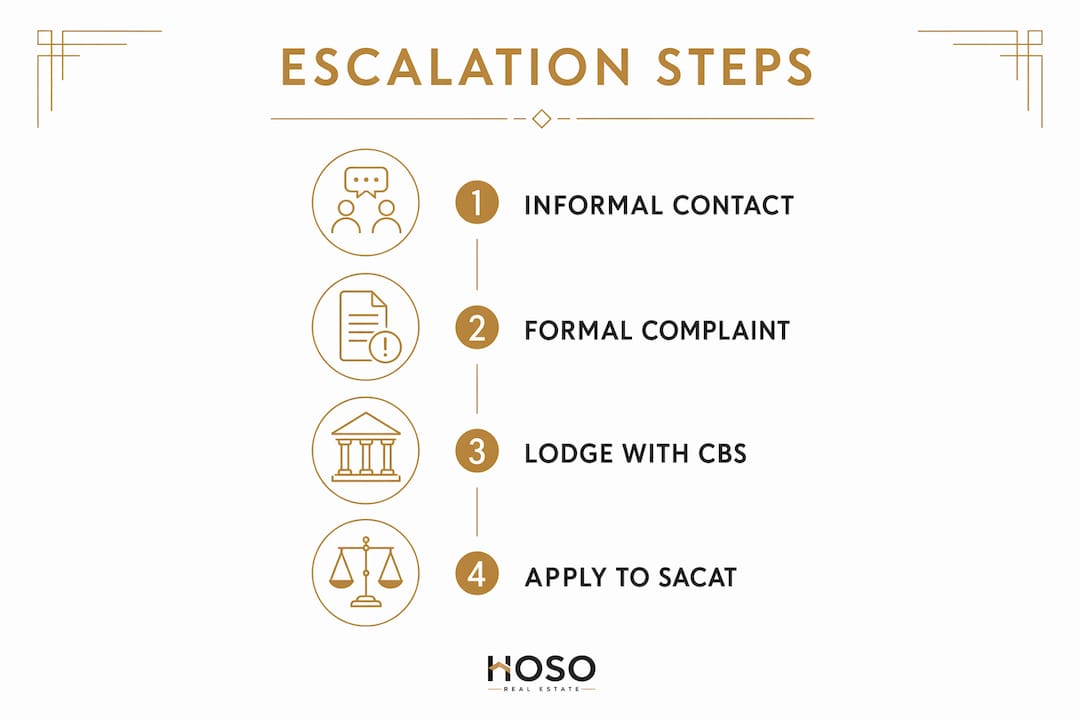
Start a dated, written complaint to the agent today. If the issue is not resolved within a reasonable period, lodge a formal complaint with Consumer and Business Services (CBS) in South Australia. For legal breaches, bond disputes, or urgent orders, apply directly to SACAT.
That is the core pathway. Everything below gives you the evidence, wording, and procedural steps to make it work.
Act now — preserve your position:
- Stop relying on phone calls. Follow every verbal exchange with a short email titled "Further to our conversation on [date]..." to create a written record.
- Back up all SMS messages, emails, and portal messages to a secure location today.
- Photograph or video the issue with your device's timestamp visible.
- Locate your tenancy agreement, bond lodgement receipt, and any inspection reports.
- Note the agent's full name, agency name, and licence number (searchable via the CBS licence register).
- If the matter involves safety risk, unlawful entry, withheld bond, or threats, contact CBS or apply to SACAT without waiting for informal resolution.
The SA Government guidance recommends keeping written records and copies of all receipts and correspondence before contacting CBS. That advice applies from day one, not after things have deteriorated.
Table of Contents
- What evidence do you need before you escalate?
- How do you escalate a property management complaint step by step?
- How do you write and lodge a formal complaint?
- Which regulator handles your complaint in each state?
- When should you take the dispute to SACAT?
- HOSO Real Estate's practical checklist for SA landlords
- Key takeaways
- Why formal escalation protects everyone involved
- HOSO Real Estate handles complaint escalation and SACAT preparation
- Useful sources and official forms
What evidence do you need before you escalate?
A complaint without evidence is an opinion. A complaint with a dated, organised evidence bundle is a case. Gather the following before you contact any regulator or tribunal.
Essential documents
| Document type | What to keep | Format |
|---|---|---|
| Tenancy agreement | Signed copy, all pages including special conditions | PDF or original |
| Bond lodgement receipt | CBS receipt number and amount | PDF or screenshot |
| Notices | All Form 1s, breach notices, entry notices, rent increase notices | PDF with date received |
| Inspection reports | Ingoing, routine, and outgoing condition reports | PDF with photos |
| Payment records | Rent receipts, invoices, repair quotes, receipts | PDF or bank statement |
| Correspondence | All emails, SMS, portal messages | Screenshots with timestamps |
| Photos and videos | Property condition, damage, maintenance issues | Dated files from device |
| Witness details | Name, contact, and a brief written statement | Written note or signed statement |
Build an evidence timeline
A simple timeline is the single most effective pre-tribunal step you can take. Use this structure and expand it as events occur:
| Date | Parties involved | Contact method | Summary | Attached evidence |
|---|---|---|---|---|
| 3 March 2026 | Tenant, Property Manager | Reported burst pipe in laundry, no response | Email screenshot | |
| 10 March 2026 | Tenant, Property Manager | Phone call | Followed up verbally, promised repair within 48 hours | Follow-up email sent same day |
| 14 March 2026 | Tenant | Photo | Pipe still unrepaired, water damage visible | Timestamped photos |
Keep this timeline in a single document. Add to it every time something happens.
Pro Tip: After any phone call with your agent or property manager, send a short email within the hour: "Further to our conversation on [date], I understand you agreed to [action] by [date]. Please confirm." This converts a verbal exchange into a written record that CBS and SACAT can rely on.
Common evidence pitfalls
- Unsynchronised timestamps. If your phone clock is wrong, photo metadata becomes unreliable. Check device time before photographing.
- Poor photo quality. Blurry or dark images do not demonstrate damage clearly. Use natural light and photograph from multiple angles.
- Missing names. "The person at the office said..." carries no weight. Always confirm who you spoke to and record their full name.
- Gaps in the timeline. A two-week silence in your records looks like inaction. Document every attempt, even unanswered ones.
How do you escalate a property management complaint step by step?
The escalation pathway moves through four stages. Each stage has a clear trigger for moving to the next.
Step 1: Informal contact with the agent (allow 5–7 business days)
Contact the property manager directly in writing. State the issue, reference the relevant clause of your tenancy agreement, and request a specific remedy by a specific date. Keep the tone factual. If the property manager does not respond or the response is unsatisfactory, move to Step 2.

Breach examples at this stage: delayed maintenance response, failure to acknowledge a repair request, unclear communication about inspections.
Step 2: Formal complaint to the agency principal (allow 10–14 business days)
If the property manager does not resolve the matter, escalate to the supervising agent or agency principal in writing. Address the letter to the principal licensee by name. Include:
- A clear chronology of events with dates.
- The specific obligation breached (reference the tenancy agreement clause or relevant Act section).
- Your requested remedy and the date by which you expect a response.
- A list of attached evidence.
State that if the matter is not resolved, you will lodge a complaint with CBS. That is not a threat; it is the next procedural step.
Breach examples at this stage: repeated failure to arrange urgent repairs, incorrect bond handling, unlawful entry without proper notice.
Step 3: Lodge a complaint with CBS or the relevant state regulator
CBS handles complaints about registered agents and trust account compliance in South Australia. CBS can offer conciliation and investigate administrative breaches. It cannot compel a trader to provide a remedy, but it can facilitate agreements and refer serious matters for further action. Conciliation through CBS is generally the required step before tribunal action on many disputes.
Breach examples at this stage: trust account errors, incorrect bond lodgement, failure to hold a valid licence, repeated statutory breaches.
| Escalation trigger | Action |
|---|---|
| Safety risk (no hot water, structural hazard) | Skip to SACAT urgent application |
| Withheld bond after tenancy ends | CBS bond reconciliation process first, then SACAT |
| Trust account irregularity | CBS complaint immediately |
| Unlawful entry (no notice served) | CBS complaint and consider SACAT |
| Repeated failure to repair | CBS conciliation, then SACAT if unresolved |
Step 4: Apply to SACAT
SACAT is a legal forum. Successful applicants link the agent's conduct to a specific breach of legislation, not general dissatisfaction. Applications can be lodged online, by post, or in person. SACAT aims to hear matters within 2 weeks and no later than 6 weeks after lodgement.
SACAT can order repairs, bond payment, compensation, termination of the tenancy agreement, and other binding remedies under sections 110 and 111 of the Residential Tenancies Act 1995 (SA). Monetary claims must not exceed $40,000 unless both parties consent in writing to SACAT's jurisdiction.
Note for interstate landlords: If one party is resident interstate, the matter cannot be heard by SACAT and must be heard by the Magistrates Court of South Australia. Apply to SACAT in the usual way; SACAT will determine whether to transfer the matter.
How do you write and lodge a formal complaint?
A formal complaint that regulators take seriously is short, factual, and structured. Emotion-driven language and hypothetical statements weaken your position. Neutral, specific language focused on breaches and outcomes is what moves a complaint forward.
Required fields for every formal complaint:
- Full legal names of all parties (tenant, landlord, agent, agency)
- Property address and tenancy agreement reference or commencement date
- Clear chronology: date, what happened, what was said or agreed, what was not done
- The specific obligation breached (clause number or Act section)
- Your requested remedy (repair by a date, bond refund, compensation amount)
- List of attached evidence with file names
Sample complaint opening (adapt for your situation):
Language to avoid:
- "You have been completely useless and negligent." (accusatory, not factual)
- "This might be a breach of the Act." (hypothetical; state the breach directly)
- "I feel like my rights are being ignored." (subjective; state the right and the breach)
Pro Tip: When submitting evidence to CBS or SACAT, use PDF format where possible. Label each file clearly: "01_Tenancy_Agreement.pdf", "02_Repair_Request_Email_3March2026.pdf". Regulators process high volumes of documents; clear file names reduce delays.
The SA Government provides a sample complaint letter to real estate agencies that you can use as a starting point. Use it, adapt the language to your facts, and attach your evidence timeline.
Which regulator handles your complaint in each state?
South Australia is the primary focus here, but the correct body differs by state. The table below covers the main regulators and what each can do.
| State | Regulator / Body | Scope | Tribunal |
|---|---|---|---|
| South Australia | Consumer and Business Services (CBS) | Agent licensing, trust accounts, conciliation, administrative breaches | SACAT |
| Victoria | Consumer Affairs Victoria | Tenancy advice, bond disputes, agent conduct | VCAT / RDRV |
| Western Australia | Consumer Protection WA | Agent licensing, tenancy complaints, bond disputes | SAT (State Administrative Tribunal) |
| Queensland | Residential Tenancies Authority | Bond, tenancy disputes, agent conduct | QCAT |
| New South Wales | NSW Fair Trading | Agent licensing, tenancy complaints, bond disputes | NSW Civil and Administrative Tribunal (NCAT) |
| Tasmania | Consumer, Building and Occupational Services | Agent licensing, tenancy complaints | Magistrates Court |
| ACT | Access Canberra | Agent licensing, tenancy complaints | ACAT |
| Northern Territory | Consumer Affairs NT | Agent licensing, tenancy complaints | Work Health Court / Local Court |
| South Australia (tenancy advice) | Tenants Victoria equivalent in SA: Shelter SA | Advice and advocacy for tenants | N/A (referral body) |
For South Australian readers specifically:
- CBS handles complaints about agent conduct, licensing breaches, and trust account irregularities. CBS can conciliate but cannot issue binding orders.
- SACAT issues binding orders on tenancy disputes, bond claims, repairs, compensation, and termination.
- Bond disputes follow a defined CBS bond reconciliation process first. The CBS bond settlement process allows parties to counter-offer up to seven times before the matter is referred to SACAT. Once SACAT makes an order, CBS releases the bond accordingly.
Consumer Affairs Victoria also refers complex matters to the Victorian Civil and Administrative Tribunal (VCAT) or the Residential Disputes Resolution Victoria (RDRV) for conciliation. Consumer Protection WA handles agent licensing and tenancy complaints for Western Australian landlords and tenants.
When should you take the dispute to SACAT?
SACAT is appropriate when a legal breach has occurred, CBS conciliation has not resolved the matter, or you need a binding order quickly. General dissatisfaction with service quality is not, on its own, a SACAT matter. The conduct must be linked to a specific provision of the Residential Tenancies Act 1995 (SA) or another relevant Act.
Clear markers for tribunal action:
- The agent has entered the property without serving a valid notice for inspection (breach of the Residential Tenancies Act 1995 SA).
- Urgent repairs have not been arranged within a reasonable time after written request.
- The bond has not been lodged with CBS or is being withheld without valid grounds.
- CBS conciliation has concluded without resolution.
- A trust account irregularity has been identified and CBS has not resolved it.
- You need an urgent order (restraining order, urgent repair order) that cannot wait for conciliation.
Preparing your evidence bundle for SACAT
SACAT requires applicants to lodge key documents with their application and to serve copies on the other party. Prepare the following:
- Completed SACAT application form (available online via the SACAT website).
- Copy of the tenancy agreement (all pages).
- All relevant notices (entry notices, breach notices, termination notices).
- Dated photographs and videos.
- Repair requests and any quotes or invoices.
- Your evidence timeline (the table you built earlier).
- Witness statements (name, contact, brief factual account).
- Any CBS correspondence or conciliation outcome.
Serve a copy of all documents on the other party before the hearing. SACAT may request both redacted and full copies of certain documents; follow any specific directions issued after lodgement.
Hearing day checklist
- Bring three copies of every document: one for yourself, one for the other party, one for the tribunal.
- Arrange an interpreter in advance if needed; notify SACAT at lodgement.
- Arrive early. SACAT hearings are conducted at the SACAT premises; confirm the address and room when your hearing date is confirmed.
- Present evidence in chronological order. Start with the tenancy agreement, then walk through your timeline.
- Keep statements factual. SACAT does not follow strict rules of evidence but responds to documented facts, not emotional accounts.
What can SACAT order?
Under sections 110 and 111 of the Residential Tenancies Act 1995 (SA), SACAT can order that all or part of the security bond be paid to the applicant; that the other party perform or refrain from a specific act; that the tenancy agreement be terminated; that possession of the premises be granted; and that compensation be paid for breach or for losses caused by abandonment. SACAT can also declare rent excessive, order eviction, and make restraining orders where there is a risk of serious property damage or personal injury.
Applications are heard within 2 weeks where possible and no later than 6 weeks after lodgement.
Representation at SACAT
SACAT generally will not allow legal representation unless all parties agree. If a land agent appears for the landlord, the tenant may then be represented by a lawyer. Parties generally bear their own costs, though SACAT can make a costs order where appropriate. If you are uncertain whether legal advice is worth seeking before your hearing, the answer is usually yes: a one-hour consultation with a tenancy lawyer before lodgement can clarify your grounds and strengthen your application.
HOSO Real Estate's practical checklist for SA landlords
Landlords managing high-value Adelaide properties need a structured internal process before any regulator is involved. The steps below reflect HOSO Real Estate's approach to property manager accountability and asset protection.
Sample complaint subject line and opening paragraph (SA landlords)
Subject: Formal complaint — [Property Address] — [Issue: e.g. Trust account discrepancy / Failure to arrange urgent repairs]
"I write to formally record a complaint regarding the management of [Property Address], managed by [Agency Name] under management agreement dated [date]. Specifically, [Agency Name] has [describe breach] in contravention of [clause X of the management agreement / section Y of the Land Agents Act 1994 (SA) / section Z of the Residential Tenancies Act 1995 (SA)]. I request [specific remedy] by [date] and attach supporting documentation. If this matter is not resolved, I will lodge a formal complaint with Consumer and Business Services."
Landlord audit checklist: is your property manager meeting statutory obligations?
Run this check quarterly or whenever a concern arises:
- Trust account: Has your agent provided a monthly trust account statement? Are all rental payments accounted for and disbursed on time?
- Bond lodgement: Was the tenant's bond lodged with CBS within the required timeframe? Do you have the CBS receipt number?
- Inspection records: Are routine inspection reports being provided at the correct intervals with dated photos?
- Repair management: Are urgent repairs being actioned within 24–48 hours? Are non-urgent repairs being completed within a reasonable period with written quotes on file?
- Notice compliance: Are all entry notices being served correctly (correct form, correct notice period)?
- Licence currency: Is your property manager currently registered with CBS? Check the CBS licence register directly.
- Communication records: Is all significant communication being confirmed in writing?
Pro Tip: Run a property manager licence check on your agent annually. An unlicensed or suspended agent managing your property creates significant legal and financial exposure for you as the owner.
HOSO's recommended internal escalation sequence
For a high-value property in suburbs such as Unley, Burnside, or Norwood, the cost of a poorly managed complaint can extend well beyond the immediate dispute. HOSO Real Estate recommends this sequence before any regulator is contacted:
- Document the issue in writing to the property manager on the day it is identified.
- Set a clear resolution deadline (48 hours for urgent matters, 7 days for non-urgent).
- If unresolved, escalate in writing to the agency principal with a copy of all prior correspondence.
- If still unresolved after 10 business days, lodge with CBS and prepare the SACAT application in parallel.
- For urgent safety matters (no heating in winter, structural hazard, unlawful entry), contact CBS and apply to SACAT on the same day.
Understanding how to delegate landlord responsibilities effectively means knowing when to step in directly and when to let the formal process run. That clarity protects both the asset and the tenant relationship.
Key takeaways
The most effective way to escalate a property management complaint in South Australia is to move from verbal contact to written complaint to CBS, and then to SACAT if a legal breach remains unresolved.
| Point | Details |
|---|---|
| Start in writing immediately | Send a dated written complaint to the agent; follow every phone call with a confirming email. |
| Build an evidence timeline | Record every contact, document, and photo in a dated table before contacting any regulator. |
| CBS first, SACAT for legal breaches | CBS handles conciliation and licensing; SACAT issues binding orders for statutory breaches. |
| Bond disputes follow their own path | Run bond claims through the CBS reconciliation process before applying to SACAT. |
| HOSO Real Estate | Provides SA landlords with compliance audits, complaint documentation support, and SACAT preparation for Adelaide properties. |
Why formal escalation protects everyone involved
The instinct to avoid formal complaints is understandable. Most landlords and tenants would rather resolve things quietly. The problem is that informal-only communication leaves no record, and without a record, there is no case.
From a property management perspective, a well-documented complaint is actually easier to resolve than a vague one. When a landlord or tenant presents a clear chronology, specific breach references, and a defined remedy, the path to resolution is straightforward. The complaint that arrives as a frustrated phone call with no documentation is the one that drags on for months.
For landlords, the stakes are higher than the immediate dispute. An unresolved maintenance issue in a property in Glenelg or Prospect can escalate into a compensation claim, a SACAT order, or reputational damage that affects tenancy quality. The role of property management in protecting asset value depends entirely on compliance being maintained and disputes being resolved quickly. A formal, evidence-first escalation process is what makes that possible.
HOSO Real Estate's position is straightforward: compliance is not optional, and neither is documentation. Landlords who treat their property as a managed asset rather than a passive income stream are the ones who avoid tribunal proceedings altogether, because their managers are held to account before problems compound.
HOSO Real Estate handles complaint escalation and SACAT preparation
Landlords in Adelaide who need structured support for a complaint, a CBS conciliation, or a SACAT application can work directly with HOSO Real Estate. The focus is on compliance, documentation, and protecting the asset through every stage of the process, from the first written complaint to hearing day preparation.
HOSO Real Estate's property management services include complaint handling, routine inspection management, maintenance coordination, and landlord advisory for South Australian property owners. For owners managing properties in suburbs such as Norwood, Unley, or Burnside, or for interstate investors with Adelaide holdings, HOSO provides the structured oversight that prevents disputes from reaching tribunal in the first place.
To discuss your situation or request a compliance audit of your current management arrangement, contact HOSO Real Estate directly via hoso.com.au.
Useful sources and official forms
The following official sources cover the key steps in the SA complaint and tribunal process. Each link goes directly to the relevant page.
| Source | What it covers |
|---|---|
| CBS — Solving a problem with a real estate agency | SA Government guidance including a sample complaint letter and advice on record-keeping before contacting CBS |
| Consumer and Business Services (CBS) | Agent licensing, trust account compliance, conciliation services, and complaint lodgement for SA |
| SACAT — Providing documents for housing disputes | Official checklist of documents required for SACAT housing applications and serving rules |
| SACAT — End-of-tenancy disputes | Bond claim pathways and end-of-tenancy dispute process, including when matters are referred to SACAT |
| SACAT — Disciplinary action (land agents) | Guidance on disciplinary proceedings against land agents and the standard of evidence required |
| SACAT — Parties' rights disputes | Types of disputes SACAT hears, including breach applications by landlords and tenants |
| CBS — Settling a bond dispute | Step-by-step CBS bond reconciliation process, counter-offer rules, and escalation to SACAT |
| Law Handbook SA — Resolving tenancy disputes | Plain-language explanation of SACAT jurisdiction, orders available, representation rules, and costs |
Using official templates: CBS and SACAT both provide forms on their websites. Use the SACAT online application portal for housing disputes. For bond claims, use the Rental Bond Online (RBO) system administered by CBS. Official forms reduce procedural errors and processing delays.
This article provides general information about complaint escalation processes in South Australia. It is not legal advice. For your specific situation, confirm current rules with CBS, SACAT, or a qualified legal practitioner.