

You can delegate the day-to-day management of your rental property to an agent, but you cannot delegate your legal liability. That is the core principle every South Australian landlord needs to understand before signing a management agreement. The landmark decision in Atkins v Hughes [2025] SADC 51 confirmed it plainly: courts will hold you accountable for negligent acts committed by your agent during the course of their agency, even when those acts occurred without your direct knowledge.
Effective delegation means transferring operational duties through a formal, detailed agency agreement while maintaining active oversight of your agent's performance. It is not a "set and forget" arrangement.
Key principles at a glance:
- Landlords retain legal liability for all obligations under the Residential Tenancies Act 1995 (SA) regardless of delegation
- Delegation discharges the practical performance of duties, not the underlying legal responsibility
- Non-delegable obligations include maintaining premises condition, meeting housing standards, and protecting tenant privacy
- Formal, written agency agreements must define delegated tasks precisely
- Regular monitoring and verification of your agent's actions is required to maintain compliance
- Atkins v Hughes confirms courts uphold landlord accountability despite delegation
What landlord obligations in South Australia cannot be delegated?
Certain duties under South Australian law attach to you as landlord, regardless of who manages the property day to day. These are not administrative tasks you can hand off. They are legal obligations that follow ownership.
Under the Residential Tenancies Act 1995 (SA), you must:
- Maintain the premises in a reasonable state of cleanliness (s 67) and repair (s 68)
- Comply with minimum housing standards under the Housing Improvement Act 2016 (SA) at the start of each tenancy (s 67A)
- Protect the tenant's right to reasonable peace, comfort, and privacy (s 65)
- Provide vacant possession on the day the tenancy begins (s 64)
- Provide and maintain locks and security devices adequate to keep the premises reasonably secure (s 66)
- Notify tenants of any change of address within 14 days (s 48)
- Keep proper records of rent and other payments, and provide receipts on request (ss 57, 58)
- Retain a copy of the tenancy agreement for at least two years after termination (s 49)
- Pay all statutory rates unless separately metered water charges apply (s 73)
- Provide written notice of any intention to sell, no less than 14 days after entering a sales agency agreement (s 71A)
Your agent can carry out these duties on your behalf, but if they fail to do so, the legal exposure remains yours.
What can a property manager actually do on your behalf?
A property manager acts as your agent, creating a formal principal-and-agent relationship. Within that relationship, the scope of what they can do is defined entirely by your written management agreement.
Property management agreements typically cover:
- Rent collection and arrears management
- Routine and entry inspections, with written reports
- Coordinating maintenance and repairs with tradespeople
- Tenant liaison and communication
- Compliance reporting and record-keeping
- Issuing breach notices on your behalf
The legal limit is clear. In Yeung v Santosa Realty Co Pty Ltd [2020] VSCA 7, a landlord's duty of care was discharged to the managing agent where the agent identified an obvious defect during inspection. But the landlord remained the principal. Where the agent failed to act on a known defect, liability flowed back to the landlord. The agent's competence and the quality of your agreement are what determine your exposure.
Pro Tip: Before signing any management agreement, confirm that it specifies inspection frequency, defect reporting obligations, and the agent's duty to escalate unresolved maintenance issues to you in writing.
How do you delegate effectively and keep oversight?
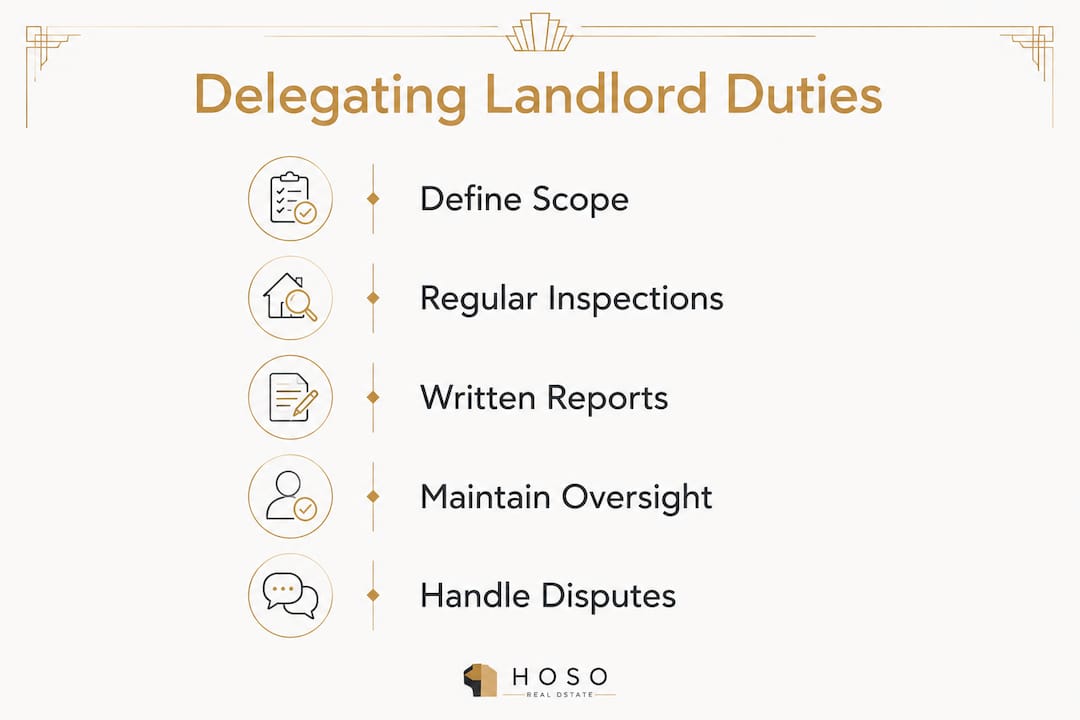
Effective delegation is active, not passive. The practical strategies that reduce your risk come down to three things: a detailed agreement, a regular reporting schedule, and the right tools.

Written agreements with defined scope. Vague agreements weaken your ability to seek indemnity from an agent who breaches their duties. A well-drafted agreement names every delegated task, sets reporting timelines, and specifies what the agent must escalate to you directly. Retaining control over major decisions, such as approving repairs above a set dollar threshold, keeps you informed without requiring you to manage daily operations.
Regular reporting and inspection schedules. Request written inspection reports after every routine inspection, and review them. Property management software platforms give landlords real-time access to inspection records, maintenance requests, rent ledgers, and communication logs. That visibility is your primary defence if a dispute arises.
Insurance as a backstop. Property managers are generally not specialists in latent defects. Both landlords and tenants are occupiers under the Civil Liability Act 1936 (SA) s 19, and public liability insurance is a necessary safety net for hazards that fall outside the scope of your management agreement. Landlord insurance covering loss of rent, malicious damage, and public liability should sit alongside, not replace, your delegation arrangements.
The lesson from Atkins v Hughes is direct: inadequate inspection by an agent still produced landlord liability. Active oversight, not just a signed agreement, is what courts look for.
How do you handle disputes and stay compliant when you have delegated?
Delegation does not remove you from the dispute process. The South Australian Civil and Administrative Tribunal (SACAT) requires landlords to participate in breach and dispute proceedings regardless of who manages the property.
Before any SACAT application, the relevant breach notice must be served. Landlords issue a Form 2 (Notice to Tenant to Remedy Breach) and tenants issue a Form 4 (Notice to Landlord to Remedy Breach). Your agent can serve and receive these notices on your behalf, but you remain responsible for ensuring the breach is actually remedied within the permitted timeframe.
Compliance best practices when delegating:
- Confirm your agent serves and responds to breach notices within statutory timeframes
- Review rent ledgers monthly to catch arrears before they escalate
- Verify that routine inspection reports document property condition in writing
- Maintain your own copy of all tenancy documents, not just the agent's file
- Confirm that any maintenance reported by the tenant is actioned and closed out
Common questions landlords ask:
Can my agent represent me at SACAT? Yes, a licensed agent can appear on your behalf at SACAT hearings in most circumstances, but you retain accountability for the outcome.
What if my agent fails to serve a breach notice on time? The delay is treated as your failure, not the agent's. You may have a claim against the agent for losses that result, but the tenant's rights are unaffected.
How HOSO Real Estate supports landlords with property management in Adelaide
HOSO Real Estate operates as a boutique property management agency in Adelaide, with a focus on South Australian residential tenancy law and compliance. For landlords who want to delegate with confidence, the quality of the agency relationship matters as much as the agreement itself.
HOSO Real Estate's services include:
- Routine and entry inspections with detailed written reports
- Maintenance coordination and defect escalation
- Compliance management aligned with the Residential Tenancies Act 1995 (SA)
- Tenant leasing and screening
- Landlord advisory on obligations, risk, and portfolio performance
- Regular landlord updates and transparent financial reporting
The agency's approach is built around clear agreements, defined responsibilities, and consistent communication. Landlords retain visibility over their asset without managing daily operations themselves. That combination of professional property management and active reporting is what reduces the risk that Atkins v Hughes highlights.
What you need to know about management agreement duration and termination
Property management agreements in South Australia are typically structured as ongoing arrangements with a defined notice period for termination, rather than fixed-term contracts. The specific terms vary by agreement, but most include a minimum notice period for either party to end the arrangement, commonly 30 to 90 days, and conditions under which the agreement can be terminated immediately for cause.
Key points to confirm before signing:
- The notice period required to end the agreement without cause
- Whether a fixed initial term applies and what early termination conditions exist
- Conditions that allow immediate termination, such as agent misconduct or material breach
- What happens to outstanding maintenance requests, bond lodgements, and tenant communications during the transition period
Changing agents mid-tenancy is possible but requires careful coordination. Tenants must be notified of the new managing agent's details, and all records, including the tenancy agreement, inspection reports, and rent ledger, must transfer to the incoming manager. A licence check on any incoming agent is a basic due diligence step before executing a new agreement.
HOSO Real Estate: premium property management for Adelaide landlords
Adelaide landlords who want to delegate without losing control of their asset have a direct option in HOSO Real Estate. The agency combines detailed management agreements, regular written reporting, and compliance oversight into a single, transparent service. You stay informed on your property's condition and financial performance without handling day-to-day management yourself.
HOSO Real Estate suits landlords with residential properties across Adelaide, including investors based interstate or overseas who need a reliable local presence managing their asset to South Australian legal standards. The agency's focus on premium property management means every delegation arrangement is backed by clear documentation and active oversight, not just a signed form.
To find out how HOSO Real Estate can manage your property, visit hoso.com.au/services.
Key takeaways
Delegating landlord responsibilities effectively in South Australia requires formal agreements, active oversight, and insurance coverage, because legal liability stays with the landlord regardless of who performs the duties.
| Point | Details |
|---|---|
| Legal liability stays with you | Atkins v Hughes [2025] SADC 51 confirms landlords remain liable for agent negligence during agency. |
| Non-delegable obligations | Maintenance, housing standards, tenant privacy, and security under the Residential Tenancies Act 1995 (SA) cannot be delegated away. |
| Agreement quality determines risk | Vague agreements weaken your ability to seek indemnity; defined scopes and reporting duties protect you. |
| Insurance is a separate requirement | Public liability cover is required for landlords as occupiers under the Civil Liability Act 1936 (SA) s 19. |
| HOSO Real Estate | Provides detailed agreements, routine inspections, and compliance management for Adelaide landlords seeking structured delegation. |