
Serviceability is a lender's assessment of whether you can meet loan repayments now and under a stress-tested interest rate. For investment property loans in Australia, it is the single factor that most often decides approval, ahead of deposit size or equity position. You can hold strong equity in a Norwood terrace or a Glenelg apartment and still be declined if the numbers do not add up under a lender's serviceability model.
The concept is straightforward. Lenders take your verified income, add a portion of expected rental income, subtract all liabilities and living expenses, then test whether the surplus covers repayments at a rate higher than the one advertised. Institutions such as APRA set the floor for how that stress test works, while lenders like Suncorp and Macquarie apply their own policies on top. Understanding property investment serviceability before you apply puts you in a far stronger position than discovering the constraints after a declined application.
Key takeaways
Serviceability is the primary filter lenders apply to investment property loans in Australia: verified income, shaded rental income, stress-tested repayments, and all liabilities are combined to determine whether a surplus exists.
| Point | Details |
|---|---|
| Serviceability definition | Lenders assess whether your income surplus covers repayments at a stress-tested rate, not just the advertised rate. |
| APRA buffer and rental shading | Lenders apply a minimum 3.0% buffer above the advertised rate and count only 70–80% of gross rental income. |
| Credit card limits reduce borrowing power | Full credit limits are treated as liabilities regardless of the balance; reducing limits before applying has a direct effect. |
| Lender policy differences matter | The same borrower can see meaningful borrowing power differences between lenders due to varying shading and floor-rate policies. |
| HOSO Real Estate documentation | Formal rental appraisals, rent rolls, and tenancy agreements from HOSO Real Estate provide the verifiable rental income evidence lenders favour. |
Table of Contents
- What inputs do lenders check in a serviceability assessment?
- How do lenders calculate borrowing power from those inputs?
- How does serviceability for an investment loan differ from owner-occupier lending?
- How can you improve serviceability before applying?
- What documents do lenders require and how long does assessment take?
- A worked example showing how shading and buffers change borrowing power
- How does professional property management strengthen your serviceability case?
- How do major Australian lenders' serviceability criteria differ?
- Sources
What inputs do lenders check in a serviceability assessment?
Lenders pull together several data points before they calculate whether a loan is serviceable. Each one either adds to your assessed income or adds to your assessed liabilities.
Income inputs lenders verify:
- Base salary or wages: confirmed via payslips and tax returns, usually averaged over two years for variable components
- Self-employment income: typically assessed on the lower of the last two years' net profit after tax, sometimes with add-backs for depreciation
- Rental income from the subject property: shaded to a percentage of gross rent (covered in detail below)
- Rental income from existing investment properties: also shaded, using statements from your property manager or tax returns
- Bonuses and overtime: counted only if they are consistent and documented across at least two years
- Other income: dividends, trust distributions, and government payments may be included at varying rates depending on the lender
Liability inputs that reduce borrowing power:
- Existing home loan and investment loan repayments, assessed at the lender's stress-test rate
- Personal loans and car finance balances
- Credit card limits (not just balances — see the pro tip below)
- HECS/HELP debt, which reduces net income
- Declared holding costs for the investment property: council rates, strata levies, insurance, and property management costs
Living expenses are assessed using either your declared figures or the Household Expenditure Measure (HEM), whichever is higher. Lenders also factor in the number of dependants, which lifts the HEM benchmark applied.
Pro Tip: Cancel or reduce any credit cards you do not actively use before applying. Lenders treat the full credit limit as a liability, not just the outstanding balance, and they impute a monthly repayment on that entire limit. A $20,000 limit on a card you rarely touch can reduce your assessed borrowing power by more than you expect.
How do lenders calculate borrowing power from those inputs?
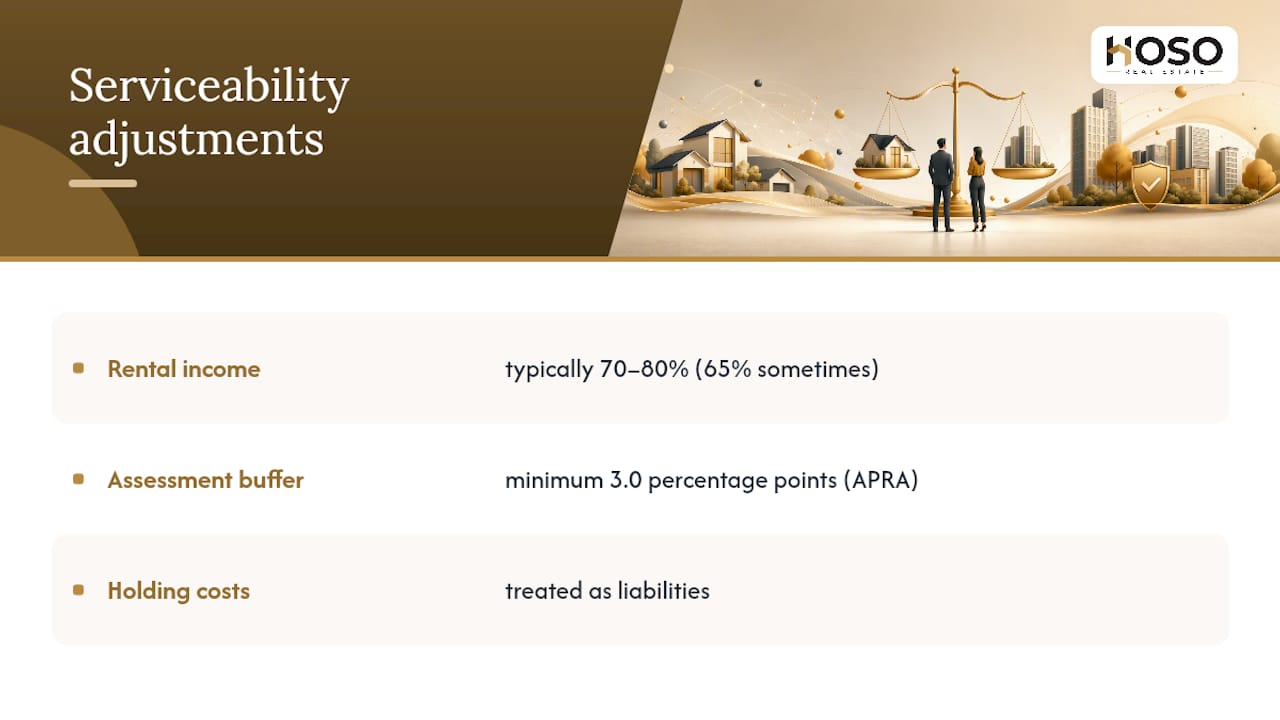
The mechanics come down to three adjustments applied before a lender tests whether repayments are affordable: a rental income shade (typically 70–80%, sometimes as low as 65% for certain lenders), an assessment rate buffer (minimum 3.0 percentage points as per APRA), and the treatment of holding costs as liabilities.
The APRA-style assessment buffer
APRA requires lenders to apply a minimum serviceability buffer of 3.0 percentage points above the loan's interest rate when testing repayments. If the advertised rate is 6.5%, the lender tests your ability to repay at a rate at least three percentage points higher, as required by APRA guidance. Some lenders apply a floor rate as well, meaning the assessment rate is the higher of the floor or the advertised rate plus the buffer. As Suncorp explains, serviceability shifts materially as interest rates move, because the assessment rate moves with them.
Rental income shading
Lenders do not count 100% of gross rent. The typical range is 70–80% of gross rental income, with the discount accounting for vacancy periods and property expenses. Macquarie's calculator guidance documents shading rates of 65–75% for various property types and requires that new investment properties include a minimum 20% expense allowance when inputting verified rental income.
A quick numeric illustration: A property renting at $500 per week generates $26,000 per year in gross rent. At 80% shading, the assessable rental income is $20,800. At 70% shading, it drops to $18,200. That $2,600 difference flows directly into the surplus income calculation and reduces borrowing power accordingly.
Common assessment parameters
| Parameter | Typical range used by lenders |
|---|---|
| Assessment buffer above advertised rate | 3.0 percentage points (APRA minimum) |
| Rental income shading | 70–80% of gross rent (sometimes as low as 65% depending on lender and property type) |
| Credit card monthly repayment factor | Approximately 3% of the total limit per month |
| Minimum expense allowance (new investment property) | 20% of gross rent deducted before inputting to calculator |
Note: These figures represent common industry practice. Individual lenders set their own policies, and the figures above may differ from the rate or percentage a specific lender applies to your application.
How does serviceability for an investment loan differ from owner-occupier lending?
Serviceability rules are typically stricter for investors than for owner-occupiers, and the gap matters when you are planning a purchase.
Four specific differences apply to investment loans:
- Rental income shading: Owner-occupier applications carry no rental income at all, so there is no shading discount. For investors, the shade reduces assessed income from the outset.
- Holding costs added as liabilities: Lenders add council rates, strata levies, insurance, and management costs to the liability side of the equation for investment properties. Owner-occupiers do not face this treatment for their primary residence.
- Principal-and-interest assessment for interest-only loans: Even if you apply for an interest-only investment loan, many lenders assess repayments on a principal-and-interest basis over the remaining loan term. This produces a higher assessed repayment figure and reduces the surplus.
- Portfolio debt caution: Lenders become progressively more conservative as total investment debt grows. A borrower with three existing investment loans faces more scrutiny than one applying for their first.
Illustrative scenario: Take a borrower earning $120,000 per year with $200,000 in existing mortgage debt. Applying for an owner-occupier loan, the lender assesses income against living expenses and the stress-tested repayment on the new loan. Applying for an investment loan on the same property, the lender also shades the rental income, adds holding costs to liabilities, and may assess the loan on a principal-and-interest basis even if the product is interest-only. The result is a lower surplus and a lower maximum loan amount, often by a meaningful margin.
Lenders with a "conservative policy" apply tighter shading (closer to 65–70%), higher floor rates, and stricter HEM benchmarks. Those with a "recognitive policy" may accept 80% shading, use declared expenses rather than HEM, and allow more rental income types. The same borrower can see borrowing power differences of tens of thousands of dollars see source between these two policy types.
How can you improve serviceability before applying?
Most of the levers that improve serviceability are within your control before you submit an application. Acting on them three to six months ahead of applying gives the changes time to show up in your credit file and bank statements.
- Reduce credit card limits. Contact your card provider and lower limits on cards you do not need at their current level. The reduction shows in your credit file and removes the imputed monthly liability from the lender's calculation.
- Pay down consumer debt. Personal loans and car finance reduce your surplus income dollar for dollar at the assessment rate. Clearing these before applying has a direct, calculable effect on borrowing power.
- Increase your deposit or usable equity. A larger deposit reduces the loan amount and therefore the assessed repayment. It can also move you below an LVR threshold that triggers lender mortgage insurance, which some lenders factor into the serviceability test.
- Document rental income thoroughly. Lenders want to see consistent, verifiable rental income. Tenancy agreements, ledgered rent rolls from your property manager, and at least 12 months of rental statements all support the income figure you declare. Presenting neat, verifiable rental income evidence reduces friction in an assessor's review and often improves how much rental income a lender will accept.
- Document bonuses and overtime consistently. If you want these included, you need two years of payslips and tax returns showing the same pattern. A single year of high overtime is unlikely to be counted in full.
- Avoid new credit enquiries. Each credit application leaves a hard enquiry on your file. Multiple enquiries in a short period signal financial stress to lenders and can reduce your credit score.
- Shop lenders or use a mortgage broker. Small differences in shading and assessment policy between lenders can change borrowing power by tens of thousands of dollars for the same borrower and property. A broker who understands investor-specific policies can match you to a lender whose criteria suit your income structure. SmartPropertyInvestment reinforces this: gathering verifiable income documents and considering lender differences are among the most practical steps an investor can take.
Pro Tip: If you receive rental income from an existing investment property, present a formal rental appraisal alongside your rent roll statements. A written appraisal from a licensed property manager confirms the market rate and gives the assessor a second data point to support the figure you have declared.
Pro Tip: If your current lender's shading policy is limiting your next purchase, consider whether refinancing the existing portfolio to a lender with a more recognitive investor policy would free up enough borrowing capacity to proceed. A broker can model this scenario before you commit to any application.
What documents do lenders require and how long does assessment take?
A complete application moves faster than an incomplete one. Lenders typically request the following:
Identity and income:
- Current passport or driver's licence
- Two most recent payslips (PAYG employees)
- Last two years' tax returns and ATO notices of assessment (self-employed applicants)
- Last three months' bank statements showing salary credits and living expenses
Property and rental income:
- Current tenancy agreement for the investment property
- Last 12 months' rental statements from your property manager
- A formal rental appraisal if the property is vacant or newly acquired
- Council rates notice and strata levy schedule (if applicable)
Existing liabilities:
- Most recent statements for all existing home loans and investment loans
- Credit card statements showing current limits
- Personal loan and car finance statements
Deposit and equity:
- Bank statements showing genuine savings (usually three to six months)
- Most recent mortgage statement if using equity from an existing property
- Valuation or contract of sale for the subject property
Typical timeline: Pre-approval or pre-assessment generally takes 3–5 business days once all documents are submitted. Full credit assessment after a signed contract of sale typically takes 5–10 business days, though complex applications or high-volume periods can extend this. Settlement follows the contract terms, usually 30–60 days after exchange.
Professional property management records, including ledgered rent rolls, signed tenancy agreements, and inspection reports, provide exactly the type of verifiable documentation lenders favour. For investors with Adelaide properties managed by HOSO Real Estate, these records are maintained systematically and can be compiled quickly when a lender requests them.
A worked example showing how shading and buffers change borrowing power
The following example is illustrative. Use actual lender calculators or speak with a mortgage broker for figures specific to your situation.
Borrower profile:
- Gross salary: $110,000 per year
- Investment property gross rent: $500 per week ($26,000 per year)
- Existing liabilities: $350,000 investment loan at 6.5% (assessed at 9.5%)
- Credit card limit: $10,000 (imputed monthly repayment: approximately $300)
- Living expenses (HEM): $3,200 per month
Step 1: Calculate assessable rental income
Step 2: Total assessed income
At 80% shading: $110,000 + $20,800 = $130,800 per year ($10,900 per month)
Step 3: Total assessed liabilities per month
- Existing loan repayment at 9.5% assessment rate: approximately $3,200
- Credit card imputed repayment: $300
- Holding costs (rates, insurance, management): $400
- Living expenses (HEM): $3,200
- Total liabilities: approximately $7,100 per month
Step 4: Monthly surplus
$10,900 minus $7,100 = $3,800 per month available to service the new loan.
At an assessment rate of 9.5%, $3,800 per month supports a loan of approximately $430,000–$460,000 depending on the loan term. Drop the shading to 70% and the assessable income falls by $217 per month, reducing borrowing power by roughly $25,000–$30,000 at the same assessment rate.
Macquarie's calculator guidance instructs brokers to pre-shade rental income and apply the 20% expense allowance before entering figures into the calculator. Running the numbers yourself before approaching a lender gives you a realistic ceiling and prevents surprises at assessment.
This example is illustrative only. Always use the actual lender's calculator or consult a licensed mortgage broker for an accurate borrowing power figure.
How does professional property management strengthen your serviceability case?
Lenders assess rental income on the quality of the evidence, not just the figure declared. A tenancy agreement signed three years ago with no supporting rent roll history carries less weight than 24 months of ledgered statements showing consistent payments, no arrears, and a current market-rate lease.
Professional property management creates exactly this paper trail. Consistent leasing, documented rent rolls, responsive maintenance history, and compliant tenancy agreements all provide verifiable evidence that an assessor can rely on. For investors with properties in suburbs like Prospect, Unley, or Henley Beach, a well-maintained rent roll from a licensed agency demonstrates that the income figure is real and sustainable, not a best-case estimate.
The practical deliverables that support a lender submission include:
- A formal rental appraisal confirming current market rent
- Ledgered rent roll statements covering at least 12 months
- Current signed tenancy agreement
- Routine inspection reports confirming property condition
- A clear record of any rent increases and lease renewals
For investors planning to scale a rental property portfolio, this documentation becomes progressively more important with each additional purchase. A lender assessing a third or fourth investment loan will scrutinise rental income evidence more carefully than they would for a first purchase.
The role of a property manager in an investment strategy extends beyond day-to-day management. Maintaining the records that support future lending decisions is a direct contribution to portfolio growth capacity.
How do major Australian lenders' serviceability criteria differ?
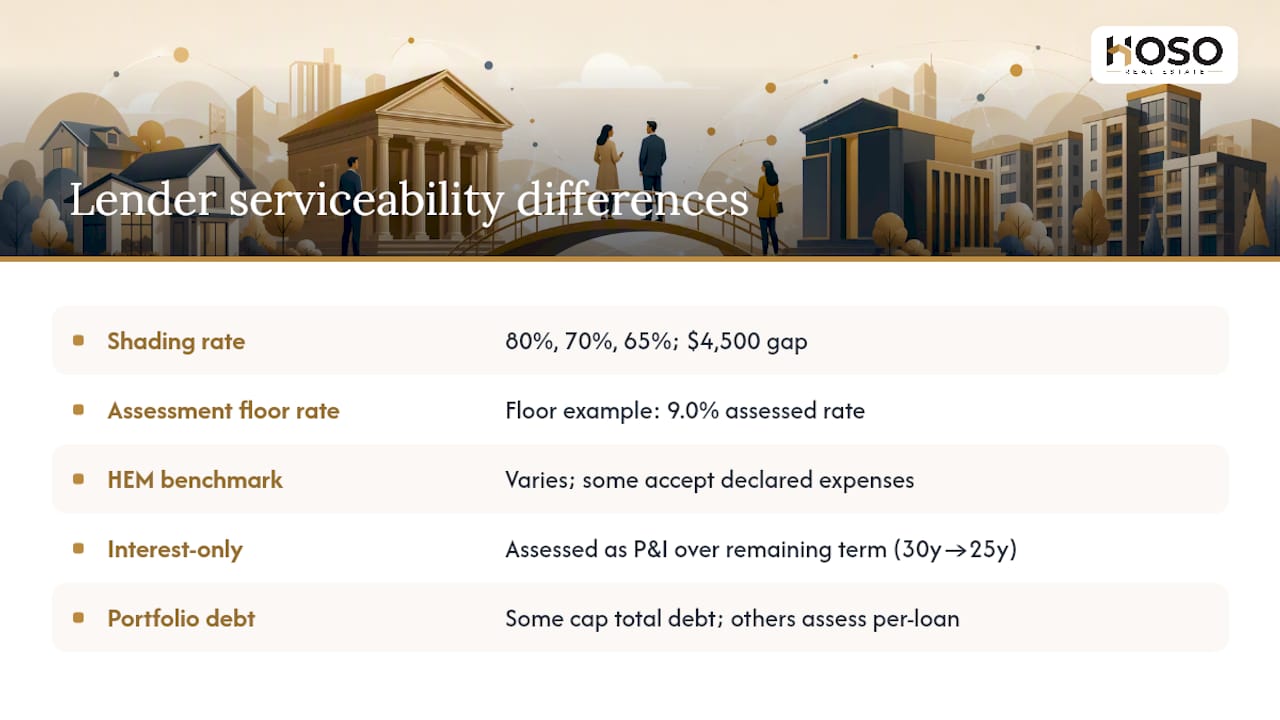
No two lenders apply identical policies, and the differences are material for investors. The key variables are shading rate, assessment floor rate, HEM benchmark, and treatment of interest-only loans.
Shading rate: Some lenders shade rental income at 80%, others at 70% or 65%. For a property generating $30,000 per year in gross rent, the difference between 80% and 65% shading is $4,500 in assessable annual income. At a 9.5% assessment rate, that gap translates to roughly $45,000–$50,000 in borrowing power.
Assessment floor rate: Lenders set a minimum rate below which the assessment rate will not fall, regardless of the advertised rate. A lender with a 9.0% floor rate will assess all loans at 9.0% even if the advertised rate plus buffer would produce a lower figure. This floor rate has a direct effect on the repayment figure used in the surplus calculation.
HEM benchmark: The Household Expenditure Measure varies by household size, location, and income band. Lenders apply different versions of HEM, and some accept declared expenses if they are higher than HEM. An investor with genuinely low living expenses may benefit from a lender that accepts declared figures rather than defaulting to the benchmark.
Interest-only assessment: Most lenders assess interest-only investment loans on a principal-and-interest basis over the remaining loan term. A 30-year loan with five years of interest-only payments is assessed as a 25-year principal-and-interest loan for serviceability purposes. This produces a higher monthly repayment figure in the calculation and reduces the surplus.
Portfolio debt policies: Lenders differ on how much total investment debt they will accept. Some apply a hard cap on total investment lending per borrower; others assess each loan on its individual merits. For investors with multiple properties, this policy difference can determine whether a new purchase is possible at all with a given lender.
A mortgage broker with experience in investor lending can identify which lender's policy best suits your income structure and portfolio position. For investors considering specialist financing options, understanding these policy differences is the starting point for any productive lender conversation.
HOSO's perspective on serviceability as a strategic resource
Serviceability is not just a lending hurdle. It is a measure of how much capacity you have left to grow your portfolio, and protecting it is as important as protecting the properties themselves.
The investors who run into difficulty are usually those who maximise borrowing at each purchase without modelling what the next one will look like. By the time they find the right property, the serviceability ceiling has already been reached. A more considered approach means treating each purchase decision as part of a sequence: what does this loan do to my assessed surplus, and does it leave room for the next acquisition?
In South Australia, tenancy records and bond handling complying with the Residential Tenancies Act 1995 and SACAT requirements help ensure credible rental income documentation for lender assessments. They are also the documentation that supports a credible rental income claim to a lender. Keeping those records clean and current has a direct effect on how smoothly a future loan application proceeds.
Before bidding at auction or signing a contract of sale in Adelaide, get a pre-assessment from a mortgage broker and confirm your rental income evidence is complete. The two steps together take less time than most investors expect and remove the two most common causes of a declined application.
Stronger rental income evidence, prepared by HOSO Real Estate
For investors who want their rental income documentation to hold up under lender scrutiny, HOSO Real Estate prepares the records that matter: formal rental appraisals, ledgered rent roll statements, signed tenancy agreements, and routine inspection reports. These are the documents lenders ask for, compiled and maintained as part of standard property management practice.
If you are preparing for a loan application or pre-approval and need a complete rental evidence pack, contact HOSO Real Estate. The full range of services includes rental appraisals, tenancy documentation, and portfolio support for Adelaide landlords and investors. This is an optional support step, not a requirement, but having the documentation ready before you approach a lender removes one of the most common sources of delay.
Sources
- Macquarie serviceability calculator input guidance
- What is loan serviceability and how do banks calculate it? — Suncorp
- 6 ways to manage serviceability of investment property loans | Firstlinks
- Investor Loan Serviceability Explained – Kin Financial
- Investment property loans Australia 2026: The complete investor's guide | Esteb and Co
- Loan serviceability explained: Banks & borrowing power (2026) | Picki
- What investors should know about serviceability | SmartPropertyInvestment
- Serviceability - Definition & How It Works (Australian Property Glossary) | PropRadar
This article is general information, not a substitute for advice from a qualified financial advisor. Consult a qualified financial professional about your own circumstances before acting on anything here.