
A property manager's core role in investment is executing the operational tasks that protect cash flow, maintain tenancy, and keep your asset compliant with South Australian tenancy law. This is not a passive administrative function. Operational execution by property managers is the pivotal factor converting acquisition potential into realised investment returns. Whether you own a single rental in Prospect or a multi-property portfolio across Norwood, Unley, and Glenelg, the role of property manager in investment determines how much of your gross rent actually reaches your pocket at year's end.
How does a property manager influence investment returns?
The three primary return levers in investment property management are tenant screening, rent collection and accounting, and maintenance and compliance management. Each of these functions has a direct, measurable effect on your net operating income (NOI) and the long-term value of your asset.
Tenant placement is where returns are won or lost before a lease even begins. A rigorous screening process, covering employment verification, rental history, and credit checks, reduces the probability of late payments, property damage, and costly eviction proceedings through SACAT. A well-placed tenant in a property in Burnside or Colonel Light Gardens typically stays longer, pays on time, and treats the property with care. That translates directly into lower vacancy rates and fewer turnover costs.

Rent collection and financial reporting give you the income certainty that makes property investment viable. A dedicated property manager tracks payment dates, issues formal notices when rent falls into arrears, and produces monthly statements that reconcile income against expenses. This level of financial discipline is what separates a performing investment from one that quietly underdelivers.
Maintenance coordination protects your asset's condition and prevents small repairs from becoming expensive capital works. A property manager who responds to a leaking roof in Mitcham within 24 hours avoids the mould remediation bill that follows six weeks of inaction. Proactive maintenance also strengthens tenant retention, which reduces the vacancy periods that erode annual yield.
Pro Tip: Ask your property manager to provide a monthly maintenance log alongside your financial statement. Tracking repair frequency and cost by category reveals patterns that inform your next capital expenditure decision.
Communication and dispute resolution are less visible but equally important. A property manager who handles tenant concerns professionally reduces the likelihood of disputes escalating to formal SACAT proceedings, which cost time and money regardless of outcome.
What compliance and licensing responsibilities do property managers hold?
Property managers in South Australia operate under licensing and trust account regulations that carry real financial consequences for non-compliance. Understanding these obligations is not optional for investors. It is a risk management requirement.
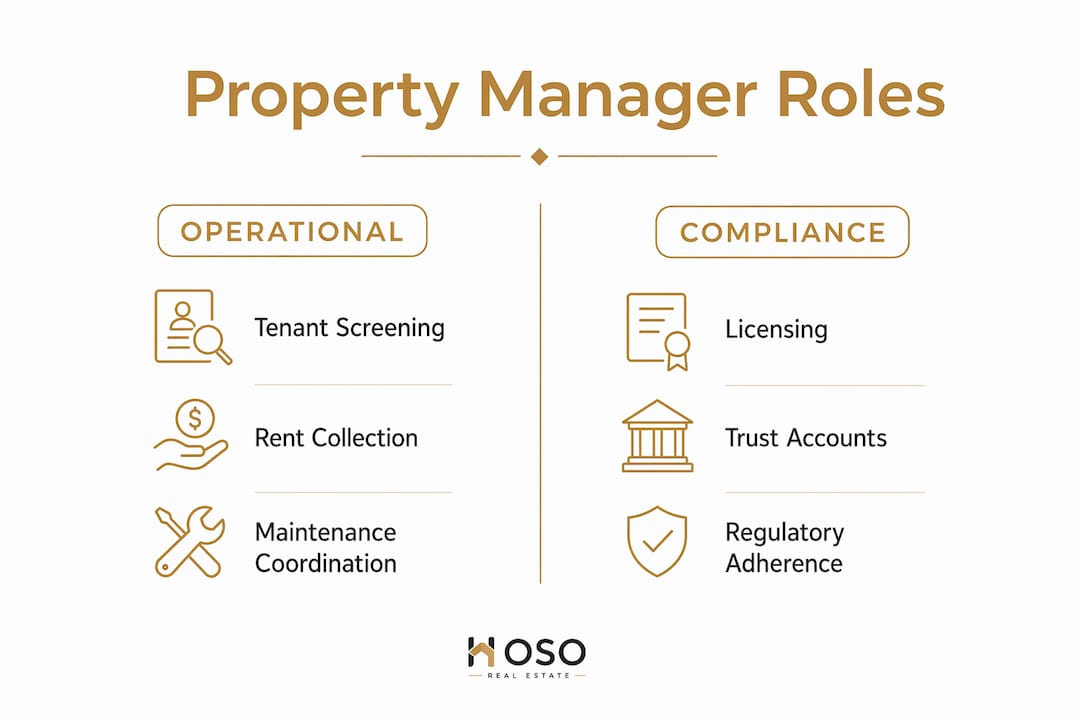
In South Australia, property managers must hold a current licence under the Land Agents Act 1994. This licence governs how they handle trust accounts, manage client funds, and conduct their agency activities. Trust account regulations are particularly strict. In comparable interstate frameworks, only a licensee-in-charge may authorise trust account withdrawals, and penalties for non-compliance can exceed $5,500 plus daily fines. This is the kind of regulatory exposure that can affect your rental income directly if your manager is not operating within the rules.
Key compliance responsibilities your property manager holds include:
- Maintaining a current real estate licence and ensuring all staff operate within their authorised scope
- Managing trust accounts in strict accordance with state regulations
- Conducting routine inspections at legally required intervals and documenting findings
- Issuing legally compliant notices for rent increases, lease renewals, and breach notifications
- Staying current with changes to the Residential Tenancies Act 1995 (SA) and Consumer and Business Services (CBS) guidance
Landlords retain ultimate legal responsibility even when a property manager handles day-to-day operations. This means your management agency agreement is not just a service contract. It is a risk control document. A written management agreement that clearly specifies repair authorisation limits, rent collection timing, inspection frequency, and dispute management procedures reduces your exposure significantly. Ambiguity in that agreement transfers risk back to you.
You can verify a property manager's current licence status in South Australia through Consumer and Business Services. For a detailed walkthrough of what to check, the SA licence verification guide covers the process step by step.
Property manager vs asset manager: what is the difference?
The operational focus of property managers differs from the strategic oversight role of asset managers, but both are necessary to maximise investment returns. Investors who conflate the two often hold one party accountable for decisions that belong to the other.
| Role | Primary focus | Typical decisions |
|---|---|---|
| Property manager | Day-to-day operations | Tenant placement, maintenance, rent collection, compliance |
| Asset manager | Portfolio strategy | Rent increase timing, capital works, acquisition and disposal |
A property manager in Glenelg implements the rent increase that an asset manager has determined is appropriate based on market analysis. The asset manager decides to renovate the kitchen in a Norwood investment property to lift yield. The property manager coordinates the tradespeople, manages tenant communication during works, and ensures the property is re-leased at the new rate. Neither role replaces the other.
For investors scaling a portfolio across multiple Adelaide suburbs, understanding this split is practical. You need a property manager with the operational capacity and local knowledge to execute at a high standard. You need either an asset manager or a clear personal strategy to direct the bigger decisions. When these two functions are aligned, the result is a portfolio that performs consistently rather than one that relies on favourable market conditions to produce returns.
How does technology affect property management at scale?
Property management at scale is a systems problem. Without software, a property manager typically handles 30 to 50 properties before service quality declines. With modern property management software, capacity can exceed 100 properties while maintaining response times and reducing vacancies. That difference matters directly to your returns if your manager is overloaded.
The practical implications for investors are straightforward:
- Confirm your manager's current portfolio size. A manager carrying 120 properties without automation support is likely to miss maintenance requests, delay lease renewals, and respond slowly to tenant concerns. Each of these failures has a cost.
- Ask what software platform they use. Property management platforms used in the Australian market, such as PropertyMe and Console Cloud, automate rent receipting, inspection scheduling, maintenance workflows, and owner reporting. These tools reduce manual error and improve response consistency.
- Assess reporting frequency and format. Automated systems produce real-time owner portals and monthly statements without manual preparation. If your manager cannot provide current data on demand, their systems are a constraint on your oversight.
- Evaluate vacancy response times. Automation allows a manager to list a vacancy, screen applicants, and process applications faster. Shorter vacancy periods have a direct positive effect on annual yield.
Pro Tip: When interviewing a property manager, ask for a sample owner statement and a walkthrough of their tenant portal. The quality of these outputs tells you more about their operational systems than any verbal description.
Operational data feedback loops on maintenance and leasing inform strategic budgeting and retention tactics, turning management activities into measurable investment outcomes. A manager who can show you trending maintenance costs by property, average days to lease, and lease renewal rates is giving you the data you need to make better investment decisions.
What criteria should investors use to choose a property manager?
Selecting a property manager is a due diligence exercise, not a price comparison. The tasks a professional property manager handles span compliance, financial management, and tenant relations. Your selection criteria should reflect that scope.
Evaluate candidates against these standards:
- Licence and compliance record. Verify their current licence with Consumer and Business Services SA. Ask directly whether they have faced any disciplinary action or trust account audits.
- Local market knowledge. A manager with direct experience in your suburb, whether that is Prospect, Unley, or Tea Tree Gully, understands local rental demand, tenant demographics, and achievable rents. Generic market knowledge is not a substitute.
- Reporting transparency. Request a sample monthly statement and ask how often you will receive updates on maintenance, inspections, and lease activity. Vague answers indicate weak systems.
- Technology and capacity. Confirm their portfolio size and the software they use. Cross-reference this against the 30 to 50 property threshold that applies without automation.
- Fee structure clarity. Management fees in Adelaide typically range from 7% to 10% of collected rent, plus letting fees and ancillary charges. Understand exactly what is included before signing.
- Management agreement detail. A clear agency agreement covering repair authorisation limits, inspection schedules, and rent arrears procedures is the foundation of a functional management relationship.
The question of self-managing versus professional management often comes down to this selection process. A well-chosen property manager produces better net returns than self-management for most investors, particularly those with multiple properties or interstate holdings.
Key takeaways
A property manager's operational execution, not market conditions alone, determines whether your investment property delivers its full return potential.
| Point | Details |
|---|---|
| Operational execution drives returns | Tenant screening, rent collection, and maintenance directly affect NOI and asset value. |
| Compliance is a shared responsibility | Landlords retain legal liability; a detailed management agreement is a risk control measure. |
| Property managers and asset managers differ | Property managers execute operations; asset managers set strategy. Both are needed at scale. |
| Technology determines scalability | Managers without software reliably handle only 30 to 50 properties before quality declines. |
| Selection criteria matter | Licence verification, local knowledge, and reporting transparency are non-negotiable evaluation points. |
What we have observed at HOSO Real Estate
The most consistent mistake investors make is treating property management as a commodity. They select a manager on fee percentage alone, sign a vague agency agreement, and then disengage until something goes wrong. By the time a problem surfaces, whether it is a rent arrears situation, a compliance breach, or a property sitting vacant for six weeks in Glenelg, the financial damage is already done.
What we have found is that the investors who achieve the strongest returns treat their property manager as an operational partner, not a service provider they check in with once a year. They review monthly statements. They ask questions about lease renewal strategy. They want to know the maintenance cost trend before it becomes a capital works problem. That level of engagement does not require significant time. It requires the right information, delivered consistently.
The role of a dedicated property manager has also changed materially in the past five years. Compliance obligations under the Residential Tenancies Act 1995 (SA) have grown more detailed. Tenant expectations around response times and communication have increased. The administrative load of managing a single property correctly, let alone a portfolio, is now substantial. Investors who underestimate this are either absorbing hidden costs through self-management or accepting below-standard service from an overloaded manager.
Technology has shifted what is possible. A manager using current property management software can give you real-time visibility over your portfolio, respond to maintenance requests faster, and produce the reporting you need to make informed decisions. That capability is now a baseline expectation, not a premium feature.
The investors who scale successfully in Adelaide are the ones who choose their property manager with the same rigour they apply to acquisition analysis. The property is the asset. The management is what determines whether that asset performs.
— HOSO
Manage your Adelaide investment with HOSO Real Estate
HOSO Real Estate provides investment property management across Adelaide, with deep knowledge of South Australian tenancy law, CBS compliance requirements, and local rental market conditions.
Our property management services cover tenant leasing, routine inspections, maintenance coordination, compliance management, and landlord advisory, all supported by modern management systems that give you clear visibility over your portfolio. We work with landlords and investors across suburbs including Norwood, Unley, Prospect, Burnside, and Glenelg, and we structure every management agreement to protect your interests from day one. If you are looking for a property management partner who treats your portfolio with the same rigour you do, contact HOSO Real Estate to discuss your investment goals.
FAQ
What does a property manager do for an investor?
A property manager handles tenant screening, rent collection, maintenance coordination, routine inspections, and compliance management on behalf of the landlord. These functions directly affect rental income, vacancy rates, and the long-term condition of the investment asset.
Are property managers in South Australia required to be licensed?
Property managers in South Australia must hold a current licence under the Land Agents Act 1994, regulated by Consumer and Business Services SA. Investors can verify a manager's licence status directly through the CBS register before signing a management agreement.
How does a property manager affect my investment returns?
Operational choices by property managers affect NOI and asset value more than acquisition analysis alone. Tenant placement quality, maintenance response speed, and lease renewal strategy each have a measurable effect on annual yield and capital growth.
How many properties can one property manager handle?
Without property management software, a single manager typically handles 30 to 50 properties before service quality declines. With automation, that capacity can exceed 100 properties while maintaining consistent response times and reporting standards.
What should be in a property management agreement?
A management agreement should specify repair authorisation limits, rent collection timing, inspection frequency, arrears management procedures, and fee structures. Ambiguity in management contracts increases landlord risk and reduces the predictability of investment returns.