
Scaling a rental property portfolio is defined as the process of acquiring additional investment properties over time by deploying equity, managing borrowing capacity, and structuring loans to preserve long-term flexibility. The industry term for this process is portfolio accumulation, and it relies on three core mechanisms: equity recycling, lender diversification, and disciplined cash flow management. Investors who understand how these mechanisms interact grow portfolios that remain financially sustainable. Those who ignore them typically stall after two properties, not because the market failed them, but because their loan structure did. HOSO Real Estate works with Adelaide landlords and investors at every stage of this process, from first acquisition through to multi-property portfolio management.
How does equity work as the engine of portfolio growth?
Equity is the difference between a property's current market value and the outstanding loan balance. It builds through two channels: capital growth in the property's value, and loan repayments that reduce the debt. Both work together over time to create usable equity that can fund the next acquisition.

Equity recycling after 2–4 years can fund new property deposits, removing the need to save fresh cash for each purchase. This is the core mechanism behind portfolio accumulation. An investor who buys in a suburb like Prospect or Norwood and holds for three years may find that capital growth alone has created enough equity to cover a deposit on a second property.
The process works like this:
- The lender assesses the current market value of the existing property.
- Usable equity is calculated as the difference between 80% of that value and the remaining loan balance.
- That usable equity is drawn down as a deposit or security for the next purchase.
- The investor acquires the next property without touching savings.
LMI costs can add tens of thousands of dollars to acquisition costs when the loan-to-value ratio (LVR) exceeds 80%. That cost directly reduces the equity available for future purchases. Keeping LVR at or below 80% on each property protects the equity position and avoids compounding debt.
Pro Tip: Draw equity from your existing property as a separate loan split, not by increasing the original loan. This keeps deductible and non-deductible debt clearly separated, which matters significantly at tax time.
Equity alone does not guarantee growth. Without adequate cash reserves to cover holding costs, vacancy periods, and maintenance, an investor can be equity-rich but cash-poor. Equity funds the entry. Cash flow keeps the portfolio running.
Why should investors use multiple lenders to grow a portfolio?
Single-lender concentration is one of the most common and least-discussed growth blockers in property investment. When all properties sit with one lender, that lender controls the investor's entire borrowing position. A policy change, a credit assessment update, or a serviceability review can freeze the entire portfolio.
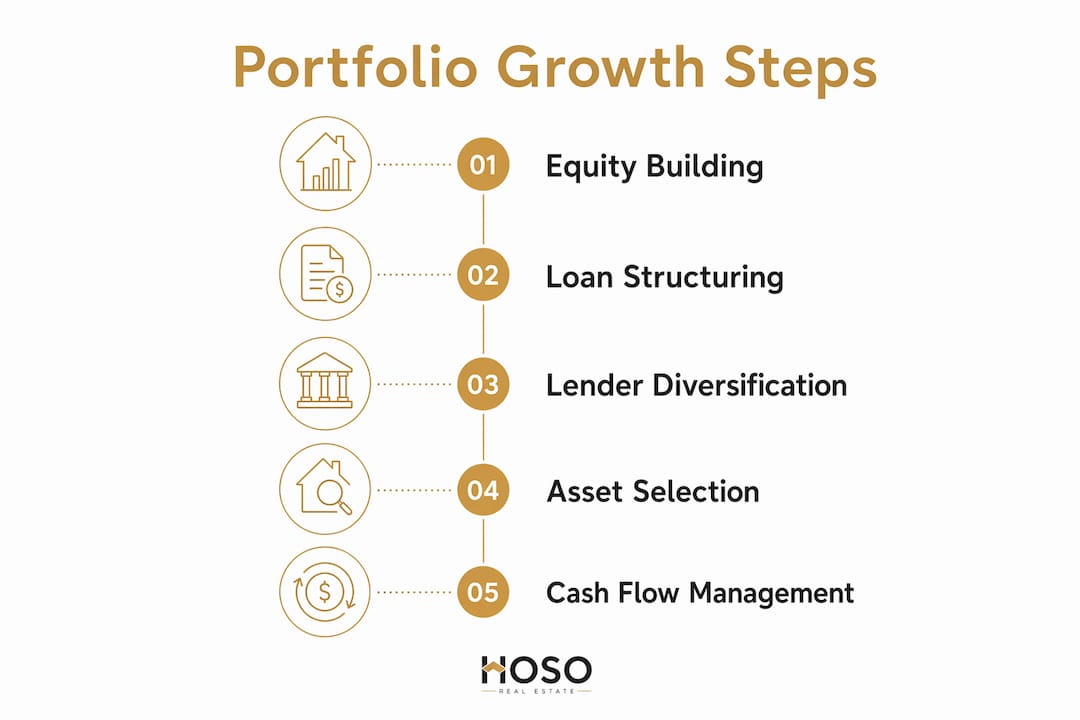
Investors with more than two properties should use at least two separate lenders to reduce concentration risk and maintain borrowing flexibility. This is the standard recommendation for portfolios beyond two properties. Each additional lender adds an independent borrowing channel, which means one lender's policy shift does not halt the entire growth plan.
The practical steps for lender diversification follow a clear sequence:
- Purchase the first property with a lender offering strong investor loan terms.
- Use equity from the first property to fund the second purchase, ideally with the same lender to simplify the process.
- From the third property onward, introduce a second lender to avoid concentration risk.
- As the portfolio grows past $1.5 million in debt, add a third lender to spread exposure further.
- Review lender mix annually with a specialist mortgage broker to identify serviceability gaps.
Diversifying lenders before portfolio debt hits $1.5–2 million prevents exposure caps from stalling acquisition progress. Waiting until a lender's internal limit is reached forces diversification under pressure, often at the cost of refinancing flexibility and growth timing.
Cross-collateralisation is a related trap that investors must avoid. This occurs when a lender uses multiple properties as security for a single loan.
Cross-collateralisation traps multiple properties under one loan security, complicating refinancing, sales, and restructuring, and limiting portfolio scalability. Standalone securities for each property are the recommended structure to preserve flexibility and reduce risk.
Each property should be secured against its own title. This means the investor can sell, refinance, or restructure one property without triggering a review of the entire portfolio.
What loan structure and cash flow decisions support long-term growth?
Loan structure determines how far a portfolio can grow before serviceability becomes a barrier. The two main loan types for investors are interest-only and principal-and-interest. Interest-only loans reduce monthly repayments, which preserves cash flow in the short term. Principal-and-interest loans build equity faster but increase monthly outgoings.
Stress-tested borrowing capacity under APRA rules is the main scalability constraint for growing investors. APRA requires lenders to assess borrowing capacity at a rate above the actual loan rate, typically 3% higher. This buffer reduces the amount each investor can borrow, which is why cash flow management matters so much at scale.
Lenders shade rental income in their calculations. Lenders count only 70–80% of rental income toward borrowing capacity to account for vacancies and expenses. This means an investor earning $2,000 per month in rent may only have $1,400–$1,600 counted toward serviceability. The gap compounds with each additional property, reducing effective borrowing power faster than most investors expect.
Key cash flow decisions that protect serviceability include:
- Using offset accounts linked to investment loans to reduce interest without reducing the loan balance, preserving tax deductibility.
- Targeting properties with gross yields above 5% to maintain positive or neutral cash flow under current interest rates.
- Maintaining a cash buffer of at least three months of holding costs per property to absorb vacancy periods.
- Avoiding negatively geared properties early in the portfolio when serviceability is already under pressure.
Positive or neutral cash flow properties with gross yields above 5% are the foundation of a serviceable, growing portfolio. Properties below this threshold create cash flow pressure that can halt acquisition progress entirely.
Pro Tip: Ask your mortgage broker to run a serviceability forecast across three to five properties before you buy the next one. Knowing your borrowing ceiling in advance lets you plan acquisitions in the right order.
Understanding why landlords sell rental properties often comes down to cash flow pressure that was not managed from the start. Getting the structure right early avoids that outcome.
How does asset selection support a diversified, growing portfolio?
Asset selection is where many investors make their most costly mistakes. Emotional buying, chasing headlines, or following short-term market trends produces a portfolio that is concentrated in one location, one property type, or one market cycle. A well-structured portfolio mixes asset types and locations deliberately.
The core principle is balancing high-growth assets with high-yield assets. High-growth properties, typically in established inner-ring Adelaide suburbs like Unley, Norwood, or Burnside, build equity over time but may carry lower rental yields. High-yield properties, often in outer suburban or regional South Australian markets, generate stronger cash flow but may grow more slowly in value. A portfolio that holds both types manages the trade-off between equity accumulation and serviceability.
| Property type | Primary benefit | Best suited for |
|---|---|---|
| Inner-ring Adelaide residential | Capital growth | Equity recycling over 3–5 years |
| Outer suburban Adelaide | Balanced yield and growth | Serviceability and moderate equity |
| Regional South Australia | Higher rental yield | Cash flow support and diversification |
Geographic diversification reduces exposure to a single local market downturn. An investor with properties across Salisbury, Glenelg, and a regional centre like Mount Gambier holds assets in different economic conditions. If one market softens, the others may hold or grow.
A repeatable, strategy-first approach using forecasting tools reduces emotional decision-making and improves asset selection over time. This means setting clear criteria before searching, such as minimum yield, maximum LVR, and target suburb growth rate, and applying those criteria consistently across every purchase.
Adding properties to the same management agency as a portfolio grows reduces administrative complexity and creates a single point of accountability for performance reporting, maintenance, and compliance.
Key takeaways
Scaling a rental property portfolio requires equity recycling, lender diversification, disciplined loan structure, and deliberate asset selection working together from the first acquisition.
| Point | Details |
|---|---|
| Equity recycling funds growth | Use equity built over 2–4 years as a deposit for the next property, avoiding fresh cash savings. |
| Diversify lenders early | Introduce a second lender from the third property to avoid concentration risk and exposure caps. |
| Loan structure determines ceiling | Separate loan splits, offset accounts, and interest-only terms preserve serviceability and borrowing capacity. |
| Target yields above 5% | Properties with gross yields above 5% maintain positive cash flow and protect borrowing power at scale. |
| Mix asset types deliberately | Combine high-growth and high-yield properties across Adelaide suburbs and regional SA for balanced returns. |
What I have learned about scaling past two properties
Most investors I speak with who have stalled at two properties share the same problem. It is not the market. It is the loan structure they set up at the start.
Loan structure and lender concentration often determine how far a portfolio grows, more so than market conditions or equity alone. Cross-collateralisation and single-lender concentration are the two most common silent blockers. Investors often do not realise the problem exists until they try to buy a third property and find their borrowing capacity has effectively disappeared.
The fix is rarely dramatic. Separating loan securities, introducing a second lender, and restructuring deductible debt correctly can restore serviceability without selling anything. Failure to separate deductible and non-deductible debt early creates tax and cash flow drag that compounds with every new acquisition.
The investors who grow consistently are not necessarily the ones with the most equity or the best market timing. They are the ones with a clear, repeatable process. They know their borrowing ceiling before they buy. They select assets against set criteria. They delegate property management tasks to professionals so their time goes toward the next acquisition, not the current one.
Gradual, consistent growth with strong cash flow and clean loan structure outperforms aggressive accumulation every time. The goal is a portfolio that can keep growing, not one that looks impressive until the next interest rate move.
— HOSO
How HOSO Real Estate supports portfolio growth in Adelaide
HOSO Real Estate works with landlords and investors across Adelaide who are building and managing multi-property portfolios. The focus is on long-term asset performance, compliance, and professional management that keeps properties tenanted, maintained, and performing. For investors at the stage of expanding their holdings, having a property manager who understands portfolio-level strategy makes a material difference to cash flow outcomes and compliance risk.
HOSO's property management and advisory services are built for investors who want more than a reactive management service. From routine inspections and maintenance coordination through to landlord advisory and investment portfolio support, the team provides the operational foundation that lets investors focus on growth. If you are ready to review your portfolio structure or discuss how professional management supports your next acquisition, HOSO Real Estate is the place to start.
FAQ
What is equity recycling in property investment?
Equity recycling is the process of drawing usable equity from an existing property to fund the deposit on a new purchase. It typically becomes available after 2–4 years of capital growth and loan repayments.
How many lenders should a property investor use?
Investors with more than two properties should use at least two separate lenders. Adding a third lender is recommended before portfolio debt reaches $1.5–2 million to avoid exposure caps.
What is cross-collateralisation and why should investors avoid it?
Cross-collateralisation occurs when a lender uses multiple properties as security for a single loan. It complicates refinancing and selling, so each property should be secured against its own title.
Why do lenders shade rental income in borrowing assessments?
Lenders count only 70–80% of rental income toward borrowing capacity to account for vacancies and property expenses. This reduces effective borrowing power with each additional property in the portfolio.
What gross yield should investment properties target?
Properties with gross yields above 5% are the benchmark for maintaining positive or neutral cash flow under current interest rates. Properties below this threshold risk cash flow pressure that can halt portfolio growth.