
A correctly completed, timestamped inspection sheet with matched photos and documented tenant communications is your primary defence in any bond or condition dispute at SACAT. That is the core claim. Everything else in this guide is about executing it reliably.
Three actions you can take in the next 15 minutes:
- Locate or complete the entry inspection sheet for your current tenancy.
- Take timestamped photos of every room, starting at the doorway and moving clockwise.
- Save all files to a named folder (e.g.
12_Smith_St_Norwood_Entry_2026) and send the tenant written confirmation of the report.
Pro Tip: Set your phone's date and time to automatic before any inspection. An incorrect device timestamp can undermine otherwise solid photo evidence at SACAT.
Table of Contents
- Why a condition report matters for South Australian landlords
- How to inspect: a step-by-step method for SACAT-grade evidence
- State and territory timeframes: what the rules require
- How to use the condition report at move-out and in disputes
- Official templates and digital tools for Australian landlords
- HOSO Real Estate's workflow for condition reports
- Key takeaways
- The case for treating condition reports as portfolio infrastructure
- How HOSO Real Estate supports landlords with condition reports
- Useful sources and official forms
Why a condition report matters for South Australian landlords
In South Australia, the document is formally called an inspection sheet, not a condition report. The distinction matters because the Residential Tenancies Regulations 2025 (SA) prescribe specific requirements for its content and provision. Under SA law, a landlord must complete and give the tenant one signed copy of the inspection sheet at the start of the tenancy. The tenant reviews it, notes any objections, returns a signed copy, and keeps one for themselves. This exchange is documented in the Law Handbook SA, which sets out the landlord's obligations clearly.
The practical value is straightforward. At the end of a tenancy, both the landlord and tenant jointly inspect the property and compare its current state against the entry inspection sheet. That sheet is the primary evidence SACAT uses to determine liability for cleaning, damage, or bond deductions. A vague or incomplete sheet hands the advantage to whichever party disputes the claim, usually the tenant.
Beyond bond disputes, a well-maintained inspection record supports maintenance decisions throughout the tenancy, helps distinguish fair wear and tear from actual damage, and gives you a defensible baseline if a tenant raises a counter-claim.
Key compliance point: SA Consumer and Business Services (CBS) provides the official inspection sheet template. Using it, rather than a generic form, signals procedural compliance from the outset and reduces the risk of a SACAT member questioning the report's validity.
How to inspect: a step-by-step method for SACAT-grade evidence
A repeatable inspection workflow removes the risk of missed items and produces evidence that holds up under scrutiny. Follow this sequence for every entry and exit inspection.
Photo and video best practice
- Take an overview shot from the doorway, then close-up shots of any defect or notable item.
- Match the angle and position of entry photos exactly at the exit inspection. Side-by-side comparison is the clearest evidence format for SACAT.
- Use your phone's native camera with location and timestamp metadata (EXIF data) enabled. A visible watermark app adds a second layer, but EXIF data is the primary record.
- Minimum resolution: 12 megapixels. Avoid digital zoom, which degrades detail.
- Aim for at least 6–8 photos per room: one overview, one of each wall, and close-ups of any defect.
File naming and folder structure
Use a consistent naming convention from day one:
[Property address]_[Inspection type]_[Date]
e.g. 14_Prospect_Rd_Prospect_Entry_2026-03-15
Within that folder: Photos, InspectionSheet_Signed, MeterReadings, KeysAndInclusions. This structure means you can locate and present any document within seconds, which matters when you are assembling an evidence pack under time pressure.
Standardised file naming and folder trees by inspection ID and tenancy dates reduce the time to assemble evidence and enable easy side-by-side photo matching at tribunal.
State and territory timeframes: what the rules require
South Australia's rules are the primary focus here, but the table below gives a working reference for landlords with properties across multiple states.
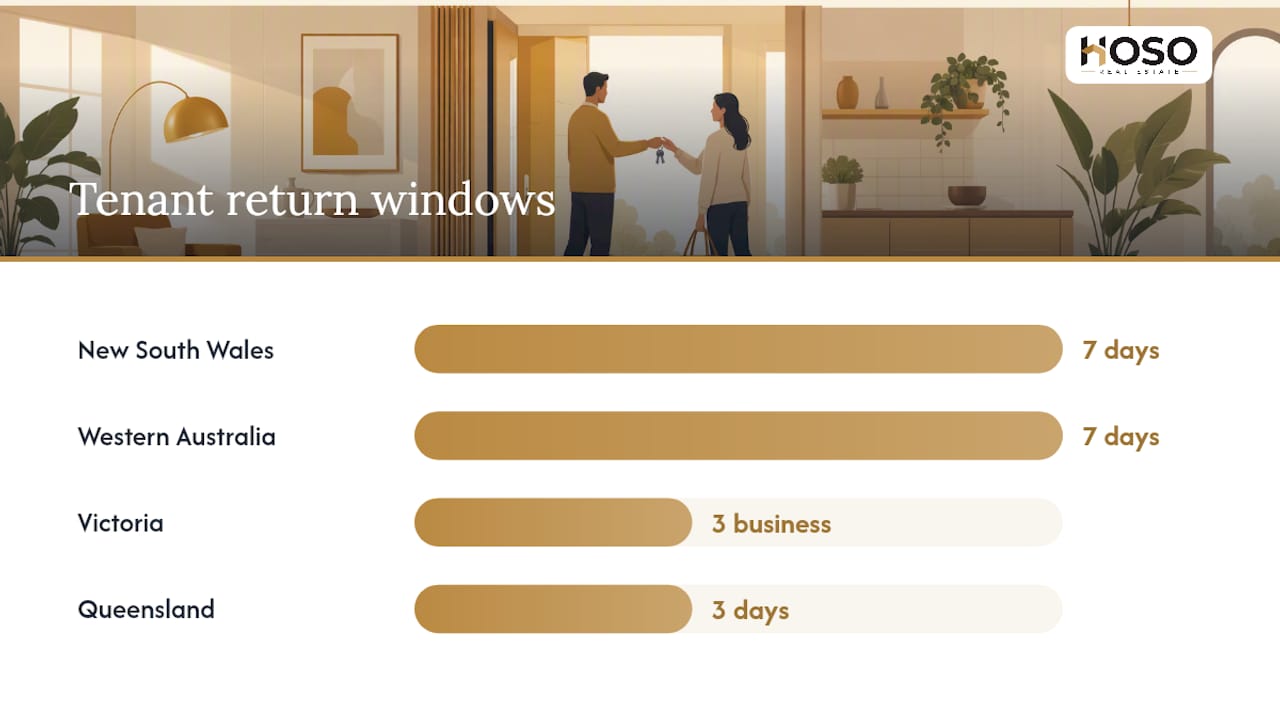
| State/Territory | Entry report required | Tenant return window | Mandated template |
|---|---|---|---|
| South Australia | Yes — inspection sheet at tenancy commencement | Tenant returns signed copy; landlord retains original | CBS official form (PDF) |
| New South Wales | Yes — condition report at or before key handover | Tenant returns within 7 days | NSW Fair Trading template |
| Victoria | Yes — condition report before or on day of possession | Tenant returns within 3 business days | Consumer Affairs Victoria template |
| Queensland | Yes — Entry Condition Report before or at key handover | Tenant returns within 3 days | RTA Form 1a |
| Western Australia | Yes — Property Condition Report at key handover | Tenant returns within 7 days | Department of Mines, Industry template |
SA-specific notes:
- The Residential Tenancies Regulations 2025 (SA) prescribe the content requirements for the inspection sheet. Using the CBS form satisfies these requirements.
- When a tenancy is renewed with the same tenant, SA law requires a fresh inspection sheet at the commencement of each new agreement. A carry-over from the previous tenancy is not sufficient.
- Failure to provide the inspection sheet at commencement weakens your position at SACAT if a bond dispute arises, because you cannot demonstrate the agreed starting condition.
- Practical guidance suggests completing the entry report within the first five days and retaining signed copies for the full tenancy period plus any applicable limitation period.
A guide to condition reports in SA notes that some digital platforms now provide templates and completion workflows that align with SA requirements, which can reduce completion time significantly.
How to use the condition report at move-out and in disputes
The exit inspection is where property condition report best practices either pay off or expose gaps. The process is sequential and must be documented at each step.
Exit inspection workflow
- Invite the tenant in writing (email or SMS) to attend the exit inspection. Keep the message and any reply. This written record demonstrates procedural fairness and is relevant if the matter reaches SACAT.
- Conduct the inspection after the tenant has vacated and before any cleaning or repairs. Photographing a property after it has been cleaned removes the evidence of the condition the tenant left it in.
- Compare line by line against the entry inspection sheet. For each item, note whether the condition has changed beyond fair wear and tear.
- Photograph every discrepancy from the same angle as the entry photo. Place the entry and exit photos side by side in your evidence folder.
- Note tenant attendance on the exit report. If the tenant does not attend, record that and retain your written invitation as evidence.
Tribunal evidence checklist
When preparing for a SACAT bond dispute, SACAT's guidance on providing documents makes clear that well-organised evidence is expected before a hearing is listed. Assemble:
- Signed entry and exit inspection sheets
- Timestamped photos (entry and exit, matched angles)
- Paid invoices or formal quotes on company letterhead with itemised tasks
- Rental ledger showing the full tenancy period
- Signed tenancy agreement
- Written communications (emails/SMS) relating to the dispute
Matched entry and exit photos, itemised inspection sheets and invoices are central to success in bond disputes. Vague invoices are routinely discounted by SACAT.
Dispute resolution steps
Attempt informal resolution first. Contact the tenant directly, document the exchange, and give them a reasonable opportunity to respond. If that fails, CBS can provide advice and conciliation support before you apply to SACAT. Handling condition report disputes in SA recommends keeping dated copies of all correspondence and escalating to CBS or SACAT only after direct resolution has been attempted and documented.
Pro Tip: The two most common evidence mistakes at SACAT are submitting photos without matching entry shots, and presenting invoices that list only a lump sum rather than itemised tasks. Fix both before you file.
Official templates and digital tools for Australian landlords
Official SA forms
The CBS provides the official SA inspection sheet (229KB PDF) along with the Notice to Enter Premises form. These are the recommended starting point for any SA tenancy. The Law Handbook SA also provides guidance on how to complete and exchange the form correctly.
For other states: NSW Fair Trading publishes its condition report template on the Fair Trading website; Tenants Victoria provides condition report guidance and a sample form through Consumer Affairs Victoria.
Digital tools worth considering
- Condition report apps — (e.g. those that allow room-by-room completion on a tablet with photo attachment and digital signature capture) reduce transcription errors and produce a timestamped PDF automatically.
When customising any template, retain all prescribed fields from the CBS form. Adding rooms or items is fine. Removing prescribed fields risks non-compliance with the Residential Tenancies Regulations 2025 (SA).
HOSO Real Estate's workflow for condition reports
HOSO Real Estate applies a consistent end-to-end workflow across every managed property in Adelaide and South Australia. The steps below reflect the process used to produce SACAT-grade evidence and protect client portfolios.
End-to-end workflow
- Routine inspections: conduct scheduled routine inspections during the tenancy and update condition notes where relevant. Routine inspection reports are stored in the same folder structure as the entry report. This supports proactive maintenance scheduling and early identification of issues before they escalate.
- Evidence packaging: — assemble the signed entry and exit sheets, matched photos, invoices, rental ledger, tenancy agreement, and all written communications into a single labelled folder, ready for CBS conciliation or SACAT if required.
Folder structure HOSO uses
[Property address]_[Tenancy start date]/
  ├── Entry_Inspection/
  │   ├── InspectionSheet_Signed.pdf
  │   ├── Photos/
  │   └── MeterReadings/
  ├── Routine_Inspections/
  │   └── [Date]_Routine/
  ├── Exit_Inspection/
  │   ├── InspectionSheet_Signed.pdf
  │   ├── Photos_Matched/
  │   └── Invoices_Quotes/
  └── Communications/
Key takeaways
A complete, itemised entry inspection sheet with timestamped photos and documented tenant communications is the single most effective protection against bond disputes and adverse SACAT outcomes in South Australia.
| Point | Details |
|---|---|
| Use the official CBS form | The SA Government inspection sheet satisfies the Residential Tenancies Regulations 2025 (SA) and signals compliance from day one. |
| Photograph before and after | Match exit photos to entry angles exactly; SACAT relies on side-by-side comparison to assess damage versus fair wear and tear. |
| Document all communications | Written invitations to the exit inspection and any dispute correspondence strengthen your procedural position at SACAT. |
| Itemise every invoice | Lump-sum quotes are routinely discounted at tribunal; attach paid invoices with itemised tasks on company letterhead. |
| HOSO Real Estate manages this end-to-end | HOSO's workflow covers entry inspection, digital evidence storage, routine inspections, and dispute support for Adelaide landlords. |
The case for treating condition reports as portfolio infrastructure
Most landlords treat the inspection sheet as a formality. That is the wrong frame. A correctly completed entry report, maintained through routine inspections and closed out with a matched exit report, is infrastructure. It is the document that determines whether a bond claim succeeds, whether a maintenance dispute is resolved quickly, and whether a SACAT hearing is even necessary.
The properties where disputes escalate most often are not the ones with the worst tenants. They are the ones where the entry report was vague, the photos were taken after the tenant moved in, or the exit inspection was conducted after cleaning had already started. Each of those gaps is procedural, not factual. The damage may be real, but without the evidence, the claim fails.
South Australian landlords operating in suburbs like Norwood, Unley, Prospect, and Burnside are managing assets worth significant capital. Treating the inspection sheet with the same rigour as a building and pest report is not excessive. It is proportionate to the risk.
How HOSO Real Estate supports landlords with condition reports
For Adelaide landlords who want SACAT-grade inspection records without managing the process themselves, HOSO Real Estate handles every stage: entry inspection completion using the CBS form, digital photo management with consistent file naming, tenant handover documentation, routine inspection reporting, and exit evidence packaging.
The process is built around compliance and asset protection, not just convenience. Every inspection file is stored in a structured format that can be presented to CBS or SACAT without additional preparation. Landlords with properties in suburbs like Glenelg, Prospect, and Burnside receive the same standard of documentation regardless of property value.
To see how HOSO manages inspections and compliance across its Adelaide portfolio, visit the HOSO Real Estate services page.
Useful sources and official forms
Official forms and guidance for South Australian landlords and property managers:
- Residential Tenancies (Law Handbook) — inspection sheet requirements and landlord obligations.
- Inspection sheet to record the condition of the property (229KB PDF) and other tenancy forms (SA Government).
- Providing documents for housing disputes (SACAT guidance).
- SACAT Bond Dispute Guide SA 2026 | Property Manager Step-by-Step
- Exit Condition Report SA 2026 | Outgoing Inspection Sheet Guide
- A guide to condition reports in SA | RentBetter
- Handling condition reports & inspection disputes in SA - aussierentlaws.com
- TABLE OF PROVISIONS — Residential Tenancies Regulations 2025 (SA)
This article provides general information about property condition reports in South Australia. It is not legal advice. Confirm current requirements with CBS, the Law Handbook SA, or a qualified property lawyer before acting on specific compliance questions.