
A property management statement is a detailed financial report issued monthly by a property manager, summarising all income received and expenses paid for a rental property during a set period. Also called an owner statement, it is the primary document showing landlords exactly what their investment earned, what it cost to run, and what was paid out to them. For property owners and investors in South Australia, understanding this document is not optional. It is the foundation of sound investment oversight.
Most management firms distribute these statements within the first week of the following month. That timing matters because it sets the rhythm for your financial review cycle. A statement arriving late, or one that lacks detail, signals a problem with the agency managing your asset. HOSO Real Estate treats the owner statement as a core deliverable, not an afterthought.
What is a property management statement and what does it contain?
A property management statement documents every financial transaction linked to your rental property within a given month. Standard components include rent collected, other income, management fees, maintenance costs, utilities, and the final owner distribution. Each line item tells part of the story of your property's financial health.

Income section
The income section records all money received on behalf of the owner during the period. This includes:
- Rent collected: The actual rent paid by the tenant, which may differ from the rent charged if a tenant is in arrears.
- Late fees: Any fees charged to the tenant for overdue rent, where applicable under the tenancy agreement.
- Other income: Pet bonds, lease renewal fees, or any additional income streams tied to the property.
Expense section
Expenses are deducted from gross income before the owner distribution is calculated. Common line items include:
- Management fees: The agency's fee for managing the property, expressed as a fixed amount for the period.
- Maintenance and repairs: Costs for work orders completed during the month, ideally with invoice references attached.
- Utilities and council rates: Any outgoings paid by the agency on the owner's behalf.
- Reserve account contributions: Funds set aside for anticipated future expenses or capital works.
Owner contributions are funds landlords send to cover shortfalls when expenses exceed income in a given month. These appear clearly on a well-prepared statement, alongside the reserve account balance and the net amount distributed to the owner.
Pro Tip: Always check that maintenance line items on your statement reference a corresponding invoice number. If your statement lists a repair cost without an invoice reference, request the supporting documentation before accepting the charge.
Owner distribution
The owner distribution is the net amount transferred to your nominated bank account after all income and expenses are reconciled. This figure is the result of the entire statement, but it should never be the only number you review.
How does a property management statement differ from other property reports?
Property owners receive several types of documents from their manager, and confusing them leads to gaps in financial oversight. The table below clarifies the key differences.
| Document | What it shows | Primary purpose |
|---|---|---|
| Owner statement | Actual cash received and paid in the period | Monthly financial reconciliation |
| Rent roll | Scheduled rent for all tenancies | Occupancy and rent tracking |
| Maintenance summary | Work orders raised and completed | Asset condition monitoring |
| Annual tax summary | Aggregated income and expenses for the financial year | Tax preparation support |
Owner statements reflect cash-based reality, documenting actual amounts collected and paid. A rent roll, by contrast, tracks what should have been collected. If a tenant paid late, the rent roll shows the scheduled amount while the statement shows what actually came in. Both documents are needed, but they answer different questions.
Many landlords confuse owner statements with tax documents. While statements are useful for tax preparation, they are internal management reports. They do not serve as legal proof of ownership. Maintaining a permanent archive of monthly statements and supporting invoices simplifies tax filing and any future financial audit.
Maintenance summaries and work order logs complement the owner statement by providing the detail behind repair line items. Cross-referencing these documents against your statement is the most reliable way to confirm that every charge is legitimate and correctly categorised. For landlords managing properties in suburbs like Norwood, Prospect, or Unley, where older housing stock generates regular maintenance activity, this cross-referencing habit pays dividends.
What key insights can owners gain from reviewing property management statements?
A property management statement is not just a receipt. It is a performance report for both your property and your property manager. Reviewing it with that lens changes what you look for.
Assessing cash flow and profitability
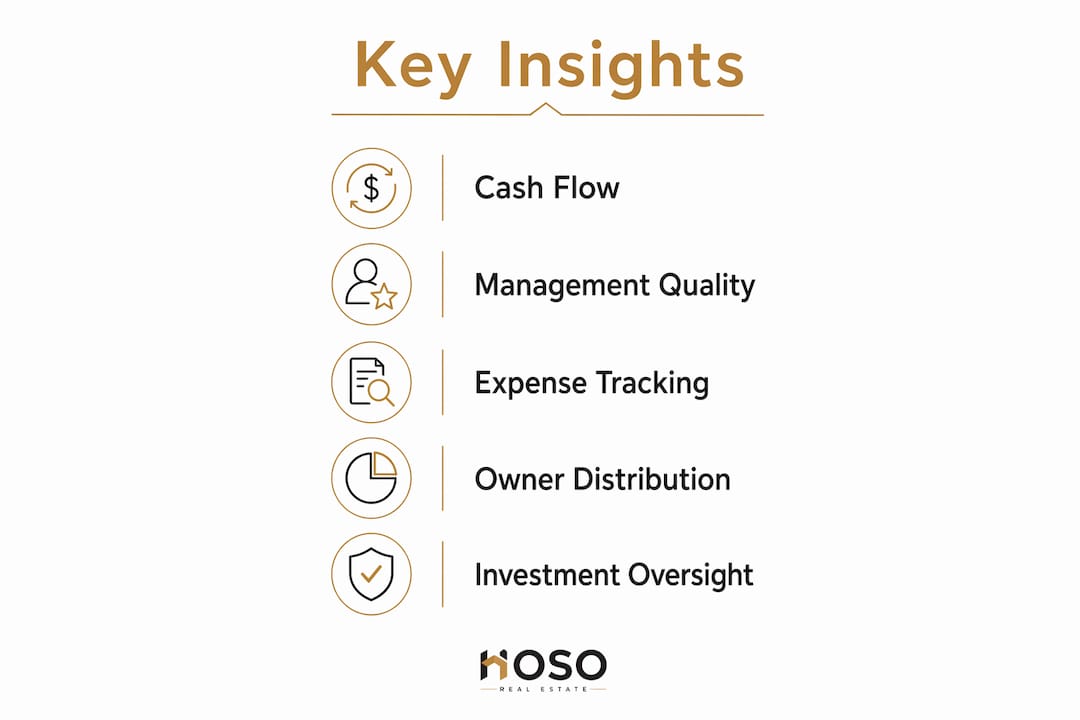
The net owner distribution tells you what you received. The gross income and expense lines tell you why. A property generating strong rent but showing high maintenance costs month after month signals a maintenance backlog or a building condition issue that needs attention. Spotting this pattern early prevents larger capital expenditure later.
Identifying management quality
The monthly owner statement is the key touchpoint showing the management company's operational standards through timeliness, clarity, and detail. Statements arriving after the 20th of the following month suggest delayed bookkeeping and lower operational standards. That delay is not just inconvenient. It means your financial data is stale when you need it to make decisions.
Transparent, digital real-time reporting signals professional management. Vague or late statements often mask operational inefficiencies. When evaluating your current agency, the quality of your monthly statement is one of the clearest indicators of how well your asset is being managed. For guidance on vetting a property management agency, statement quality should sit near the top of your checklist.
Common pitfalls to avoid
- Relying only on the deposit amount: The net figure tells you what arrived in your account, not whether your property is performing well. A high distribution in one month could reflect deferred maintenance rather than strong performance.
- Ignoring reserve account movements: Reserves protect you from unexpected large expenses. If your reserve balance is declining without explanation, ask why.
- Accepting vague expense descriptions: "Maintenance" as a line item without a description or invoice reference is insufficient. Demand specifics.
- Skipping months: Patterns only emerge over time. Reviewing statements quarterly instead of monthly means you miss early warning signs.
Pro Tip: Set a recurring calendar reminder on the 10th of each month to review your owner statement. If it has not arrived by that date, contact your property manager. Consistent late delivery is a red flag worth acting on.
How to use property management statements to improve your investment oversight
Regular statement review is a discipline, not a one-off task. Building a structured approach to rental property oversight turns your monthly statement from a passive document into an active management tool.
- Review every line item, not just the total. Compare income against the rent roll to confirm full collection. Check each expense against prior months to spot unusual increases.
- Cross-reference maintenance charges with work orders. A high-quality property management report includes a maintenance summary alongside the financial statement. Match repair costs to completed work orders to confirm accuracy.
- Build a 12-month expense tracker. Record your monthly maintenance, management, and utility costs in a simple spreadsheet. This gives you a baseline for budgeting and flags cost creep before it becomes significant.
- Use statements to plan capital works. If your property in Glenelg or Henley Beach is showing recurring plumbing or electrical costs, your statement history provides the evidence base for a planned upgrade rather than a reactive repair.
- Archive every statement permanently. Maintaining a permanent archive of monthly statements and supporting invoices simplifies tax preparation and financial audit processes. Store digital copies in a dedicated folder, organised by financial year.
- Ask your property manager questions. A good manager welcomes questions about statement line items. If your manager is evasive or slow to respond, that behaviour is itself useful information about their standards.
Owner portals offered by professional agencies give landlords access to statements, invoices, and inspection reports in real time. This removes the lag between a transaction occurring and you seeing it. For interstate or overseas investors managing South Australian properties remotely, real-time portal access is not a luxury. It is a practical necessity. Understanding what property management involves helps you set the right expectations for the reporting you should receive.
Key takeaways
A property management statement is the single most important monthly document a landlord receives, and its quality directly reflects the standard of the agency managing your investment.
| Point | Details |
|---|---|
| Definition and timing | An owner statement is a monthly financial report; professional agencies deliver it within the first week of the following month. |
| Core components | Statements must show gross income, itemised expenses, reserve balances, and the net owner distribution. |
| Statements vs other reports | Owner statements show actual cash flows; rent rolls show scheduled rent; tax summaries aggregate the full year. |
| Management quality indicator | Late or vague statements signal operational problems; timely, detailed statements signal professional management. |
| Oversight discipline | Review every line item monthly, cross-reference maintenance invoices, and archive all statements permanently. |
Why statement quality is the first thing I look at
After working across Adelaide's property management sector, the owner statement is the document I reach for first when assessing how well a property is being managed. Not the lease. Not the inspection report. The statement.
A detailed, timely statement tells me the agency has its bookkeeping in order, its maintenance records organised, and its communication with owners prioritised. A vague or late statement tells me the opposite, regardless of how polished the agency's website looks. Landlords often focus on tenant selection or maintenance response times when evaluating their manager. Those matter. But the statement is the evidence trail that proves everything else is actually happening.
The most common mistake I see is landlords who review only the deposit amount each month. They see money arrive and assume all is well. A property can be losing ground financially while still generating a positive monthly distribution, if maintenance is being deferred, reserves are being underfunded, or expenses are being miscategorised. The detail in the statement is where those problems surface.
My advice to any landlord, whether you own one property in Prospect or a portfolio across the northern suburbs, is to treat your monthly statement as a management performance report. Read it line by line. Ask questions. Expect clear answers. If your current agency cannot provide that level of transparency, it is worth considering whether they are the right fit for your investment. You can also review how property management protects landlords to understand the full scope of what professional management should deliver.
— HOSO
HOSO Real Estate and owner reporting standards
HOSO Real Estate delivers detailed, itemised owner statements to landlords across Adelaide, with statements available through a real-time owner portal so you always have current financial data at hand. Every statement includes income, expenses, maintenance references, and owner distributions, with supporting invoices accessible alongside each report. For landlords who want comprehensive property management services built around transparency and financial clarity, HOSO Real Estate provides the reporting standard your investment deserves. Whether you manage a single rental in Burnside or a multi-property portfolio across metropolitan Adelaide, the quality of your monthly statement should never be a point of uncertainty.
FAQ
What is a property management statement?
A property management statement, also called an owner statement, is a monthly financial report prepared by a property manager. It summarises all rent collected, expenses paid, management fees charged, and the net amount distributed to the property owner.
How often should I receive an owner statement?
Most management firms distribute owner statements within the first week of the following month. Receiving your statement after the 20th is a sign of delayed bookkeeping and warrants a direct conversation with your agency.
Is a property management statement the same as a tax document?
No. Owner statements are internal management reports used for monthly financial tracking. They support tax preparation but do not replace formal tax documents or serve as legal proof of ownership.
What should I do if my statement has unexplained charges?
Request the supporting invoice or work order for any expense you cannot identify. A professional property manager will provide this documentation promptly. Persistent inability or unwillingness to supply invoices is a red flag.
Can I access my owner statement online?
Professional agencies provide owner portals where statements, invoices, and inspection reports are available in real time. This is particularly useful for interstate and overseas investors managing South Australian properties remotely. Understanding what to look for in a rental agreement and related documents also helps landlords build a complete picture of their property's financial position.