

Vetting a property management agency is the process of systematically verifying an agency's licences, financial controls, communication standards, and operational performance before entrusting them with your investment property. Done properly, it protects your rental income, your asset, and your legal standing as a landlord in South Australia. Skipping this process is the single most common reason property owners end up with poor tenant outcomes, unresolved maintenance, and funds at risk. This guide gives you a structured framework to assess any agency with confidence, from first contact through to a 90-day performance review.
What licences and compliance to verify when vetting a property management agency
Licence verification is the first non-negotiable step when choosing a property management agency. In South Australia, property managers must hold a current registration or licence issued under the Land Agents Act 1994. You can verify this through Consumer and Business Services (CBS) South Australia via their online public register. An agency operating without a valid licence exposes you to significant legal and financial risk.
Trust account compliance is equally critical. Agencies holding rental income and bond money on your behalf must maintain a designated trust account at an authorised deposit-taking institution. Trust accounts must be audited yearly, with audit reports lodged by 30 september each year. This annual audit cycle is the clearest indicator of whether an agency handles client funds with proper discipline.
Requesting documentary evidence of trust account handling and reconciliation cadence separates mature agencies from those operating loosely. A well-managed agency will provide this without hesitation. One that deflects or delays is a warning sign. For a full breakdown of what to check, the SA licence verification guide covers compliance requirements in detail.
- Confirm the agency holds a current Land Agents Act licence via CBS South Australia
- Ask for the name of their designated trust account and the institution holding it
- Request a copy of their most recent trust account audit report
- Confirm the audit was lodged on time and by a registered auditor
Pro Tip: Ask the agency directly: "Can you provide your last trust account audit report?" A confident, immediate response tells you more than any brochure.
How to evaluate fees, financial handling, and contract terms
Fee transparency is a direct indicator of how an agency will manage your money over time. The most common fee models include a management fee (a percentage of weekly rent), a leasing fee (often one to two weeks rent), and maintenance markups. Leasing fees that incentivise tenant churn and high maintenance markups can quietly erode your returns without ever appearing on a headline rate comparison.

Contract terms deserve the same scrutiny as fees. Cancellation clauses typically range from 30 to 90 days. Any contract with a lock-in period beyond 90 days, combined with a financial penalty for early exit, is a red flag. You need the ability to exit cleanly if performance falls short.
Maintenance approval thresholds and markup transparency are two of the most common sources of landlord-agency disputes. Vague contract language around who approves what spend, and at what margin, creates ambiguity that costs you money. Demand clear, auditable terms before signing anything. The property management contract guide for SA landlords explains what specific clauses to look for.
| Fee type | What to check |
|---|---|
| Management fee | Percentage of weekly rent; confirm GST inclusion |
| Leasing fee | Flat weeks rent or percentage; check if charged on renewals |
| Maintenance markup | Percentage above trade invoice; must be disclosed in writing |
| Vacancy fee | Some agencies charge during vacant periods; confirm upfront |
| Exit fee | Penalty for early termination; acceptable range is nil to one month |
- Request a sample owner statement to verify how disbursements are itemised
- Confirm rent collection frequency (weekly, fortnightly, or monthly)
- Ask how maintenance invoices are presented and whether markups are itemised
- Check whether the contract auto-renews and on what terms
Pro Tip: Compare fee structures alongside vacancy and retention data, not in isolation. A lower management fee means nothing if the agency has a pattern of long vacancies or high tenant turnover.
Which performance metrics and communication standards to assess
Poor communication is the number one reason owners switch property managers. 57% of owners who changed agencies cited communication failures as the primary cause. That figure reflects a systemic problem across the industry, not isolated incidents. When evaluating an agency, test their responsiveness before you sign, not after.
The core performance metrics to assess are vacancy rate, tenant retention rate, and maintenance response time. A low vacancy rate in a suburb like Norwood or Prospect tells you the agency prices and markets properties accurately. High tenant retention tells you they manage relationships well and reduce your re-leasing costs. Fast maintenance response protects your asset and keeps tenants in place.
Requesting sample owner reports before committing to an agency verifies whether their reporting is structured and consistent. A strong report includes rent collection status, maintenance updates, inspection outcomes, and financial reconciliation. An agency that cannot produce a sample report on request does not have a reliable operating rhythm.
Owner portals and digital tools are now standard in quality agencies. Platforms that give you real-time access to your financial statements, inspection reports, and maintenance logs remove the need to chase updates. Assess whether the agency uses a recognised property management platform such as PropertyMe or Console Cloud, and whether you will have direct portal access.
- Vacancy rate: ask for the agency's average days on market across their current portfolio
- Tenant retention: ask what percentage of tenancies are renewed versus re-leased each year
- Maintenance response: ask for their target response time for urgent versus routine requests
- Reporting cadence: confirm whether owner statements are issued monthly and on a fixed date
How to conduct a 90-day performance review
A 90-day review is the structured checkpoint every property owner should build into a new management arrangement. Assessing vacancy rates, maintenance response, rent collection, and reporting consistency at the 90-day mark gives you objective data to decide whether the relationship is working. Waiting longer to act on poor performance typically makes the management change more disruptive and more expensive.
- Set written expectations at the start. Before handover, document your expectations for vacancy turnaround, maintenance response times, and reporting frequency. This creates a baseline for the 90-day review.
- Review the first three owner statements. Check that disbursements are accurate, maintenance costs are itemised, and rent collection has been consistent. Errors in the first three months rarely self-correct.
- Assess communication quality. Count how many times you had to follow up on unanswered queries. One or two follow-ups is normal. A pattern of chasing is not.
- Request a performance summary from the agency. A professional agency will proactively offer this. If they do not, ask for it. Their response tells you a great deal about their culture.
- Decide and act. If no improvement plan is proposed after the 90-day review, initiate a management change. Delayed action leads to more costly transitions later.
Pro Tip: A management change does not require the tenancy to end. In South Australia, you can appoint a new agent while the existing lease continues. The transition affects the agency, not the tenant.
The role of a property manager in your investment extends well beyond collecting rent. Owners who treat the 90-day review as a formal process, rather than a casual check-in, retain far more control over their portfolio outcomes.
Key takeaways
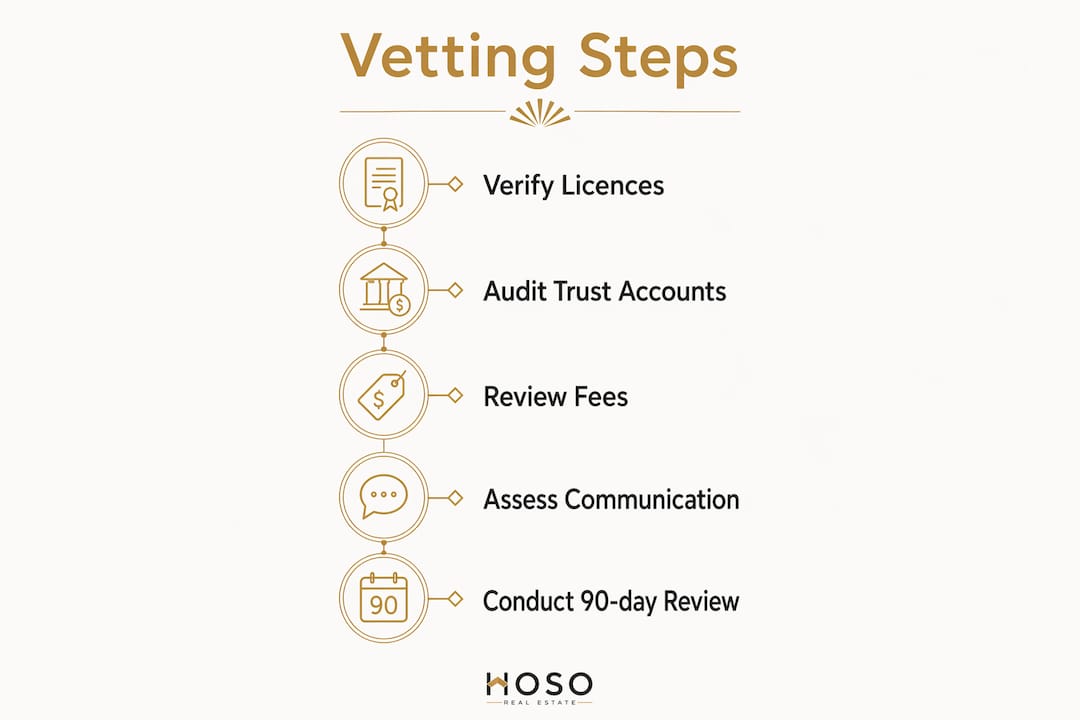
Effective vetting of a property management agency requires verifying licences, trust account compliance, fee transparency, communication standards, and performance metrics before and after appointment.
| Point | Details |
|---|---|
| Verify licences first | Confirm the agency holds a current licence via CBS South Australia before any other assessment. |
| Audit trust account evidence | Request the agency's most recent trust account audit report as proof of financial discipline. |
| Scrutinise fees and contracts | Compare leasing fees, maintenance markups, and exit clauses before signing any management agreement. |
| Test communication before signing | Poor communication is the top reason owners switch agencies; assess responsiveness during the vetting process itself. |
| Use a 90-day review | Set written performance expectations at handover and conduct a formal review at 90 days to protect your investment. |
What I have learned vetting property managers in Adelaide
The most common mistake I see Adelaide landlords make is treating the fee comparison as the whole vetting process. They get three quotes, pick the middle one, and sign. Six months later they are chasing their property manager for a maintenance update on a Glenelg unit or wondering why their Unley investment has been vacant for seven weeks. The fee was never the problem. The operating discipline was.
SA-specific trust accounting rules matter more than most owners realise. The requirement for annual audits and designated trust accounts is not bureaucratic box-ticking. It is the clearest signal of whether an agency treats client funds with the seriousness they deserve. I have seen agencies with polished websites and competitive rates that could not produce a clean audit report when asked directly. That is the question that separates the credible from the careless.
Communication is the performance metric that predicts everything else. An agency that responds to your enquiry within four hours during the sales process but takes three days to return a call once you are a client has shown you exactly who they are. Test them before you sign. Send an email at 5pm on a Friday and see what happens. The best practices for landlord oversight reinforce this point consistently. The agencies that perform well in Adelaide's current rental market are the ones that treat owner communication as a non-negotiable standard, not an afterthought.
— HOSO
Property management in Adelaide done with full transparency
HOSO Real Estate works with landlords and investors across Adelaide, from inner suburbs like Norwood and Prospect to growth corridors in the north and south. Every management arrangement includes transparent financial reporting, monthly owner statements, and direct access to your property data through our owner portal.

If you are evaluating property management agencies and want to see what structured, compliance-focused management looks like in practice, view our full services or browse our recently leased properties to assess our track record directly. HOSO Real Estate does not lock clients into long contracts with punitive exit clauses. Our position is simple: performance retains clients, not paperwork.
FAQ
What licences should a property manager hold in South Australia?
Property managers in South Australia must hold a current registration or licence under the Land Agents Act 1994. You can verify this through the Consumer and Business Services public register.
How do I check if an agency handles trust accounts correctly?
Request a copy of the agency's most recent trust account audit report. Well-managed agencies provide audited trust statements to owners and lodge audit reports annually by 30 september.
What is a reasonable cancellation clause in a property management contract?
A reasonable notice period for terminating a management agreement is 30 to 90 days. Contracts with longer lock-ins and financial penalties for early exit are red flags when evaluating property management services.
Why do most owners switch property managers?
57% of owners switch due to poor communication. Maintenance responsiveness and tenant management quality are the next most cited reasons.
What should a 90-day property manager review cover?
A 90-day review should assess vacancy rate, rent collection consistency, maintenance response times, and reporting accuracy. If the agency cannot demonstrate improvement or provide a clear plan, initiating a management change is the right call.