
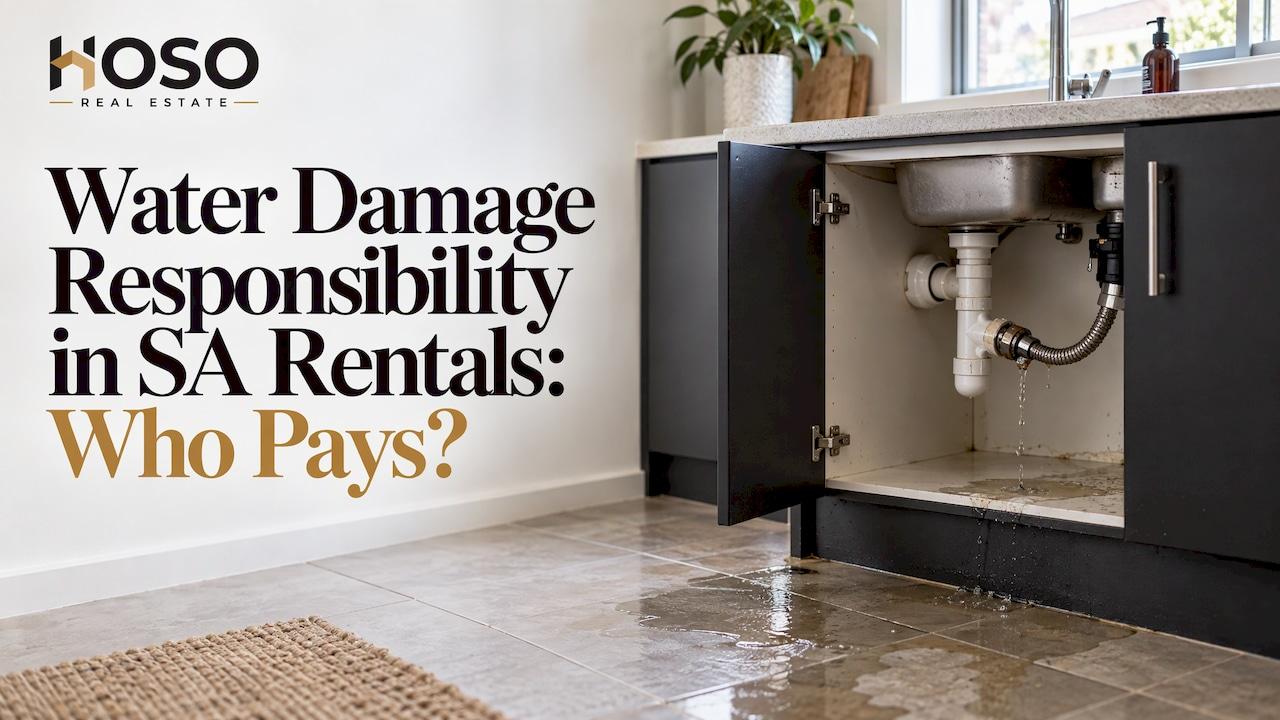
In a South Australian rental, the landlord is usually responsible for repairing water damage, unless the tenant caused it intentionally or through negligence. The Residential Tenancies Act 1995 (SA) sets the duty, and the cause of the leak, the notice given and the speed of the response decide how a dispute ends. This guide sets out how responsibility is allocated, how strata and neighbouring-lot leaks change the picture, what insurance may respond to, and how an Adelaide landlord protects the asset when water gets in.
TL;DR
- Landlords must keep the property in a reasonable state of repair under section 68 of the Residential Tenancies Act 1995 (SA). Water damage from failing pipes, roofs or fixtures normally sits with the landlord.
- Tenants are responsible for damage they cause intentionally or negligently (section 69), but not for genuine accidents or normal wear and tear.
- In strata or community titles, the source of the leak matters: common property is the corporation's job, and the lot is the owner's. The tenant's repair rights still run against their own landlord.
- Burst pipes and serious leaks are urgent. A tenant who notified you and got no action can arrange a licensed repairer and recover the cost.
- Disputes go through a written breach notice first, then SACAT. Early documentation and a fast response keep most matters from getting that far.
Table of Contents
- The starting rule: the landlord maintains, the tenant does not cause
- When the tenant is responsible
- What the landlord must do, and when
- Strata and community titles: where did the water start?
- Insurance: what may respond
- The first 24 hours after a leak is reported
- Prevention that holds up in a dispute
- Perspective from HOSO
- When it ends up in dispute: the SA process
- Having water issues handled for you
- FAQ
- Sources
The starting rule: the landlord maintains, the tenant does not cause
The South Australian Government says landlords are usually responsible for larger repairs, while tenants must repair damage they caused, including damage caused intentionally, through neglect or by visitors. Water damage follows the same logic.
Under section 68(1)(a) of the Act, the landlord must provide and maintain the premises in a reasonable state of repair, taking into account age, character and prospective life. TermLogic's analysis of the section notes that the duty applies even where the tenant knew of a defect before moving in. The SA Government adds two exceptions: items the tenancy agreement lists as excluded, and serious structural issues listed in a housing improvement notice.
In practice, these are landlord matters:
- a leaking roof, cracked tiles or blocked gutters letting water in
- a corroded or failed pipe inside a wall
- a failed hot water service
- a leaking built-in fixture such as a shower base, or a failed waterproofing membrane
- a faulty fixed dishwasher connection supplied with the property
For the wider list of duties, see our guide to landlord obligations in South Australia.
When the tenant is responsible
Section 69 of the Act says a tenant must not intentionally or negligently cause or permit damage. The Law Handbook for South Australia explains that this includes damage caused by guests, unless the tenant could not reasonably have prevented it. It also confirms the tenant is not responsible for genuine accidents or normal wear and tear.
Typical tenant-caused scenarios include:
- leaving a bath running and overflowing
- ignoring a dripping tap or a running toilet for weeks and not reporting it
- blocking a drain through misuse
- a guest leaving a washing machine hose unattached
The reporting duty matters as much as the cause. The Law Handbook says that if something needs repair, the tenant should notify the landlord as soon as possible under section 69(1). A leak that is reported early is usually a small repair. A leak that sat unreported can become a negligence question, and a mould problem that grows from it.
Accident versus negligence
A burst flexible hose that fails with no warning is typically a genuine accident or wear. A tenant who knew a hose was weeping and did nothing is closer to negligence. The evidence decides it: dated photos, tenant reports, the last routine inspection report and the age of the fitting. This is why an agent's records carry real weight if the matter reaches SACAT.
What the landlord must do, and when
The landlord is not automatically in breach the moment water appears. Under section 68(2), as explained by the Law Handbook, the landlord is not in breach unless they have notice of the defect and fail to act with reasonable diligence. Once the tenant gives notice, though, the clock is running.
The SA Government says landlords must carry out repairs within a reasonable time, and that a landlord who knows of a problem and does not repair it in that time could be breaking the agreement.
South Australia takes a principle-based approach to urgency rather than a fixed hour limit. Rental 360's summary reports that Consumer and Business Services SA advises dealing with urgent issues as quickly as possible, ideally within 24 to 48 hours depending on severity. Burst water pipes, serious leaks, flooding, serious roof leaks, sewage overflow and blocked drains creating health risks all sit in that urgent group.

On entry, the SA Government states a landlord can enter to carry out a repair at the tenant's request, or after at least 48 hours' notice (written is best). No notice is required for urgent repairs.
Urgent repairs and tenant self-help
Section 68(3) gives tenants a self-help remedy. Per the Law Handbook, it applies when all of these are true:
- the disrepair is not the tenant's fault
- it is likely to cause undue inconvenience or injury, or damage to the tenant's belongings
- the tenant notified the landlord or made reasonable attempts to
- the landlord failed to carry out repairs
The tenant can then arrange the repair using a suitably licensed person, who should provide a report on the apparent cause, and recover the cost. The Rental 360 analysis notes South Australia does not set a dollar cap on this, so the landlord may face a bill of any amount deemed reasonable. The takeaway for owners is simple: an unanswered leak report is the most expensive kind.
For jobs that are not urgent, see our guide to non-urgent repairs in SA.
Strata and community titles: where did the water start?
Units and townhouses in Adelaide add a second question: whose pipe, roof or wall was it?
The Law Handbook for South Australia explains that under section 10 of the Strata Titles Act 1988 (SA), the corporation holds common property in trust for all unit holders and must maintain it, while each unit holder maintains what is not common property. Marsh makes the same practical point: responsibility depends on where the problem started, what caused it and whether the pipe, fixture or building element belongs to the lot or common property.
| Source of the leak | Usually the responsibility of |
|---|---|
| Roof, external wall or shared pipe (common property) | Strata corporation |
| Pipe, fixture or appliance serving only your lot | Lot owner (the landlord) |
| Neighbouring lot's plumbing or appliance | That neighbouring owner, depending on cause |
| Tenant-caused overflow inside the lot | Tenant, if negligent or intentional |
Two points protect a landlord here.
The tenant still looks to you. TermLogic's analysis explains that a leak involving another lot or common property does not remove the landlord from the tenancy claim. The tenant's repair rights run principally against their own landlord under section 68, and waiting on an insurance assessment does not suspend your duty. Chase the corporation in parallel, and keep the tenant informed.
The Strata Titles Act has access and urgency powers. The Law Handbook notes that a unit holder may enter another unit, after practicable notice, where water supply or drainage fails and entry is needed to investigate or repair (section 42). Where urgent action is needed to avert a risk of injury or significant property damage, a corporation officer can authorise entry to a unit (section 28), and the unit holder is liable to the corporation for the reasonable cost of that work (section 28(4)). Where a lot's own fault caused the risk, you carry that exposure.
Insurance: what may respond
Insurance often decides who ultimately funds the repair, so read the policy before a leak happens.
- Strata insurance. Marsh states it may cover building damage from a sudden escape of water, such as a burst pipe, depending on cause and policy terms. Carpet, furniture and belongings may fall to the lot owner's, landlord's or tenant's own policies. Exclusions for wear and tear, corrosion, defects, maintenance problems and gradual deterioration can affect a claim.
- Landlord insurance. One landlord insurer's product disclosure statement lists cover for water escaping from items such as pipes, fixed basins and baths, appliances, tanks and roof gutters. It excludes loss from a leak the landlord knew about, or should reasonably have known about, and did not fix. Policies differ, so check yours.
- Tenant contents insurance. Youi advises tenants to check their contents policy, since a landlord's policy does not generally protect a tenant's belongings.
The insurer exclusion for known, unfixed leaks is the reason prompt action is also asset protection. A slow response can turn a covered sudden event into an excluded maintenance problem. EBM RentCover also notes that water damage caused by tenant actions, such as an overflowing appliance, is generally the tenant's responsibility.
The first 24 hours after a leak is reported
A sound sequence for owners and their agent:
- Stop the water. Isolate the supply or the appliance and make the area safe. Where there is any electrical risk, the tenant should keep clear and the agent should send a licensed tradesperson.
- Record everything. Youi quotes a property lawyer advising that the best step is a photo or video sent immediately, noting the location, the time it was noticed and the likely cause, with all contact kept in writing. Landlords should do the same: date-stamped images, trade reports and a log of contact.
- Engage a licensed trade for the cause. A written report on the apparent cause is the best evidence of whether it was wear, a defect or tenant conduct.
- Notify insurers and, if relevant, the strata manager early. Late notice can complicate a claim.
- Confirm the plan to the tenant in writing. State who is attending, when, and what happens if access or temporary accommodation is needed.
A tenant's guide to photographing a leak and notifying the landlord promptly matches the same principle: the earlier the evidence and the report, the cleaner the outcome for both sides.
Prevention that holds up in a dispute
Most water disputes are won or lost on the condition record. In Varricchio v Wentzel [2016] SASC 86, a tenancy dispute over mould and water damage reached the Supreme Court. CaseChat's summary records that the landlords' pre-tenancy inspections were found more cursory than a reasonably competent inspection would involve. The lesson is that thorough, dated condition reports matter.
Practical measures for Adelaide investors:
- Photograph wet areas, ceilings, window frames and the roof space at the start of every tenancy.
- Check gutters and downpipes before winter, which is when Adelaide's rain tends to expose roof and flashing faults.
- Replace ageing flexible hoses and hot water components before they fail.
- Look closely at window seals and frames, where slow leaks often begin. A window leak checklist helps you know what to look for at inspection time.
- Act on small drips quickly. Ongoing moisture can lead to mould, which is covered in our guide to mould in SA rentals.
- Keep inspection reports and maintenance logs in one place.
Older character homes in suburbs such as Unley, Norwood, Prospect and Glenelg often have original roofing, cast-iron or galvanised pipework and older bathroom waterproofing. Newer builds in areas like Mount Barker or Lightsview can have defect issues of a different kind, covered in our new build rental defects guide. Property age is part of what "reasonable state of repair" means under section 68, so a record of upkeep supports you.
Perspective from HOSO
Water damage is rarely a surprise in hindsight. It is usually a small defect that was reported late, recorded poorly, or sat in someone's inbox.
We manage property only, not sales, so our attention is on how an asset performs year after year. For water issues, that means three things. Condition reports that stand up if a matter goes to SACAT. A tenant-screening process, including our four-layer HPTS system, designed to place tenants who report problems early and care for the home. And an owner portal, available 24/7, so you can see maintenance activity and records as they happen, wherever you live.
Interstate and overseas owners carry the most exposure, because a leak found on day three costs far less than one found on day thirty. We built our maintenance coordination around fast tradesperson dispatch and written records for exactly that reason.
Our view: the cheapest water damage is the one documented and fixed within a day.
HOSO
When it ends up in dispute: the SA process
South Australia has a set order of steps.
- Written notice. SACAT says that before applying, a party should first give the other a notice to correct the breach. Tenants may use Form 4, Notice to landlord to remedy breach of agreement.
- Time to remedy. If the breach is not remedied within the permitted time, the other party may apply to SACAT to end the agreement.
- SACAT application. SACAT can hear applications for orders requiring a party to remedy a breach or clarifying rights and obligations, with failure to carry out reported repairs given as an example.
- Hearing. Per the Law Handbook, monetary claims must not exceed $40,000 unless both parties consent in writing, and applications are generally heard within 2 weeks and no later than 6 weeks after lodgement.
Where a tenant caused damage and offers to repair, the SA Government says the landlord can agree to that arrangement. If damage remains unrepaired, the landlord can issue a notice asking the tenant to fix it or the agreement will end. Rent that is lost along the way is a separate issue, covered in our guide to recovering rent arrears in South Australia. For the broader compliance picture, see Adelaide rental compliance requirements.
Having water issues handled for you
If you would rather not manage tradespeople, notices and records yourself, we handle maintenance coordination, property inspections, lease administration and tenant screening for Adelaide landlords. See our property management services, or request a rental appraisal for your property.
FAQ
Is the landlord or the tenant responsible for water damage in SA?
Usually the landlord, because section 68 requires the property to be kept in a reasonable state of repair. The tenant is responsible where they caused the damage intentionally or negligently under section 69. Genuine accidents and normal wear and tear are not the tenant's responsibility.
Who pays if the leak comes from the unit upstairs?
It depends on the source and cause. Common property is the strata corporation's responsibility, and a neighbouring lot's plumbing is generally that owner's. Your tenant's repair rights still run against you as their landlord, so act first and pursue the responsible party or insurer afterwards.
Can a tenant arrange urgent repairs themselves?
Yes, in limited circumstances. Under section 68(3), the disrepair must not be the tenant's fault, must risk undue inconvenience, injury or damage to belongings, and the landlord must have been notified and failed to act. The tenant should use a suitably licensed person who provides a report on the apparent cause.
Will landlord insurance cover water damage?
Often for sudden events such as a burst pipe, depending on the policy. Policies commonly exclude gradual leaks and leaks the landlord knew about and did not fix. Read your product disclosure statement and notify your insurer promptly.
Where does a water damage dispute go if it cannot be settled?
To SACAT, after a written notice asking the other party to remedy the breach. SACAT can order repairs, clarify obligations or consider compensation, and applications are generally heard within 2 to 6 weeks of lodgement.
Sources
- SA.GOV.AU: Repairs and maintenance in private rental
- Law Handbook SA: Repairs
- Law Handbook SA: Repairs (landlord notice and tenant self-help)
- Law Handbook SA: Strata and Community Titles
- Law Handbook SA: Resolving tenancy disputes
- SACAT: Breaches
- SACAT: Parties' rights disputes
- CaseChat: Varricchio v Wentzel [2016] SASC 86
- TermLogic: SA landlord repair duties and strata repairs
- Rental 360: Landlord repairs and maintenance obligations
- Marsh: Water damage in strata properties
- Youi: What to do if there is water damage in your rental
- RAA landlord insurance product disclosure statement
- EBM RentCover: Understanding water damage cover
- Window leak prevention checklist
- Water damage documentation and prompt reporting