
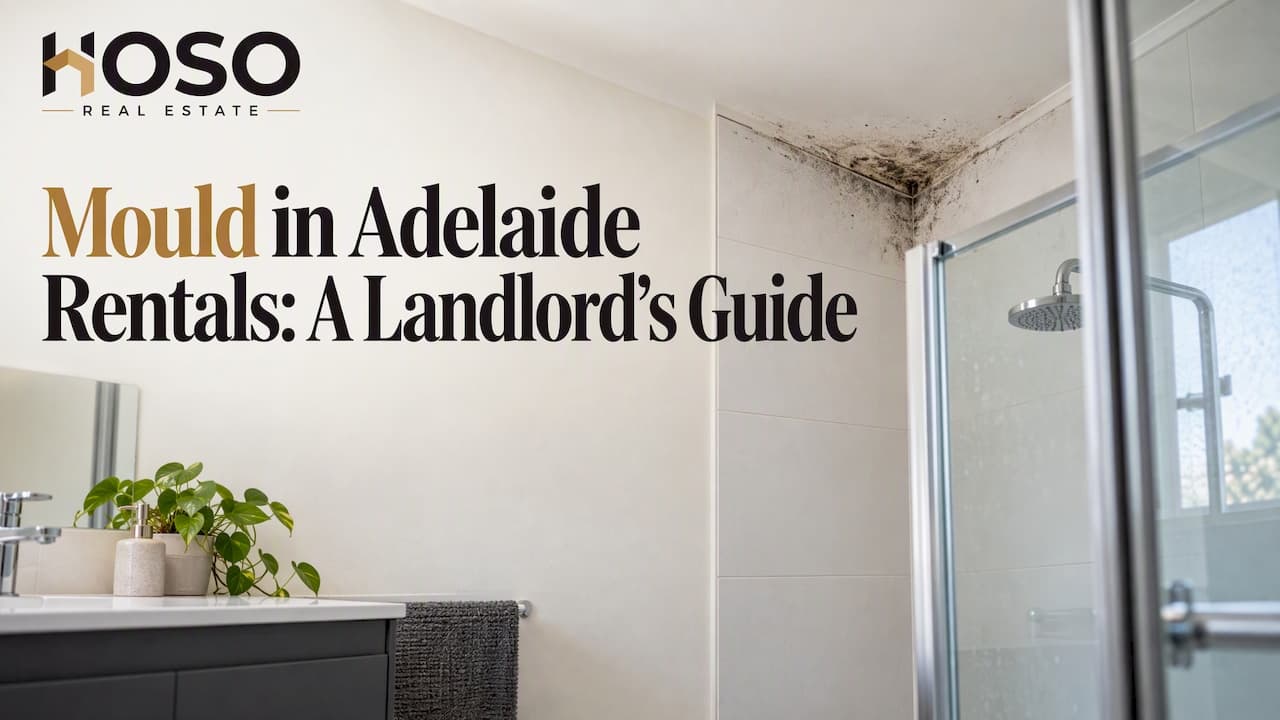
If a tenant reports mould in your South Australian rental, treat it as a repair request with a legal clock on it. Find the cause, fix the cause, then clean the surface. Responsibility depends mostly on why the mould is there. A leak, a failed seal or poor ventilation points to the property and to you. Damage caused by the tenant's own neglect points to them. Either way, a documented and timely response protects your asset and your position if the matter reaches the South Australian Civil and Administrative Tribunal (SACAT).
This guide covers what the rules say, what to do step by step, how landlord insurance treats mould, and how to reduce the chance of it happening at all.
TL;DR
- South Australian landlords must keep a rental in a condition that meets minimum housing standards, and mould linked to leaks, structure or ventilation is generally treated as the landlord's problem.
- Once notified, a landlord must arrange repairs within a reasonable time. Delay can amount to a breach of the tenancy agreement and lead to a SACAT application.
- Tenants can arrange urgent repairs through an authorised repairer and pass the invoice to the landlord.
- Most Australian landlord insurance policies exclude mould that results from gradual deterioration or poor maintenance, so prevention is your main protection.
- Fast action, a recorded cause and a clear paper trail reduce both the damage and the dispute risk.
Table of Contents
- Who is responsible for mould in a South Australian rental?
- What the law expects of you as the landlord
- What to do when a tenant reports mould
- What happens if the problem is not fixed
- Does landlord insurance cover mould?
- Preventing mould in Adelaide rentals
- Our perspective on mould in rentals
- How we can help
- A final check before the next winter
- FAQ
- Sources
Who is responsible for mould in a South Australian rental?
There is no single sentence in SA law that says "mould is the landlord's job" or "mould is the tenant's job". Responsibility follows the cause.
The landlord's side is the property itself. Under the state's private rental reforms, landlords must ensure a rental meets minimum housing standards at the start of a tenancy, and since 1 July 2024 tenants can request urgent repairs during occupation to meet those standards. Mould that grows because of a leaking roof, a failing pipe, a blocked gutter, rising damp, a defective exhaust fan or a poorly sealed wet area is a property condition problem. That sits with you.
The tenant's side is conduct. According to SA.GOV.AU, tenants are responsible for repairing damage they cause intentionally or through neglect, including damage caused by visitors or other household members. A tenant who dries laundry indoors every day with windows shut, never uses the bathroom fan and ignores condensation may share responsibility for the resulting growth.

In practice the cause is often mixed. A bathroom with a weak fan and a household that never ventilates it will grow mould, and a tribunal will look at both. That is why evidence matters more than argument.
Common causes, and who they usually point to
| Cause | Typical origin | Usually points to |
|---|---|---|
| Roof, gutter or pipe leak | Property defect | Landlord |
| Failed waterproofing or shower seals | Property defect | Landlord |
| Rising damp or poor subfloor ventilation | Structure | Landlord |
| Exhaust fan not working or not fitted | Fixture in poor condition | Landlord |
| No heating or ventilation use, indoor drying, blocked vents | Occupant behaviour | Tenant, or shared |
| Furniture pushed hard against external walls | Occupant behaviour | Tenant, or shared |
| Damage left unreported for months | Failure to notify | Shared |
The table is a guide, not a ruling. Each case turns on its facts, and an inspection report with photographs is the best way to establish them.
What the law expects of you as the landlord
Three duties matter most when mould appears.
Keep the property to standard. The minimum housing standards are the baseline. The prescribed standards under the Housing Improvement Regulations 2017 require that fixtures, fittings and facilities in bathrooms, kitchens and laundries are in sound condition, properly installed and not a health hazard. Mould in a wet area, caused by a failed fixture, falls straight into that territory. Our guide to room-by-room checks for minimum housing standards walks through what to check before a tenant moves in.
Repair within a reasonable time. SA.GOV.AU states that a landlord must carry out repairs within a reasonable time once notified, and that failing to do so may put the landlord in breach of the tenancy agreement. "Reasonable" is not defined by a number of days. A small patch of surface mould in a bathroom and an active roof leak over a bedroom are not the same urgency.
Respect the tenant's peace, comfort and privacy. The Law Handbook notes that landlords must not cause or permit interference with a tenant's reasonable peace, comfort or privacy. When you send a tradesperson to assess mould, follow the entry rules. Our overview of tenant privacy laws in SA covers how to arrange access properly.
For the wider picture, see our explainer on landlord obligations in South Australia and the Adelaide rental compliance requirements.

What to do when a tenant reports mould
Speed and records are what separate a routine repair from a tribunal file. Here is the sequence we recommend.
- Acknowledge in writing the same day. A short message confirming receipt, and the date, starts your paper trail. Tenants are required to tell the landlord when something needs fixing, so a clear report is the start of the clock.
- Ask for photos and detail. Where is it, how large, how long has it been there, is there a smell, any visible water, any recent leaks or storms?
- Inspect promptly. Arrange entry with proper notice. Photograph everything, note moisture sources, check exhaust fans, window seals, ceilings, subfloor vents and external drainage.
- Identify the cause before cleaning. Wiping a wall without fixing the leak behind it only resets the problem. If the cause is not obvious, bring in a licensed plumber, roofer or building inspector.
- Repair the source. Fix the leak, replace the fan, reseal the shower, improve drainage or add ventilation.
- Remediate the affected area. Small surface patches can be cleaned. Larger areas, mould on porous material like plasterboard or carpet, or repeated regrowth call for a professional.
- Confirm the outcome in writing. Tell the tenant what was found, what was done and what they can do to help keep humidity down.
If mould has an odour but no visible growth, it may be hiding behind a surface. Do not scrub or cut into it casually. Disturbing hidden growth can release spores, which is why a specialist assessment is the right call for any suspected concealed moisture.
When it is urgent
The state's repair rules let tenants arrange urgent repairs themselves. Per SA.GOV.AU, tenants may organise to have urgent problems fixed and give the landlord an invoice from an authorised repairer. A burst pipe feeding visible mould is the sort of situation where that could happen. If you are unreachable or slow, you lose control of who does the work and what it costs.
What happens if the problem is not fixed
A tenant who is ignored has options. If a landlord refuses or fails to address repairs within a reasonable time, SA.GOV.AU explains that tenants can apply to SACAT for orders requiring repairs, compensation for losses, or ending the tenancy.
There is a further risk. The Consumer and Business Services guidance on tenancy reforms states that tenants may serve a notice of termination if the premises are unsafe or do not comply with the prescribed minimum housing standards. Serious mould that you have let stand can therefore cost you a tenant mid-lease, a vacancy and a refit, on top of any tribunal outcome. If you ever face the other direction, ending a tenancy yourself, our SA tenancy termination guide sets out the process.
The pattern in disputes is consistent: the landlord who responded quickly and documented the cause is in a strong position. The landlord who left the message unanswered is not.
Does landlord insurance cover mould?
Usually not, and this surprises many owners.
The RAA landlord insurance product disclosure statement is typical of the market: damage from mould, mildew, wear and tear or gradual deterioration is excluded, and removal is generally not covered where mould results from poor maintenance. GIO says on its landlord insurance page that mould or mildew is excluded unless directly caused by an insured event and you can show it was not there before.
Two practical consequences follow.
- Baseline evidence counts. A clean, dated entry condition report and photographs of wet areas and ceilings give you something to prove that mould was absent before an insured event such as a storm or burst pipe.
- Policy conditions count. The 360 Underwriting landlords policy wording requires you to take reasonable steps to safeguard and maintain the property, and breaching conditions may reduce or prevent payment. Ignoring a leak for months is the kind of thing that can undermine a claim.
Policies differ, so read your own product disclosure statement and ask your insurer about water damage and mould before you need to claim.
Preventing mould in Adelaide rentals
Adelaide's climate is drier than much of the country, yet mould still appears. It tends to follow specific property features rather than the weather alone: bathrooms with weak extraction, laundries off the main living area, poorly drained courtyards, subfloor vents blocked by garden beds, and homes with little cross-ventilation. Older character homes in suburbs such as Unley, Norwood and Prospect, and coastal properties around Glenelg and Semaphore, deserve a closer look at damp, salt exposure and roof and gutter condition. Newer townhouses and apartments in places like Mawson Lakes or the city fringe can have sealed, low-airflow layouts where condensation builds in winter.
A short prevention routine covers most of the risk:
- Check exhaust fans at every routine inspection. Confirm they run, vent outside and are not clogged with dust.
- Inspect wet areas for failing silicone, cracked grout, loose tiles and staining on adjacent ceilings and walls.
- Clear gutters and downpipes before winter, and check that water drains away from the foundations.
- Keep subfloor vents clear and check for signs of damp at skirting level.
- Photograph the condition of wet areas at entry and each inspection, so changes are visible.
- Give tenants simple guidance at the start of the tenancy: use the fans, wipe down condensation, open windows when practical and keep furniture a little off external walls.
- Respond to the first small report. Early reports are cheap to resolve. Late ones are not.
For higher-value homes, a more rigorous schedule is worth adopting. Our piece on luxury rental property maintenance standards covers maintenance planning for premium properties, and the new build rental defects guide is useful when moisture problems show up in a recently completed home.
Our perspective on mould in rentals
We manage rentals only. We do not sell property, so our attention is on how a home performs as an income-producing asset over years, not on a single transaction. Mould is a good example of why that matters.
Most mould disputes we see described in the market are not really about mould. They are about a slow response, unclear communication and missing records. A landlord who hears "there is black spot in the bathroom" and replies within a day, inspects, finds the cause and tells the tenant what happens next has usually already solved the dispute, whatever the cause turns out to be.
That is why we build the process around three things: routine inspections that look at moisture sources rather than only cleanliness, maintenance coordination that routes the right trade to the right fault, and a 24/7 owner portal so you can see reports, photos and outcomes without chasing anyone. For owners based interstate or overseas, or simply too busy to attend, that visibility is the difference between controlling the asset and hoping for the best.
Tenant selection matters too. Our four-layer tenant screening is designed to place households who will treat the property carefully, which reduces the neglect side of the mould equation. Screening cannot remove a leaking roof, but it does help with the day-to-day habits that keep humidity under control.
— HOSO
How we can help
If you own an Adelaide rental and want inspections, maintenance coordination and compliance handled consistently, see our property management services. We are an Adelaide agency focused on property management, with a 60-day satisfaction guarantee, an owner portal and premium advertising on major portals. If you are weighing up a property before appointing an agent, you can also request a rental appraisal.
A final check before the next winter
Before the cooler months, run a quick audit of every property you own. Confirm the fans work, the gutters are clear, the wet areas are sealed and the last inspection photos are on file. If a tenant reports mould, reply the same day, find the source and put the outcome in writing. That sequence keeps you inside your obligations, protects the building and keeps good tenants in place.
FAQ
Is the landlord responsible for mould in South Australia?
Often, yes, when the cause is the property: leaks, structural moisture, failed seals or inadequate ventilation. Tenants are responsible for damage they cause through neglect or intentionally. Where both contribute, responsibility can be shared, so a documented inspection of the cause is essential.
What should a landlord do if there is mould?
Acknowledge the report in writing, inspect with proper notice and identify the moisture source. Repair that source within a reasonable time, then clean or remediate the affected area. Confirm the outcome to the tenant in writing and keep the photos and invoices.
What can a tenant do if mould is not fixed?
For urgent problems, a tenant may arrange an authorised repairer and give you the invoice. If repairs are not made within a reasonable time, they can apply to SACAT for repair orders, compensation or termination of the tenancy. Serious non-compliance with minimum housing standards can also let a tenant serve a notice of termination.
Is mould covered under landlord insurance?
Generally not. Policies from major Australian insurers commonly exclude mould and mildew from gradual deterioration or poor maintenance, and cover it only where an insured event directly caused it and you can show it was not there before. Check your product disclosure statement and ask your insurer about your specific policy.
Sources
- SA.GOV.AU: Repairs and maintenance in private rental properties
- Housing Safety Authority: Private rental reforms
- Housing Improvement Regulations 2017 (SA)
- Law Handbook: The landlord's obligations
- Consumer and Business Services: Tenancy reforms for landlords and agents
- RAA: Landlord and Short Stay product disclosure statement
- GIO: Landlord insurance
- 360 Underwriting: Landlords policy wording