

Outsourcing property management is the strategic delegation of routine, process-driven tasks to specialised external teams, allowing property owners and investors to maintain portfolio oversight without being consumed by day-to-day administration. For South Australian landlords managing properties across suburbs like Norwood, Prospect, or Glenelg, the operational load of tenant communication, maintenance coordination, and compliance tracking is substantial. PMVA reports that 65% of companies see increased productivity after outsourcing core business functions. That figure reflects a shift in how serious investors treat property operations: not as something to manage personally, but as a system to build deliberately.
Why outsource property management in 2026?
The reasons to outsource property management have grown sharper in 2026, particularly as South Australian tenancy compliance requirements have become more demanding. The Residential Tenancies Act 1995 (SA) has seen ongoing updates, and landlords who manage their own portfolios face real exposure if they miss notice periods, inspection obligations, or bond lodgement requirements.
The strategic drivers behind outsourcing go well beyond saving time:
- Scalability without proportional cost. Adding properties to a portfolio does not require hiring additional staff when external teams handle the volume. Third-party management offers scalability and market entry speed that in-house models cannot match at the same cost point.
- Access to technology without capital outlay. Outsourcing provides access to enterprise-grade technology and consistent data reporting without the cost of building systems internally.
- Cost reduction on labour. Outsourcing property management can save up to 70% on labour costs compared to full in-house staffing. The real return, though, is that senior staff are freed to build owner relationships and grow the portfolio.
- Process discipline. External providers operate with defined workflows. That consistency reduces errors in routine tasks like lease renewals, routine inspection scheduling, and maintenance follow-up.
- Relief from administrative load. Trust accounting, compliance documentation, and tenant correspondence are high-volume and low-margin in terms of strategic value. Delegating these tasks frees internal capacity for higher-value work.
Pro Tip: Before outsourcing, map every task your team performs in a typical week. Categorise each as either process-driven or judgement-driven. The process-driven list is your outsourcing shortlist.
The 2026 compliance environment in South Australia adds another layer of urgency. Landlords who lack dedicated administrative support are more likely to miss obligations, which creates liability. Outsourcing that function to a provider with current knowledge of SA tenancy law is a risk management decision, not just an operational one. You can read more about landlord protections in 2026 and how professional management supports compliance.

Which tasks should you outsource vs. keep in-house?
Not every property management function belongs with an external provider. The most effective approach is selective outsourcing: transferring specific, repeatable tasks while retaining high-judgement decisions internally. Callzent's 2026 guide confirms that outsourcing works best for high-volume, process-driven tasks, while sensitive decisions should remain in-house for quality control.
| Task | Recommended Approach |
|---|---|
| Maintenance coordination and scheduling | Outsource: high volume, process-driven, trackable |
| Tenant communication (general enquiries) | Outsource: benefits from 24/7 coverage and structured responses |
| Routine inspection scheduling and follow-up | Outsource: repeatable, documentation-heavy |
| Back-office leasing administration | Outsource: form processing, listing coordination, reference checks |
| Lease renewals and rent reviews | Keep in-house: requires owner context and negotiation judgement |
| Sensitive owner communications | Keep in-house: relationship-critical, brand-sensitive |
| Tenant dispute resolution | Keep in-house: requires SACAT knowledge and legal judgement |
| Strategic portfolio decisions | Keep in-house: investment-level decisions need direct accountability |
The logic is straightforward. Tasks that follow a defined process, repeat frequently, and do not require local relationship knowledge are strong candidates for external delegation. Tasks that involve owner trust, legal exposure, or strategic direction require internal ownership.
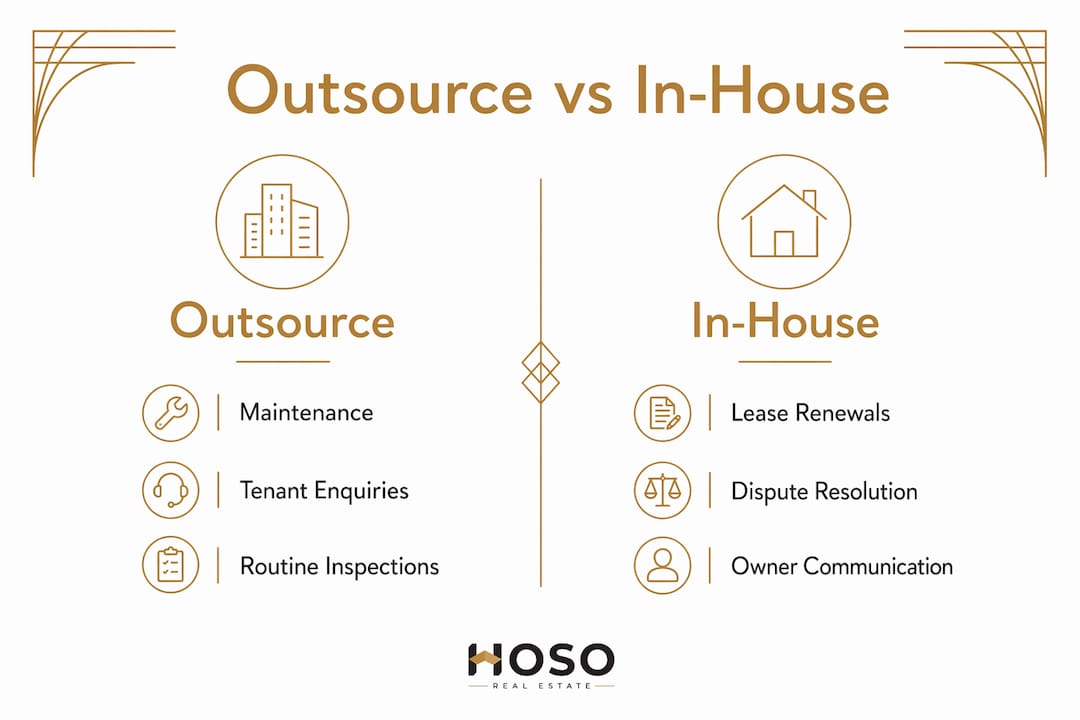
Clear role definitions matter as much as the decision itself. When an external provider handles maintenance coordination but your internal team manages the owner relationship, both parties need to know exactly where the handover point sits. Ambiguity in that boundary creates gaps in service quality and communication.
Pro Tip: Document a one-page task ownership matrix before onboarding any external provider. List every recurring task, assign it to either internal or external, and share it with both teams. Review it at 90 days.
South Australian compliance adds a specific consideration here. Inspection obligations, entry notice requirements, and bond lodgement rules under SA tenancy law are not generic processes. Any external provider handling these tasks must demonstrate current knowledge of SA-specific requirements, not just general property management practice. For a detailed breakdown of tasks to delegate to professionals, HOSO Real Estate has published practical guidance on this exact question.
How does outsourcing compare to in-house management?
Outsourcing and in-house management each carry distinct cost, control, and service quality profiles. Understanding the trade-offs helps you make a decision based on your portfolio's actual needs rather than assumptions.
Cost comparison
In-house management requires fixed costs: salaries, training, software licences, and office infrastructure. Outsourcing converts much of that fixed cost into a variable one. For a landlord with two or three properties in Adelaide's inner north, the cost of a full-time property manager is disproportionate. For an investor with 20 properties across Prospect, Mawson Lakes, and Morphett Vale, the calculus changes. The labour cost savings from outsourcing can reach 70%, but that figure applies most strongly to high-volume operations.
Control and communication risks
Loss of direct control and communication gaps are the primary risks of outsourcing. These risks are real but manageable. Service-level agreements, regular reporting cadences, and defined escalation paths reduce the likelihood of a provider operating outside your expectations. The risk is highest when owners outsource without establishing clear standards upfront.
Tenant satisfaction
Outsourcing can improve tenant satisfaction by providing structured, 24/7 communication coverage and faster responses across channels. Tenants in properties managed by professional teams with dedicated communication workflows report fewer unresolved maintenance issues and faster response times. That directly affects lease renewal rates and vacancy periods, both of which affect your net return.
The comparison between property management and self-managing is worth examining in detail if you are still weighing whether professional management pays for itself.
What steps should you take to outsource successfully?
Successful outsourcing does not happen by signing a contract and stepping back. It requires deliberate setup, clear expectations, and ongoing oversight. Follow these steps to implement it well.
-
Assess your portfolio and growth plan. Identify how many properties you manage, what tasks consume the most time, and where you plan to be in three years. A portfolio of five properties in Adelaide's eastern suburbs has different outsourcing needs than a 15-property portfolio spread across multiple council areas.
-
Identify your outsourcing shortlist. Use the task ownership framework from Section 3. List every process-driven, repeatable task that does not require your direct judgement or owner relationship knowledge.
-
Select providers with local SA knowledge. A provider unfamiliar with SACAT processes, SA bond lodgement requirements, or the Residential Tenancies Act 1995 (SA) is a liability, not an asset. Verify their compliance knowledge before signing any agreement.
-
Establish service-level agreements. Define response time standards, reporting formats, escalation procedures, and quality benchmarks in writing. Vague agreements produce vague results. Specify what "timely maintenance coordination" means in hours, not intentions.
-
Set up internal oversight. Outsourcing does not remove your accountability as a landlord. Assign one internal contact responsible for reviewing provider performance, handling escalations, and maintaining the owner relationship.
-
Run a 90-day review. Measure performance against your service-level agreement at 90 days. Identify gaps, adjust role boundaries, and confirm the arrangement is producing the outcomes you defined at the outset.
-
Use outsourcing to complement your team, not replace it. Selective outsourcing combined with strong internal systems produces the best results. Fully handing off operations risks quality and alignment loss. The goal is a model where your internal team acts as high-level stewards, not administrative clerks.
The advantages of outsourcing property management are most fully realised when the transition is treated as a systems project, not just a staffing decision.
Key takeaways
Outsourcing property management delivers the strongest results when selective task delegation is combined with clear internal oversight and SA-specific compliance knowledge.
| Point | Details |
|---|---|
| Outsource process-driven tasks | Maintenance coordination, tenant enquiries, and leasing admin are best suited for external delegation. |
| Retain high-judgement decisions | Lease renewals, dispute resolution, and owner communications should stay with your internal team. |
| Labour cost savings are significant | Outsourcing can reduce labour costs by up to 70%, freeing senior staff for portfolio growth. |
| Control risks are manageable | Service-level agreements and defined reporting standards reduce communication gaps and quality loss. |
| SA compliance knowledge is non-negotiable | Any external provider must demonstrate current knowledge of SA tenancy law and SACAT processes. |
The case for outsourcing is stronger than most owners realise
Most landlords who resist outsourcing do so because they equate delegation with losing control. That assumption is wrong, and it costs them. What they are actually doing is spending high-value time on low-value tasks, which is the real loss of control: control over where their attention goes.
The owners I see get the most from outsourcing are not the ones who hand everything over. They are the ones who are precise about what they delegate. They outsource maintenance coordination and tenant communication because those tasks are volume-heavy and process-driven. They keep lease renewals and owner reporting internal because those tasks require relationship knowledge and judgement that no external provider can replicate.
The mistake I see most often is outsourcing without a clear brief. A provider cannot meet a standard that was never defined. The second most common mistake is outsourcing sensitive communications too early, before trust and process alignment are established. Both errors are avoidable with upfront planning.
For Adelaide landlords specifically, the compliance environment in 2026 makes outsourcing more attractive than it was three years ago. The administrative burden of staying current with SA tenancy obligations is real. A provider with genuine SA compliance knowledge is not just operationally useful. It is a form of risk management that protects your asset and your relationship with your tenants.
Approach outsourcing as a growth tool, not a cost-cutting measure. The owners who treat it that way build portfolios faster, retain better tenants, and spend their time on decisions that actually move the needle.
— HOSO
How HOSO real estate supports your outsourcing strategy
HOSO Real Estate works with Adelaide landlords and investors who want professional property management without sacrificing oversight or quality. Our team handles maintenance coordination, tenant communication, routine inspections, compliance management, and leasing administration, all with a clear understanding of South Australian tenancy law and local market conditions.
We do not offer a one-size-fits-all service. We work with you to identify which functions benefit from professional management and which decisions stay with you. If you are evaluating whether outsourcing is the right move for your portfolio, explore our property management services to see how HOSO Real Estate structures its approach for Adelaide property owners. Our recently leased properties reflect the standard we hold ourselves to across every portfolio we manage.
FAQ
What does outsourcing property management actually mean?
Outsourcing property management means delegating specific operational tasks, such as maintenance coordination, tenant communication, and leasing administration, to an external provider rather than managing them in-house.
Is outsourcing property management worth it for small portfolios?
For portfolios of two to five properties, outsourcing to a professional agency is often more cost-effective than managing internally, particularly when compliance obligations and tenant communication volume are factored in.
Which tasks should never be outsourced in property management?
Lease renewals, tenant dispute resolution, SACAT proceedings, and sensitive owner communications should remain with your internal team or principal agent, as these require local knowledge, legal judgement, and direct accountability.
How do i protect quality when outsourcing property management?
Establish a written service-level agreement that defines response times, reporting formats, and escalation procedures before any provider begins work. Review performance at 90 days against those agreed standards.
Does outsourcing property management affect tenant satisfaction?
Professional outsourcing can improve tenant satisfaction by providing structured communication and faster maintenance responses. Tenants benefit from consistent, 24/7 coverage that most self-managed or under-resourced in-house teams cannot deliver.