
A tenant welcome pack is a single, organised set of documents, instructions and local information handed to a new tenant at the start of their lease. It cuts early disputes, speeds up maintenance reporting and sets clear expectations from day one. Below you'll find a copy-ready checklist, sample letter templates, delivery guidance and the South Australian compliance details every landlord needs to get right.
TL;DR:
- Providing all mandatory South Australian legal documents, including the tenant information brochure, Section 48 notice, and signed condition report, is essential at tenancy start.
- Clear appliance instructions, bin collection schedules, utility details, and emergency contacts help tenants avoid early maintenance issues and disputes.
- Supplying a digital and printed welcome pack, delivered before move-in, with a process for confirming receipt protects landlords from later disputes.
- A local area guide and straightforward online rent and maintenance portals improve tenant experience and reduce unnecessary inquiries.
- Emphasizing compliance with data retention rules and proper delivery proof ensures legal protection and dispute prevention.
Table of Contents
- What to include in a tenant welcome pack
- Sample welcome letter and templates you can copy
- Delivering the pack: timing and format
- Legal essentials: what South Australia requires at tenancy start
- How a welcome pack prevents disputes and protects your bond
- HOSO's approach to building and using welcome packs
- Customising the pack for different tenant types
- Local area information tenants actually use
- Digital tools for rent payment and maintenance requests
- Where landlords get this wrong
- Let HOSO Real Estate handle your tenant onboarding
- Sources
What to include in a tenant welcome pack
Every welcome pack needs four groups of information: legal documents, operational details, contacts, and a few tenant-friendly extras. Skip any group and you're inviting a phone call three weeks into the tenancy that a folder could have prevented.
Start with the legal and administrative essentials. These aren't optional extras. In South Australia, landlords are required to give tenants a tenant information brochure at the start of a tenancy, and missing this step can attract significant penalties. Alongside it, supply the Section 48 contact notice, a signed copy of the condition report, and the bond lodgement receipt. Official versions of these forms and fact sheets are published by the SA Government, so there's no excuse for using an outdated template.
Next come the operational items that stop small confusions turning into maintenance calls. Appliance instructions, rubbish and recycling collection days, meter and switchboard locations, and basic Wi-Fi or utility connection tips all belong here. Guides consistently list these as the most-used items in a welcome pack, and appliance manuals in particular help prevent accidental damage from misuse of heating, cooling or garbage disposal units.
A well-built pack covers:
- Tenant information brochure and Section 48 notice
- Signed condition report and bond receipt copy
- Appliance instructions and a short "how to" for heating, cooling and hot water
- Bin and recycling collection days, plus meter and fuse box locations
- Wi-Fi setup tips and utility connection contacts
- Emergency contact numbers and after-hours maintenance line
- Preferred repair-reporting channel, with example wording ("For non-urgent repairs, email [address] with a description and photo")
- Optional extras: a welcome card, local area map, or printed appliance manuals
The emergency and maintenance section deserves its own attention. List a 24-hour contact for genuine emergencies (burst pipes, electrical faults, gas leaks) separately from the standard repair-reporting line, and give tenants exact wording to use. Something as simple as "Please report all repairs through [portal/email], including a photo where possible" removes ambiguity and gets issues logged correctly the first time.
Sample welcome letter and templates you can copy
A welcome letter works best when it's short, warm without being informal, and structured so tenants can scan it in under a minute. Here's a printed version you can adapt:
"Dear [Tenant Name], welcome to [Property Address]. We're pleased to have you as our tenant and want your move-in to go smoothly. Enclosed you'll find your condition report, bond receipt, and tenant information brochure, along with details for reporting repairs and reaching us in an emergency. If you have any questions in your first week, contact [Property Manager Name] on [phone/email]. We look forward to a positive tenancy."
For email or SMS, trim it further:
"Hi [Tenant Name], welcome to [Property Address]! Your welcome pack is attached, covering key contacts, repair reporting and local info. Save this email for reference. Questions? Reply here or call [phone number]."
A few adjustments matter depending on who's sending it:
- Property managers acting on a landlord's behalf should reference the managing agency by name and include the trust account details for rent, not a personal bank account.
- Private landlords self-managing should still use formal language for legal sections, even if the tone elsewhere is more relaxed.
- Provide both a PDF (for printing and permanent records) and an editable Word or Google Doc version, so the pack can be quickly customised per property.
- Add clickable links for portals, maps or online rent-payment tools when sending digitally.
Delivering the pack: timing and format
A hybrid approach works better than choosing one format outright; for practical moving-in checklists and advice, see Understanding Moving into a Rental Property: What to Know - Onyx Removals. Email the digital pack a few days before move-in so tenants can read it at their own pace, then hand over a printed copy at the key handover. This gives tenants a portable reference and gives you a paper record of delivery.
A simple handover script keeps the process consistent:
- Confirm identity and hand over keys or access details.
- Walk through the condition report together and note any discrepancies on the spot.
- Point out the welcome pack's location of emergency contacts and repair-reporting instructions.
- Confirm the tenant has received both the digital and printed copies.
- Ask the tenant to sign or reply confirming receipt, and file that confirmation in the tenancy record.
Logging receipt matters more than most landlords realise. A short email reply saying "Received, thanks" is enough to create a paper trail that protects you if a dispute over disclosure ever reaches SACAT.
Legal essentials: what South Australia requires at tenancy start
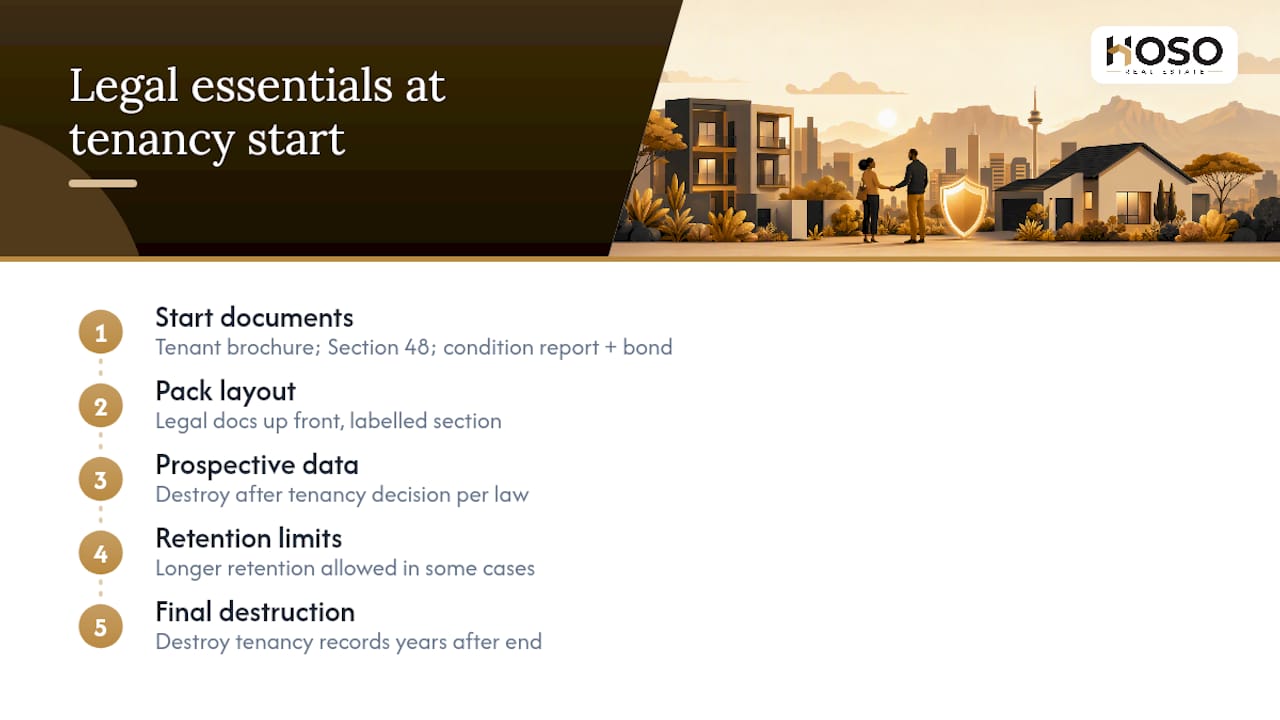
Three documents are non-negotiable at the start of any South Australian tenancy: the tenant information brochure, the Section 48 notice, and a completed condition report paired with the bond receipt. These aren't welcome-pack nice-to-haves. They're statutory obligations, and the SA Government's start-of-tenancy forms page has the current versions.
Data handling deserves equal attention, particularly for prospective tenant information gathered during applications.
Landlords and agents must destroy prospective tenant information within legally defined timeframes after a tenancy decision, with longer retention permitted under certain conditions, and retained tenancy records must be destroyed several years after the tenancy ends.
These timelines apply whether the information sits in a filing cabinet or a property management system, and getting them wrong is a compliance risk many landlords don't think about until it's raised.
Practically, place legal documents at the front of the pack in their own labelled section, separate from the operational and local-area content. This avoids duplication, and it means a tenant (or an inspector) can find the required paperwork without wading through appliance manuals first.
How a welcome pack prevents disputes and protects your bond
Clear appliance instructions cut down avoidable damage claims, because a tenant who knows how to use a ducted heater properly is less likely to cause the kind of wear landlords end up disputing at bond time. Pair that with a photo-based condition report, date-stamped and itemised, and you've got a far stronger position if a bond claim is contested.
A short follow-up schedule reinforces the pack rather than letting it sit forgotten in a drawer: a welcome message on move-in day, a check-in message after one week, and the first routine inspection around the three-month mark. Landlords using a formal pack report fewer early disputes and better tenant retention, and a property condition report done properly is the backbone of that outcome.
HOSO's approach to building and using welcome packs
Our premium welcome packs pair the required SA compliance documents with a tailored local guide, and every handover is logged against the property management vetting checklist we run for each new tenancy. We reference the pack again at first inspection and whenever a maintenance request comes through, so nothing gets duplicated or lost. Landlords working with us can request editable templates for their own portfolio.
Customising the pack for different tenant types
A family moving into a four-bedroom home in Golden Grove needs different information to a share house of students near the University of Adelaide, or a fly-in-fly-out professional leasing an apartment in the CBD.
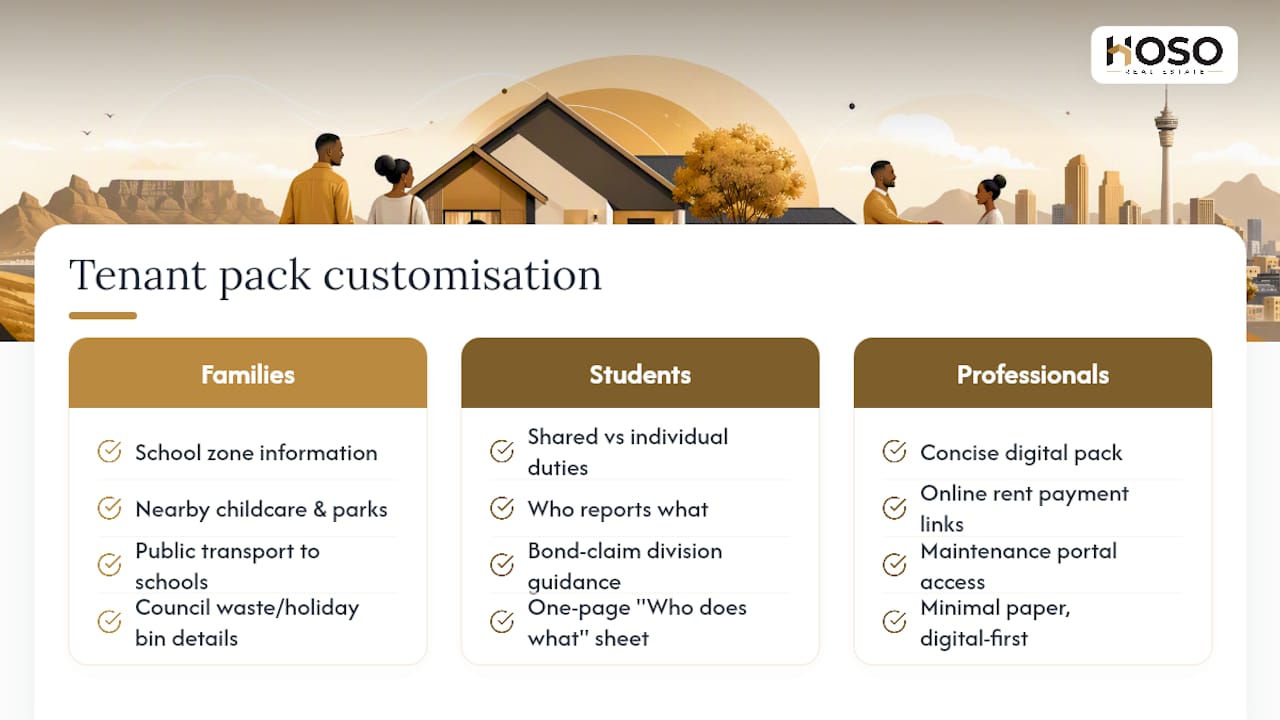
For families, prioritise school zone information, nearby childcare, parks and public transport routes to schools. Include council contact details for waste collection changes around public holidays, since families tend to generate more general enquiries about bin days and street parking.
Student tenants, often in shared households, benefit from clearer breakdowns of individual versus shared responsibilities: who's responsible for reporting what, and how bond claims are divided if the property is leased under separate agreements. A one-page "who does what" sheet resolves a lot of miscommunication before it starts.
Professionals and interstate or overseas investors renting for themselves usually want efficiency over detail. A concise digital pack with online rent payment links, a maintenance portal, and minimal paper is often preferred over a printed folder. If the tenant is relocating from interstate or overseas, a short section on public transport, the nearest shopping precincts and internet providers saves them a research task in their first week.
The common thread across all three: the legal and compliance section stays identical regardless of tenant type. Only the local information and tone should vary.
Local area information tenants actually use
A welcome pack that stops at legal paperwork wastes an opportunity. New tenants, especially those relocating from interstate or overseas, want to know where the nearest supermarket, GP, and pharmacy are without googling it at 9pm on move-in night.
Include a short local guide tailored to the suburb. For a property in Norwood, that might mean noting the Parade's shopping strip, the nearest medical centre, and public transport options into the CBD. For a rental in Mawson Lakes, it's more useful to flag the nearest shopping centre, local schools, and bus routes to the O-Bahn.
Useful inclusions:
- Nearest supermarket, pharmacy, and medical centre
- Public transport stops and approximate travel times to the CBD
- Council contact details for bins, hard rubbish and local permits
- Nearby parks, libraries or community centres
- Emergency services locations, including the closest hospital
This section doesn't need to be exhaustive. A tenant who's just moved from Perth or Singapore needs the basics covered clearly, not a tourism brochure. Keep it to one page and update it whenever council collection schedules or transport routes change.
Digital tools for rent payment and maintenance requests
Most tenants now expect a digital option for paying rent and logging repairs rather than a bank deposit slip and a phone call. Property management platforms typically offer a tenant portal where rent payments, ledger history and maintenance requests sit in one place, which also creates a timestamped record every landlord benefits from if a dispute arises later.
When introducing these tools in the welcome pack, keep the instructions simple: how to log in, how to submit a maintenance request with a photo attached, and who to contact if the portal isn't working. Tenants who understand the reporting channel from day one raise fewer duplicate requests and fewer phone calls chasing an update, because the portal gives them visibility on progress themselves.
If a tenant genuinely can't or won't use a digital platform, always keep a phone and email fallback listed in the pack. Not every tenant, particularly some older tenants or those without reliable internet access, wants an app-based process, and forcing one is a fast way to create friction in an otherwise smooth tenancy.
Where landlords get this wrong
Most advice on tenant welcome packs treats them as a goodwill gesture, a nice touch that makes the property feel more professional. That undersells what the pack actually does. The real value sits in the compliance layer and the dispute-prevention layer, not the welcome card.
Too many landlords focus on making the pack look polished while skipping the parts that actually protect them, like a properly itemised condition report or documented delivery of the Section 48 notice. A beautifully designed folder with no proof of handover is worth less in a SACAT dispute than a plain email with a read receipt.
Prioritise legal documentation and delivery evidence first, then build the local information and tenant-friendly extras around it. If you only have time to get one thing right, get the condition report and its accompanying photos right; that document does more heavy lifting in a bond dispute than anything else in the pack. Everything else is genuinely useful, but it's secondary.
— HOSO
Let HOSO Real Estate handle your tenant onboarding
Building a compliant, well-organised welcome pack for every new tenancy takes time most landlords don't have, particularly if you're managing a property from interstate or overseas. HOSO Real Estate handles the entire onboarding process for Adelaide landlords, from preparing the required SA start-of-tenancy documents through to coordinating maintenance requests and keeping a clear record of every handover. Our approach to property management covers compliance, communications and recordkeeping as part of the standard onboarding process, so nothing gets missed between lease signing and move-in day. If you'd like to see how we manage tenancies across Adelaide, browse our recently leased properties or get in touch to discuss handing your onboarding process over to a team that already has the systems built.
Sources
- Becoming a tenant
- Forms and fact sheets for private rental tenancies
- Protection of tenant information