

A good tenant screening service gives you a verified, lawful and consistent picture of every applicant before you sign a lease. In South Australia the screening is only as strong as its compliance: the law limits what you can ask for, how many documents you can require and how tenancy database information is handled. A service that works within those limits protects your rent, your property and your position if a decision is ever questioned at SACAT (the South Australian Civil and Administrative Tribunal). HOSO Real Estate manages rentals only, and tenant screening through HPTS is part of how we place tenants for Adelaide landlords.
TL;DR
- Screening should confirm identity, ability to pay, rental history and suitability, using only the information South Australian law allows you to request.
- SA landlords and agents cannot require more than 2 documents per category, and a list of information is prohibited outright, including social media, medical details and past tenancy disputes.
- Tenancy databases are private systems with their own rules in SA: notice to applicants, post-tenancy listings only, accuracy and a 3-year general limit.
- Fair, consistent assessment against criteria set before you advertise is your best protection against complaints and disputes.
- Choose a service that is transparent about what it checks, how it stores applicant information and how it reports back to you.
Table of Contents
- What a tenant screening service actually does
- What South Australian law lets you ask
- Privacy: collecting and holding applicant information
- Tenancy databases: what the SA rules require
- Beyond the paperwork: checks that change the outcome
- Assessing results fairly and consistently
- What to look for in a tenant screening service
- How HOSO screens tenants for Adelaide landlords
- Perspective
- FAQ
- Sources
What a tenant screening service actually does
A tenant check assesses whether an applicant is reliable and able to meet the obligations of a lease. In practice that means identity verification, financial and rental-history checks, database searches, employment and income confirmation, and references from former landlords or employers. Each answers a different question:
- Identity: is this person who they say they are?
- Ability to pay: does their income comfortably cover the rent?
- Rental history: did they pay on time, care for previous homes and leave properly?
- Suitability: do the references and the application support a stable tenancy?
For a busy professional or an interstate owner, the value of a service is that these checks are done in the same order, to the same standard, on every application. You are not relying on a gut feel from a 15-minute inspection, and you are not chasing referees on weekends.
If you want the methods broken down, our guide to types of quality tenant screening methods for SA landlords goes through them one by one.
What South Australian law lets you ask
The most common mistake in rental applicant screening is asking for too much. South Australia sets firm boundaries, and they apply whether you screen yourself or use a service.
According to SA.GOV.AU, a landlord may ask for identity and contact details, previous rental details (but not past rental disputes) and the intended length of the tenancy. Financial requests are limited to a redacted bank statement, a payslip or employment confirmation, and a document relating to financial capacity. The same page lists what is prohibited: past legal action, medical records, social media information, vehicle registration, education level and the applicant's reason for moving.
The Tenant Information Guide from Consumer and Business Services adds further detail. You cannot require more than 2 documents per category, and the categories are identity, ability to pay rent and suitability. Applicants may offer more voluntarily, but you cannot require it. The guide also lists tenancy disputes, bond history, unredacted bank statements and pet microchip numbers among the information you must not request.
| Category | What you can require | What you cannot require |
|---|---|---|
| Identity | Up to 2 identity documents | A third document, or details unrelated to identity |
| Ability to pay | Up to 2 documents, such as a payslip or employment confirmation and a redacted bank statement | Unredacted bank statements |
| Suitability | Up to 2 documents, plus previous rental details | Past tenancy disputes, bond history, medical or social media information, vehicle registration, education level, reason for moving |
There are narrow exceptions. The Residential Tenancies Regulations 2025 permit a landlord to ask whether an applicant is at least 18 and has legal capacity. Where the landlord or managing agent lives in the premises, they may also ask whether a child or person in the applicant's care will live there.
One more rule matters for anyone using a third party: a person must not receive a payment from a prospective tenant to aid their assessment or rating for suitability. The cost of screening belongs on the landlord's side of the process, not the applicant's.
Our guide to rental application criteria in SA sets out what you can assess in more detail.
Privacy: collecting and holding applicant information
Screening means holding a stranger's identity documents and financial details. That brings privacy duties. The Office of the Australian Information Commissioner says an agent covered by the Privacy Act may collect personal information only when reasonably necessary for its functions or activities. It should explain why the information is needed, what happens if it is not provided, the usual disclosures, and how the applicant can access it or complain.
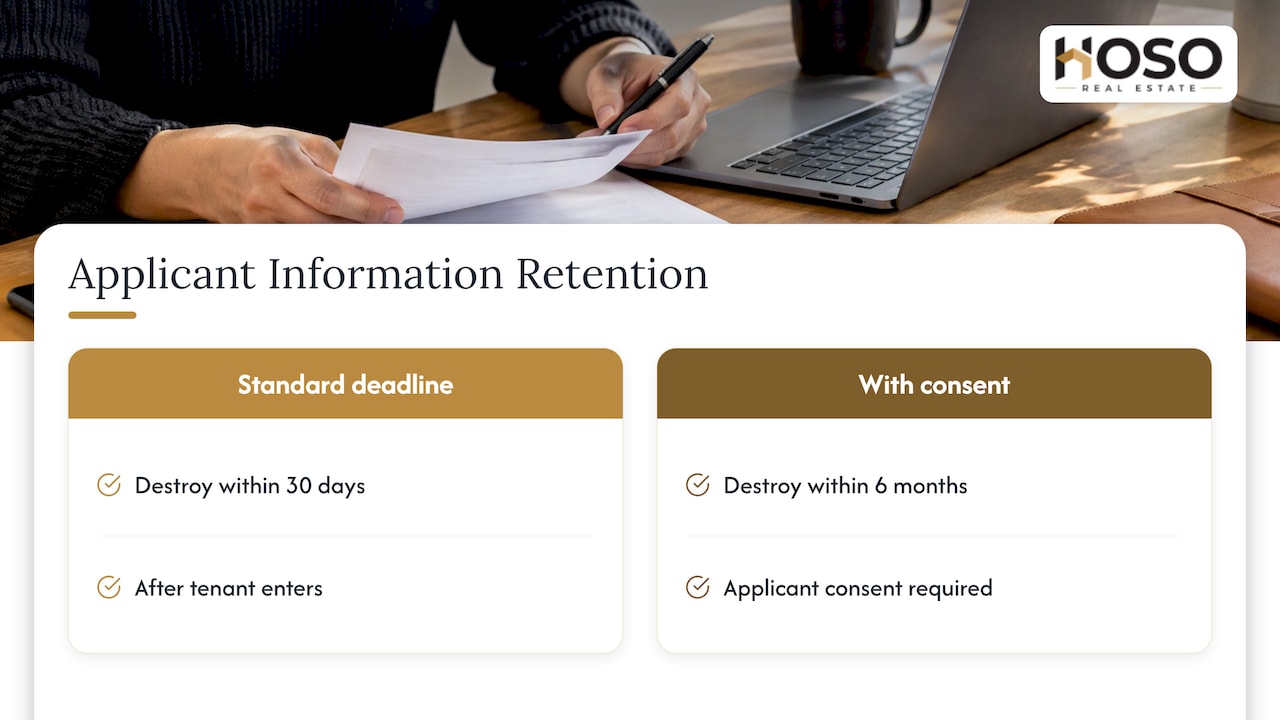
SA adds a specific retention rule. Holders of applicant information must protect it and, according to the Tenant Information Guide, destroy the information of unsuccessful applicants within 30 days after the successful tenant enters, or within 6 months with the applicant's consent.
This is where an owner screening applicants by email carries real exposure. Identity documents sit in an inbox, get forwarded and are rarely deleted on time. A managed process with defined storage and destruction closes that gap. Our tenant privacy laws in SA guide covers the landlord's side in full.
Tenancy databases: what the SA rules require
Residential tenancy databases are privately owned commercial systems that record information about tenants after a tenancy. In South Australia they are regulated under Part 5A of the Residential Tenancies Act 1995, and the rules also apply to interstate operators. Because they are private, a listing on one database does not automatically appear on another. A single-database search can therefore miss information held elsewhere.
The SA Law Handbook sets out what you must do before relying on one:
- Give notice up front. You must tell prospective tenants in writing which databases you usually use and how to contact the operator. Failing to give that notice is an offence under section 99D.
- Tell the applicant which database you used. This must happen within 7 days, including how to seek removal or amendment of a listing.
- Respect the listing rules. Listings are limited to post-tenancy breaches. They must be accurate, complete and unambiguous, allow 14 days for the tenant to review, and generally cannot be kept for more than 3 years.
From 1 July 2024, SA landlords, agents and database operators also must not charge for a copy of a person's personal information held on a tenancy database.
These rules cut both ways. A database result that is inaccurate or out of date should not be the sole reason you reject an applicant. A sound process treats a listing as one input, verifies it and weighs it against the rest of the application. For how this fits with tribunal readiness, see making tenancy database checks SACAT ready.
When a tenancy ends badly, the end of the process matters too. Landlords weighing whether to keep a property or sell it with tenants in place can read an overview of selling a house with tenants, and those who are staying invested can use the SA tenancy termination process guide to see how listings and SACAT orders fit together.
Beyond the paperwork: checks that change the outcome
Paper checks confirm what an applicant presents. The stronger screening services verify it.
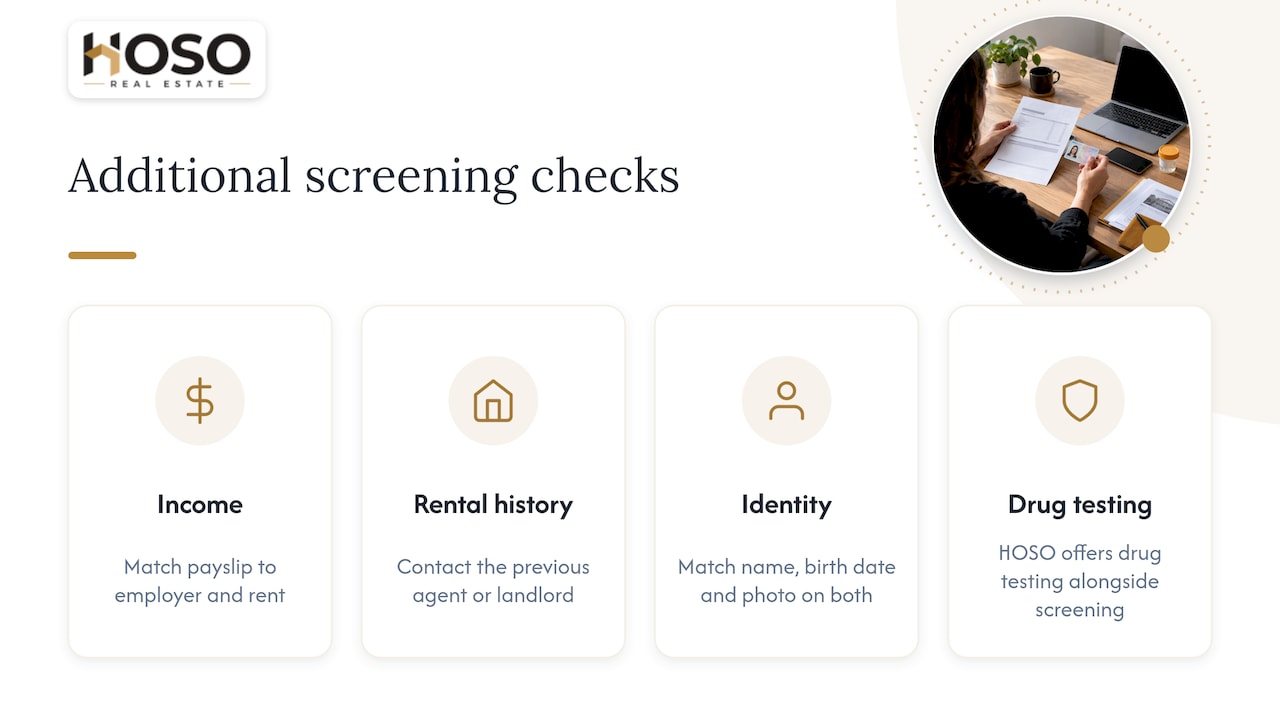
Income and employment. A payslip or employment confirmation should be matched to the stated employer and the rent. A common benchmark is rent at a manageable share of income, but set your own threshold and apply it to everyone. Consistency is the point.
Rental history. Speak to the previous agent or landlord, not just a nominated friend. The OAIC notes that an agent may disclose an applicant's information to a previous agent giving a reference and to nominated referees, which is what makes a real reference check possible.
Identity. Check the documents against each other: name, date of birth and photo should agree across both documents you are allowed to request.
Drug testing. HOSO offers a drug testing service alongside screening for owners who want an additional layer of assurance on a premium property.
What not to check. Do not look up applicants on social media. SA prohibits requesting social media information, and NSW Fair Trading's guidance notes that it is unlikely to bear on capacity to pay and risks mistaken identity. A decision built on it is hard to defend.
Our tenant selection criteria checklist turns these checks into a form you can work through.
Assessing results fairly and consistently
Screening produces data. Selection is a decision, and the decision is where landlords create risk for themselves. A workable approach:
- Write your criteria before you list. Minimum income relative to rent, acceptable rental history, required references. Fix them in advance so no application is judged on a different standard.
- Score every applicant the same way. Use the same checklist and the same documents, limited to what SA law allows.
- Record the reason. Note the specific, relevant factor behind each decision: for example, an unverifiable reference or income below your threshold. Notes tied to rent and property care are the ones you can rely on later.
- Verify before you rely. Confirm a database listing is current and accurate before it influences a decision.
- Keep the personal details out. Do not let age, family situation, background or anything on the prohibited list shape the outcome.
- Close the file properly. Destroy unsuccessful applications within the SA time limits.
The SA.GOV.AU page confirms the principle underneath all of this: a landlord has the right to choose a suitable tenant. That right is best exercised with documented, relevant and even-handed reasons.
What to look for in a tenant screening service
When you compare options, whether an agency, a standalone check provider or a do-it-yourself approach, test them against the SA framework:
- SA-specific process. Does it use the information categories and 2-document limit that apply in South Australia, not a generic national form?
- Database practice. Does it give applicants the required notice about databases and follow the 7-day follow-up?
- Verification depth. Does it confirm income, call previous landlords and match identity, rather than simply collect documents?
- Privacy handling. Is applicant information secured, and destroyed within the SA time limits?
- Reporting. Do you receive a clear summary against your criteria, so you make the final call with the evidence in front of you?
- What happens after. Does screening feed into a lease, inspections, rent collection and compliance, or stop at the report?
That last point is why screening works best inside property management. Our tenant placement service article explains how placement connects to the ongoing tenancy, and landlord obligations in South Australia shows what the tenancy then asks of you. For the wider picture, see Adelaide rental compliance requirements.
How HOSO screens tenants for Adelaide landlords
HOSO Real Estate focuses exclusively on property management, not sales. Our HPTS Tenant Screening is an exclusive 4-layer system, and our drug testing service is available alongside it. Owners follow their property through a 24/7 owner portal, which suits interstate owners and busy professionals who want visibility without handling applications themselves. Tenant placement, rent collection, maintenance management, lease administration and inspections sit under the same roof, so the tenant you select is the tenant we manage.
See HPTS Tenant Screening and the drug testing service or our full range of management services. If you are working out what your property could rent for before listing, start with a rental appraisal.
Perspective
Most disputes we see described by landlords begin with a rushed selection, not a bad tenant. An owner is under pressure to fill a vacancy, collects whatever documents are offered and decides on instinct. When something goes wrong, there is no record of why that applicant was chosen.
We built our approach around the opposite habit. Our focus is property management and nothing else, so screening is a core discipline for us, not a step before a sale. HPTS is our exclusive 4-layer tenant screening system, and drug testing is available where an owner wants it. Every applicant is assessed against the same criteria, within what South Australian law allows.
For an Adelaide investor, a lease is an asset decision. Choosing the tenant carefully, documenting the reasons and managing the property with clear reporting through the 24/7 owner portal is how long-term performance is protected. That is the standard we hold ourselves to: your portfolio, our craft.
HOSO
FAQ
Can I ask applicants for their bank statements?
Yes, but only a redacted one. SA landlords may request a redacted bank statement, a payslip or employment confirmation, and a document showing financial capacity, with no more than 2 documents in the ability-to-pay category. Unredacted statements are on the prohibited list in the Tenant Information Guide.
Can a landlord check an applicant's social media?
No. SA prohibits requesting social media information from prospective tenants. Even outside the formal request process, it is poor practice because it rarely shows capacity to pay and can lead to mistaken identity.
Do I have to tell applicants I use a tenancy database?
Yes. In SA you must give written notice of the databases you usually use and the operator's contact details, and tell applicants within 7 days which database was actually used and how to seek removal or amendment of a listing. The SA Law Handbook sets out these duties.
How long can I keep an unsuccessful applicant's information?
Under the SA Tenant Information Guide, you should destroy it within 30 days after the successful tenant enters the premises, or within 6 months if the applicant consents. Until then it must be protected.
Is a tenancy database listing enough to reject an applicant?
It should not be the only factor. Listings must be accurate and are limited to post-tenancy breaches, so verify the entry and weigh it with income, references and rental history against your written criteria.
Sources
- How to Do a Tenant Check in Australia
- SA.GOV.AU: Choosing a tenant
- Tenant Information Guide, Consumer and Business Services SA
- Residential Tenancies Regulations 2025 (SA)
- Tenancy, Office of the Australian Information Commissioner
- Residential tenancy databases, SA Law Handbook
- When an agent or landlord assesses a tenancy application, NSW Fair Trading