

Choose tenants using a short, consistent checklist that prioritises ability to pay, verified rental history and demonstrated property care, applied the same way to every applicant. Ground your process in the Residential Tenancies Act and Form A1 requirements, stay within Australian Privacy Principle obligations, and keep records that would satisfy SACAT if a decision is ever challenged. HOSO Real Estate applies this exact framework across its Adelaide portfolio. The checklist below shows you how to build it.
TL;DR:
- Landlords should use a standardized tenant screening process based on objective criteria, documented in a decision log, to ensure fairness and legal defensibility.
- Verifying rent affordability typically involves requesting recent payslips or bank statements and using a 30% rent-to-income guideline as a prompt, not a strict limit.
- Screening must comply with privacy laws and discrimination rules, including strict document caps and transparent applicant notification about data collection.
- Tenancy database checks are useful but must be used responsibly, with applicant notification, verification, and regard for dispute rights; they are not automatic rejection tools.
- Consistent recordkeeping at the time of application decision-making is crucial to defend against disputes, making instincts secondary to documented, objective processes.
Table of Contents
- Tenant selection criteria Australia: the practical checklist
- What can you legally ask tenants in South Australia?
- How do tenancy databases work for landlords?
- Assessing financial capacity: what actually proves an applicant can pay
- Building a repeatable screening workflow
- HOSO Real Estate in practice
- Handling applications fairly and keeping compliant records
- Pets, smoking and lifestyle factors: where the legal line sits
- How recent legislative change has reshaped screening
- Communicating decisions to applicants
- Common mistakes landlords make when selecting tenants
- Why documentation matters more than instinct
- Let HOSO Real Estate manage your tenant selection
- Sources
Tenant selection criteria Australia: the practical checklist
Landlords who screen well don't rely on gut feel. They run every applicant through the same short list of checks, in the same order, and score them the same way. That consistency is what protects you if a rejected applicant ever questions your decision at SACAT.
Here's the sequence worth following for every application that lands on your desk:
- Financial stability. Request recent payslips or an employer letter confirming income, and use a rent-to-income ratio as a starting guide rather than a hard cutoff, since Adelaide's rental market has enough variation between suburbs like Norwood and Mawson Lakes that rigid rules can exclude good tenants.
- Rental history. Contact current and previous property managers where possible, and ask about payment punctuality, notice periods given, and general conduct. Steer clear of asking about past tribunal disputes in a way that implies automatic exclusion. That crosses into unlawful blanket discrimination.
- Property care. Ask referees directly about the condition the applicant left previous properties in, and request photos from a recent routine inspection if the applicant has them.
- Communication and reliability. Note how quickly the applicant responds to requests, how clearly they answer questions about occupants, and whether their stated lease length matches what you're offering.
- Weighing and scoring. Give each category a simple score, say 1 to 5, and total them. A basic scoring sheet turns a subjective impression into an objective, defensible record.
The scoring step matters more than most landlords realise. A documented, consistent scoring approach is one of the strongest defences you have if an unsuccessful applicant later claims bias. If you're managing the process yourself, our guide to rental reference checks that are SACAT ready walks through how to document referee conversations properly.
What can you legally ask tenants in South Australia?
Selection has to be based on objective tenancy criteria, not personal characteristics. SA Government guidance is explicit: you can choose a suitable tenant, but you cannot discriminate on race, sex, family status, disability, or several other protected attributes. That means every question on your application form needs a genuine tenancy purpose behind it.
Document limits matter just as much as the discrimination rules. Under the Residential Tenancies Regulations, you cannot request more than two verifying documents per category, whether that's identity, income, or rental suitability. Stacking demands for a passport, a licence, three payslips and a reference letter all at once isn't just excessive. It's outside what the regulations allow.
A few practical rules to apply when building your application form:
- Ask only for what verifies tenancy suitability, and be ready to explain why you're requesting each document.
- Notify applicants at the point of collection that you're gathering personal information, in line with OAIC guidance on APP 5.
- Redact account numbers and unrelated transaction details on any bank statement before it's stored.
- Keep the same document list for every applicant. Varying it between applicants is where discrimination claims often start.
NSW Fair Trading's guidance on this point applies just as sensibly in South Australia: collect only what's reasonably necessary, and tell applicants plainly why you need it.
How do tenancy databases work for landlords?
Residential tenancy databases can be a legitimate part of your screening process, but only when used correctly. Under SA regulation, a listing is lawful to check when it relates to a genuine tenancy breach, and it must not be used as a blanket blacklist tool.
Compliance duties sit on you as much as the database operator:
- Notify the applicant which database you checked and supply the operator's contact details.
- Respect retention limits. Listings can't sit indefinitely once a debt is paid or a dispute resolved.
- Verify accuracy before relying on a listing. Applicants have a right to access and challenge their own data.
- If an applicant disputes a listing, pause your decision until you've given them a reasonable chance to respond, rather than rejecting outright.
Failing to notify an applicant, or relying on an inaccurate listing, exposes you to penalty risk under SA legislation. Treat the database as one input among several, not the deciding factor.
Assessing financial capacity: what actually proves an applicant can pay
The 30% rent-to-income ratio is a useful starting heuristic. If weekly rent sits above roughly 30% of an applicant's gross income, that's worth a closer look, though it's not a rule written into legislation. Adelaide's premium rental pockets, think Unley, Walkerville, or the Adelaide Hills, often see applicants with strong assets but irregular cash flow, so treat the ratio as a prompt for further questions rather than an automatic disqualifier.
Acceptable proof usually means payslips, an employer confirmation letter, or bank statements with irrelevant details redacted. For casual workers or the self-employed, ask for average earnings over several months, recent BAS statements, or invoices, and cross-reference against ATO guidance on rental income documentation where you need more certainty.
Pro Tip: Build a two-minute verification habit: request one payslip plus one bank statement for PAYG applicants, or two BAS quarters plus a signed income declaration for self-employed applicants. That's enough to verify capacity without breaching the two-document limit per category.
Building a repeatable screening workflow
A workflow only works if it's identical every time. Start with a standardised, Form A1-compatible application, request only the documents you're legally allowed to ask for, and log exactly what was requested and supplied for each applicant.
The sequence that holds up under scrutiny runs like this:
- Verify identity using no more than two accepted documents.
- Confirm income through payslips, employer letters, or BAS statements.
- Check rental history through direct referee contact.
- Run tenancy database checks, with notification sent to the applicant.
- Score the application, make a decision, and write down the reasoning.
Keep a short decision log for every applicant, listing documents supplied, database check dates, referee notes, and the score applied. This is precisely what SACAT panels expect to see if a screening decision is ever questioned. Our types of quality tenant screening methods for SA landlords guide breaks this sequence down further.
Once a tenant is approved, supply the lease agreement, any required Section 48 notice, a condition report, and lodge the bond promptly. Skipping this step, or delaying it, is one of the more common compliance gaps we see in self-managed tenancies.
HOSO Real Estate in practice
Across HOSO Real Estate's Adelaide portfolio, this checklist runs on every application, from a two-bedroom unit in Glenelg to a family home in Burnside. Applicants are scored against the same criteria, database checks are notified every time, and each decision is logged with the documents supplied and referee notes attached. That paper trail is what keeps a portfolio SACAT ready. Our rental application approval checklist and tenant vetting guide for premium rentals show the templates behind that process.
Handling applications fairly and keeping compliant records
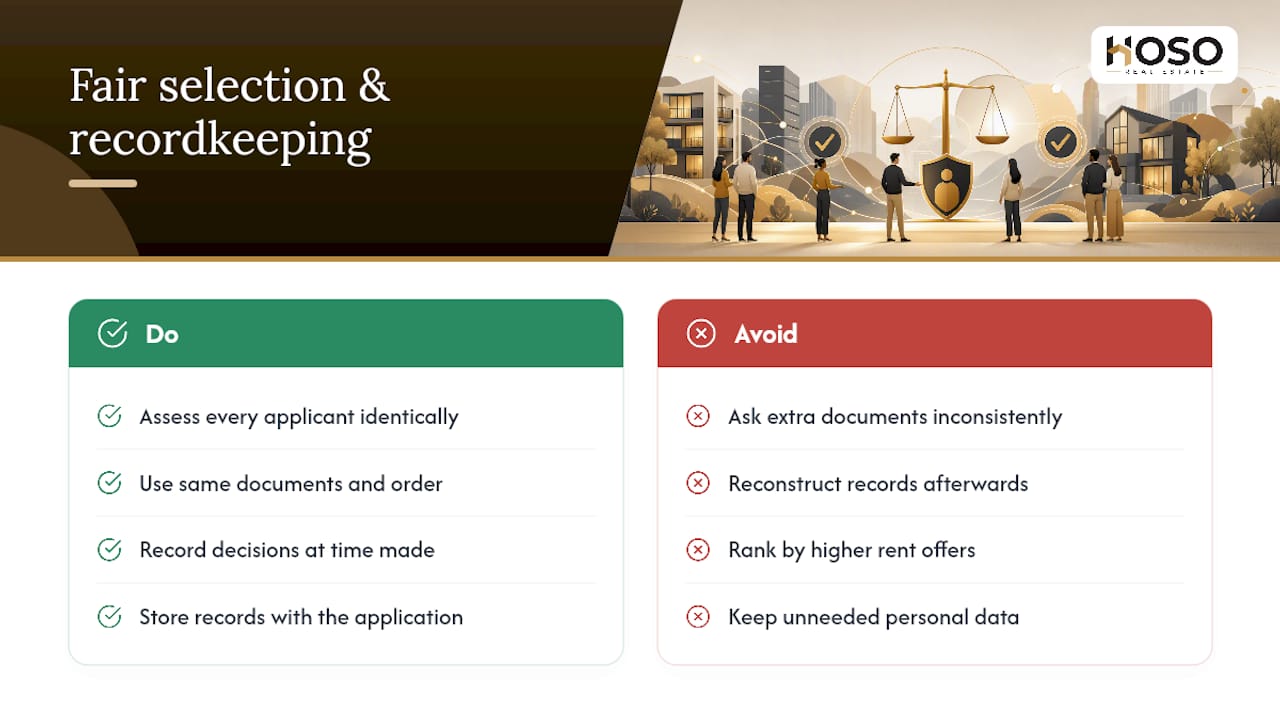
Fairness in tenant selection comes down to process discipline, not good intentions. Every applicant needs to be assessed against the same objective criteria, in the same order, using the same document requests. If two applicants apply for the same Prospect townhouse and one gets asked for three extra documents the other wasn't, that inconsistency is exactly what a discrimination complaint or SACAT dispute will focus on.
Recordkeeping needs to happen at the time of the decision, not reconstructed afterwards. For each applicant, keep a note of what was requested, what was supplied, who you spoke to for references, and the score or reasoning behind your final call. Store this alongside the application itself, not in a separate email thread that's easy to lose.
Section 52B of the Residential Tenancies Act is worth knowing well here. It restricts landlords from rating or ranking applicants based on their willingness to pay above the advertised rent, and prohibits charging applicants for suitability assessments. Rent bidding might feel like a market-driven way to select tenants, but it's specifically restricted under SA law, and building it into your scoring system is a compliance risk, not a shortcut.
Retention periods matter too. Keep application records for as long as your professional obligations require, and destroy personal information you no longer need rather than letting it accumulate unused.
Pets, smoking and lifestyle factors: where the legal line sits
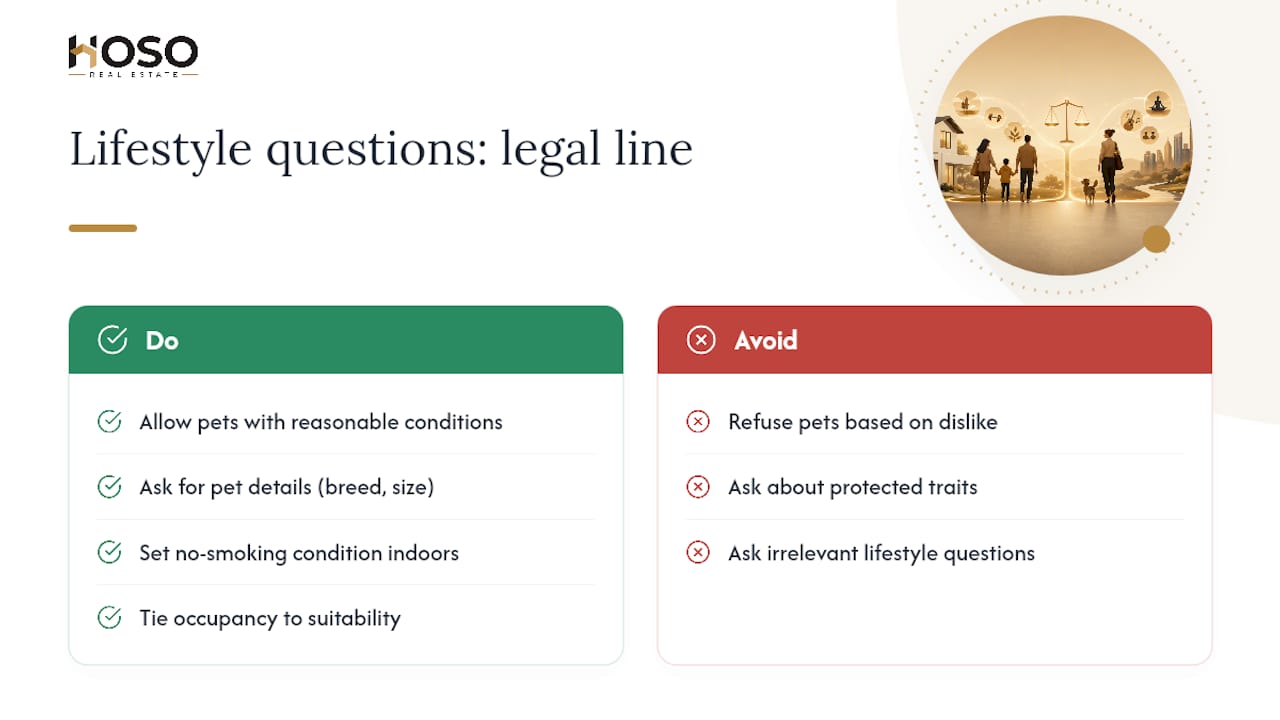
Lifestyle questions sit in genuinely grey territory for many landlords, and getting them wrong either exposes you to a discrimination complaint or leaves you carrying risk you didn't need to accept.
Pets are the clearest example, and managing package delivery risks for pet owners is crucial; learn how to reduce disruptions in multi-unit buildings with package interruptions advice. You can set reasonable conditions around pet ownership, such as requiring a professional carpet clean at the end of tenancy, but a blanket refusal needs to be based on the specific property's suitability (a small apartment with no yard, for instance) rather than a general dislike of animals. Ask applicants for pet details, including breed, size, and whether the animal is desexed, since that's directly relevant to property suitability.
Smoking is more straightforward. You're entitled to set a no-smoking condition inside the property, and it's reasonable to ask directly whether an applicant smokes indoors. This isn't a protected attribute, so there's no discrimination risk in asking or in setting the condition.
Other lifestyle questions, like number of occupants, need to stay tied to genuine tenancy suitability, occupancy limits under health and safety standards, for example, rather than assumptions about lifestyle or household makeup. If a question wouldn't help you assess whether the applicant can pay rent, look after the property, or comply with reasonable tenancy conditions, it probably doesn't belong on your application form.
How recent legislative change has reshaped screening
Tenancy law in South Australia has moved noticeably in recent years, and screening practices that were considered standard five years ago wouldn't pass muster today. The regulatory tightening around document limits, the two-document cap per category under the current Residential Tenancies Regulations, is one of the clearest examples: it directly restricts how much financial and identity information you can request compared to older practice.
Tenancy database regulation has also sharpened. Applicants now have clearer rights to access and dispute their own database listings, which means landlords can't treat a database hit as automatic grounds for rejection the way some once did. That shift pushes more weight back onto direct referee contact and documented income verification, rather than a single database flag deciding an outcome.
Privacy expectations have risen too. The OAIC's guidance on notifying individuals at the point personal information is collected is now a baseline expectation, not a nice-to-have. Landlords still running application forms without a privacy notice are increasingly out of step with current practice, even where no complaint has yet been made.
Communicating decisions to applicants
How you deliver a decision matters almost as much as how you reach it. Successful applicants should be notified promptly, in writing, with next steps spelled out clearly: lease signing arrangements, the condition report process, and bond lodgement timing.
Unsuccessful applicants deserve a courteous, timely response too. You're not obliged to give a detailed breakdown of your scoring, but a brief, professional message avoids the drawn-out uncertainty that leads to complaints. Avoid vague language that could be read as referencing a protected attribute. Stick to tenancy-relevant reasoning such as "another application better matched the property's requirements."
Keep a record of when each applicant was notified and by what method. If a rejected applicant later raises a discrimination concern, being able to show a prompt, consistent, professionally worded response, sent the same way to every unsuccessful applicant, is a meaningful part of your defence.
Common mistakes landlords make when selecting tenants
The pitfalls that show up most often in self-managed tenancies aren't complicated. They're usually a matter of inconsistency or overreach.
Asking different applicants for different documents is the most common one. It happens innocently, a landlord asks a friend's referral for less paperwork than a stranger, but it's exactly the kind of inconsistency that undermines a defence if challenged.
Skipping the privacy notice at collection time is another frequent gap, often because landlords assume verbal consent is enough. Relying too heavily on a single tenancy database check, without direct referee contact, is a third: databases capture breaches, not the full picture of how someone actually maintains a property.
Perhaps the most costly mistake is failing to keep records at the time of the decision. Landlords remember roughly why they chose one applicant over another, but "roughly" doesn't hold up months later if a dispute reaches SACAT. A same-day note, even a few lines, is worth far more than a strong memory.
Why documentation matters more than instinct
Most landlord advice on tenant selection focuses heavily on what to look for, income, references, property care, and barely touches on how to prove you looked for it fairly. That's backwards. Good judgement about applicants matters, but judgement alone is indefensible if it isn't written down.
The overrated piece of conventional wisdom here is "trust your gut." A landlord's instinct about an applicant is often right, but instinct without a documented, consistent process is precisely what gets picked apart in a discrimination complaint or a SACAT hearing. The document limits, the privacy notices, the database notifications, none of that is bureaucratic box-ticking. It's the actual evidence that your decision was made on lawful, objective grounds.
If there's one thing worth prioritising above everything else in this guide, it's the decision log. Not the scoring system, not the database check, the simple habit of writing down what you asked for, what you received, and why you chose the applicant you did. Everything else in tenant selection criteria Australia-wide compliance flows from that habit.
— HOSO
Let HOSO Real Estate manage your tenant selection
Running a compliant, consistent screening process on top of managing your own property is a lot to carry, especially if you're an interstate or overseas investor without eyes on the ground in Adelaide. HOSO Real Estate applies the exact checklist outlined above to every application across its managed portfolio, backed by SACAT-ready recordkeeping and a genuine understanding of South Australian tenancy law.
That's the real advantage: you get premium-property screening standards without personally chasing referees, redacting bank statements, or tracking database notification windows. Explore HOSO Real Estate's property management services to see how leasing and screening are handled end to end, or browse recently leased properties to see the calibre of tenant the process attracts. If you're ready to hand over the screening headache, get in touch with HOSO Real Estate to discuss your property.
Sources
- Choosing a tenant — SA Government
- Residential Tenancies Regulations 2025 — reg 8 (SA)
- Residential tenancy databases — Legal Services Commission (SA)
- OAIC — APP 5 notification of the collection of personal information
- ATO — Residential rental properties