
Subletting is legal in South Australia, but only with the landlord's written consent, and the head tenant stays fully liable for the lease. If a landlord unreasonably refuses, the fix is a dated-written written request followed by Consumer and Business Services (CBS) conciliation, then a SACAT application if that fails.
TL;DR:
- Landlords can only refuse subletting requests if they have reasonable grounds such as safety concerns or occupancy limits; discrimination or fee demands are unlawful.
- The head tenant remains fully liable for rent, damage, and compliance obligations, while the sub-tenant’s obligations are toward the head tenant, not the landlord.
- Unauthorised subletting is a breach that can lead to termination or compensation claims, emphasizing the importance of obtaining written landlord consent beforehand.
- Proper subletting requests should be written, detailed, and include proposed dates, references, and contact details, with records kept at every step.
- If a landlord unreasonably refuses consent, tenants can seek resolution through CBS conciliation, and if necessary, apply to SACAT for a ruling that consent is not required.
Table of Contents
- What does subletting mean under South Australia rental laws?
- When can a landlord refuse consent to sublet?
- Who is liable: the head tenant or the sub-tenant?
- What happens if a landlord refuses consent unreasonably?
- How do you write a subletting request the right way?
- What are the risks of subletting without consent?
- Are there exceptions for community housing or boarding arrangements?
- HOSO perspective: protecting the asset when a subletting request lands
- A better way to manage subletting requests without the guesswork
- Where to check the law and get official guidance
- Sources
- FAQ
What does subletting mean under South Australia rental laws?
Subletting happens when a tenant rents out all or part of their property to a third party while remaining on the original lease. It differs from assignment, where the original tenant exits and a new tenant takes over entirely. The sub-tenancy term must run shorter than the head lease. Even one day longer and it becomes an assignment, which shifts remedies and rights in ways most tenants don't anticipate.
Section 74 of the Residential Tenancies Act 1995 (SA) sets the baseline: written landlord consent is required, and that consent cannot be unreasonably withheld. Registered community housing providers sit outside this rule. An unauthorised sublet is invalid unless SACAT rules otherwise, meaning a tenant who sublets without asking is exposed the moment a dispute lands in front of the Tribunal.
When can a landlord refuse consent to sublet?
Landlords retain real discretion here, but it has limits. Reasonable grounds for refusal typically include genuine suitability concerns, safety issues, or evidence the proposed sub-tenant would breach occupancy standards. Refusing consent because of a tenant's race, family status, or other discriminatory factors is not defensible and invites a SACAT challenge.
What landlords cannot do is charge for saying yes. Demanding or accepting a fee or payment for granting consent is an offence under South Australian law, a point the Law Handbook makes explicit. That penalty exists precisely because consent fees were once a quiet workaround landlords used to profit twice from the same property.
Common reasonable grounds include:
- Documented concerns about the proposed sub-tenant's suitability or references
- Genuine safety or occupancy limits on the property
- A sub-tenancy term that would exceed the remaining head lease
Common unreasonable grounds include:
- Refusal based on discrimination
- Refusal with no stated reason at all
- Refusal used as leverage to negotiate a fee
Landlords should always put a refusal in writing with a clear reason, dated and specific. If the matter ever reaches SACAT, that written reason is often the difference between a defensible decision and an adverse ruling.
Who is liable: the head tenant or the sub-tenant?
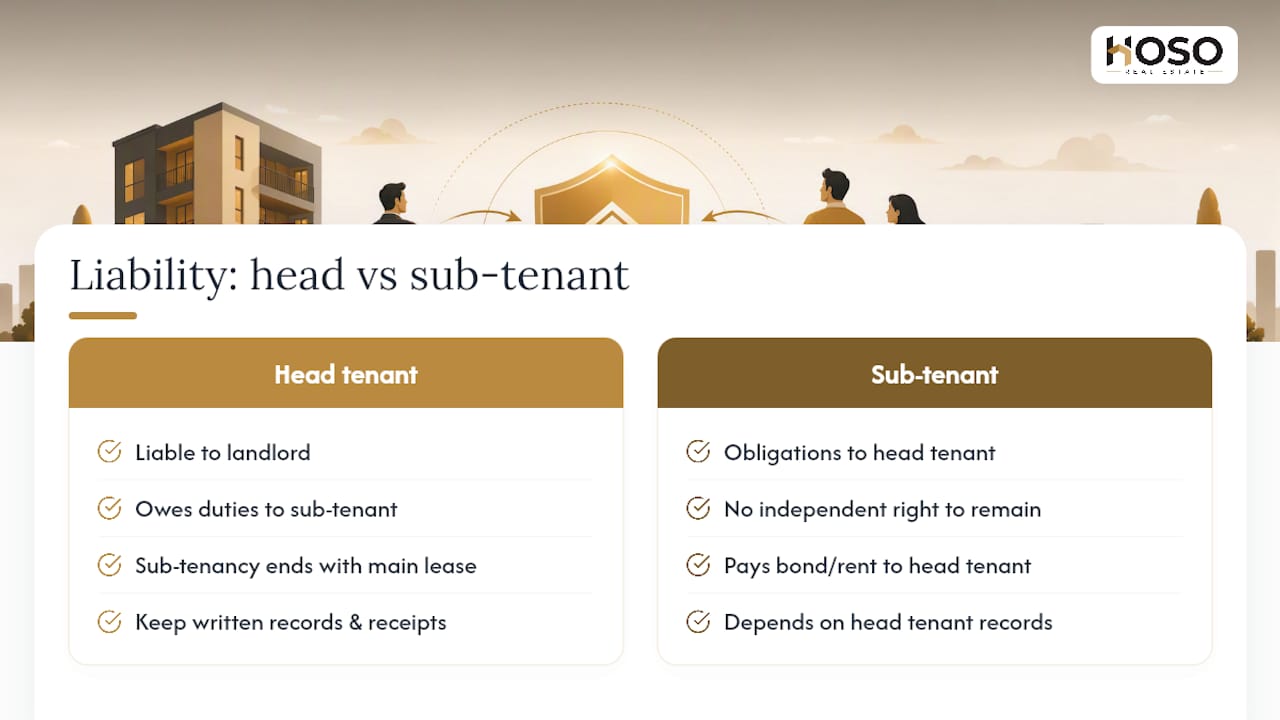
The head tenant remains answerable to the landlord for rent, damage, and every compliance obligation in the original tenancy agreement, regardless of who is actually living there. Legal commentary often describes the head tenant as effectively stepping into the landlord's shoes for the sub-tenant, carrying duties down while carrying liability up.
The sub-tenant's obligations run to the head tenant, not the landlord. A sub-tenancy automatically ends when the head tenancy ends, which means a sub-tenant has no independent right to stay once the main lease is terminated. The SA Government's guidance on sharing and subletting confirms this chain of responsibility.
For bond handling, the practical rule is simple: keep every arrangement in writing and issue receipts for any bond or rent contribution collected from the sub-tenant. A head tenant who can't produce records when a dispute arises has no leg to stand on.
What happens if a landlord refuses consent unreasonably?
CBS conciliation is the recommended first step, and it's free of the formality that puts many tenants off approaching SACAT directly. A tenant lodges a request with CBS, both parties present their position, and a conciliator works towards an agreed outcome without a formal hearing.
If conciliation doesn't resolve it, the tenant can apply to SACAT under section 74A for a determination that consent is not required. The Law Handbook's guidance on subletting and assignment outlines the process in detail.
A SACAT application generally moves through these stages:
- Lodge the application with copies of the lease, the written consent request, and the landlord's response (or lack of one)
- Attach reference checks or other evidence supporting the proposed sub-tenant's suitability
- Attend the hearing prepared to explain, briefly and factually, why the refusal was unreasonable
- Await the Tribunal's determination, which can override the landlord's refusal if it finds no reasonable basis for it
Pro Tip: Keep a simple chronological folder, physical or digital, from the day you send your first request. SACAT members respond well to a clean timeline: request, response, follow-up, refusal. A messy inbox scroll does not read as evidence.
How do you write a subletting request the right way?
There's no single mandated SA form for a sublet request, which trips up more tenants than you'd expect. A clear, dated written request is what carries weight, not a specific template.
Your request should include:
- The proposed sub-tenant's full name and contact details
- Identification and at least one reference
- Proposed start and end dates for the sub-tenancy, ending before the head lease does
- The proposed rent and bond arrangement
- A note confirming the sub-tenancy will end automatically if the head tenancy ends
It's worth documenting a few basic clauses directly with your sub-tenant too, covering rent amount, bond handling, and notice periods, even if this sits outside the formal tenancy agreement. Keep copies of every email, text, and letter exchanged with both the landlord and the sub-tenant. If this ever becomes a SACAT matter, that paper trail is the entire case.
What are the risks of subletting without consent?
Unauthorised subletting is treated as a breach of the tenancy agreement, and landlords have real remedies available, including termination of the head tenancy or a claim for compensation. Our guide to the SA tenancy termination process covers what that looks like in practice.
The head tenant carries the principal legal exposure, since the landlord's contract sits with them, not the sub-tenant. A landlord who successfully terminates for an unauthorised sublet can then pursue the head tenant for any resulting loss, and the head tenant is left to sort out the sub-tenant separately. SACAT outcomes in these matters commonly involve either validating a refused sublet where the landlord had no reasonable grounds, or upholding a termination where the tenant genuinely ignored the consent requirement.
Are there exceptions for community housing or boarding arrangements?
Community housing providers sit outside the standard consent rules under section 74(4), and eligibility criteria can lawfully affect whether a sub-letting arrangement proceeds. That's a deliberate carve-out, not a loophole.
Boarding and lodging arrangements sit in murkier territory. Renting out fewer than two rooms in a house can fall outside some Residential Tenancies Act protections entirely, which changes what a resident can claim if things go wrong.
Joint tenancy is a separate concept again. When two people sign the same lease as joint tenants, one person moving out doesn't trigger subletting rules. It's a change in occupancy under the existing agreement, not a new legal relationship, and the remaining tenant typically stays liable for the whole tenancy unless the lease is formally varied.
HOSO perspective: protecting the asset when a subletting request lands
A subletting request is a document trail waiting to happen, and most disputes trace back to a landlord who responded verbally, informally, or not at all. HOSO Real Estate's approach is to treat every request the same way SACAT will eventually look at it: dated, written, and evidenced.
That means a written acknowledgment of the request, a defined timeframe for a decision, and a documented reason if the answer is no. Professional property managers also vet the proposed sub-tenant properly, references, identification, rental history, rather than accepting a name on a text message. None of this involves charging for consent, which remains prohibited regardless of how the tenancy agreement is worded. Landlords who build a clear subletting policy into their agreement upfront, within the limits section 74 allows, spend far less time in conciliation later.
— HOSO
A better way to manage subletting requests without the guesswork
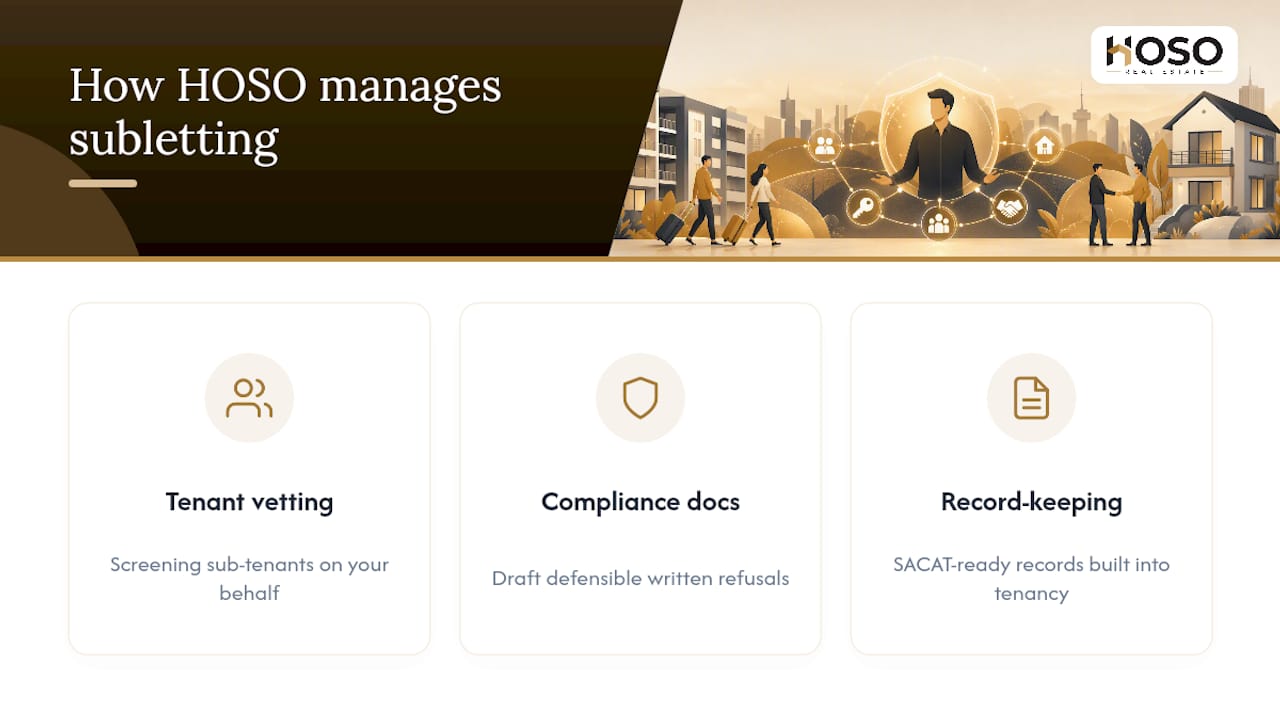
Handling a subletting request properly, tracking dates, vetting a sub-tenant, drafting a defensible written refusal, takes more disciplined process than most self-managing landlords have time for. HOSO Real Estate manages this end to end for Adelaide property owners: tenant vetting, compliance documentation, and SACAT-ready record-keeping built into the way every tenancy is run, not bolted on after a dispute starts. That structure is what separates a landlord who wins at conciliation from one who's still digging through old text messages the night before a hearing. For landlords across Adelaide's inner suburbs and beyond who want their portfolio handled with that level of discipline, our property management and advisory services outline exactly how we take this off your plate. Get in touch to talk through your current tenancy and how we'd manage a subletting request on your behalf.
Where to check the law and get official guidance
For the statutory text itself, section 74 of the Residential Tenancies Act 1995 (SA) is the primary source, with the full Act available through Legislation. For plain-language guidance on sharing and subletting, sa.gov.au's renting pages are the most current government resource. For dispute pathways and tribunal process, the Law Handbook's chapter on subletting and assignment explains what CBS conciliation and a SACAT application actually involve.
Sources
- Sharing and subletting in a private rental property
- Residential Tenancies Act 1995 (SA) — s 74
- Subletting or assignment of tenancy — Law Handbook (SA)
- Legislation
FAQ
Can my partner live with me without being on the lease?
Yes. A partner or friend moving in generally doesn't require landlord consent unless they're paying rent as a sub-tenant or their presence breaches an occupancy limit in the agreement. If they're contributing to rent as an occupant rather than a named tenant, it's worth clarifying the arrangement in writing regardless.
What are the legal requirements for subletting in South Australia?
You need the landlord's written consent under section 74 of the Residential Tenancies Act 1995 (SA), the sub-tenancy term must be shorter than your own lease, and the landlord cannot unreasonably refuse or charge a fee for that consent.
What happens if I'm caught subletting without consent?
An unauthorised sublet is treated as a breach of your tenancy agreement, and the landlord can pursue termination or compensation. The sublet itself is invalid unless SACAT later determines consent wasn't reasonably required.
What's the legal difference between a tenant and a sub-tenant?
A tenant holds the lease directly with the landlord and carries full responsibility for it. A sub-tenant's agreement sits with the head tenant, not the landlord, and their occupancy automatically ends when the head tenancy ends.
How do I request consent to sublet in SA?
Send the landlord a dated written request naming the proposed sub-tenant, including references and identification, proposed dates, and rent or bond arrangements, then keep copies of everything. If they refuse unreasonably, CBS conciliation followed by a SACAT application under section 74A is the next step.