
The strongest defence against a bad tenancy is a standard checklist, direct calls to previous landlords, and a tenancy-database search, done in that order, every time. A thorough check reliably surfaces payment history, property care, and whether a previous landlord would rent to the applicant again. Keep every request within South Australia's document limits, because over-asking now carries real compliance risk.
TL;DR:
- Running a landlord or property manager check should always be followed by a direct call to previous landlords, then a tenancy database search, within legal document limits.
- Asking the landlord if they would rent to the applicant again is the most predictive question during reference checks and often reveals honest opinions.
- Tenancy database entries can be disputed or outdated; they should be used as a supplementary verification method rather than the sole basis for decision-making.
- Red flags such as unexplained rental gaps, evasive referees, or repeated arrears should prompt further investigation rather than automatic rejection.
- Reference checks and documentation requests are limited by new SA regulations, emphasizing the importance of efficient, compliant, and thorough screening processes.
Table of Contents
- What questions should you ask rental referees?
- What do tenancy databases like TICA and NTD actually show?
- How do you spot red flags and score similar applicants?
- What can you legally ask during a reference check?
- How does HOSO Real Estate run reference checks?
- What do we prioritise when screening for premium rentals?
- How can HOSO Real Estate help with tenant vetting?
- Sources
What questions should you ask rental referees?
A reference call only works if you ask the right questions, in the right order, and actually listen for hesitation rather than politeness. Split your questionnaire into four referee types: previous landlords or property managers, employers, and personal referees. Each one tells you something different, and none of them replaces the others.
Start with rental history. You want the lease start and end dates confirmed against the application, whether rent was paid on time, whether any arrears occurred, and whether a bond claim was lodged at exit.
Previous landlord or property manager questions:
- What were the lease dates and weekly rent?
- Was rent ever late, and if so, how often and by how much?
- Were there any bond deductions, and what were they for?
- How many routine inspections did the tenant fail to prepare for or attend?
- Were there noise or neighbour complaints during the tenancy?
- Would you rent to this person again?
That last question does more work than the rest combined. Industry guidance consistently flags it as the single most revealing prompt when screening tenants, because it forces a referee to commit rather than hedge.
Employment verification needs a different lens. Confirm role, tenure, and whether the income stated on the application matches what the employer reports. Accept no more than two supporting documents per verification category, such as a recent payslip and an employment letter, rather than requesting an entire financial history.
Property condition and conduct checks:
- Any reported damage beyond fair wear and tear
- Frequency and outcome of routine inspections
- Whether notice was given correctly or the tenancy ended abruptly
Personal referees carry the least weight of the four categories. Treat them as a character sanity check only, never as a substitute for a landlord or employer confirmation.
What do tenancy databases like TICA and NTD actually show?
Tenancy databases are a verification layer, not a decision-making tool on their own. TICA and NTD typically record unpaid rent, property damage claims, and abandoned tenancies, drawn from listings that member agencies and landlords have submitted over time.
Running a search requires the applicant's written consent, which should already be captured as part of your standard application process. Once you have a result, read it carefully rather than treating a listing as automatic disqualification.
- Listings can be disputed, and a tenant may have successfully challenged an entry that still shows on some searches.
- Time limits apply to how long an entry stays visible, so an old listing carries less weight than a recent one.
- False positives happen, particularly with common names, so match the listing against the applicant's exact details before acting on it.
A coherent screening approach never leans on a database result alone. Industry guidance treats it as one part of a wider check alongside references and income verification, since a clean database record says nothing about how well someone communicated with a previous property manager or whether they paid rent early rather than merely on time.
How do you spot red flags and score similar applicants?
Some issues disqualify an applicant outright. Others deserve a second look before you decide. Knowing the difference protects you from both a bad tenancy and an unfair rejection.
Red flags that warrant deeper checks:
- Unexplained gaps in rental history longer than a few months
- Referees who dodge direct questions or can't be reached after repeated attempts
- A pattern of repeated arrears across more than one previous tenancy
- An applicant offering extra rent upfront to skip reference checks entirely
Not every red flag is disqualifying. A gap caused by overseas travel or a family relocation is different from an unexplained silence about the last twelve months. Weigh compassionate circumstances against genuine risk before you rule someone out.
A simple scoring rubric helps when two applicants look similar on paper:
- Income relative to rent (aim for gross household income at least three times the annual rent)
- Rental history consistency
- Referee responsiveness and content of answers
- Clean or explainable database result
Any flagged item should trigger a second call, not an automatic rejection.
What can you legally ask during a reference check?
South Australia's rental reforms tightened what landlords can request, and it's worth knowing the limits before you draft a screening questionnaire. From 1 January 2026, standard rental applications must use Form A1, and certain categories of personal information can no longer be requested at all.
- No more than two documents per verification category (identity, ability to pay, or suitability), under the Residential Tenancies Regulations 2025
- Medical information, social media details, and vehicle registration cannot be requested as part of a standard application
- Consent must be logged separately for any tenancy database search
- Records should be kept only as long as genuinely needed, not indefinitely
Keeping requests tight isn't just about avoiding a fine. An applicant who feels over-asked is less likely to disclose useful information voluntarily. Where a contested item comes up, whether it's a disputed database listing or a disagreement over document requirements, SACAT or Consumer and Business Services guidance is the right next step rather than guesswork.
How does HOSO Real Estate run reference checks?
Every application HOSO Real Estate processes follows the same documented sequence: application intake with Form A1, identity verification, tenancy database search, direct referee calls, and secure storage of every response against the property file.
- Identity and income documents capped at two per category, matching regulatory limits
- Every referee call logged with date, referee name, and a summary of answers
- Database search consent captured and stored alongside the application
- Full file retained in a format that's SACAT-ready if a dispute ever arises
A property file that can answer "what did the previous landlord say, and when did we call them?" months later is the difference between a defensible decision and a guess dressed up as due diligence.
This isn't a process built for volume. It's built for portfolios where one wrong tenant costs far more than the time it takes to verify properly. Our approach draws on the same screening methods we apply across every managed property, from Unley apartments to family homes in Golden Grove, because thorough tenant screening protects the asset long before a lease is ever signed.
What do we prioritise when screening for premium rentals?
Speed matters, but not at the expense of a phone call that could save you six months of grief. We'd rather delay an approval by a day to reach a hesitant referee than fast track an application on paper alone. Borderline cases, like an unexplained six-week gap that turns out to be a compassionate leave period, get resolved with a direct conversation, not assumption. If a portfolio is large or the property is high-value, that's exactly when professional management earns its place over self-managing.
— HOSO
How can HOSO Real Estate help with tenant vetting?
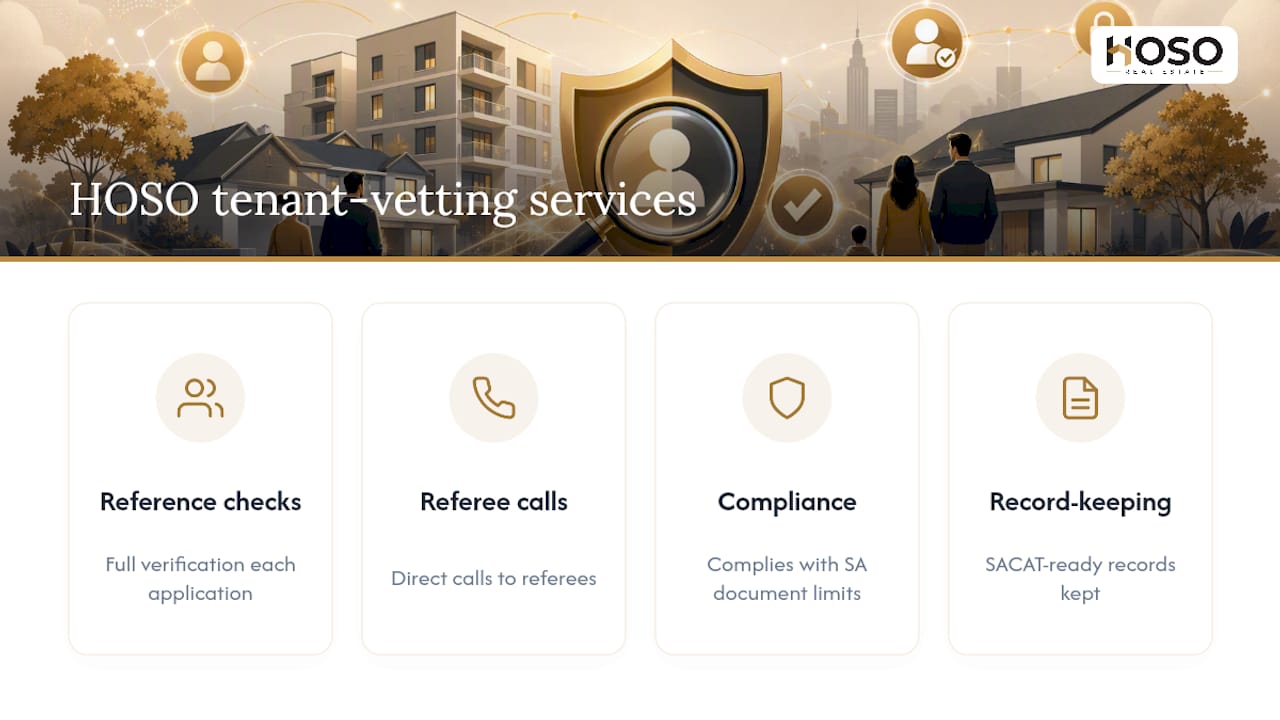
HOSO Real Estate runs the full reference and verification workflow described above on every application, so you're not the one chasing referees between meetings or wondering if a database listing is current. Our services cover tenant vetting, direct referee calls, compliance with SA's document limits, and SACAT-ready record-keeping, built specifically for landlords who want their asset protected without doing the legwork themselves. If you're weighing up self-managing against professional oversight for a Adelaide investment property, our recently leased properties show the calibre of tenant our process consistently places. Get in touch to have your next application screened properly, start to finish.
Sources
For the regulatory detail behind this guide, see Consumer and Business Services on rental reforms, the Residential Tenancies Regulations 2025, practical screening steps from Propkt, and the self-management checklist from Landlord Wise.
- Rental reforms | Consumer and Business Services
- RESIDENTIAL TENANCIES REGULATIONS 2025 - REG 8
- How to Screen Tenants in Australia in 2026