
If you own a rental property in South Australia, three obligations sit at the centre of every tax return: declare all rental income to the Australian Taxation Office (ATO), keep records that prove genuine availability for rent, and understand how RevenueSA aggregates site values for land tax. HOSO Real Estate works with Adelaide landlords daily on exactly these compliance points.
Immediate actions to reduce audit risk:
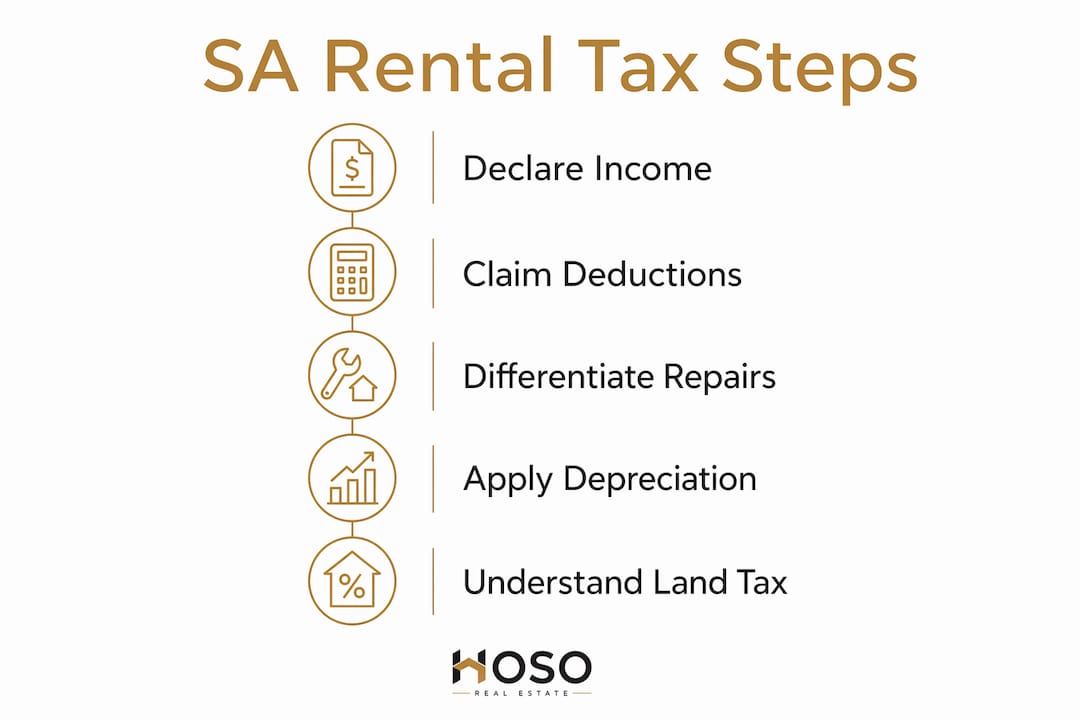
- Declare rental income in the financial year the tenant pays or the agent receives it, not when you receive the disbursement
- Keep advertising records, vacancy logs, and agent correspondence to prove genuine availability
- Separate repairs (deductible now) from capital improvements (claimed over time)
- Check your aggregated site values with RevenueSA if you hold multiple SA properties
- Obtain a depreciation schedule from a qualified quantity surveyor
- Consult a registered tax agent for trust, company, or joint ownership structures
Table of Contents
- What are your SA rental property tax obligations?
- HOSO Real Estate supports your compliance, not your tax advice
What are your SA rental property tax obligations?
Rental income: what to declare and when
Rental income you must declare includes rent, bond money retained for damage or default, insurance payouts for lost rent, and fees from cancelled bookings. The timing rule catches many landlords: if a tenant pays your agent in June but the agent disburses in July, that income is assessable in the June financial year. Payments in goods or services must be valued at market rates and declared the same way.
Deductible expenses and apportionment
The ATO's rental properties guide lists deductible items including loan interest, council rates, insurance, agent fees, body corporate charges, land tax, and repairs. Where a property has any private use, expenses must be apportioned. Prepaid expenses covering 12 months or less that end on or before 30 June 2026 may qualify for an immediate deduction; longer prepayments are generally apportioned across years.

Repairs vs capital improvements
This is the single most common trigger for ATO review of rental returns. ATO guidance is clear: repairs fix existing deterioration and are deductible in the year incurred; improvements increase value or change the character of the property and must be claimed over time as capital works or depreciation. Replacing a broken fence paling is a repair. Replacing the entire fence with a new style is an improvement.
Pro Tip: Keep dated photos, contractor invoices, and a written description of the pre-existing damage for every repair claim. That evidence is what separates an accepted deduction from an audit adjustment.
Depreciation: Division 40 and Division 43
Division 43 covers capital works (the building structure itself) at 2.5% per year for eligible properties. Division 40 covers plant and equipment items such as appliances, carpet, and hot water systems, each depreciating at its own effective life rate. A quantity surveyor's depreciation schedule is the standard method of substantiation; without one, many deductions simply cannot be claimed.
Record keeping and genuine availability
The ATO expects specific evidence that a vacant property was genuinely available for rent, not merely listed. Advertising with limited exposure, setting unrealistic rent, or refusing reasonable tenants can all undermine a claim. Keep:
- Rental listings with dates and platforms used
- Agent correspondence and tenant enquiry records
- Vacancy logs noting reasons for any gap periods
- Inspection reports and maintenance records
- Loan statements, council rate notices, and insurance certificates
Records should be retained for the relevant ATO retention period, generally five years from lodgement.
SA land tax: aggregation, thresholds, and ownership structures
RevenueSA calculates land tax on site value only (land, not buildings) and aggregates all taxable land in the same ownership. Multi-property investors are regularly surprised when combined site values push them into a higher tier. Current 2025–26 general rates show progressive tiers; the table below illustrates how the calculation works at each level.
| Total site value | Tax estimate (general rates) |
|---|---|
| — | A few hundred dollars |
| — | A few thousand dollars |
| — | Around twenty thousand dollars |
| — | Over fifty thousand dollars |
Source: RevenueSA land tax calculation examples 2025–26
Ownership structure changes the outcome materially. Trusts face separate (often lower) thresholds, and companies are assessed differently again. RevenueSA publishes current thresholds and indexes them annually. Land tax assessments are issued by RevenueSA; late payment attracts penalties, so check your assessment date and pay promptly.
Capital gains tax when you sell
Disposing of a rental property triggers a CGT event. The ATO's supplementary return guidance explains that if you ever rented out part of your home, you lose a proportionate share of the main residence exemption. The 50% CGT discount applies to assets held for more than 12 months. For long-term capital growth planning, understanding the CGT interaction with your ownership structure before you sell is worth the time with a tax agent.
GST and residential rentals
GST does not apply to standard residential rent. The ATO confirms that amounts received for residential rental are input-taxed, meaning no GST is charged and no GST credits are claimed on related expenses. Specialist advice is warranted if the property is used for short-stay or commercial purposes.
Common compliance pitfalls
| Pitfall | Why it triggers review |
|---|---|
| Claiming improvements as repairs | ATO's most flagged rental issue |
| Incorrect income timing | Agent disbursement vs. payment date confusion |
| Poor vacancy records | Deductions disallowed without genuine availability evidence |
| Aggregation surprise (land tax) | Multi-property site values push into higher tiers |
| No depreciation schedule | Division 40/43 claims unsupported |
HOSO Real Estate supports your compliance, not your tax advice
Adelaide landlords who work with HOSO Real Estate's property management services receive the documentation that makes tax time straightforward: annual financial reports, itemised rent statements, routine inspection records, advertising archives, and vacancy logs. These are the exact records your registered tax agent needs to substantiate deductions and respond to any ATO query.
HOSO Real Estate does not provide tax advice. For personalised guidance on depreciation schedules, trust or company structures, or CGT planning, consult a registered tax agent. What HOSO does provide is the property oversight and documentation discipline that keeps your records audit-ready year-round. Contact HOSO Real Estate to discuss how professional management can reduce your compliance risk.
This article is general information only and does not constitute tax advice. Confirm your obligations with the ATO, RevenueSA, or a registered tax agent for your specific situation.