
Capital growth is defined as the increase in a property's market value over time, and it is the primary mechanism through which Australian property investors build long-term wealth. Unlike rental income, which provides regular cash flow, capital growth compounds silently in the background, often delivering the largest share of total investment returns. Australian house prices have grown at an average rate of ~6.4% per year over the past 30 years. That figure means a property purchased for $500,000 could be worth well over $1 million within 12 years, without a single renovation. Understanding rental property capital growth explained through this lens, and knowing how to position your portfolio to capture it, is what separates passive landlords from active wealth builders.
What drives rental property capital growth in Australia?
Labour market strength is the primary medium-term driver of property capital growth, more so than interest rate movements. Strong employment conditions convert theoretical housing demand into real buying power. When wages rise and unemployment stays low, more households can borrow and spend, which pushes property prices upward.

Population growth compounds this effect. Adelaide, for example, has recorded sustained interstate migration gains over recent years, driven by relative affordability and lifestyle factors. More people competing for a fixed or slowly expanding housing stock creates upward price pressure. This is particularly visible in suburbs like Norwood, Prospect, and Unley, where land supply is constrained and demand from both owner-occupiers and investors remains strong.
Supply constraints are equally critical. Low building approvals relative to population growth reduce the number of dwellings available, which tightens the market. Planned infrastructure projects within a 3–5 year horizon are among the strongest predictors of future capital growth. New train lines, hospital expansions, and university precincts all attract workers and residents to specific corridors, lifting values before the projects are even complete.
Vacancy rates below 2% signal strong rental demand, which often precedes price growth. Nationally, vacancy rates sat at around 1.2% in 2026. That level of tightness means landlords face minimal void periods, and the same scarcity that keeps rents high also supports capital values.
Pro Tip: Monitor DA (development application) approvals in your target suburb. A sudden spike in approvals signals incoming supply, which can cap or slow capital growth even in otherwise strong markets.
How does capital growth compare with rental yield?
Rental yield is the annual rental income expressed as a percentage of the property's value. Capital growth is the annual increase in that value. The two metrics often move in opposite directions, and understanding this trade-off is central to building a balanced portfolio.
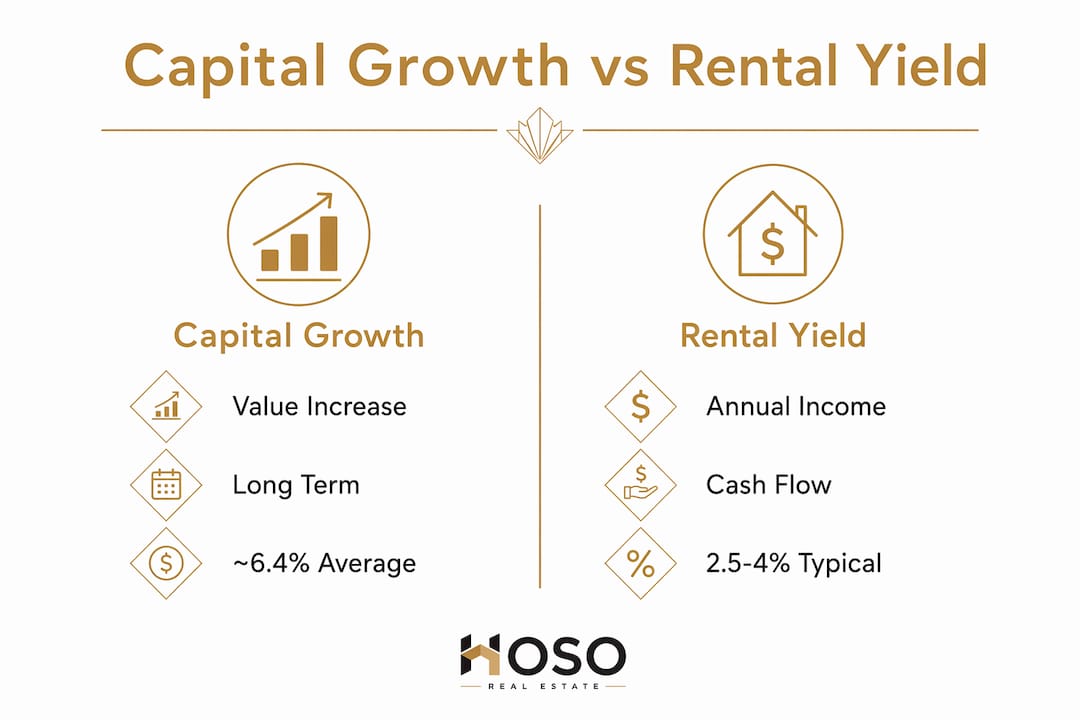
High-growth areas typically produce yields of 2.5–4%, while high-yield regional areas often deliver slower capital appreciation. Inner-city Adelaide suburbs like Hyde Park or Burnside tend to sit in the lower-yield, higher-growth category. Regional centres like Port Augusta or Whyalla can offer yields above 6%, but their long-term capital appreciation track record is less consistent.
| Market type | Typical gross yield | Capital growth profile |
|---|---|---|
| Inner metro (e.g., Norwood, Unley) | 2.5–3.5% | Strong, consistent long-term growth |
| Middle-ring suburban | 3.5–4.5% | Moderate growth, improving yield |
| Regional centres | 5.5–7%+ | Variable, often cycle-dependent |
| High-growth corridor (infrastructure-led) | 3–4.5% | Above-average medium-term growth |
Experienced investors often combine both strategies. A high-yield regional property provides cash flow that services debt, while a lower-yield metro property builds the equity that funds the next purchase. Median rental yields nationally average 3.9% for houses, with capital city rents growing 7.8% year-on-year in 2026. That rental growth, in turn, supports capital values by improving the income multiple buyers are willing to pay.
Borrowing capacity is where the two metrics intersect most practically. A property with strong rental income improves your serviceability assessment, which expands what lenders will approve for your next purchase. This is why rental yield and capital gains are not competing priorities but complementary tools in a well-structured portfolio.
Pro Tip: Do not chase yield at the expense of location quality. A 7% yield in a town with declining population will not protect you from capital loss. Location fundamentals always outrank income metrics.
How long does capital growth take and what affects its timing?
The Australian property cycle typically runs 7–10 years from trough to peak. Growth is not linear. Most investors experience long flat periods followed by sharp repricing events, often compressed into 18–24 months. Expecting steady annual gains misrepresents how the cycle actually works.
Timing matters more than most investors admit. Buying early in a cycle, particularly near the completion of a major infrastructure project, captures the repricing that occurs as the market catches up to new fundamentals. Buying at the peak of a cycle, when media coverage is loudest and sentiment is highest, often means holding through a flat or declining period before growth resumes.
The Next Time Buyer cohort represents on average 44.9% of market transactions historically. This group, existing homeowners upgrading or downsizing, drives liquidity and price discovery. When Next Time Buyer activity rises, it signals that confidence is returning and that price growth is likely 6–12 months away. Tracking sales volumes and days-on-market in your target suburb gives you a practical proxy for this indicator.
Local supply and demand imbalances also affect timing. South Australia's planning system has historically been slower to approve medium-density infill than New South Wales or Victoria. That constraint has protected capital values in established Adelaide suburbs, even during national market slowdowns. Demographic shifts, such as the ageing population's preference for single-level homes in walkable suburbs, are reshaping demand patterns in areas like Glenelg, Henley Beach, and Mitcham.
What strategies maximise capital growth in a rental portfolio?
Location selection is the single most important decision an investor makes. Properties in areas with scarcity, employment proximity, and committed infrastructure consistently outperform those chosen on yield alone. Experienced investors apply scoring frameworks that weigh multiple converging signals rather than relying on any single data point.
A practical approach to location scoring includes the following criteria:
- Infrastructure pipeline. Identify committed government projects within 3–5 years. Road upgrades, hospital expansions, and public transport extensions all lift surrounding values.
- Supply constraint. Check zoning maps for heritage overlays, flood zones, or minimum lot sizes that limit future development. Scarcity protects capital values.
- Employment proximity. Properties within 10 kilometres of major employment nodes, such as the Adelaide CBD, Flinders Medical Centre, or the Tonsley Innovation District, attract stable, higher-income tenants and owner-occupier demand.
- Vacancy rate trend. A suburb with a vacancy rate falling below 2% and rental growth above the metro average is signalling demand that will eventually push prices higher.
- Owner-occupier ratio. Suburbs where owner-occupiers represent more than 60% of residents tend to have better maintained streetscapes and stronger price floors during downturns.
Negative gearing affects the cash flow equation but should not drive location decisions. Tax policy should not override fundamentals like location quality and supply constraints. The tax benefit is a buffer, not a strategy.
Portfolio scaling requires careful debt management. Lenders assess loans with a buffer 3 percentage points above the actual interest rate. That buffer erodes borrowing capacity faster than most investors expect. Sequencing purchases to maintain serviceability, rather than maximising the number of properties held, is the approach that sustains long-term portfolio growth. For a detailed framework on sequencing and scaling, the portfolio scaling guide covers this in practical depth.
Pro Tip: After each purchase, recalculate your borrowing capacity before committing to the next one. Many investors discover their capacity has tightened significantly, even when their income has not changed, simply because of how lenders model existing debt.
Key takeaways
Capital growth in rental property is driven by labour market strength, supply constraints, and infrastructure investment, not by yield alone.
| Point | Details |
|---|---|
| Capital growth defined | It is the increase in property value over time, averaging ~6.4% annually in Australia over 30 years. |
| Primary growth driver | Labour market strength and wage growth convert demand into actual buying power and price movement. |
| Yield vs growth trade-off | High-growth metro areas typically yield 2.5–4%, while high-yield regional areas offer slower appreciation. |
| Timing the cycle | The Australian property cycle runs 7–10 years; buying near infrastructure completion captures early repricing. |
| Debt management | Lenders apply a 3 percentage point buffer above actual rates, making borrowing capacity the key constraint on portfolio scaling. |
What I have learned about capital growth after years in Adelaide property
The most common mistake I see investors make is conflating activity with progress. They buy frequently, chase yield in regional markets, and end up with a portfolio that generates income but builds little equity. Capital growth requires patience and selectivity, not volume.
Data matters, but local knowledge closes the gap. Knowing that a particular street in Prospect has heritage restrictions that prevent subdivision, or that a new tram extension will stop two blocks from a property in Bowden, is the kind of insight that does not appear in a spreadsheet. That combination of data and ground-level understanding is what produces consistent results.
Debt management is where most portfolios stall. Investors focus on the deposit and underestimate how quickly the serviceability buffer tightens after two or three purchases. Managing debt carefully, maintaining cash reserves, and holding quality assets through flat periods is not exciting advice. It is, however, what the investors with the strongest portfolios actually do.
Tenant quality also affects capital growth indirectly. A well-maintained property in a high-demand suburb attracts tenants who treat the asset with care. That reduces maintenance costs, preserves presentation, and supports the property's value at appraisal time. Good property oversight practices protect the asset between purchases, not just during them.
— HOSO
How HOSO Real Estate supports your capital growth strategy
HOSO Real Estate works with Adelaide landlords and investors who are serious about long-term asset performance. The focus is on tenant quality, compliance, and property presentation, all of which directly support capital values over time. For investors building or scaling a portfolio, HOSO Real Estate provides property management services tailored to growth-focused landlords, including market insights specific to South Australian suburbs and conditions. A free rental appraisal gives you a clear picture of your current income position and how it aligns with your capital growth objectives. If you are planning your next purchase or reviewing an existing portfolio, that appraisal is the right starting point.
FAQ
What is capital growth in rental property?
Capital growth is the increase in a rental property's market value over time. Australian residential property has averaged approximately 6.4% annual growth over the past 30 years.
Is capital growth or rental yield more important for investors?
Both metrics serve different purposes. Capital growth builds long-term wealth, while rental yield supports cash flow and borrowing capacity. Most experienced investors target both within a single portfolio.
How long does it take to see capital growth on a rental property?
The Australian property cycle typically runs 7–10 years. Growth is uneven, with flat periods followed by sharp repricing, so investors should plan to hold assets through at least one full cycle.
What are the main factors affecting capital growth?
Labour market strength, population growth, supply constraints, infrastructure investment, and vacancy rates are the primary factors. Location quality and demographic demand are the most consistent long-term predictors.
How does negative gearing affect capital growth strategy?
Negative gearing reduces the after-tax cost of holding a property with a cash flow shortfall, but it should not drive location decisions. Location quality and supply constraints remain the strongest determinants of capital growth outcomes.