
Real-time rental reporting is the process of tracking rental income and expenses as they occur, using automated payment systems and integrated accounting tools to reflect cleared transactions immediately. The industry term for this practice is automated rental ledger management, though landlords and property platforms commonly use "real-time rental reporting" to describe the same function. Unlike traditional rent tracking, which relies on manual bank reconciliation and end-of-year summaries, real-time reporting gives landlords a live view of their financial position at any point during the year. For South Australian landlords managing properties in suburbs like Norwood, Unley, or Glenelg, this means no more waiting for your accountant to confirm what you already suspect about your cash flow. HOSO Real Estate builds this level of financial visibility into its property management approach as standard practice.
How does real-time rental reporting work?
Real-time rental reporting depends on two core mechanisms: instant payment processing and automated bookkeeping. When these two systems connect, rent payments flow directly into a live financial ledger without manual input.

Instant payment rails replace traditional bank transfers
Modern platforms use payment infrastructure such as PayTo instead of traditional bank transfers. PayTo confirms and reconciles funds within minutes, 24 hours a day, seven days a week, including weekends and public holidays. That eliminates the standard 2–3 business day waiting period that landlords have tolerated for decades. When a tenant pays rent on a Saturday morning, the ledger reflects it by Saturday morning.
Automated reconciliation and expense categorisation
Once a payment clears, the platform updates the rental ledger instantly and issues a legal receipt automatically. Modern Australian property platforms categorise transactions into Australian Taxation Office (ATO) compliant groups and make live income and expenditure reports accessible around the clock. This means your repairs, rates, insurance, and interest charges are sorted into the correct tax categories without you lifting a finger. The result is a financial record that is always audit-ready.
Integration with property management platforms
Property management platforms connect payment processing, document storage, and accounting into a single workflow. When a maintenance invoice is paid, it is logged, categorised, and reflected in your net yield calculation immediately. Landlords no longer need to cross-reference bank statements, spreadsheets, and paper receipts at the end of the financial year.
Pro Tip: If a tenant pays rent via cash or a traditional bank transfer outside the integrated payment system, you must manually mark the payment as received in the platform. Skipping this step breaks ledger continuity and creates gaps that are difficult to explain at SACAT hearings or ATO audits.
What are the benefits of real-time rental reports?
The benefits of real-time rental reports go well beyond knowing whether rent has been paid. Live financial data changes how landlords plan, decide, and protect their assets.
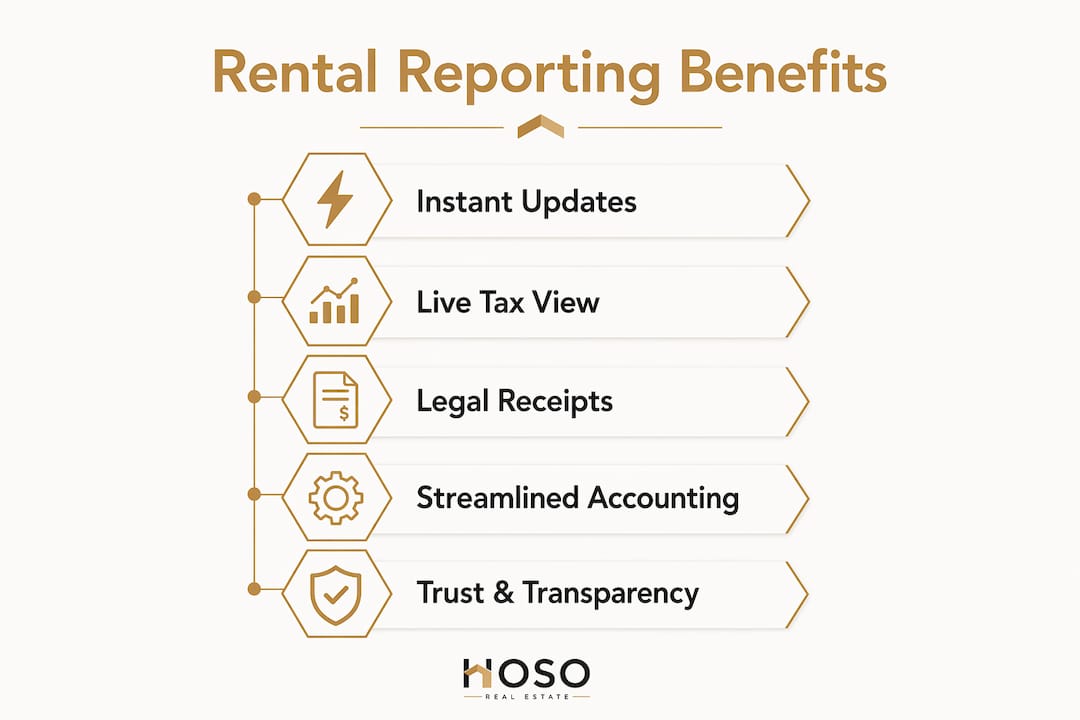
Live tax visibility throughout the year
Live tax visibility allows landlords to manage cash flow and tax planning proactively throughout the year rather than scrambling at the end of june. You can see your net yield, current tax position, and year-to-date cash flow at any time. If an unexpected repair in February pushes your deductible expenses higher, you can see the tax impact immediately and adjust your planning accordingly. This is a capability that traditional annual reporting simply cannot provide.
Immediate access to legal documents
Automated rental ledgers update the moment a payment clears, issuing legal receipts and maintaining indisputable payment histories. In South Australia, a complete and accurate rental ledger is critical evidence in any SACAT dispute. Having that document available instantly, rather than requesting it from a property manager days later, puts landlords in a stronger position.
Reduced end-of-year accounting delays
Real-time rental tracking removes the bottleneck that typically hits landlords between july and september. Your accountant receives categorised, ATO-compliant data rather than a folder of bank statements. That reduces both the time and the cost of preparing your tax return.
Stronger landlord-owner trust and transparency
Transparency through live access to statements, invoices, and performance data significantly builds owner trust and reduces the need for frequent status enquiries. Landlords who can log in and see their property's financial position at any time are less likely to feel anxious about what their property manager is doing. That confidence reduces friction and improves the working relationship.
Pro Tip: Use your live dashboard data when timing major decisions. If your net yield data shows a strong cash flow position in march, that is the right time to approach your lender about refinancing, not after the financial year closes when the opportunity may have passed.
The key benefits of real-time rental reports include:
- Live net yield and cash flow visibility at any point in the financial year
- ATO-compliant expense categorisation without manual data entry
- Instant access to rental ledgers and receipts for SACAT or tribunal use
- Reduced end-of-year accounting workload for landlords and accountants
- Proactive tax planning based on current, not historical, financial data
Common challenges when implementing rental reporting systems
Real-time rental reporting delivers clear advantages, but landlords need to understand where the system requires attention to maintain accuracy.
Manual payments break automated workflows
The most common gap in any real-time system occurs when tenants pay outside the integrated rails. Manual reconciliation is required whenever a tenant pays via cash or traditional bank transfer. If those payments are not logged promptly, the ledger shows an outstanding balance that does not reflect reality. This creates confusion for landlords, accountants, and potentially for SACAT if a dispute arises.
Avoiding over-complex platforms
Landlords should avoid platforms that add administrative burden rather than reduce it. The goal of real-time rental tracking is fewer manual tasks, not more. Platforms that require extensive configuration, multiple logins, or manual data imports defeat the purpose. Prioritising platforms that reduce manual admin and automate expense categorisation is the right approach for most South Australian landlords.
Distinguishing reporting from full property management software
Real-time rental reporting is one feature within a broader property management platform. Landlords sometimes confuse a reporting dashboard with a complete management solution. Reporting tools show you what is happening financially. They do not handle lease renewals, routine inspections, maintenance coordination, or compliance management. Understanding this distinction helps landlords select the right tools for the right tasks.
Key challenges to manage include:
- Logging cash and bank transfer payments manually to maintain ledger accuracy
- Selecting platforms that reduce rather than increase administrative work
- Maintaining digital ledger accuracy for SACAT evidence and ATO compliance
- Recognising that reporting tools complement, but do not replace, full property management services
How to adopt real-time rental reporting: practical steps for SA landlords
South Australian landlords can implement real-time rental reporting without significant technical knowledge. The process follows a clear sequence.
-
Select a compatible platform. Choose a property management platform that integrates PayTo or equivalent instant payment rails with automated bookkeeping. Confirm that the platform produces ATO-compliant reports and supports document storage for receipts and invoices. Review digital tools for SA investors to compare feature categories before committing.
-
Set up your properties and tenants. Enter each property's details, including address, lease terms, and rent amount. Add tenant payment details and link them to the integrated payment system. Accurate setup at this stage prevents reconciliation errors later.
-
Communicate payment method changes to tenants. If you are moving tenants from direct bank transfer to an integrated payment system, give written notice and explain the process clearly. Tenants who understand the new system are more likely to use it correctly, which keeps your ledger accurate.
-
Import historical financial data. Upload previous financial years' income and expense records to create a baseline. This gives your accountant a complete picture and allows the platform to calculate accurate year-to-date figures from the start.
-
Schedule regular reviews of live reports. Set a recurring time each month to review your dashboard. Check net yield, outstanding balances, and expense categories. Monthly reviews catch errors early and keep your rental property oversight consistent throughout the year.
-
Link your accountant to the platform. Most modern platforms allow read-only accountant access. Granting this access means your accountant can pull ATO-compliant reports directly, without you needing to compile and send documents manually.
Key takeaways
Real-time rental reporting gives South Australian landlords live financial visibility that traditional annual reporting cannot match, making it the most effective tool for proactive property management and tax compliance.
| Point | Details |
|---|---|
| Definition and purpose | Real-time rental reporting tracks income and expenses as they occur using automated payment and accounting systems. |
| Payment technology | PayTo and equivalent instant rails clear and reconcile rent within minutes, including weekends and public holidays. |
| Tax and compliance benefit | ATO-compliant expense categorisation is automated, reducing end-of-year accounting delays and errors. |
| Legal document access | Live rental ledgers and receipts are available instantly, providing critical evidence for SACAT disputes in South Australia. |
| Manual payment risk | Cash or bank transfer payments outside integrated rails must be manually logged to maintain ledger accuracy and audit readiness. |
Why live reporting changed how I think about property management
The shift from annual statements to live dashboards is not just a technology upgrade. It changes the entire dynamic between a landlord and their portfolio.
Before live reporting became standard, landlords were always working with old information. You would find out about a cash flow problem weeks after it started. You would discover a tax issue when your accountant called in august. The financial picture was always a reconstruction of the past, not a view of the present.
What I have seen with landlords who adopt real-time rental tracking is a genuine shift in confidence. They stop asking "how is my property performing?" because they already know. That confidence changes how they make decisions. They refinance at the right time. They schedule maintenance when cash flow supports it. They approach lease renewals with accurate yield data rather than rough estimates.
The transparency benefit also flows to the landlord-tenant relationship. When tenants can see receipts issued instantly and landlords can access complete payment histories without delay, disputes become less common. The data is clear, current, and accessible to both parties. That removes the ambiguity that fuels most tenancy disagreements.
My advice to landlords who are still relying on spreadsheets or annual statements is direct: the administrative cost of switching is low, and the financial clarity you gain is significant. Select a platform that automates the work rather than adding to it. If you are unsure where to start, transparent property management practices provide a clear framework for what good reporting looks like in practice.
— HOSO
How HOSO Real Estate supports landlords with live financial reporting
HOSO Real Estate integrates real-time rental reporting into its property management services for Adelaide landlords and investors. Rather than receiving a quarterly statement and hoping the numbers add up, landlords managed by HOSO have access to live financial data, automated expense categorisation, and complete rental ledgers at any time. The property management services HOSO provides are built around financial transparency, compliance, and long-term asset performance. For landlords managing properties across suburbs like Prospect, Burnside, or Henley Beach, that level of visibility is not a luxury. It is the standard you should expect from a professional management partner.
FAQ
What is real-time rental reporting?
Real-time rental reporting is the automated tracking of rental income and expenses as transactions occur, using integrated payment systems and live accounting tools to update financial records immediately.
How does rental reporting differ from a standard rental ledger?
A standard rental ledger records payments after manual entry. Real-time rental reporting updates the ledger automatically the moment a payment clears, including issuing receipts and categorising expenses without manual input.
Can real-time rental reports be used as evidence at SACAT?
Automated rental ledgers provide indisputable payment histories that are accepted as legal evidence in South Australian Civil and Administrative Tribunal (SACAT) hearings, provided all payments are accurately recorded.
What happens if a tenant pays by cash or bank transfer?
Payments made outside integrated payment rails require manual entry in the platform. Failing to log these payments creates ledger gaps that affect ATO compliance and can undermine your position in a tenancy dispute.
Do I need a property manager to access real-time rental reporting?
Landlords can access real-time rental reporting through self-managed property platforms. Working with a professional property manager like HOSO Real Estate means the reporting is maintained accurately as part of a complete management service.