
Itemised property management billing creates an audit-ready, verifiable record that protects your asset, supports your tax and BAS positions, and prevents disputes before they start. The role of itemised property management billing goes well beyond administrative tidiness. It is the governance standard that separates a defensible portfolio from one that is exposed at tax time or in a maintenance dispute.
- Owners get a clear property expense breakdown they can reconcile, verify, and hand to their accountant.
- Managers get faster approvals, fewer callbacks, and a documented record that protects them from liability.
- Tenants benefit indirectly: disputes over maintenance quality are resolved faster when evidence exists.
HOSO Real Estate treats itemised billing as a non-negotiable governance standard across every Adelaide portfolio it manages.
Table of Contents
- What does itemised property management billing actually mean?
- How does itemised billing work from job to owner statement?
- What should an itemised invoice include?
- What are the real benefits of itemised billing for owners and managers?
- What are the most common problems with itemised billing?
- How should owners request itemised billing and managers implement it?
- What do practitioners say about itemised billing?
- What records do Australian owners and managers need to keep?
- Key takeaways
- Why itemised billing is the standard worth insisting on
- HOSO Real Estate can help you set this up
- Useful sources and further reading
What does itemised property management billing actually mean?
An itemised invoice records every charge as a separate line, with its own description, quantity, unit cost, GST indicator, and supporting reference. That is the one-sentence definition. In practice, scope covers maintenance labour, materials, subcontractor costs, call-out fees, disbursements, management commissions, and any applicable GST treatment, with attachments such as photos, supplier invoices, and job reports.
The contrast with a bundled or summary invoice matters. A summary statement might show "Repairs — $1,450" as a single line. That figure tells you nothing about what was done, who did it, whether GST applies, or whether the cost was a deductible repair or a capital improvement. Bundled invoices make correct tax classification difficult and weaken your audit trail at precisely the moment you need it most.
Itemised records reduce administrative friction and support ATO reviews. Bookkeeping specialists consistently identify them as the foundation of trust between owners and managers.
How does itemised billing work from job to owner statement?
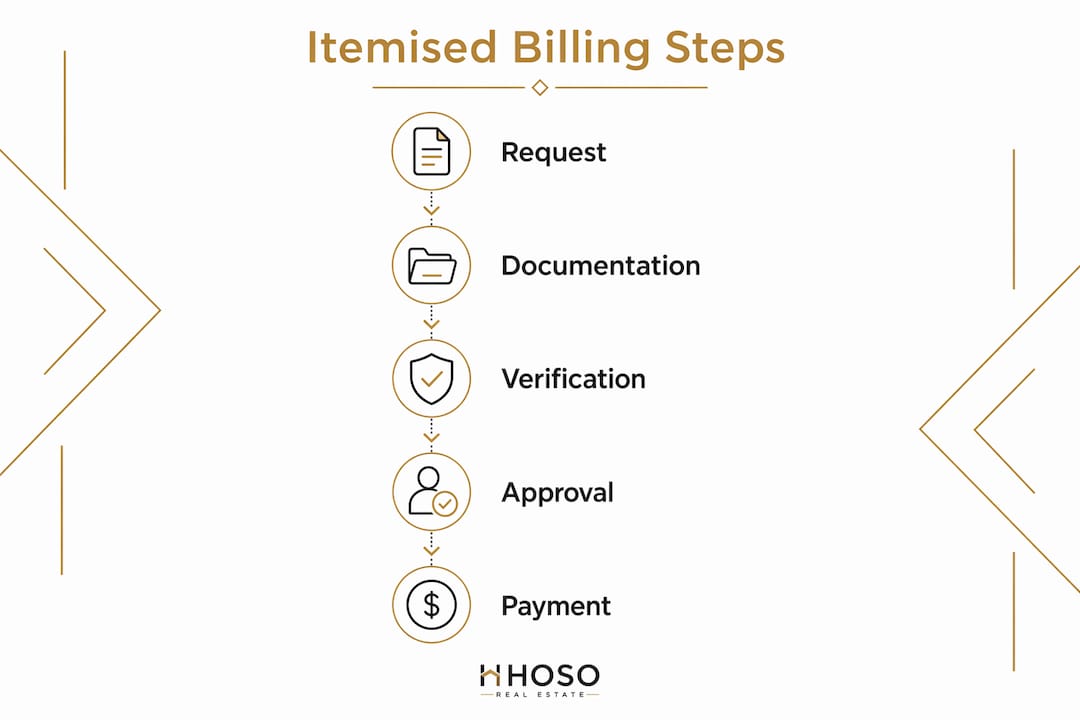
The flow is straightforward once a system is in place. A maintenance issue is reported, a quote is raised and approved, the job is assigned a unique job ID, work is completed, and the supplier invoice with line items is uploaded before the owner is billed.
Operational steps managers must run:
- Assign the property and owner in the management system before any job is raised.
- Create a job number and link it to the property record.
- Record every supplier invoice line item separately: description, quantity, unit cost, and GST treatment.
- Upload before-and-after photos and attach them to the relevant line item.
- Tag each expense to the correct category (repair, capital, disbursement, commission).
- Generate the owner invoice or statement with all attachments visible and referenced.
- Deliver the statement within the agreed reporting period, typically monthly.
Pro Tip: Use a property management photo tool to timestamp and geo-tag before-and-after images at the job site. Linking those images directly to the line item in your management system creates an unambiguous record that is far harder to dispute than a written description alone.

What should an itemised invoice include?
The minimum acceptable invoice contains: a line item description, quantity, unit cost, GST indicator, job ID, contractor name, supplier invoice reference, date, and supporting photos or a job report. Anything less leaves gaps a dispute or ATO audit can exploit.
Example line items by category:
- Labour: "Plumber — 2 hrs @ $95/hr — Job #1042 — GST inclusive"
- Materials: "Copper pipe fittings x 4 — $38.00 — GST inclusive"
- Call-out fee: "After-hours call-out — $110.00 — GST inclusive"
- Subcontractor: "Electrical contractor — switchboard inspection — $220.00 — GST inclusive"
- Disbursement: "Council rate notice — $340.00 — GST exempt"
- Commission: "Management commission — 8% of $2,100 rent — $168.00 — GST inclusive"
Understanding what disbursements cover and how they should appear on owner statements is worth reviewing separately, as these are the line items most commonly buried or mislabelled.
| Invoice element | Why it matters | Supporting attachment |
|---|---|---|
| Line item description | Identifies the work for tax classification | Job report or scope of works |
| Quantity and unit cost | Enables cost verification and comparison | Supplier invoice |
| GST indicator | Required for BAS accuracy | Tax invoice from supplier |
| Job ID | Links invoice to approval and photos | Management system record |
| Contractor name and ABN | Confirms legitimate supplier | Supplier invoice |
| Before/after photos | Proves work was completed as stated | Photo file with timestamp |
| Quote reference | Confirms approved scope | Written quote |
What are the real benefits of itemised billing for owners and managers?
Transparency, trust, audit readiness, and dispute avoidance are the primary benefits. Each one has a practical consequence for how you manage your portfolio and how your accountant handles your return.

For owners, the tax benefit is direct. The ATO explicitly recommends requesting itemised invoices from tradespeople so you can separate deductible repairs from capital works. In one ATO example, a landlord who requested an itemised invoice from a painter could claim internal wall painting as a repair deduction and external rendering as a capital works deduction. Without that breakdown, both costs would have been lumped together and the deduction timing would have been wrong.
For managers, itemised bookkeeping reduces administrative friction and supports ATO reviews. Per-property ledgers and clear expense categorisation also protect trust account compliance, which is a regulatory requirement in South Australia.
- Fewer disputes over maintenance charges because evidence exists before the question is raised.
- Faster owner approvals because the scope and cost are visible upfront.
- Cleaner BAS preparation because GST treatment is recorded at the line-item level.
- Stronger supplier accountability because contractors know their invoices will be scrutinised.
Governance advisers increasingly treat itemised disclosure of commissions and outgoings as best practice in strata and owners-corporation settings, not just a courtesy to individual landlords.
What are the most common problems with itemised billing?
Vague descriptions, bundled charges, missing supporting evidence, late invoices, and misclassification of capital versus repair costs are the failures that create the most damage. Each one has a specific consequence.
A description like "general maintenance" tells you nothing about what was done, who did it, or how to classify it for tax. Bundling mixed-service invoices into a single repair cost undermines your depreciation and deduction claims. A plumber who repairs an existing toilet and installs a new vanity in the same visit must be invoiced separately for each task. Missing photos mean a disputed repair becomes your word against the contractor's. Late invoices disrupt monthly reconciliations and push BAS preparation into guesswork.
Misclassifying capital works as repairs is the most costly error. Capital improvements are depreciated over time; repairs are deducted in the year incurred. Getting that wrong triggers ATO adjustments.
Pro Tip: Require written, itemised quotes before approving any job above your agreed threshold. Contractors who refuse to provide a quote with inclusions, exclusions, and provisional sums should be replaced. That single control eliminates most scope-creep disputes.
How should owners request itemised billing and managers implement it?
Owners should start with the management agreement. If itemised billing is not already specified, add a clause before the next renewal.
Steps for owners:
- Review your current management agreement for invoice and reporting standards.
- Add a clause requiring itemised invoices for all maintenance, disbursements, and commissions, with supporting attachments.
- Set a written quote threshold (for example, any job above $500 requires a quote before approval).
- Request the last three months of owner statements and check each line against the criteria in the table above.
- Ask for any missing attachments in writing and set a seven-day response expectation.
Sample request phrase: "Please provide itemised invoices for all maintenance charges, including a job reference number, contractor name, line-item breakdown, and before-and-after photos. For any job above $500, a written quote must be approved before work commences."
Manager's implementation checklist:
- Property and owner assigned in the system before any job is created.
- Job number generated and linked to the property record.
- Supplier invoices entered line by line, not as a lump sum.
- Photos uploaded and linked to the job record.
- Owner statement generated with all references visible.
Pro Tip: Embed the itemised billing requirement into your onboarding workflow and routine inspection process. When a routine inspection identifies a maintenance item, raise the job immediately with a job ID. That way, the paper trail starts before the tradesperson is even booked, and the rental property oversight process becomes self-documenting.
What do practitioners say about itemised billing?
Practitioner consensus is consistent: itemised invoices with photos and supplier invoices materially reduce disputes and protect tax positions. Maintenance providers report that itemised invoices with photographic evidence cut maintenance disputes and speed landlord sign-off. Bookkeepers identify itemised records as the foundation of trust between owners and managers, noting they simplify BAS preparation and make audit trails defensible.
Attaching before-and-after photographs to maintenance line items creates an unambiguous audit trail that both prevents disputes and supports asset valuation over time.
In Adelaide portfolios managed by HOSO Real Estate, itemised billing has resolved situations where a tenant disputed whether a repair was completed. Because the job record included timestamped photos linked to the line item, the matter was closed without escalation to SACAT. That outcome is not unusual. It is the predictable result of a documented process.
Pro Tip: Present owner statements with a summary page followed by the line-item detail. Owners who receive a wall of line items without context tend to query everything. A one-page summary with totals by category, followed by the full itemised breakdown, gives the owner the overview they need and the detail their accountant requires.
What records do Australian owners and managers need to keep?
Itemised billing supports BAS, ATO audits, and owners-corporation governance. The ATO's guidance on rental expenses requires owners to keep evidence of all income and expenses. In South Australia, that obligation sits alongside Consumer and Business Services requirements for trust account records.
| Document type | Retention period | Purpose |
|---|---|---|
| Supplier tax invoice | 5 years minimum | BAS, ATO audit, deduction support |
| Before/after photos | Duration of tenancy + 5 years | Dispute defence, asset record |
| Written quote | 5 years minimum | Scope verification, dispute prevention |
| Owner statement | 5 years minimum | Reconciliation, tax return support |
| Job report or timesheet | 5 years minimum | Labour cost verification |
| Outgoings reconciliation | 5 years minimum | Recoverable vs non-recoverable cost separation |
Dedicated accounting platforms such as MYOB or Xero, with property management integrations, reduce reconciliation errors as portfolios grow. Transitions to specialist platforms commonly occur between 15 and 50 properties, where manual processes begin to create trust accounting risk. For South Australian landlords, accurate outgoings reconciliation depends on itemised records that separate recoverable from non-recoverable costs. Without that separation, ATO audit friction increases and strata or commercial outgoings disputes become harder to resolve.
This article is general information, not tax or legal advice. Confirm current ATO record-keeping requirements and SA-specific obligations with a qualified accountant or adviser for your own situation.
Key takeaways
Itemised property management billing is the single most effective control owners have for protecting their tax position, preventing disputes, and maintaining an audit-ready portfolio record.
| Point | Details |
|---|---|
| Itemised invoices protect tax positions | The ATO recommends itemised invoices so owners can correctly separate repairs from capital works deductions. |
| Photos linked to line items prevent disputes | Timestamped before-and-after photos attached to job records resolve maintenance disputes without tribunal involvement. |
| Five-year retention is the minimum standard | Supplier invoices, photos, quotes, and owner statements must be kept for at least five years to support BAS and ATO audits. |
| Quote thresholds stop scope creep | Requiring written quotes above an agreed dollar threshold eliminates most cost disputes before work begins. |
| HOSO Real Estate applies this as standard | HOSO manages Adelaide portfolios with itemised billing, job IDs, and photo evidence as baseline governance practice. |
Why itemised billing is the standard worth insisting on
Most disputes in property management do not start as disputes. They start as ambiguity. A vague invoice, a missing photo, a bundled charge that nobody can explain. By the time an owner or manager realises the record is inadequate, the tradesperson has moved on and the evidence is gone.
The conventional view is that itemised billing is extra administration. That framing gets it backwards. A summary invoice is the one that creates extra work, because every query, every BAS correction, and every SACAT appearance costs more time than the documentation would have taken. The administration is not in the itemised invoice. It is in the absence of one.
What owners often underestimate is that itemised billing also changes the quality of the maintenance relationship. When contractors know their invoices will be reviewed line by line and compared against photos, the quality of both the work and the paperwork improves. That is not a theory. It is a consistent pattern in well-managed Adelaide portfolios.
The gap between transparent property management and opaque management is usually not the manager's intent. It is the absence of a documented standard. Itemised billing is that standard, written into the process before anything goes wrong.
HOSO Real Estate can help you set this up
HOSO Real Estate works with Adelaide landlords and investors to implement itemised billing as part of a complete portfolio governance framework. That includes reviewing recent owner statements, recommending clause language for management agreements, setting quote thresholds, and establishing a reporting cadence that keeps your records audit-ready year-round.
If you manage properties in Adelaide and want to know whether your current invoicing meets the standard, the HOSO services page outlines how the agency approaches property management, compliance, and owner reporting. A conversation typically covers a review of your last three months of statements, the documentation gaps most commonly found, and the practical steps to close them. No jargon, no pressure. Just a clear picture of where your records stand.
Useful sources and further reading
The following primary sources informed this article and are worth bookmarking for ongoing reference.
- ATO — Repair and maintenance expenses: The primary authority on separating repairs from capital works, with a worked example of how an itemised invoice changes the deduction outcome.
- ATO — How to claim rental expenses: Sets out the evidence requirements for rental expense claims and the obligation to keep supporting records.
- PMVA — Outgoings reconciliation: Practical guidance on the reconciliation process for commercial and mixed-use properties, including how itemised records support end-of-year adjustments.
- Everglow — Investment property accounting: Australian guide explaining why bundled invoices create tax classification problems and how to separate capital and repair costs correctly.
- Bookkeeping Clerk — Property management bookkeeping: Covers per-property ledgers, trust account separation, and the role of itemised records in ATO-ready bookkeeping.
Itemised billing is not a preference. It is the documentation standard that makes every other part of property management — tax, compliance, disputes, and reconciliation — function correctly.