
Property management fees are the charges landlords pay a real estate agent or management company to oversee a rental property, typically calculated as a percentage of collected rent plus a range of additional service fees. In South Australia, the standard monthly management fee sits between 8% and 12% of rent collected, though premium services can reach 15%. Understanding the full fee structure, not just the headline percentage, is what separates landlords who budget accurately from those who face unexpected costs at the end of each financial year. This article covers property management fees explained in full, from base rates to hidden charges, fee structure comparisons, and practical negotiation strategies for Adelaide landlords.
What are the common components of property management fees?
Property management fees are not a single charge. They are a collection of fees covering different services, each triggered at different points in the tenancy lifecycle.

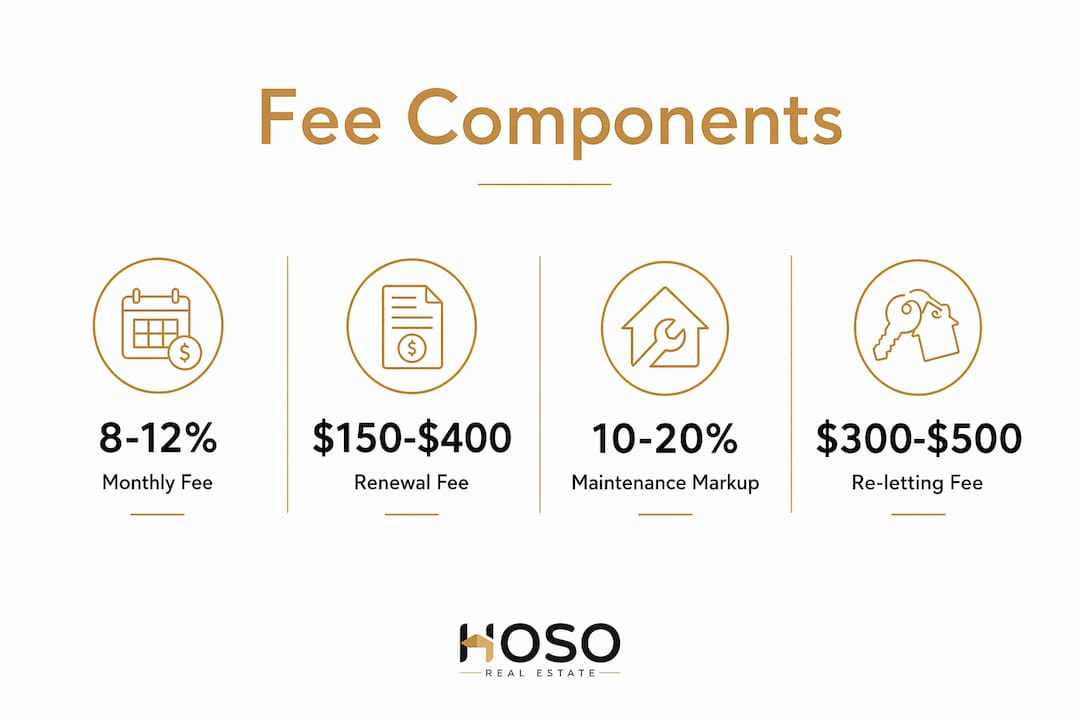
The monthly management fee is the base charge. Monthly fees typically range from 8% to 12% of collected rent, with flat fee alternatives ranging from $100 to $299 per unit per month. This fee covers rent collection, routine communication, and general oversight of the tenancy.
Beyond the base fee, landlords should expect the following additional charges:
- Leasing or tenant placement fee: Charged when a new tenant is placed. Tenant placement fees range from 50% to 100% of one month's rent, depending on the agency and property type.
- Lease renewal fee: Charged each time an existing tenant extends their lease. Lease renewal fees average $150 to $400 and are often applied annually.
- Routine inspection fees: Inspection fees generally run between $50 and $150 per inspection, with most agencies conducting two to four inspections per year.
- Onboarding or setup fee: A one-off charge at the start of the management agreement. Setup fees range from $0 to $500 depending on the agency.
- Eviction coordination fee: If a tenant must be removed, eviction coordination costs $200 to $500, plus any applicable SACAT filing costs.
- Vacancy or marketing fee: Some agencies charge a small flat fee or a percentage of the management fee during vacant periods to cover advertising and marketing activity.
The table below summarises when each fee is typically charged:
| Fee type | Typical range | When charged |
|---|---|---|
| Monthly management fee | 8%–12% of rent collected | Monthly |
| Tenant placement fee | 50%–100% of one month's rent | Per new tenancy |
| Lease renewal fee | $150–$400 | Per renewal |
| Routine inspection fee | $50–$150 per inspection | 2–4 times per year |
| Onboarding/setup fee | $0–$500 | Once at contract start |
| Eviction coordination fee | $200–$500 plus court costs | Per eviction event |
| Vacancy/marketing fee | Variable flat fee | During vacant periods |
Pro Tip: Ask your prospective property manager for a written fee schedule before signing. A reputable agency will provide this without hesitation. If they are reluctant, that tells you something important.
How do hidden fees affect total property management costs?
The headline management percentage is rarely the full story. Total effective costs including base fees and additional charges frequently reach 18% to 25% of gross rental income. That figure can significantly reduce net returns, particularly for landlords with properties in mid-range suburbs like Prospect, Unley, or Norwood where yields are already compressed.
The most common hidden charges include:
- Maintenance markups: Agencies often add a 10%–20% margin on top of contractor invoices. On a $2,000 repair, that is an extra $200 to $400 you may not notice unless you request itemised invoices.
- Administration or postage fees: Small flat charges for correspondence, statements, or document preparation. These can add up across a full year.
- Tribunal or dispute fees: Charges for preparing SACAT documentation or attending hearings, sometimes billed separately from eviction coordination fees.
- Re-letting fees after early vacancies: If a tenant breaks their lease early, some agencies charge a full leasing fee again, even if the property is re-let quickly.
- End-of-year statement fees: A charge for producing annual financial summaries for tax purposes, sometimes billed separately.
"A lower headline fee does not mean a lower total cost. Lower percentage fees often come with more hidden additional charges, which can make total costs higher than higher-percentage all-inclusive models."
The cumulative effect is real. A landlord paying 8.5% monthly management on a $2,200 per month rental in Glenelg pays $187 per month in base fees. Add two inspections at $100 each, one lease renewal at $250, and a maintenance markup of $300 across the year, and the effective annual cost climbs well above the stated 8.5%.
Pro Tip: Request a full, itemised fee schedule and ask specifically about maintenance markups, re-letting fees, and statement charges. These three items account for the majority of unplanned landlord costs.
Percentage-based fees vs flat fees: which structure suits your property?
Property management fee structures fall into two main categories: percentage-based and flat fee. Each suits a different type of landlord and property.
How percentage-based fees work
Percentage fees are calculated on rent collected each month. At 9% on a $1,800 per month rental in Salisbury, the monthly management fee is $162. At 10% on a $3,500 per month property in Burnside, it is $350. The fee scales with the rent, which means higher-value properties cost more to manage under this model.
How flat fees work
Flat fees charge a fixed dollar amount regardless of rent level. At $200 per month flat, a landlord with a $3,500 rental in Burnside pays significantly less than under a 10% model. Monthly flat fees benefit landlords with higher-rent properties, while percentage fees can be more cost-effective for lower-rent or smaller portfolios.
The table below illustrates the cost difference across three common Adelaide rental price points:
| Monthly rent | 9% fee | 10% fee | Flat fee ($200/month) |
|---|---|---|---|
| $1,500 | $135 | $150 | $200 |
| $2,200 | $198 | $220 | $200 |
| $3,500 | $315 | $350 | $200 |
The crossover point sits around $2,200 per month. Above that, a flat fee structure generally favours the landlord. Below it, a percentage model is typically cheaper.
Pro Tip: If you own multiple properties or a higher-value rental, ask agencies whether they offer flat fee structures or portfolio discounts. Many will negotiate, particularly for landlords bringing two or more properties under management.
You can also use a property investment calculator to model the annual impact of different fee structures against your expected rental income before committing to an agency.
How can landlords negotiate and audit property management fees?
Most property management contracts are negotiable. Most contracts allow negotiation on fees and termination clauses, and landlords benefit from securing 30 to 60 day termination rights without penalty. Knowing this before you sign gives you real leverage.
Here is a practical approach to negotiating and auditing your management fees:
- Request a full itemised fee schedule in writing. Do not accept a verbal summary. Every fee, including maintenance markups, inspection charges, and renewal fees, should appear in the written agreement.
- Present competing proposals. Obtain quotes from at least two or three agencies. Use those quotes as a reference point when negotiating. Agencies will often match or improve on a competitor's fee structure to secure your business.
- Negotiate the leasing fee. Tenant placement fees are often the largest single charge outside the monthly management fee. Ask for a flat leasing fee rather than a percentage of rent, particularly on higher-value properties.
- Cap or eliminate maintenance markups. Maintenance markups of 10%–20% create potential conflicts of interest. Request transparent invoicing from contractors directly, or negotiate a capped markup of no more than 10%.
- Confirm fees are charged on rent collected, not rent due. Fees calculated on rent collected protect landlords from paying management fees during vacancy or tenant default. This is a critical clause to check in any South Australian management agreement.
- Secure a short termination window. Aim for a 30 to 60 day termination clause without financial penalty. This protects your ability to change agencies if service quality drops.
For a detailed walkthrough of SA-specific contract clauses, the SA landlord contract guide covers the key terms to review before signing.
Once you are under management, audit your monthly statements. Check that maintenance invoices match what contractors charged. Confirm inspection fees align with the agreed schedule. Review renewal fees each time a lease is extended. Ongoing oversight is the most effective way to prevent fee creep over a long management term.
For a broader view of what to look for when comparing management quotes, including benchmarks by property type and suburb, HOSO Real Estate has published a dedicated guide for Adelaide landlords.
Key takeaways
The total cost of property management is always higher than the headline percentage, and landlords who understand every fee component protect their returns more effectively than those who focus on the base rate alone.
| Point | Details |
|---|---|
| Base fee is just the start | Monthly management fees of 8%–12% are only one part of the total cost structure. |
| Hidden fees add up fast | Total costs frequently reach 18%–25% of gross rent when all charges are included. |
| Fee structure matters by rent level | Flat fees suit higher-rent properties; percentage fees suit lower-rent or smaller portfolios. |
| Negotiate before you sign | Leasing fees, maintenance markups, and termination clauses are all negotiable in most contracts. |
| Fees must be on rent collected | Contracts specifying fees on collected rent protect landlords from charges during vacancy or default. |
What HOSO Real Estate has observed about fee transparency
The landlords who come to us most frustrated are rarely upset about the management percentage itself. They are upset because they did not know about the lease renewal fee until it appeared on their statement, or because a maintenance invoice included a 15% markup they never agreed to in writing.
The headline percentage is the number agencies use to compete for your business. The full fee schedule is where the real cost lives. A 7.5% management fee with uncapped maintenance markups, a $350 annual renewal fee, and a $400 leasing fee on every new tenancy will cost more over three years than a 10% all-inclusive model with no hidden charges.
The other pattern worth noting: landlords who negotiate at the start of a management relationship consistently get better outcomes than those who accept the first proposal. Agencies expect negotiation. Presenting a competing quote and asking for itemised fees in writing is standard practice, not confrontational. If an agency resists providing a full written fee schedule, that is a clear signal about how they will operate once you are under contract.
Local context matters too. Adelaide's rental market, particularly in suburbs like Norwood, Prospect, and Glenelg, has seen strong demand and rising rents over recent years. That makes fee structures more consequential, not less. A 2% difference in effective management cost on a $2,500 per month rental is $600 per year. Over a five-year management term, that is $3,000 in additional cost that a well-negotiated contract could have avoided.
Work with an agency that publishes its fees clearly, provides itemised invoices, and welcomes your questions. That standard of transparency is not exceptional. It should be the baseline.
— HOSO
Transparent property management in Adelaide with HOSO Real Estate
HOSO Real Estate provides property management services for South Australian landlords with a clear, itemised fee structure from day one. There are no surprises on your monthly statement and no markups buried in maintenance invoices.

HOSO Real Estate manages residential properties across Adelaide, from inner-ring suburbs like Norwood and Unley to growth corridors in the north and south. Services include tenant leasing, routine inspections, maintenance coordination, compliance management, and full landlord advisory support. Every landlord receives a written fee schedule at onboarding and direct access to their property manager throughout the management term. To review HOSO Real Estate's property management services and fee structures, visit the services page or contact the team directly to discuss your portfolio.
FAQ
What is the average property management fee in South Australia?
Monthly management fees in South Australia typically sit between 8% and 12% of rent collected. Premium or full-service agencies may charge up to 15%, while flat fee structures range from $100 to $299 per month.
What hidden fees should landlords watch for in management contracts?
The most common hidden charges are maintenance markups of 10%–20%, lease renewal fees of $150–$400, re-letting fees after early vacancies, and end-of-year statement fees. Always request a full itemised fee schedule before signing.
Are property management fees worth it for Adelaide landlords?
Professional management reduces vacancy risk, handles SACAT compliance, and protects the property from maintenance neglect. For landlords with higher-value properties or multiple investments, the cost is generally offset by better tenant outcomes and reduced personal time commitment.
Should fees be calculated on rent collected or rent due?
Fees should always be calculated on rent collected. Contracts that charge fees on rent due mean you pay management fees even when the property is vacant or a tenant is in arrears, which is an unnecessary cost and a red flag in any agreement.
Can landlords negotiate property management fees?
Most management contracts are negotiable, particularly leasing fees, maintenance markups, and termination clauses. Presenting competing quotes and requesting itemised fee schedules in writing are the two most effective negotiation tools available to landlords.