
Flat fee property management is defined as a fixed monthly charge per property, regardless of the rent collected. In South Australia, this model typically sits in the range of $100–$200 per unit per month, compared to the traditional percentage-based model of 8–12% of monthly rent. Negotiating flat fee property management goes well beyond agreeing on that headline number. Leasing fees, maintenance markups, lease renewal charges, and termination clauses all affect your true annual cost. Landlords who understand the full fee structure before signing are the ones who secure the best outcomes.
What components should you negotiate in a flat fee agreement?
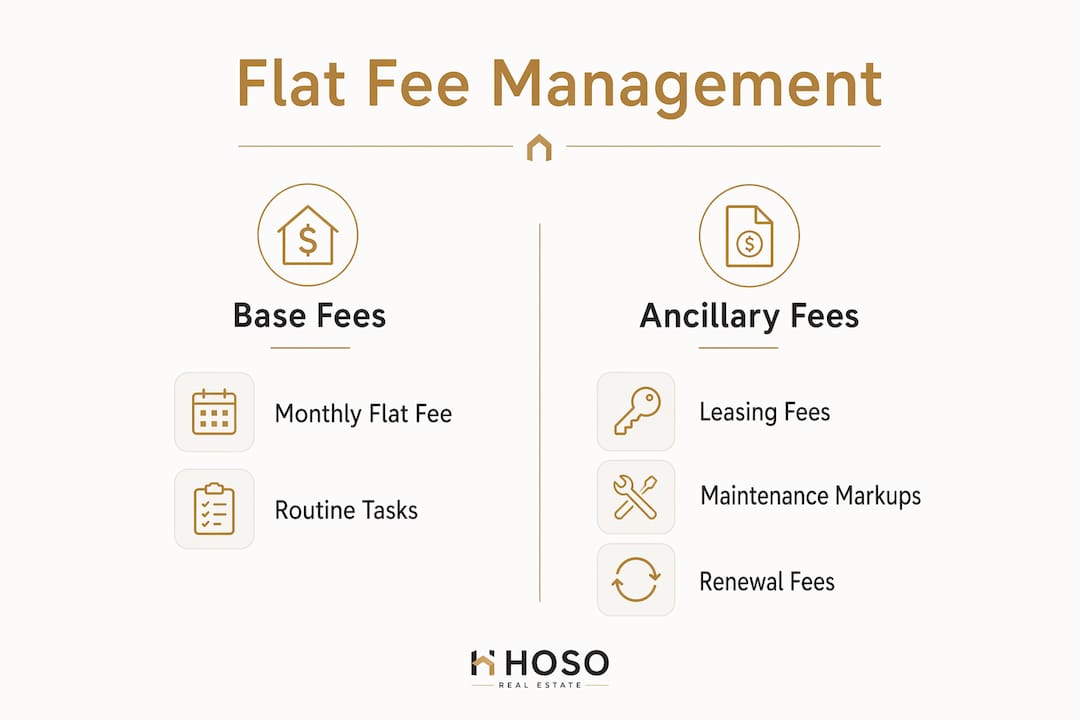
The monthly flat fee is only one part of the total cost picture. Ancillary fees can account for 40–60% of total annual management costs beyond the base monthly charge. That figure means a landlord paying $150 per month may be spending the equivalent of $250–$300 per month once all other charges are included.
Monthly flat fee
The base fee covers routine management tasks: rent collection, routine inspections, and day-to-day communication with tenants. In South Australia, this fee is negotiable, particularly for landlords with multiple properties or long-term management agreements.

Leasing and tenant placement fees
Leasing fees are among the highest-impact charges in any management agreement. Leasing fees commonly range from 50–100% of one month's rent. On a property renting for $2,200 per month in Norwood or Unley, that is a $1,100–$2,200 charge every time a new tenant is placed. Negotiating this to a fixed dollar amount rather than a percentage is one of the most effective ways to control costs.
Lease renewal fees
Lease renewal fees are often overlooked. They typically sit between $150 and $300 per renewal. For a landlord with three properties, that adds up to $450–$900 per year in fees that deliver minimal additional work for the manager. Request a cap or a full waiver for long-term tenants.
Maintenance coordination fees and markup caps
Many managers charge a markup on maintenance invoices, typically 0–15% above the contractor's rate. A maintenance markup cap of 0–10% is a standard and reasonable request. Without a cap, a $500 plumbing job can quietly become $575 or more.
Vacancy fees and setup costs
Some managers charge a reduced fee during vacancy periods. Vacancy fee relief of around 50% of the normal monthly charge is common and worth requesting in writing. Setup or onboarding fees of $150–$300 are also frequently waived for landlords bringing multiple properties or committing to a longer contract term.
Pro Tip: Request a full written fee schedule before any negotiation begins. Verbal commitments mean nothing once the management agreement is signed.
How should you prepare before negotiating property management fees?
Preparation determines the outcome of any fee negotiation. The strongest position comes from documented evidence, not from asking for a discount without context.
Gather competing quotes
Presenting written quotes from 2–3 property managers comparing total annual cost is the most effective negotiation strategy available to landlords. This approach works because it shifts the conversation from "can you do better?" to "here is what the market is offering." Managers respond to specifics, not vague requests.
Use a simple comparison table to map out total annual costs across each quote. Include the monthly flat fee, leasing fee, renewal fee, maintenance markup, and any vacancy or setup charges. The total annual figure is what matters, not the headline rate.
| Fee type | Manager A | Manager B | Manager C |
|---|---|---|---|
| Monthly flat fee (x12) | $1,800 | $2,100 | $1,680 |
| Leasing fee | $1,800 | $1,200 | $2,000 |
| Lease renewal fee | $250 | $0 | $300 |
| Maintenance markup | 10% | 5% | 15% |
| Setup fee | $200 | $0 | $250 |
| Estimated annual total | $4,050+ | $3,300+ | $4,230+ |
This kind of table reveals the true cost difference between managers and gives you a concrete basis for negotiation.
Use portfolio size as leverage
Landlords with three or more properties can typically secure volume discounts on flat monthly rates or leasing fees. Managers value portfolio clients because they reduce acquisition costs and provide stable, predictable revenue. If you own properties in suburbs like Prospect, Glenelg, or Mawson Lakes, presenting them as a package rather than individual listings strengthens your position considerably.
Pro Tip: Always present a specific counter-offer in writing. "I'd like the leasing fee reduced to $800 flat" is far more effective than "can you sharpen your pencil on the fees?"
Step-by-step negotiation tactics for a fair flat fee contract
A structured approach produces better results than an ad hoc conversation. Work through these steps in order.
-
Lead with portfolio or volume leverage. If you have multiple properties, open by presenting them as a package. Managers are more willing to negotiate when the revenue upside is clear.
-
Negotiate the leasing fee first. This is the highest-impact variable in most agreements. Push for a fixed dollar amount rather than a percentage of rent. For properties in higher-rent suburbs, this single change can save thousands per year.
-
Request a maintenance markup cap. Ask for a written cap of 0–10% on all contractor invoices. A 0% pass-through policy is achievable with the right leverage.
-
Push for vacancy fee relief. Request that the monthly fee reduces by at least 50% during any vacancy period. This aligns the manager's financial interest with filling the property quickly.
-
Negotiate setup fees down to zero. Onboarding fees of $150–$300 are routinely waived for multi-property clients or landlords signing agreements of 12 months or more.
-
Secure a 30-day penalty-free termination clause. A 30-day termination clause with no penalty is the standard to aim for. Anything longer than 30 days or with a financial penalty exposes you to risk if service quality drops.
-
Cap or waive lease renewal fees. For long-term tenants, renewal fees represent low-effort income for the manager. Request a waiver or a fixed cap of no more than $150.
-
Get everything confirmed in writing. Before signing, request a final written fee schedule that reflects every negotiated term. Do not rely on email summaries or verbal agreements.
Pro Tip: Review your management agreement annually. Market conditions change, and a contract that was competitive in 2024 may be overpriced by 2026 standards. Schedule a review conversation 60 days before each contract anniversary.
What mistakes do landlords make when negotiating flat fee agreements?
The most common mistake is focusing only on the monthly flat fee and ignoring everything else. A landlord who negotiates the base fee from $180 to $150 per month saves $360 per year. The same landlord who fails to negotiate a leasing fee can lose $1,500–$2,000 in a single tenant placement. The priorities are clear.
- Ignoring ancillary fees. Leasing, renewal, and maintenance charges often cost more than the monthly fee itself over a full year.
- Not comparing total annual cost. Comparing headline rates without calculating total annual spend leads to poor decisions.
- Skipping maintenance markup negotiations. A 15% markup on a $10,000 annual maintenance spend adds $1,500 in hidden costs.
- Accepting vague contract terms. Phrases like "reasonable fees" or "standard charges" in a management agreement are not enforceable limits.
- Overlooking lock-in clauses. A 12-month contract with a 90-day exit notice and financial penalties removes your ability to respond to underperformance.
- Not renegotiating annually. Management agreements are not set-and-forget documents. Market conditions, property performance, and your portfolio size all change.
"The landlords who get the best outcomes are not the ones who ask for the lowest fee. They are the ones who understand every line item, compare total annual costs, and negotiate each component with specific, written counter-offers."
How does flat fee management compare with percentage-based fees?
The industry standard for percentage-based management sits at 8–12% of monthly rent collected in South Australia. Flat fees average $100–$150 per unit per month nationally, with the South Australian market sitting at the higher end of that range for full-service management.
The comparison is not straightforward. On a property renting for $2,500 per month, a flat fee of $200 equates to 8% of rent. On a property renting for $1,800 per month, that same $200 flat fee represents 11.1%. Flat fees favour landlords with higher-rent properties and penalise those with lower-rent stock.
| Scenario | Monthly rent | Flat fee | Equivalent % | Percentage fee (9%) |
|---|---|---|---|---|
| High-rent property | $2,500 | $200 | 8.0% | $225 |
| Mid-rent property | $2,000 | $180 | 9.0% | $180 |
| Lower-rent property | $1,800 | $200 | 11.1% | $162 |
Flat fee models shift the manager's focus toward operational efficiency rather than rent growth. Percentage-based models align the manager's revenue with rent increases, which can be an advantage in a rising market. For landlords in established Adelaide suburbs with stable, higher rents, flat fee contracts generally deliver better cost predictability. For landlords with lower-rent properties or those in growth corridors where rents are rising quickly, a percentage model may be more competitive. You can read a detailed fee model comparison to assess which structure suits your portfolio.
Key takeaways
Negotiating flat fee property management requires targeting ancillary fees, not just the base monthly rate, to achieve genuine cost savings and contract transparency.
| Point | Details |
|---|---|
| Ancillary fees drive total cost | Leasing, renewal, and maintenance charges can account for 40–60% of total annual management costs. |
| Written quotes are your strongest tool | Presenting 2–3 competing quotes with total annual cost comparisons produces the best negotiation outcomes. |
| Portfolio size creates leverage | Landlords with three or more properties can negotiate volume discounts on flat rates and leasing fees. |
| Termination clauses protect you | A 30-day penalty-free exit clause is the standard to secure before signing any management agreement. |
| Annual review is non-negotiable | Management agreements should be reviewed and renegotiated every 12 months as market conditions shift. |
What I've learned negotiating flat fee agreements in Adelaide
The landlords who come to us at HOSO Real Estate having done their homework are the ones who get the best outcomes. Not because we give them a better deal out of sympathy, but because they ask the right questions and make the conversation productive.
The single biggest oversight I see is landlords treating the management agreement as a formality. They focus on the monthly fee, sign quickly, and then spend the next 12 months absorbing leasing charges, renewal fees, and maintenance markups they never questioned. By the time they calculate the true annual cost, they've paid significantly more than they expected.
My honest advice: build a total annual cost model before you sign anything. Include every fee category. Then present that model to the manager and ask them to compete on the full number, not just the headline rate. For landlords with properties across suburbs like Burnside, Henley Beach, or Campbelltown, the difference between a well-negotiated agreement and a poorly negotiated one can easily exceed $3,000 per year per property.
The other thing I'd push back on is the idea that negotiating hard damages the relationship. A good manager respects a landlord who understands the business. Vague requests for discounts are annoying. Specific, written counter-offers based on market evidence are professional. There is a real difference, and managers respond to it accordingly.
Review your contract every year. The market moves, your portfolio changes, and your leverage grows as you add properties. An agreement that was fair at signing may be well below market standard 18 months later.
— HOSO
Transparent property management for Adelaide landlords
HOSO Real Estate works with Adelaide landlords who want clear pricing, no hidden charges, and a management relationship built on accountability. Whether you own a single investment property in Prospect or a portfolio across the inner suburbs, HOSO Real Estate provides property management services structured around your investment goals. Fee discussions are direct and documented from the first conversation. If you want to understand what fair management costs look like for your specific property, a free rental appraisal is the right starting point. No obligation, no pressure, just a clear picture of your property's position in the current Adelaide market.
FAQ
What is flat fee property management?
Flat fee property management charges a fixed monthly amount per property regardless of the rent collected, typically $100–$200 per unit per month in Australia.
What fees should I negotiate beyond the flat monthly rate?
Leasing fees, lease renewal fees, maintenance markups, vacancy fee relief, and setup costs all affect total annual spend and are negotiable in most management agreements.
How do I negotiate a lower flat fee with a property manager?
Present written quotes from 2–3 managers showing total annual costs. Specific, written counter-offers based on competitor pricing produce better outcomes than vague discount requests.
Is flat fee or percentage-based management better for South Australian landlords?
Flat fee management suits landlords with higher-rent properties, as the fixed cost represents a lower percentage of rent. Percentage-based models may suit lower-rent properties or rising-rent markets better.
Can I negotiate a 30-day termination clause in a flat fee agreement?
A 30-day penalty-free termination clause is a standard and achievable request. Always confirm this term in writing before signing the management agreement.