
Property management disbursements are the net proceeds paid to a property owner after all operational expenses, management fees, and reserve contributions have been deducted from the gross rental income collected. The term "disbursement" is the industry standard for what many owners simply call their "rental payment" or "owner distribution." Understanding what are property management disbursements is the foundation of sound investment budgeting. Every dollar that leaves your rental account before you receive payment has a name, a purpose, and a paper trail. HOSO Real Estate treats this transparency as non-negotiable for every landlord it manages.
What are property management disbursements and how are they calculated?
A disbursement is not simply the rent your tenant pays. It is the net proceeds transferred to you after every legitimate cost has been settled. Management fees, maintenance invoices, reserve contributions, and any other approved expenses are deducted first. What remains is your disbursement.

Management fees typically range between 8% and 12% of gross rent collected. That single deduction alone can reduce a $2,500 monthly rent to a starting figure of $2,200 to $2,300 before any other costs are applied. Understanding this calculation from the outset prevents the common frustration of expecting one figure and receiving another.
Reserve contributions are a separate line item that confuses many owners. These are funds held back from incoming rent to maintain a required operating reserve. Reserve replenishments appear on your owner statement as a deduction, but the money stays in your account with the agency. It does not leave your control permanently. It covers future maintenance without requiring emergency calls for funds.
What costs are deducted before you receive your disbursement?
The property expense breakdown follows a consistent structure across well-managed portfolios. Gross rent is the starting point. From there, deductions fall into several categories.
Common expense categories deducted before disbursement:
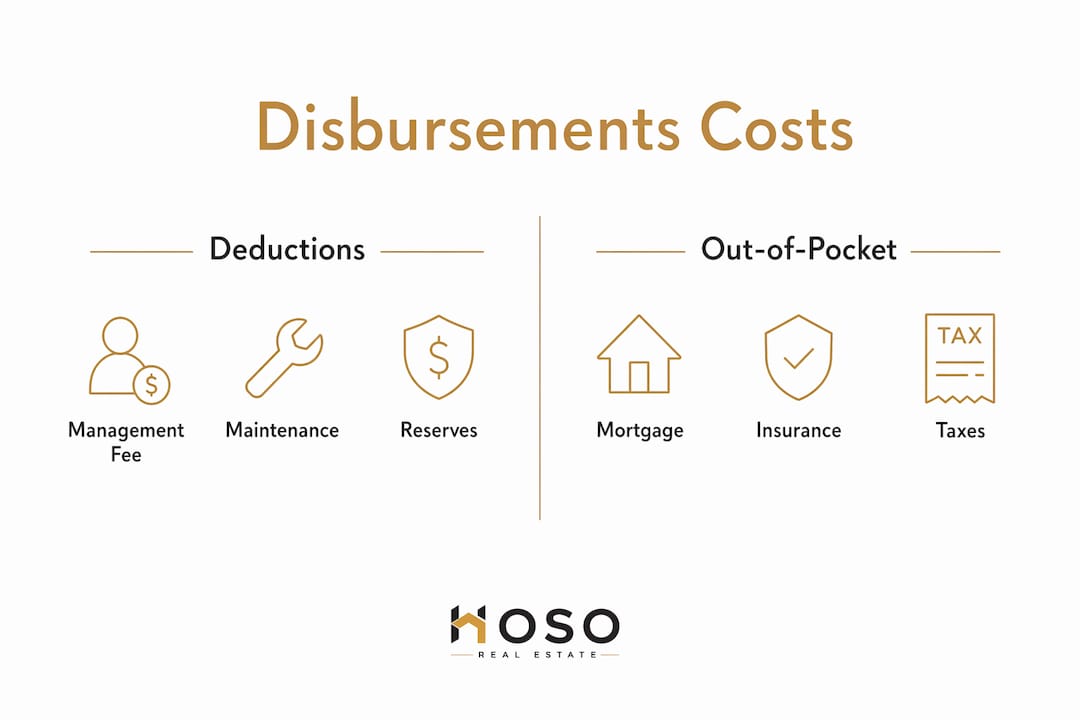
- Management fees: Typically 8%–12% of gross rent collected, covering day-to-day management, tenant communication, and rent processing. For South Australian context, SA landlords can review how these fees are structured locally.
- Maintenance and repairs: Invoices from licensed tradespeople for plumbing, electrical, general repairs, and garden upkeep.
- Routine inspection fees: Charged per inspection, covering the cost of the property manager's time and reporting.
- Letting or leasing fees: Applied when a new tenant is placed, often equivalent to one to two weeks' rent.
- Advertising costs: Photography, listing fees, and online portal charges when the property is vacant.
- Reserve fund contributions: Amounts held back to maintain an operating buffer for upcoming or unexpected expenses.
- Council rates, water, and utilities: Where the owner is responsible under the lease agreement.
| Expense category | Typical cost range |
|---|---|
| Management fee | 8%–12% of gross rent |
| Routine inspection | $55–$110 per inspection |
| Letting fee | 1–2 weeks' rent |
| Maintenance and repairs | Varies by job; invoiced at cost |
| Reserve fund contribution | Set by agency; usually $200–$500 |
Pro Tip: Ask your property manager for a full schedule of fees before signing a management agreement. Knowing every deduction category in advance removes surprises from your monthly statement.
How and when are disbursements processed?
The disbursement cycle follows a predictable monthly pattern, though many owners are caught off guard by the timing. Disbursements typically operate on a 20–25 day lag from the date rent is collected. Rent received on the 1st of the month is not disbursed until late in the same month.
The reason for this lag is reconciliation. Before your agency releases funds, it must:
- Confirm rent has cleared the trust account.
- Pay all outstanding vendor invoices for maintenance and services.
- Reconcile the trust account to confirm every dollar is accounted for.
- Calculate and deduct management fees and any other approved charges.
- Initiate the electronic transfer to your nominated bank account.
ACH-style electronic transfers typically arrive within 1–3 business days after the agency initiates the payment. In Australia, direct bank transfers follow a similar clearing window. The total time from rent collection to funds in your account is commonly three to four weeks.
Clear communication of disbursement timelines during agency onboarding significantly reduces owner anxiety. Ask your property manager to confirm the exact disbursement date in writing before your first rent cycle begins.
Pro Tip: Negotiate a fixed disbursement date during onboarding. A confirmed date, such as the 25th of each month, lets you plan mortgage repayments and personal cash flow with confidence.
What does an owner statement show?
Owner statements are more than payment slips. They function as mini financial statements tracking gross revenue through every deduction to the final net distribution. A well-prepared statement is a primary financial document for your investment portfolio.
Every owner statement should include the following components:
- Gross rent collected: The full amount paid by the tenant during the period.
- Management fees deducted: Itemised by type, such as management fee, letting fee, or inspection fee.
- Maintenance and repair invoices: Each job listed separately with the tradesperson's name and cost.
- Reserve fund movements: Contributions added or amounts drawn down for approved works.
- Other deductions: Council rates, water charges, advertising, or any other approved costs.
- Net distribution: The final amount transferred to your account.
- Opening and closing balances: Showing the trust account position at the start and end of the period.
Detailed distribution reports provide an audit trail confirming every dollar collected is accounted for by either an expense or a reserve allocation. This level of detail supports owner confidence and satisfies the Australian Taxation Office's record-keeping requirements for rental income. Review your statement every month, not just at tax time. Patterns in maintenance costs or vacancy periods become visible when you read statements consistently.
Tax and accounting considerations for rental disbursements
Your net disbursement is not your taxable rental income. The Australian Taxation Office assesses rental income on the gross rent received, not the net amount deposited into your account. Deductions are claimed separately in your tax return, not pre-applied by your property manager.
Your end-of-year owner statement is the primary document your accountant needs. It shows total rent collected, total expenses paid on your behalf, and the net distribution for the financial year. Cross-reference this statement against your own records for any costs paid directly, such as mortgage interest, depreciation, or insurance premiums paid outside the management agreement.
In the United States, property managers issue a Form 1099-MISC for distributions above a set threshold. In Australia, the equivalent obligation sits with the owner to declare gross rental income and claim deductions through their individual tax return, supported by the owner statement as evidence. The property manager's responsibility includes maintaining accurate trust account records that support this reporting.
Pro Tip: Give your accountant both your end-of-year owner statement and a list of any expenses you paid directly outside the management agreement. Missing either document can result in under-claimed deductions or incorrect income reporting.
Best practices for budgeting around disbursements
Owners often confuse net distribution with true cash flow. Your disbursement reflects only the costs managed through the agency. Mortgage repayments, loan interest, depreciation, and insurance premiums paid directly by you do not appear on the owner statement. True cash flow is lower than the disbursement figure in most cases.
Maintaining a secondary spreadsheet to reconcile your owner statement against all out-of-pocket costs gives you an accurate picture of portfolio performance. This is not optional for serious investors. It is the baseline for understanding whether a property is genuinely profitable.
| Budget category | Recommended allocation |
|---|---|
| Management fees | 8%–12% of gross rent |
| Maintenance and repairs | 5%–10% of gross rent annually |
| Vacancy allowance | 2%–4% of annual gross rent |
| Reserve fund | $200–$500 per property per month |
| Letting and advertising | 1–2 weeks' rent per tenancy cycle |
Automated disbursement processes reduce errors and improve payment consistency. When evaluating a property manager, ask whether their trust accounting software automates reconciliation and disbursement initiation. Manual ledger processes increase the risk of delays and miscalculations. For owners comparing self-management versus professional management, the accuracy and consistency of disbursement handling is a key financial differentiator.
Pro Tip: Set a calendar reminder to review your owner statement within 48 hours of receiving it each month. Early review means any discrepancies are flagged while invoices and records are still fresh.
Key takeaways
Property management disbursements represent the net rental income paid to owners after all fees, expenses, and reserves are deducted, and understanding each line item is the foundation of accurate investment budgeting.
| Point | Details |
|---|---|
| Disbursements are net, not gross | Management fees, maintenance, and reserves are deducted before you receive payment. |
| Expect a 20–25 day lag | Rent collected early in the month is typically disbursed between the 20th and 25th after reconciliation. |
| Owner statements are financial records | Review them monthly and use them as primary documents for tax reporting and portfolio analysis. |
| Net distribution is not true cash flow | Add mortgage, interest, and direct costs to get an accurate picture of actual returns. |
| Transparency is non-negotiable | A quality property manager provides itemised statements with every deduction clearly labelled. |
What I have learned managing Adelaide landlords' disbursements
The most common frustration I see from property owners is not the cost of management. It is the surprise. An owner expects $2,400 and receives $1,950, with no clear explanation on the statement. That gap erodes trust faster than any fee ever could.
Disbursement transparency is not a bonus feature. It is the baseline standard every landlord deserves. When I review statements with owners in suburbs like Norwood, Unley, or Prospect, the ones who understand every line item make better decisions. They budget accurately, they plan maintenance proactively, and they do not panic when a repair invoice reduces their monthly payment.
The 20–25 day disbursement lag catches many first-time investors off guard, particularly those with tight mortgage schedules. Knowing this cycle in advance, and planning cash flow around it, removes a significant source of stress. I always recommend owners confirm their disbursement date in writing before the first rent cycle begins.
Compliance in disbursement reporting is also tightening across the industry. Owners who treat their monthly statement as a serious financial document, not a receipt, are far better positioned for audit, refinancing, and portfolio growth. Budgeting discipline alongside professional management is not optional for high-value investors. It is the standard.
— HOSO
HOSO Real Estate: financial clarity in every disbursement
HOSO Real Estate delivers property management built on financial transparency. Every owner receives itemised monthly statements showing gross rent, all deductions, reserve movements, and net distributions. There are no hidden line items and no unexplained reductions. For Adelaide landlords and interstate investors managing South Australian properties, HOSO provides the reporting detail and disbursement consistency that serious portfolio management requires. If you want a property manager who treats your statement as a financial document rather than a formality, view our property management services to see how HOSO Real Estate manages your investment with the rigour it deserves.
FAQ
What are property management disbursements?
Property management disbursements are the net funds paid to a property owner after all management fees, maintenance costs, and reserve contributions are deducted from gross rent collected. They represent the owner's actual take-home income from the rental property for that period.
How long does a disbursement take after rent is collected?
Disbursements typically follow a 20–25 day lag after rent is collected, as the agency must reconcile vendor invoices and trust account balances before releasing funds. Electronic transfers then take a further 1–3 business days to clear.
What is the difference between gross rent and a net disbursement?
Gross rent is the full amount paid by the tenant. The net disbursement is what remains after management fees, repairs, letting fees, and reserve contributions are deducted. The two figures are rarely the same.
Are property management disbursements the same as taxable rental income?
No. The Australian Taxation Office assesses rental income on the gross rent received, not the net disbursement. Owners claim deductions separately in their tax return, using the end-of-year owner statement as supporting documentation.
What should an owner statement include?
A complete owner statement shows gross rent collected, itemised management fees, maintenance invoices, reserve fund movements, any other approved deductions, and the final net distribution amount transferred to the owner's account.