

The role of digital landlord reporting is to give you legally compliant, timestamped financial and inspection records — rent receipts, ledgers, inspection photos, maintenance logs and bond status — delivered promptly through secure digital portals. Under the Residential Tenancies Act 1995 (SA), your property manager must offer an electronic payment option and maintain rent records containing six specific fields:
- Date of payment
- Payer name
- Amount paid
- Property address
- Tenancy period
- Bond flag or purpose
Section 58 requires a receipt within 48 hours where rent was not paid into an authorised deposit-taking institution (ADI) account, and a full statement within seven days of a written request. Section 57 adds that records must show any arrears on the date of payment. Consumer and Business Services (CBS) and SACAT are the local regulators and tribunal for disputes. HOSO Real Estate delivers these reports digitally to Adelaide landlords as standard practice.
Key takeaways
Digital landlord reporting under the Residential Tenancies Act 1995 (SA) requires six specific record fields, a 48-hour receipt rule, a seven-day statement-on-request obligation, and timestamped inspection reports delivered within 24–48 hours.
| Point | Details |
|---|---|
| Six mandatory record fields | Every rent record must show date, payer name, amount, address, tenancy period and bond flag per ss 57–58. |
| 48-hour receipt and 7-day statement | Receipts are due within a short time frame where rent was not paid into an ADI account; statements must be provided within a week on written request. |
| Inspection reports within 24–48 hours | Timestamped photos and a maintenance action log sent promptly are the primary SACAT evidence. |
| RBO bond verification | Use Residential Bonds Online to confirm lodgement and track bond status in real time before any dispute arises. |
| HOSO Real Estate | Provides portal access, timestamped inspection reports, RBO checks and same-day payment alerts for Adelaide landlords. |
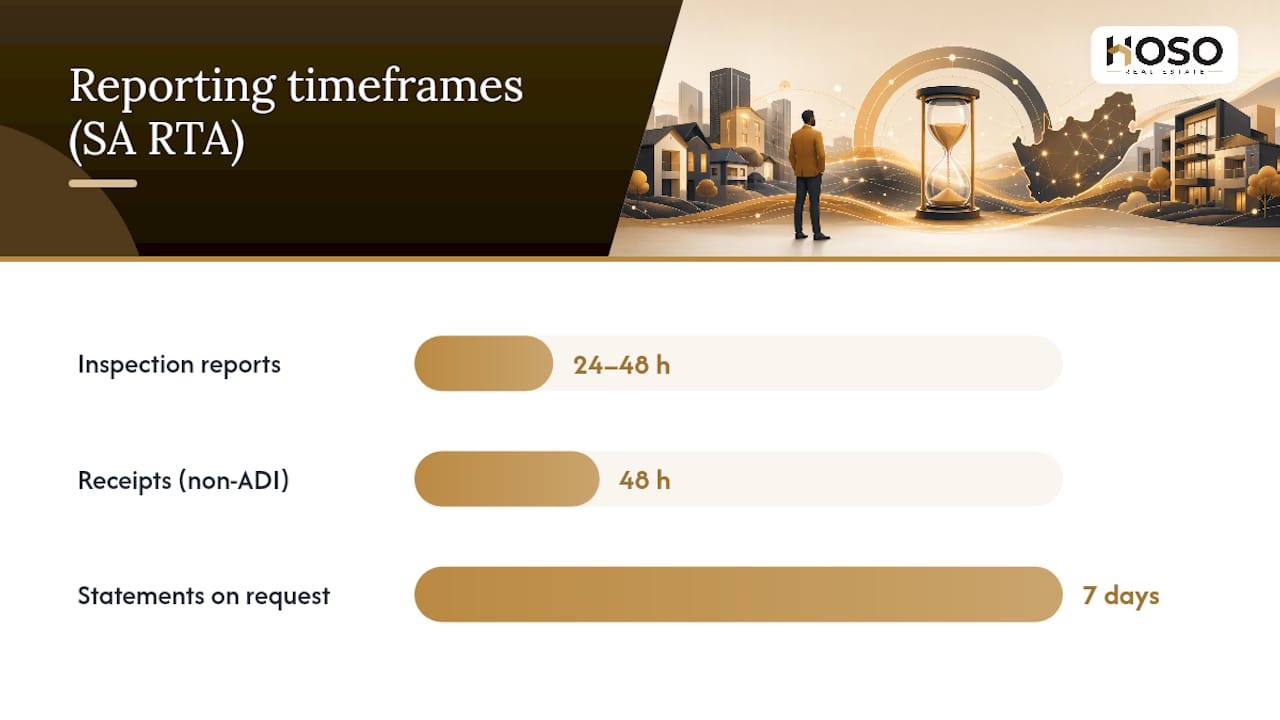
Table of Contents
Why digital records reduce your SACAT risk
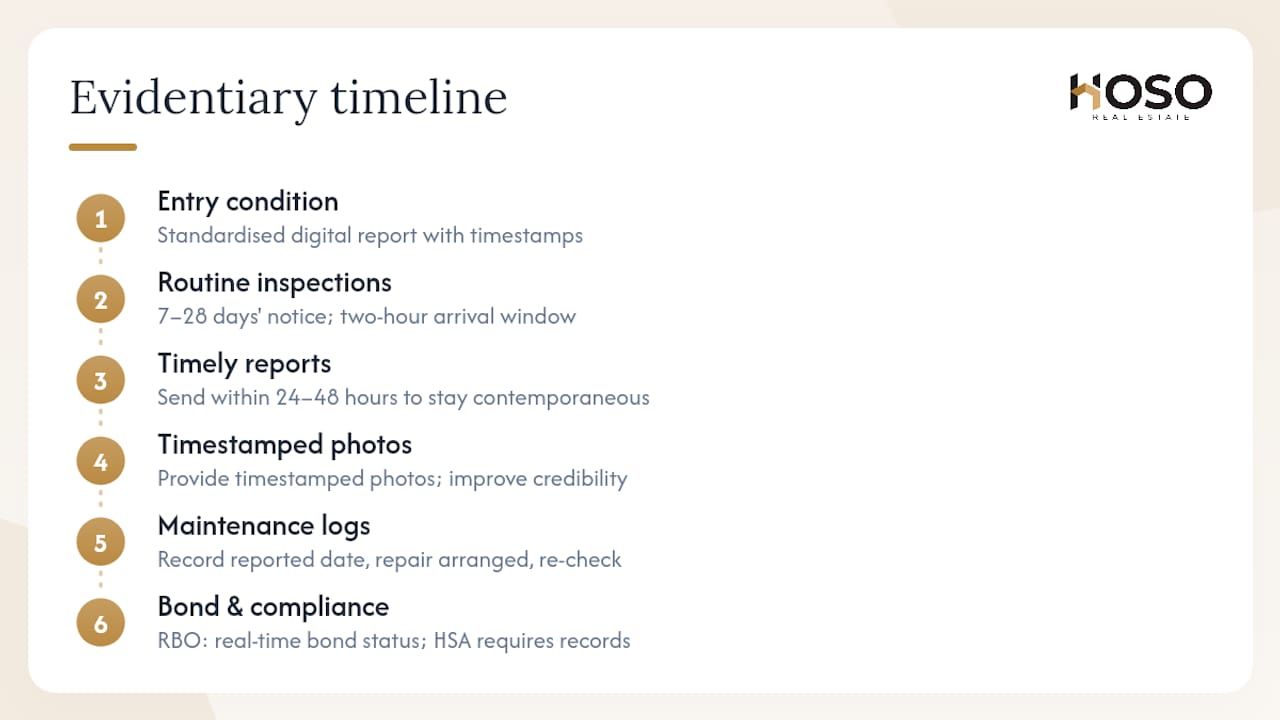
Well-structured digital records shorten bond disputes and reduce SACAT exposure. The logic is straightforward: every report you receive builds an evidentiary timeline from entry condition through routine inspections, maintenance actions and exit condition. A gap in that chain is what loses bond claims.
SA routine inspection rules require 7–28 days' notice with a two-hour arrival window, and industry guidance recommends inspection reports be sent within 24–48 hours so evidence stays contemporaneous. A report that arrives a week late is harder to rely on at SACAT. Timestamped photos matter for the same reason: because SA does not mandate a single condition report form, consistency and detail are what SACAT treats as credible. A standardised digital format with timestamps is therefore best practice for condition reports.
Maintenance logs add a second layer. A log that records the date an issue was reported, when a repair was arranged and when a re-check occurred creates a defensible chain of custody. Combined with Residential Bonds Online (RBO), which shows bond status in real time and allows managing parties to request payments and manage transfers online, a landlord with a good digital portal can verify compliance in minutes rather than days.
The Housing Safety Authority also links condition reporting directly to minimum housing standards obligations. Keeping those records is not optional.
At HOSO Real Estate, reports include timestamped photos, audit trails and secure bond handling through RBO. Payment alerts go out the same day. Monthly consolidated statements are issued for accounting, and real-time rental reporting is built into the portal workflow.
Pro Tip: Before signing any management agreement, ask the agency to show you a live portal walkthrough. If they hesitate, that tells you something.
What HOSO Real Estate gives Adelaide landlords
Landlords should insist on a sample digital statement and a portal walkthrough before committing to any management agreement. Three requests to make immediately:
- Ask for an anonymised monthly statement showing all six s57/s58 fields.
- Request the latest inspection report with timestamped photos.
- Ask for RBO bond status and lodgement evidence.
Sample request wording you can paste now:
CBS guidance on recent tenancy reforms — including the mandatory Form A1 from 1 January 2026 — adds further reason to confirm your manager is across current obligations before you sign.
HOSO Real Estate's property management services include portal access, sample report walkthroughs, RBO bond checks and secure digital reporting with role-based access and SSL-protected data. Contact HOSO to arrange a walkthrough before your next management decision.
Sources
The primary sources that define what you must receive and keep are the Residential Tenancies Act 1995 (SA), CBS, RBO and SACAT. Keep copies of all statements and timestamped inspection photos — they are your evidence if a dispute reaches the tribunal.
- Law Handbook — Rent receipts and records (SA)
- Residential Tenancies Act 1995 (SA) s58 — AustLII
- Residential Bonds Online help page | Consumer and Business Services
- Property owners and landlords — Housing Safety Authority (SA)
For a broader view of your landlord duties under SA tenancy law, the HOSO blog covers the full scope of obligations in plain language. A rental checklist can also help you structure your pre-management-agreement review, though always verify requirements against SA-specific sources.