
Yes, you can increase rent on a South Australian investment property, provided you meet three legal requirements. You must give 60 days' written notice on the prescribed form, wait at least 12 months since the tenancy began or the last increase, and accept that the tenant can challenge the amount at SACAT within 90 days.
TL;DR:
- Landlords must serve a 60-day written notice using the prescribed form, with the rent increase effective at least 60 days later, to meet legal requirements.
- Increasing rent after 12 months since the last increase is only valid if supported by at least three recent, comparable rental appraisals and proper documentation.
- Tenants can challenge the increase within 90 days of receipt, with SACAT weighing comparables, property condition, and outgoings against the proposed amount.
- Accurate recordkeeping of rent, repairs, and appraisals is essential for defending a rent increase if disputed at SACAT.
- Most rent increases proceed smoothly when justified with evidence, but poorly documented or unjustified hikes often lead to disputes or tribunal orders.
Table of Contents
- What is the rent review process, step by step?
- What does South Australian law require for a rent increase?
- How do you build evidence for a rent increase?
- What does a property manager actually do during a rent review?
- What happens if a tenant disputes the rent increase?
- Your rent review checklist
- What usually happens after a rent review?
- What counts as a fair reason to increase rent, and what doesn't?
- Why HOSO backs an evidence-led rent review every time
- Get a compliant, evidence-backed rent review for your Adelaide property
- Sources
What is the rent review process, step by step?
A rent review is not a single letter. It's a sequence of checks, evidence gathering, and formal notice that, done properly, holds up if a tenant pushes back. Here's how it runs in practice.
- Check timing eligibility. Confirm 12 months have passed since the tenancy started, or since the last increase took effect. This applies whether the tenant is on a periodic agreement or a fixed term, and it resets with every increase, not just the original lease date.
- Commission a market rental appraisal. Ask your property manager for a written appraisal built on comparable properties in the same suburb, similar bedroom and bathroom count, and similar condition. A verbal "I think we could get more" is not evidence.
- Get landlord sign off and plan the conversation. Decide the new figure and effective date before anything is sent. If the tenant has been reliable and the property is in good condition, a heads up conversation before the formal notice often smooths the transition.
- Complete and serve the prescribed Notice of Rent Increase. The official form needs the new amount, the frequency, and an effective date at least 60 days out. Get the service date right. Miscounting is the single most common way landlords accidentally invalidate their own notice.
- Leave the door open for negotiation. A mutually agreed increase, reached through conversation rather than formal notice, can sometimes land faster and preserve goodwill. It still needs to respect the 12 month rule.
- Never assume a new lease term resets the clock. A series of agreements between the same landlord and tenant is treated as one continuous tenancy for the 12 month rule.
- Build the appraisal before you set a number in your head. Anchoring on last year's figure or a friend's opinion is how landlords end up under market or, worse, over it.
Pro Tip: Serve the notice at least 65 to 70 days out rather than exactly 60. Postal delays, tenant disputes about the receipt date, or a public holiday can quietly eat into your buffer and push the effective date later than you planned.
What does South Australian law require for a rent increase?
The Residential Tenancies Act 1995 (SA) sets three hard rules, and each one carries real consequences if ignored.
- 60 days' written notice, delivered using the prescribed Notice of Rent Increase form, not an email or a text message referencing the new figure.
- A 12 month minimum interval between increases applies to both periodic and fixed term agreements. A fixed term lease can only allow an increase mid term if the contract explicitly says so and sets out how the new rent will be calculated.
- Recordkeeping and payment obligations under the Act require landlords and agents to keep accurate records of rent received, provide at least one electronic payment option with no collection fee, and issue receipts or statements when a tenant asks.
There's no cap on how much you can raise rent by. The trade off is that an uncapped figure invites more scrutiny, and tenants can apply to SACAT within 90 days if they believe the new amount is excessive.
An invalid notice, whether it's the wrong form, the wrong timing, or a missing effective date, simply doesn't take effect. The old rent continues to apply, and you'll need to start the 60 day clock again. Repeated breaches or charging above a rent SACAT has capped is treated as an offence under the Act.
How do you build evidence for a rent increase?
SACAT doesn't take a landlord's word for it, and it doesn't take a tenant's word for it either. The tribunal weighs comparable rents, the condition of the premises, outgoings, and whether the proposed increase is proportionate to those factors. That means the burden of proof sits with whoever brings better documentation.
- Gather at least three recent, dated comparables from properties genuinely similar in size, location, and standard, not aspirational listings from a different suburb.
- Keep inspection photos, maintenance invoices, and repair records linked directly to the property address and date.
- Retain rent ledgers and payment history showing consistent, on time collection over the tenancy.
- Structure the written appraisal with the data first, the sources next, then a clear conclusion recommending the new figure.
A tenant is far less likely to challenge a number that's already backed by three dated comparables and a maintenance file than one that arrives as a bare figure on a form.
Pro Tip: Screenshot comparable listings the same week you prepare the appraisal, complete with the listing URL and date visible. Listings get taken down, and a comparable you can't reproduce six months later is a comparable SACAT can't verify.
What does a property manager actually do during a rent review?
A competent manager isn't just filling in a form. They're running the entire chain of custody on evidence and compliance so that if a tenant disputes the figure, the paperwork is already tribunal ready.
- Running current local market analysis and turning it into a documented, dated appraisal rather than a verbal estimate.
- Selecting the correct prescribed form and tracking the 60 day timing so the effective date is never miscounted.
- Managing the tenant conversation in a way that reduces the chance of a dispute reaching SACAT in the first place, including negotiating a mutually agreed figure where that's realistic.
- Maintaining rent payment records, receipts, and an evidence pack ready to hand over if a tenant lodges an excessive rent application.
- Keeping landlords briefed on obligations that sit alongside the increase itself, including broader compliance requirements that affect the same tenancy.
Getting the notice mechanics right is one part of the job. The other part is knowing which comparables will actually stand up if the tenant pushes back, and having them ready before the notice is even served.
What happens if a tenant disputes the rent increase?
A tenant has 90 days from receiving the notice to apply to SACAT for a ruling on whether the new rent is excessive. That window matters for landlords too. Once it closes without an application, the increase stands.
- The tenant lodges an application with SACAT, disclosing the notice, the tenancy agreement, and any comparable evidence they intend to rely on.
- SACAT compares local rents, the property's condition, and considers whether the tenant was pressured into agreeing before the tribunal was involved.
- Both parties must exchange all evidence they intend to use with each other ahead of the hearing. Surprise evidence at the hearing itself generally isn't accepted.
- If SACAT finds the rent excessive, it can fix a maximum rent for up to one year. Charging above that figure while the order stands is an offence.
- A landlord who disagrees with the outcome can apply to vary the order once circumstances change, such as a genuine improvement to the property.
Landlords with a documented appraisal, dated comparables, and clean rent records tend to fare far better in this process than those relying on a single figure with no paper trail behind it.
Your rent review checklist
Give this to your property manager, or work through it yourself if you're self managing.
- Confirm 12 months have passed since the tenancy began or the last increase.
- Request a written rental appraisal with at least three comparable properties.
- Prepare the prescribed Notice of Rent Increase and set an effective date at least 60 days out.
- Document property condition, recent repairs, and the tenant's payment history, and keep copies.
- If the tenant contests it, assemble an evidence bundle and follow SACAT's disclosure directions exactly.
Pro Tip: Store every rent review document, appraisal, notice, comparables, photos, in one dated folder per tenancy. If a dispute lands 18 months later, you won't be reconstructing a paper trail from memory.
What usually happens after a rent review?
Most rent reviews end quietly. The tenant accepts the new figure, pays it from the effective date, and the tenancy continues without any tribunal involvement. That's the outcome in the overwhelming majority of cases where the increase is proportionate and well documented.
A smaller number end in negotiation. The tenant queries the figure, the landlord or manager explains the comparables, and both parties land on a middle figure or an adjusted start date. This tends to preserve a good tenancy relationship, particularly with a long term, reliable tenant.
A minority escalate to SACAT. If the tribunal agrees the increase is fair, it stands and the tenant pays accordingly. If SACAT finds it excessive, it can fix a lower figure for up to a year, which then becomes the ceiling until that order lapses.
The practical implication for landlords is this: the process itself is fairly forgiving of a well justified increase and unforgiving of a poorly documented one. Tenants who feel blindsided by a large, unexplained jump are far more likely to escalate than tenants who received a clear appraisal and a reasonable explanation up front. For landlords, the review isn't just about the number. It's about protecting the tenancy relationship well enough that the property keeps performing without a vacancy gap or a tribunal date on the calendar.
What counts as a fair reason to increase rent, and what doesn't?
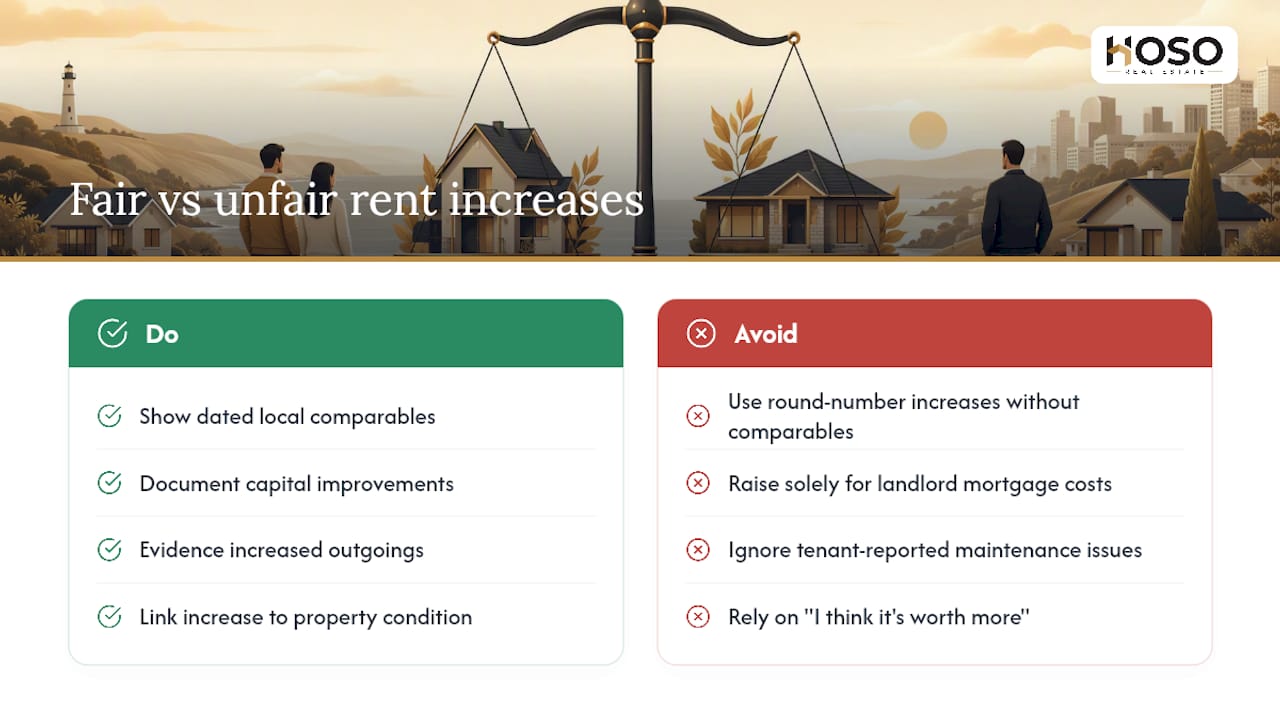
SACAT's test is proportionality, not sentiment. Reasonable grounds include a documented rise in comparable rents nearby, capital improvements that materially lift the property's standard, such as a new kitchen or added off street parking, and outgoings that have genuinely increased, like council rates or water charges passed through under the agreement.
Weak or unacceptable grounds include a round number increase with no comparables behind it, an increase pitched purely to match the landlord's own rising mortgage repayments without reference to market rent, or an increase that ignores the property's actual condition, for example raising rent on a property with an outstanding maintenance backlog the tenant has repeatedly reported.
A useful test: if you had to explain the figure to a SACAT member using only comparables, condition, and outgoings, would it hold up? An increase justified by "the market's moved" and backed by three dated comparables from Prospect or Norwood will usually survive scrutiny. An increase justified by "I think it's worth more" generally won't. The broader trend in local house price movements can support a market argument, but it's the specific, comparable evidence tied to your actual property that carries weight at the tribunal.
Why HOSO backs an evidence-led rent review every time
Compliance isn't a formality. It's what protects your rental income from a tribunal order that caps it below market for a year. A documented appraisal does two things at once: it preserves your negotiating position and it keeps the tenant relationship intact, because a well explained increase rarely feels like an ambush.
The landlords who avoid disputes altogether are the ones who treated the paperwork as seriously as the number itself.
— HOSO
Get a compliant, evidence-backed rent review for your Adelaide property
HOSO Real Estate is the direct alternative to guessing your way through a rent increase. Where a self managed review often means a single verbal estimate and a hastily filled form, our approach means a documented market appraisal, correct use of the prescribed notice, and an evidence file ready before you need it, not after a SACAT application lands.
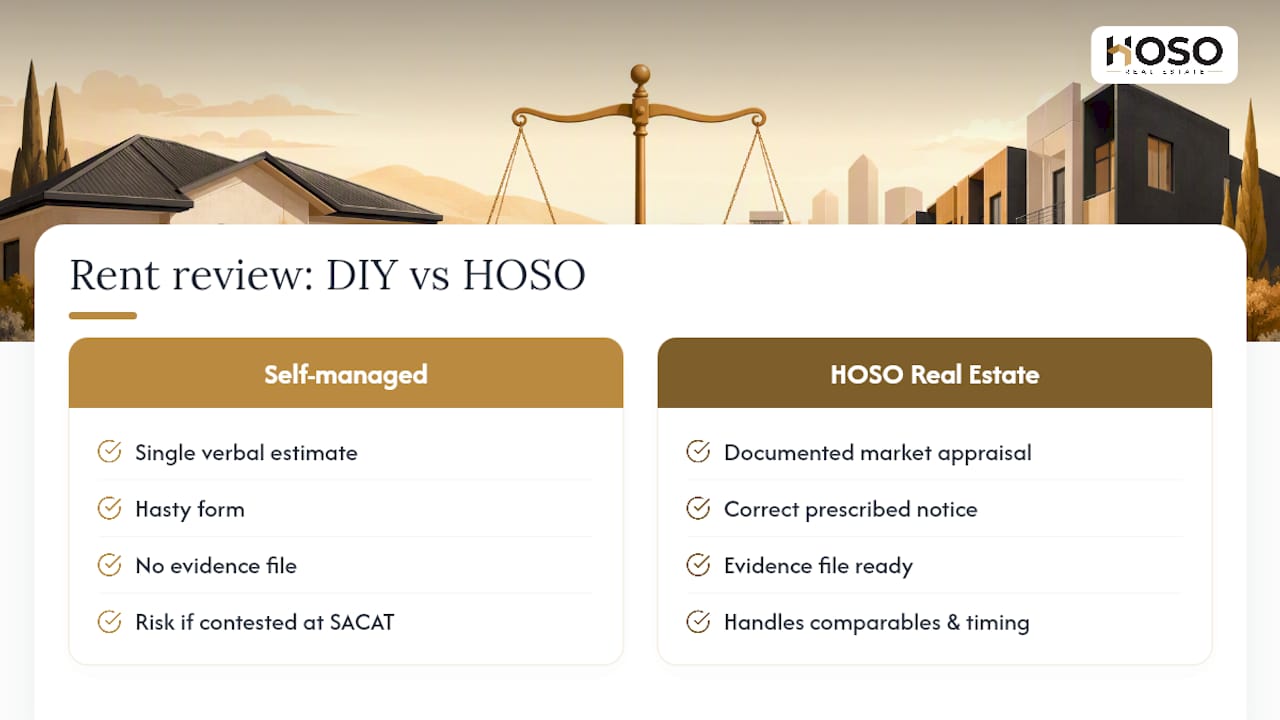
We handle the comparables, the timing, the tenant conversation, and the recordkeeping that protects your position if a review is ever contested. If your rent hasn't been reviewed in the last 12 months, or you want a second opinion on a figure before you serve notice, request a rental appraisal through our services page and we'll tell you honestly whether an increase is justified and what the evidence supports.
Sources
- Rent increases – SA Government
- Excessive rent applications – SACAT
- Notice to tenant of rent increase – CBS (SA Government)