

No, ordinary residential rent is not subject to GST. The Australian Taxation Office classifies residential rent and bonds as input‑taxed, so landlords never add GST to a tenant's rent and cannot claim GST credits on the expenses tied to that rent. This applies whether you own one investment property in Norwood or a portfolio spread across Adelaide's inner suburbs.
TL;DR:
- Residential rent is always input‑taxed, so landlords cannot add GST to rent or claim credits on related expenses, regardless of GST registration status.
- Only new or substantially renovated properties, commercial residential premises, and short‑stay arrangements can trigger GST applicability, not standard residential rentals.
- Income from residential rent does not count toward the $75,000 GST registration threshold, but registration may be required for linked commercial activities exceeding that amount.
- Proper documentation for apportioning mixed-use properties is crucial, as only the non‑residential portions generate GST obligations and need precise records.
- Landlords should include GST as a cost in cash flow models because GST on repairs, management, and maintenance is unrecoverable in residential letting.
Table of Contents
- What 'input‑taxed' actually means for landlords
- What counts as residential premises under the physical characteristics test
- When GST does apply: new builds and commercial residential premises
- GST registration, ABN, and the $75,000 threshold
- Mixed‑use properties and how apportionment works
- Practical implications for landlord cash flow
- GST implications for tenants in residential rental agreements
- Handling GST when renewing leases or increasing rent
- GST reporting requirements when GST does apply
- GST and shared or co-owned residential properties
- How HOSO Real Estate helps you stay across GST implications
- How HOSO Real Estate reads the GST rules for landlords
- Sources
What 'input‑taxed' actually means for landlords
Input‑taxed is one of three GST categories the ATO applies to supplies, alongside taxable and GST‑free. Residential rent sits firmly in the input‑taxed bucket, which means the transaction is entirely outside the GST system rather than taxed at a zero rate.
The practical fallout runs in both directions. You don't charge GST on rent, but you also can't claim input tax credits for the GST embedded in property management costs, repairs, or maintenance connected to that letting. Being registered for GST because of a separate business activity changes nothing here. Residential rent stays input‑taxed regardless of what else appears on your ABN.
- No GST added to weekly or monthly rent charged to tenants
- No GST added to bond amounts lodged with Consumer and Business Services
- No GST credits recoverable on agent commissions, repairs, or maintenance invoices for that property
- GST registration status for other income streams has zero bearing on this treatment
Pro Tip: Don't assume a GST‑registered trust or company structure changes the tax treatment of residential rent. The premises, not the entity, determines input‑taxed status.
What counts as residential premises under the physical characteristics test
The ATO doesn't ask what you intend to do with a property. It asks what the property is physically capable of doing. Under the physical characteristics test set out in GSTR 2012/5, premises qualify as residential if they're fit for human habitation and provide basic living facilities, such as sleeping areas, bathroom access, and a kitchen or cooking facility.
This test is objective. A landlord's stated purpose or the length of a tenancy doesn't override what the building is built to do.
Typical qualifiers include:
- Standalone houses, units, and townhouses used for standard tenancies
- Long‑stay rentals in suburbs such as Glenelg, Unley, or Prospect
- Granny flats and secondary dwellings with proper kitchen and bathroom facilities
Non‑qualifiers include vacant land, warehouses fitted out purely for commercial use, and premises stripped of habitable features. Borderline cases deserve extra caution: a home‑based business operating from part of a residential property, or a property listed on a short‑stay platform, can shift the GST analysis entirely. When a property blurs these lines, get advice before you lodge a return, not after.
When GST does apply: new builds and commercial residential premises
Most rental income for existing houses and units stays clear of GST, but three scenarios flip that outcome.
- New residential premises. Selling or leasing a newly constructed dwelling that hasn't previously been sold as residential premises, or has been substantially renovated, can be a taxable supply under ATO guidance on residential premises. This matters most to developers and investors selling off‑the‑plan stock, less to landlords holding established rentals.
- Commercial residential premises. Hotels, motels, serviced apartments, and commercial boarding houses operate under a different GST regime entirely. If a property is run more like short‑term commercial accommodation than a home, GST generally applies to the income it generates.
- Short‑stay and holiday rentals. Listing a property on a booking platform doesn't automatically create a commercial residential supply, but the ATO's sharing‑economy guidance flags that the answer depends on how the arrangement is structured and run. Landlords testing the short‑stay market in areas near the coast, such as Glenelg or Semaphore, should check this before assuming standard input‑taxed treatment carries over.
GST registration, ABN, and the $75,000 threshold
Residential rent doesn't count toward the $75,000 GST registration turnover threshold, because input‑taxed supplies are excluded from that calculation entirely. A landlord earning rental income below the registration turnover threshold, with no other enterprise income, has no GST registration obligation on that basis alone.
Registration still becomes relevant in specific circumstances:
- You run a separate enterprise (a trades business, consulting practice, or short‑stay operation classed as commercial residential premises) that generates $75,000 or more in taxable turnover
- You choose to register voluntarily for reasons unrelated to residential rent
- A property manager or agent handles supplies on your behalf that carry different GST treatment, such as commission on a sale rather than rent collection
An ABN is often useful for landlords regardless of GST status, particularly to avoid PAYG withholding complications when dealing with contractors for repairs and maintenance. HOSO Real Estate's guide to SA rental property tax obligations walks through how these obligations sit alongside income tax reporting for South Australian landlords.
Mixed‑use properties and how apportionment works
A shop with a residential unit above it, or a house with a granny flat used for a small business, doesn't get one blanket GST answer. The ATO's apportionment principle splits the supply according to how much of the property is genuinely residential and how much is not, and only the non‑residential portion counts toward GST turnover and taxable treatment.
A ground‑floor retail tenancy on a Prospect Road corner site with a residential flat above it is the classic example. The shop's rent is a taxable supply; the flat's rent stays input‑taxed. Getting this split right depends on solid records: floor plans, separate lease agreements, and a documented basis for the allocation, whether that's floor area or market rental value.
- Keep separate lease documentation for each portion of a mixed‑use property
- Record the apportionment method used (floor area versus market value) and apply it consistently
- Revisit the split whenever the use of either portion changes materially
Pro Tip: Apportionment disputes with the ATO almost always come down to weak paperwork. A written, dated apportionment schedule prepared when the lease starts is worth far more than a retrospective estimate.
Where the split isn't obvious, loop in your accountant before you file rather than after an ATO query lands.
Practical implications for landlord cash flow
The input‑taxed treatment feels simple on the rent side and expensive on the cost side. Because you can't claim GST credits on agent commissions, repairs, or materials tied to residential letting, the GST component of every invoice becomes a real, unrecoverable cost that sits inside your net yield rather than outside it.
Modelling this properly means treating GST as embedded in the expense line, not as a separate recoverable amount. A $1,100 plumbing invoice (including $100 GST) costs you the full $1,100, not $1,000 net of a credit you're entitled to claim elsewhere.
- Build unrecoverable GST into yield calculations rather than assuming costs will be net of tax
- Track maintenance, repair, and management costs gross of GST in your own budgeting
- Keep clean invoice records so your accountant can confirm nothing has been claimed in error
HOSO Real Estate's management reporting presents maintenance and repair costs in full, so owners see the real cash impact rather than a stripped‑back figure that understates true outgoings. For a deeper walkthrough of the numbers, see our guide to calculating cash flow for an investment property, and for premium portfolios, Stu Harvey Estates' luxury rental property cash flow guide covers similar modelling for higher‑value assets.
GST implications for tenants in residential rental agreements
Tenants renting a standard house or unit never see GST on their rent, and there's no line item for it on a lease or a rent receipt because the supply is input‑taxed at the landlord's end. This is one of the more common points of confusion in tenancy disputes brought to SACAT: tenants sometimes assume rent should carry the same GST treatment as retail goods or services, and it simply doesn't work that way for residential tenancies.
Where tenants can encounter GST is in adjacent charges that fall outside the core tenancy relationship, such as certain third‑party services arranged directly by the tenant rather than through the landlord or agent. Bond payments, weekly rent, and standard lease fees connected purely to residential occupation stay outside the GST system entirely.
For lease agreements that blend residential occupation with a commercial element, such as a live‑work arrangement, the GST position can differ for that non‑residential component, which is where the apportionment principles covered earlier become relevant to the tenant's side of the ledger too. Tenants querying GST on their lease should be pointed to the specific clause in question rather than given a blanket answer, because a badly drafted lease can occasionally mislabel charges in a way that creates confusion at tax time for both parties.
Handling GST when renewing leases or increasing rent
A rent increase doesn't change the GST treatment of residential rent, no matter how large the increase or how the lease is renewed. If the premises met the residential test on day one, they still meet it after a renewal, a rent review, or an indexation clause kicks in. There's no threshold at which ordinary residential rent tips into taxable territory purely because the dollar figure has grown.
The one time this needs a second look is when a lease renewal changes the nature of the tenancy itself. If a residential lease is renegotiated into an arrangement that starts to resemble commercial residential premises, such as converting a house into short‑stay accommodation as part of the renewal, that's the trigger to reassess, not the rent figure itself.
For South Australian landlords managing renewals under the Residential Tenancies Act 1995, the rent‑increase process itself is governed by SACAT and the standard notice periods, and GST simply doesn't enter that calculation. Our guide to landlord obligations in South Australia covers the procedural side of rent reviews if you're working through a renewal now. Document the rent increase clearly in the renewed lease and keep the input‑taxed treatment consistent across all versions of the agreement, past and present.
GST reporting requirements when GST does apply
Landlords whose properties stay squarely residential and input‑taxed have essentially nothing to report for GST purposes on that income, because there's no taxable supply to declare. This is one of the more welcome quirks of the system: no BAS entries, no GST labels, no quarterly adjustments tied to rent itself.
The reporting obligation only switches on when a property genuinely falls into a taxable category, new residential premises being sold, a portion of a mixed‑use building generating taxable rent, or a short‑stay arrangement that's crossed into commercial residential premises territory. In those cases, a GST‑registered landlord reports the taxable portion through a standard Business Activity Statement, declaring GST collected on that portion of income and claiming credits only against costs attributable to that same taxable portion.
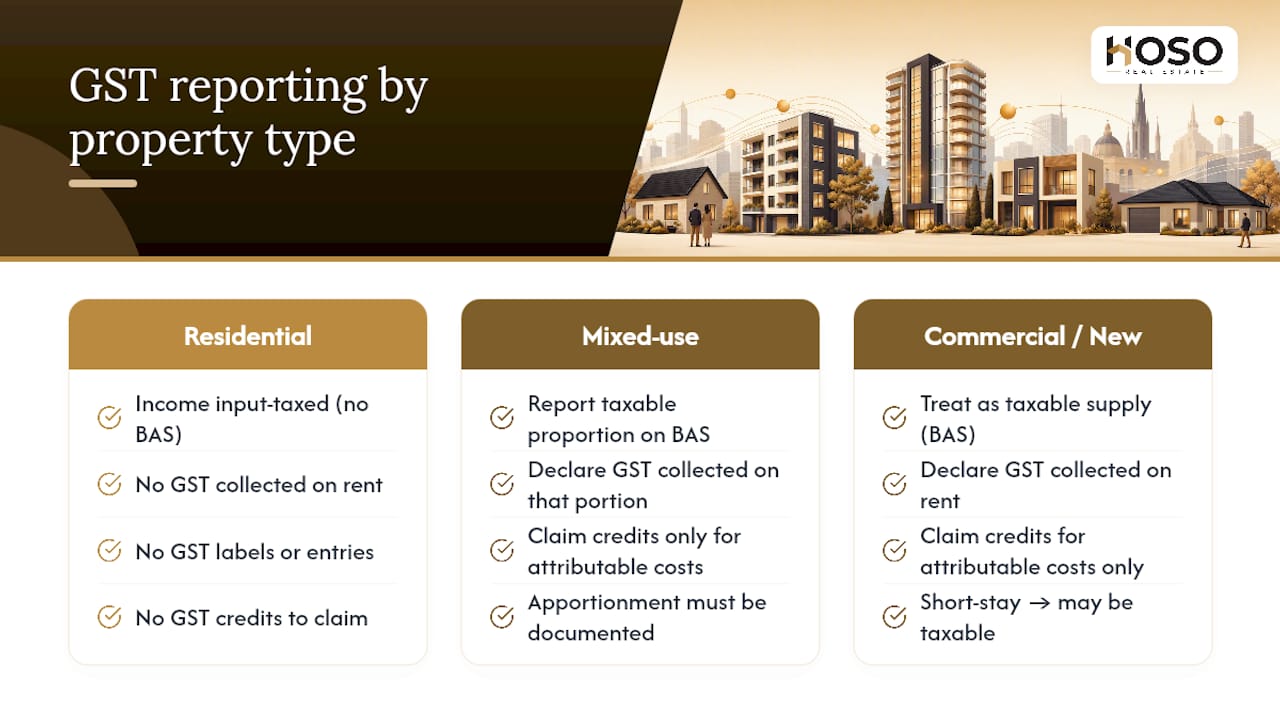
Mixed‑use owners face the most complex reporting position, because BAS entries need to reflect only the apportioned non‑residential share, supported by the same documentation used to justify the split in the first place. Getting the apportionment percentage wrong on a BAS is a common trigger for ATO review, so any landlord in this position benefits from having an accountant reconcile the apportionment schedule against actual BAS figures each cycle rather than relying on a one‑off estimate from years earlier.
GST and shared or co-owned residential properties
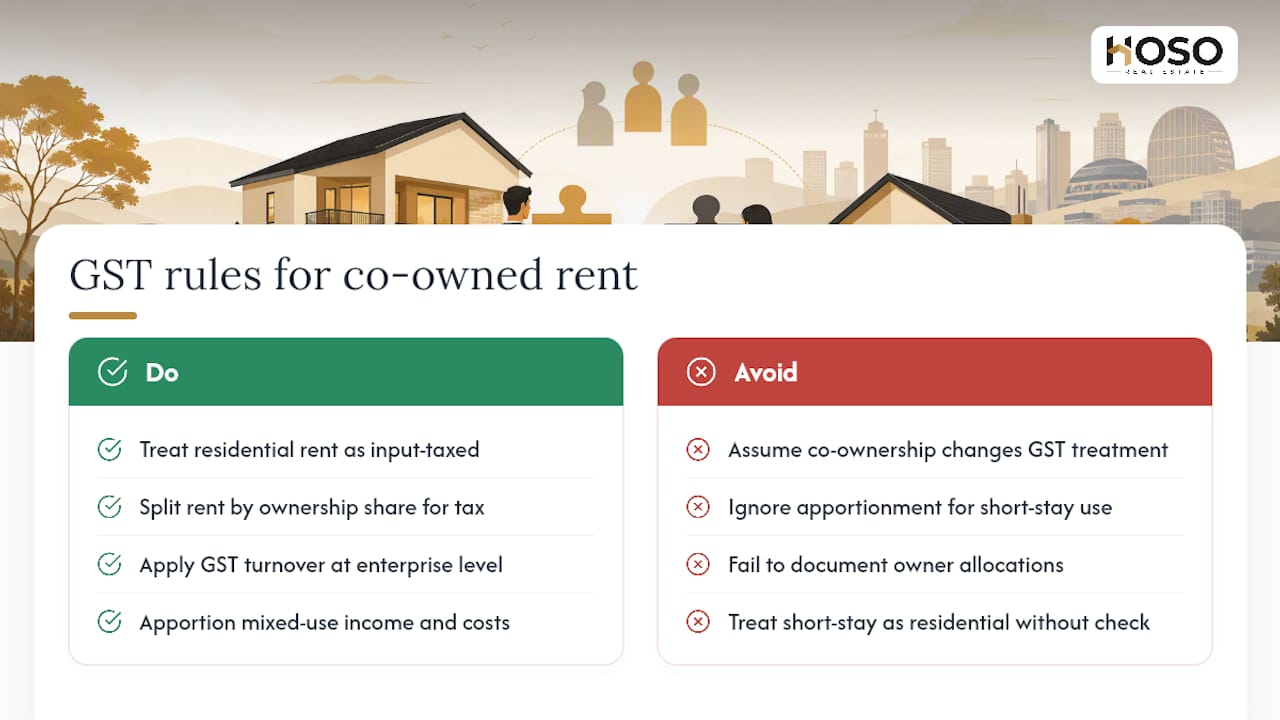
Co‑ownership, whether between spouses, family members, or unrelated investors pooling capital for an Adelaide property, doesn't change the underlying GST treatment of the rent itself. Rent from a jointly owned residential property stays input‑taxed in exactly the same way as rent from a sole‑owned property, split between owners according to their ownership share for income tax purposes.
Where shared ownership adds complexity is in registration and enterprise structuring. If co‑owners are running the property as part of a broader enterprise, say, a small portfolio held through a partnership that also derives taxable income elsewhere, the GST turnover calculation applies at the enterprise level, not to each owner individually. Input‑taxed rental income still gets excluded from that turnover test regardless of how many names sit on the title.
Co‑owned properties that include a commercial or short‑stay component raise the same apportionment questions as any mixed‑use property, just with an added layer: owners need to agree on how apportioned income and costs get allocated between them, not just between residential and non‑residential use. This is worth settling in writing at the outset of a co‑ownership arrangement, particularly for properties near Adelaide's beaches where short‑stay temptation runs highest and the GST stakes of getting the classification wrong are correspondingly larger.
How HOSO Real Estate helps you stay across GST implications
HOSO Real Estate keeps clean, itemised records of rent, bonds, repairs, and maintenance for every property under management, giving your accountant a reliable base for GST and income tax reporting. We flag anything that looks like a mixed‑use or short‑stay scenario early, and we work alongside your accountant rather than replacing their advice on registration or apportionment calls. If your portfolio needs a closer look at compliance and cash‑flow clarity, explore HOSO Real Estate's landlord services or get in touch for tailored advisory.
How HOSO Real Estate reads the GST rules for landlords
The input‑taxed rule on residential rent gets treated as a footnote in most property advice, when it deserves a proper line in every yield calculation a landlord runs. Too many investors budget for gross rental income and net expenses without ever separating out the unrecoverable GST sitting inside every trade invoice, and that gap compounds across a portfolio of three or four properties.
Our view, built from watching how landlord queries land at ATO review stage, is that the riskiest territory isn't the core residential rule at all. It's the edges: a granny flat rented separately, a short‑stay experiment during a slow leasing season, a home office that grows into something more commercial. Those are the moments landlords assume the old rules still apply, and they're exactly when the physical characteristics test and apportionment principles need a fresh look. Treat any change in how a property is used as a trigger to recheck its GST status, not an afterthought for tax time.
— HOSO
This article is general information, not a substitute for advice from a qualified financial advisor. Consult a qualified financial professional about your own circumstances before acting on anything here.