
Yes, landlords can collect rent by direct debit in Australia, provided they hold a valid Direct Debit Request and give the tenant a Direct Debit Service Agreement. Every debit must run through the Bulk Electronic Clearing System under AusPayNet's rules, and tenancy law in South Australia still requires you to offer at least one free, accessible payment method alongside it. Get the paperwork right first. The automation comes second.
TL;DR:
- Landlords must use a valid Direct Debit Request and provide a comprehensive Service Agreement, with automatic debits running through the Bulk Electronic Clearing System under AusPayNet rules.
- Proper paperwork, including tenancy agreements, DDR, and DSSA, must be aligned and properly documented to prevent disputes, especially in South Australia where SACAT can review all records.
- Verifying tenant identity and retaining signed authorizations and proof of delivery creates a solid evidence trail, reducing risks of disputes or bank reversals.
- Failures or disputes require immediate action: check account details, notify tenants promptly, and pause future debits if issues persist, following a clear process for reconciliation.
- A seven-year record retention of all direct debit documents and careful reconciliation throughout the tenancy ensure compliance and support in case of disputes or audits.
Table of Contents
- Quick set-up checklist for landlords using direct debit rent Australia methods
- What legal and compliance rules apply to direct debit rental options?
- How do you collect valid DDR authorisation from tenants?
- What happens when a rent direct debit fails or is disputed?
- Recordkeeping and reporting for automatic rent payments Australia landlords rely on
- Does direct debit change how bonds and other rental fees work?
- HOSO Real Estate's view: where Adelaide landlords get this wrong
- Let HOSO Real Estate manage your direct debit rent collection in Adelaide
- Primary sources and scheme documents worth reading
- Sources
- FAQ
Quick set-up checklist for landlords using direct debit rent Australia methods
Setting up automatic rent payments in Australia is less about technology and more about paperwork sequencing. Get the authorisation chain right and the debits themselves become routine.
- Choose your BECS connection. Most landlords never sponsor directly with a bank. Instead they use a BECS-enabled payments provider, which handles mandate collection, file submission, and reconciliation on their behalf, a path Stripe's guidance on BECS confirms is standard for small operators.
- Draft your DDR and DSSA. These two documents anchor the entire arrangement. Sprintlaw's breakdown of direct debit laws recommends stating debit timing, frequency, what happens on a failed payment, and how either party can cancel.
- Collect tenant authorisation. A signed paper DDR or an approved electronic mandate both work, but the DSSA must reach the tenant within the timeframe your provider or bank specifies.
- Set the schedule and test it. Lock in the debit date, align it with the rent due date in the tenancy agreement, then run at least one test cycle before relying on it fully. Confirm the funds reconcile against your rent roll before you switch tenants over permanently.
Pro Tip: Run the first two rent cycles manually alongside the automated debit. If the numbers match for two consecutive periods, you've confirmed the mandate, the schedule, and the reconciliation process are all working before you switch off manual tracking entirely.
What legal and compliance rules apply to direct debit rental options?
Direct debit sits inside a compliance framework with three layers: the payments scheme, consumer protections, and South Australian tenancy law. Missing any one of them creates risk that shows up later, usually when a tenant disputes a debit or a bank asks for evidence you don't have.
At the scheme level, AusPayNet's guidelines for establishing direct debit requests require you to identify the customer, confirm they have authority over the account, and keep records that can be produced if a debit is later contested. Bank terms echo this. NAB's direct debit terms and conditions require a valid DDR before the first debit is ever sent, plus ongoing trace records and correct file formats for every submission.
At the tenancy level, the obligation is simpler but easy to overlook:
- You generally can't make direct debit the only payment option. Guidance on property management duties notes landlords must offer at least one free, accessible method alongside any automated one.
- Payment terms belong in the tenancy agreement itself, not just the DDR paperwork, so both documents tell the same story.
- In South Australia, unresolved payment disputes that escalate go to SACAT, which will expect to see the tenancy agreement, the DDR, and the DSSA as consistent, dated records.
Align your DDR and DSSA wording with your tenancy agreement rather than treating them as separate boilerplate. Adelaide landlords who skip this step are the ones most likely to face a SACAT dispute where the paperwork tells three different stories about when rent was due.
How do you collect valid DDR authorisation from tenants?
An electronic DDR only holds up if you can prove the tenant actually authorised it. AusPayNet's guidance for electronic and telephone DDRs sets a clear bar: identify the customer, verify they have the authority to operate the account being debited, and use a method reliable enough to withstand a later dispute.
In practice, that means building a small evidence file for every tenancy, not just a signature on a form.
- Verify identity before the mandate is signed. Match the name on the DDR to the name on the lease and the bank account, not just the tenant's stated details.
- Retain the signed mandate itself, whether it's a paper DDR or an electronic authorisation captured through your tenant portal.
- Keep a copy of the DSSA you provided, along with proof it was delivered, an email timestamp or portal download log is usually sufficient.
- Log verification calls or portal confirmations, including trace numbers where your provider generates them.
- Store everything against the tenancy file, not a separate payments system that could get disconnected from the lease record later.
The easiest way to build this evidence trail is to fold it into onboarding rather than treating it as a separate admin task. A tenant who signs their lease through a portal can complete the DDR and receive the DSSA in the same session, with the confirmation email doing double duty as your delivery record. AusPayNet's own guidance treats this kind of integrated record keeping as the standard, not an extra.
What happens when a rent direct debit fails or is disputed?
A failed debit needs a fast, calm response, not a scramble. Check the account and BSB details first, since a mistyped digit is the most common cause of a dishonour, then re-attempt on your normal schedule rather than immediately chasing arrears.
- Notify the tenant the same day, in writing, so there's a clear record of when they were told.
- If a second attempt also fails, pause future debits until you've spoken with the tenant directly.
- Document every failure with a date, reason code where available, and the communication sent.
- Escalate repeated failures towards your standard arrears process, which may mean switching that tenant temporarily to a manual payment method while the issue is resolved. A guide to recovering lost rent arrears in South Australia covers the steps that follow if a dishonour turns into genuine arrears.
If a tenant disputes a debit through their bank, expect the bank to ask for the same three things every time: the signed DDR, proof the DSSA was delivered, and your reconciliation log showing what was debited and when. Sprintlaw's analysis of direct debit service agreements notes that a clear audit trail resolves most of these disputes in the landlord's favour, but only if the paperwork was done properly at the start.
Pro Tip: Freeze future debits the moment a dispute is raised, not after it's resolved. Continuing to debit a disputed account while the bank investigates almost always makes the eventual resolution more contentious.
Recordkeeping and reporting for automatic rent payments Australia landlords rely on
Every direct debit arrangement generates a paper trail that needs somewhere permanent to live. At minimum, keep the signed DDR, the delivered DSSA, an audit trail of every debit run, any failure notices, and the tenant communications tied to them.
- Retain DDR records for at least seven years after the last debit, which aligns with AusPayNet's recommended retention period for scheme disputes.
- Restrict access to stored bank details to the people who actually need it, and use a system with proper access controls rather than a shared spreadsheet.
- Reconcile debits against owner statements and tenant receipts each cycle. Understanding property management disbursements helps clarify how rent flows through to owner reporting once it's collected.
- Set alerts for failed debits so they're caught the same day, not discovered weeks later during a routine reconciliation.
Does direct debit change how bonds and other rental fees work?
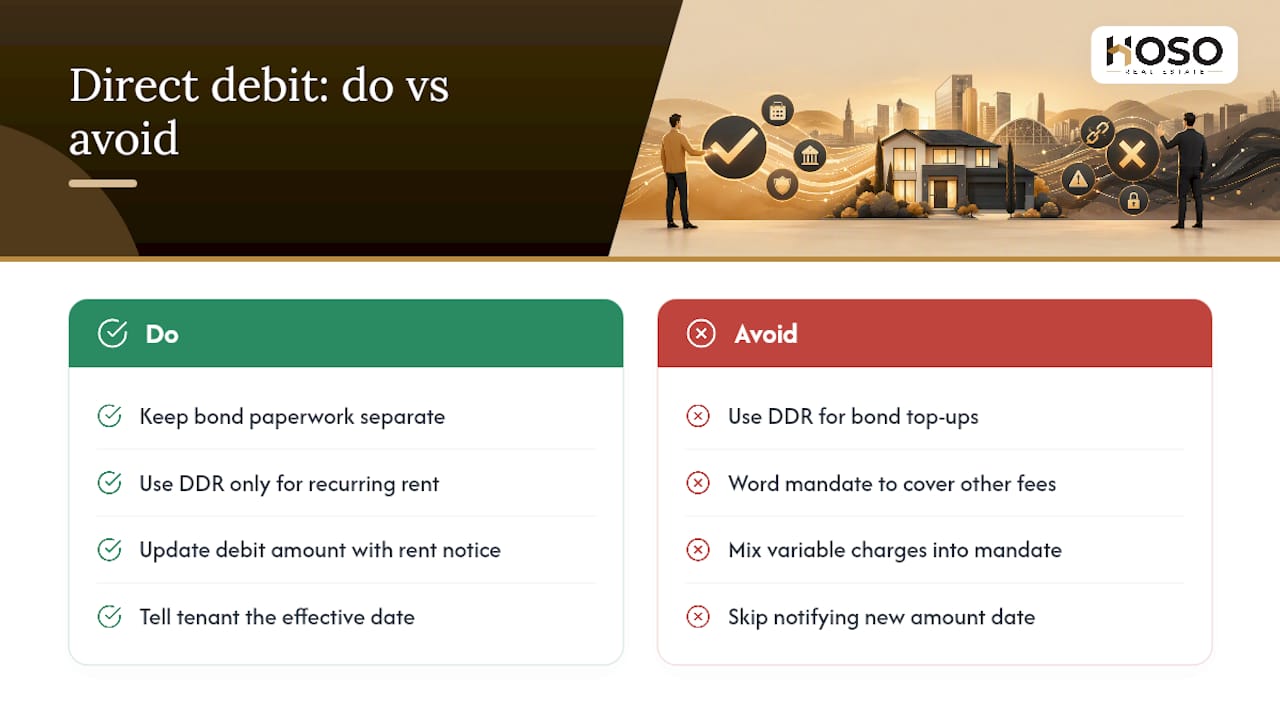
Direct debit affects the collection of ongoing rent, not the bond itself. Bonds in South Australia are lodged with Consumer and Business Services rather than paid to the landlord or agent, so a rent direct debit arrangement has no bearing on how the bond is held or released. Keep the two processes entirely separate in your paperwork. A DDR authorises recurring rent debits; it should never be worded broadly enough to imply it also covers a bond top-up or any other one-off charge.
Where direct debit does interact with fees is timing. If rent increases during a tenancy, the debit amount needs updating in step with the notice period that applies, and tenants need to be told the new figure will apply from a specific date, not just that "the amount has changed." A guide to rent increases and notice periods in South Australia sets out how much notice is required before a new figure takes effect.
The safest structure treats direct debit as a rent-only mechanism. Any variable charges, such as a one-off invoice for damage outside normal wear and tear, should be handled through a separate transaction with its own paper trail, not folded into the recurring mandate. Mixing the two makes reconciliation harder and gives a disputing tenant grounds to challenge the whole arrangement rather than just the disputed line item.
HOSO Real Estate's view: where Adelaide landlords get this wrong
The most common mistake we see across Adelaide suburbs isn't a broken DDR. It's poor communication around it, tenants who never received a clear DSSA and later dispute a debit they don't remember agreeing to. Upfront verification during onboarding prevents most of these disputes before they start. For landlords managing several properties, the reconciliation and paperwork load is usually the point where engaging a property manager starts paying for itself.
— HOSO
Let HOSO Real Estate manage your direct debit rent collection in Adelaide
Setting up compliant direct debit rent collection yourself means drafting DDR and DSSA documents, verifying every tenant's identity, and building a reconciliation system that survives a SACAT dispute if one ever arises. HOSO Real Estate runs this as a built-in part of property management, not an add-on you have to configure separately. Our approach covers DDR and DSSA setup, tenant onboarding, ongoing reconciliation, and dispute handling, backed by a 24/7 owner portal so you can see every debit against your rent roll without chasing paperwork. With HOSO Real Estate handling the SA tenancy alignment and BECS procedure side of things, you get the transparency of doing it yourself without the administrative exposure. If you're an Adelaide landlord ready to hand over rent collection to a team that lives and breathes this compliance work, visit our property management services page to start the conversation.
Primary sources and scheme documents worth reading
Read AusPayNet's guidelines for establishing DDRs electronically or by telephone for the scheme's own identity verification and retention rules. Sprintlaw's article on direct debit laws in Australia explains DDR and DSSA content in plain legal terms. NAB's direct debit terms and conditions show what a sponsoring bank expects operationally.
Sources
- Guidelines for Establishing Direct Debit Requests Electronically or by Telephone (AusPayNet)
- Direct debit laws in Australia (Sprintlaw)
- NAB direct debit terms and conditions
FAQ
Can a landlord force a tenant onto direct debit in Australia?
No. Tenancy law generally requires landlords to offer at least one free, accessible payment method alongside direct debit, so it can be the default but not the only option. State this clearly in the tenancy agreement to avoid disputes later.
What documents do I need before debiting a tenant's account?
You need a valid Direct Debit Request signed or electronically authorised by the tenant, plus a Direct Debit Service Agreement delivered to them beforehand. AusPayNet's guidance treats both as mandatory before the first debit is sent.
How long should I keep DDR records for a former tenant?
Keep DDR records for at least seven years after the last debit, in line with AusPayNet's recommended retention period. This protects you if a dispute or reversal is raised well after the tenancy has ended.
What should I do if a rent direct debit bounces?
Check the account details for errors, notify the tenant the same day, and pause further debits if a second attempt also fails. If the situation moves towards arrears, HOSO Real Estate's guide to recovering lost rent arrears in South Australia outlines the next steps.
Can HOSO Real Estate set up direct debit rent collection for my property?
Yes. HOSO Real Estate manages DDR and DSSA setup, tenant onboarding, and reconciliation as part of its property management services for Adelaide landlords. Current details are available on the services page.