
A property portfolio strategy is a structured plan that defines which assets you buy, in what order, for what purpose, and how you manage and finance them over time. Before anything else, define your primary objective: capital growth, cash flow, or a blend of both. That single decision shapes every acquisition, finance structure, and review trigger that follows.
Sequencing and protection matter more than most investors expect. Two investors with identical budgets and similar properties can reach very different positions over a decade simply because one had a clear acquisition order and the other did not. Getting the sequence right preserves borrowing capacity, protects equity, and keeps your options open for the next purchase.
Table of Contents
- What does a property portfolio strategy actually include?
- Which strategy type suits your goals and stage?
- How to build your property portfolio strategy step by step
- Financing, ownership, and tax considerations for Australian investors
- Key takeaways
- What successful portfolio stewardship actually looks like
- How HOSO Real Estate supports your portfolio at every stage
- Useful sources for Australian property investors
What does a property portfolio strategy actually include?
A portfolio strategy is more than a list of properties you plan to buy. It is a system where each asset plays a defined role and the whole collection is managed as one interconnected structure. Buying a good property is not the same as building a good portfolio — asset selection, market selection, acquisition timing, and finance structure all interact to determine long-term performance.
The core building blocks are:
- Management plan: Who manages each property, what standards apply, and how tenancy compliance is maintained. In South Australia, landlord obligations and dispute escalation run through the Residential Tenancies Act 1995 and SACAT.
Think of this list as a checklist. If your current plan is missing any of these blocks, that is a gap worth closing before the next purchase.
Which strategy type suits your goals and stage?
No single strategy works for every investor. The right mix depends on your borrowing profile, risk tolerance, and where you are in the accumulation cycle. The table below compares the main options across the outcomes investors care about most.
| Strategy | Equity growth | Cashflow impact | Serviceability stress | Management intensity | Regulatory/insurer complexity |
|---|---|---|---|---|---|
| Buy and hold (growth) | High | Negative short-term | High | Low–medium | Low |
| Positive cash flow | Low–medium | Positive | Low | Medium | Low–medium |
| Negative gearing | High (target) | Negative | High | Low | Low |
| Renovation/flipping | Variable | Neutral to positive | Medium | High | Medium |
| Subdivision/development | High (potential) | Neutral to negative | Very high | Very high | High |
| Commercial/industrial | Medium–high | Positive | Medium | Medium | Medium–high |
| Blended portfolio | Balanced | Neutral to positive | Medium | Medium | Medium |
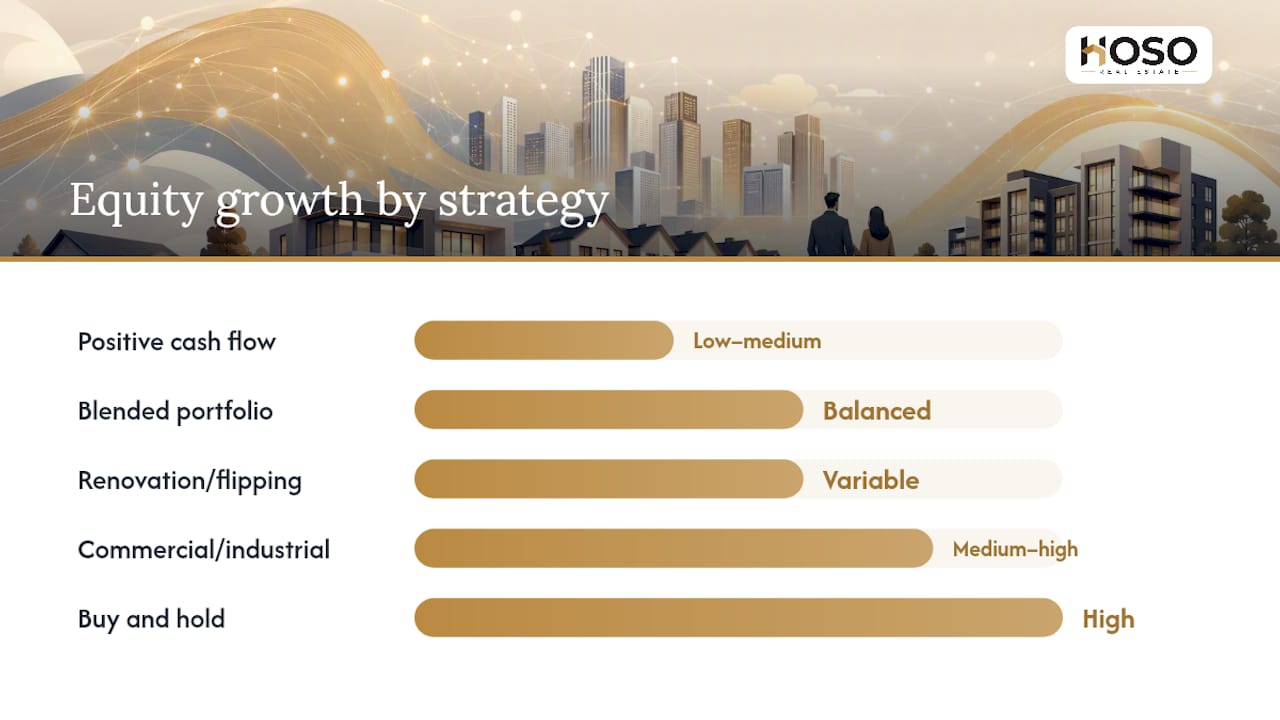
Buy and hold suits investors with strong serviceability who can absorb short-term negative cashflow in exchange for long-term capital growth. Adelaide suburbs such as Norwood, Unley, and Prospect have historically rewarded this approach.
Positive cash flow properties generate more rent than they cost to hold. They suit investors with limited borrowing headroom or those building a buffer before the next acquisition. Regional South Australian markets can offer stronger gross yields than inner Adelaide.
Negative gearing is a tax-assisted growth strategy where holding costs exceed rental income and the shortfall is offset against other taxable income. It suits high-income earners with stable employment and strong serviceability.
Renovation and flipping can generate returns quickly but requires accurate cost estimation, reliable trades, and a clear exit. Margins compress fast when holding costs blow out or the market softens.
Subdivision and development carries the highest complexity and capital requirement. It suits experienced investors with development finance access and a tolerance for extended timelines and council approval risk.
Commercial and industrial assets often carry longer leases and tenant-paid outgoings, which improves cashflow predictability. Entry costs are higher and lending conditions differ from residential.
A blended portfolio assigns different roles to different assets — one growth property, one cash flow property, one lower-risk stabiliser — so the portfolio as a whole is less exposed to any single market condition. Diversification works best when it is role-focused and cycle-aware, not just postcode diversification for its own sake.
How to build your property portfolio strategy step by step
This sequence gives you a working framework. Adapt the timeline to your serviceability and market conditions, but do not skip steps.
-
Run your acquisition checklist. Before committing to a purchase: independent building and pest inspection, strata records review (if applicable), conveyancing, rental appraisal, and a tax and structure consultation with your accountant. Treating each purchase as part of a broader wealth plan materially reduces the chance of long-term underperformance.
-
Set up your operational plan. Select a property manager, confirm landlord insurance cover (including loss of rent and public liability), establish a maintenance reserve, and document your tenant selection criteria. For scaling a multi-property portfolio, consolidating management under one agency reduces coordination overhead and improves consistency.
Broad cost considerations include deposit (typically 10–20% of purchase price), stamp duty (calculated on the dutiable value under South Australian legislation), building and pest inspection, conveyancing, landlord insurance, and a cash holding cost buffer for the first 90 days of vacancy. Model these before you commit, not after.
Financing, ownership, and tax considerations for Australian investors
Finance structure is where many portfolios stall. Getting it wrong early limits how many properties you can hold and how quickly you can move to the next acquisition.
Key finance variables to set in your strategy:
- Serviceability buffers: Lenders apply a serviceability buffer (currently 3% above the loan rate under APRA guidance) when assessing new applications. Model your portfolio against this buffer before applying for the next loan.
Ownership structures each carry different tax and asset-protection implications:
Pro Tip: Never choose an ownership structure based on a single article or a friend's recommendation. The right vehicle depends on your income, existing assets, estate planning goals, and long-term exit strategy. Engage a qualified accountant or tax adviser before the first purchase, not after.
Equity recycling — drawing on accumulated equity in one property to fund the deposit on the next — is the primary growth mechanism for most buy-and-hold investors. It works when LVR is below the lender's threshold and serviceability supports the additional debt. Pulling equity too aggressively compresses your buffer and can stall the portfolio at a critical point.
For South Australian investors, a property manager or accountant should be engaged for record keeping from the first rental property. The ATO requires accurate records of all rental income, deductible expenses, depreciation schedules, and capital improvements. SACAT handles tenancy disputes in South Australia; a property manager familiar with SA tenancy frameworks reduces the risk of procedural errors that can affect your position at tribunal.
For finance structuring guidance specific to property investors, ZENRG Finance provides lending options tailored to portfolio growth strategies.
Key takeaways
A property portfolio strategy works when goals, role assignment, sequencing, finance structure, and risk controls are set before each acquisition, not after.
| Point | Details |
|---|---|
| Define roles before buying | Assign each property a role (growth, cash flow, or lower risk) to reduce concentration and guide sequencing. |
| Sequencing drives outcomes | The order and pace of purchases determines borrowing capacity and equity position over five to ten years. |
| Insurance gaps are real | Strata policies often exclude loss of rent and fixtures; private landlord insurance must cover the shortfall. |
| Review on a fixed cadence | Monthly cashflow, quarterly portfolio review, and an annual deep review keep the strategy current and the portfolio on track. |
| HOSO Real Estate | HOSO Real Estate provides portfolio support, property management, and compliance advisory for Adelaide investors building and managing multi-property portfolios. |
What successful portfolio stewardship actually looks like
The investors who build durable portfolios in Adelaide are not necessarily the ones who buy the most properties. They are the ones who know what each asset is supposed to do, check whether it is doing it, and act when it is not.

The gap between a good property and a good portfolio is almost always a structural one: no sequencing rule, no role assignment, no review cadence, and no one watching the insurance. Capital growth can mask these gaps for years. Then a vacancy, a special levy, or a rate cycle exposes them all at once.
What works in practice is unglamorous: clear goals, conservative finance, up-to-date insurance, a property manager who knows SA tenancy law, and a quarterly review that asks the same three questions every time. Is this asset performing its role? Can I borrow again? Is there anything in the risk column that has changed?
Portfolio stewardship is not a one-time plan. It is a standing discipline.
How HOSO Real Estate supports your portfolio at every stage
Adelaide investors who want to move from a single property to a managed, multi-asset portfolio need more than a plan on paper. They need consistent execution at the property level: compliant tenancies, accurate financial records, timely maintenance, and a manager who understands SA tenancy frameworks and SACAT processes.
HOSO Real Estate provides residential property management, tenant leasing, routine inspections, maintenance coordination, compliance management, and landlord advisory across Adelaide. For investors building a portfolio, HOSO also supports acquisition-stage portfolio reviews, insurance checks, and operational setup for new properties.
The practical next step is a portfolio review conversation. Whether you hold one property or five, HOSO can assess how your current assets are performing against their assigned roles and identify gaps in your management or risk controls. Visit HOSO Real Estate's services page to request a review or learn more about how the team supports Adelaide investors at each stage of the build.
Useful sources for Australian property investors
These sources are referenced throughout this article and are worth bookmarking for ongoing research and planning.
- Property investment isn’t just about growth – it’s about protection
- Property Portfolio Strategy and Sequencing Australia | Get RARE
- How to Build a Property Investment Portfolio [2026]
- Portfolio Strategy for Property Investors - InvestVise
- How to build a property portfolio | Real estate investing Australia
- Investment property risks — Westpac
- How to Reduce Property Risk in Australia - InvestVise
This article provides general information for educational purposes. It is not financial, legal, or tax advice. Confirm your ownership structure, tax position, and insurance requirements with a qualified accountant, financial adviser, or legal professional before making investment decisions.