
Poor property management reduces rental income through five compounding channels: missed rent reviews, prolonged vacancies, weak tenant screening, reactive maintenance, and deficient documentation. If your property has not had a formal rent review recently, your rent is likely below market. The immediate action is an audit of three things: the date of the last rent review, the current arrears balance, and whether your bond paperwork is complete and lodged.
The main loss channels at a glance:
- Missed or delayed rent reviews leave rent anchored below market, and every future increase compounds from that lower base
- Prolonged vacancies cost the full weekly rent for every week the property sits empty
- Poor tenant screening drives turnover, which triggers reletting costs, cleaning, and repair cycles
- Reactive maintenance produces inflated single-quote repair bills and emergency callout rates
- Incomplete documentation destroys the ability to recover bond money or compensation at SACAT
Do these three things in the next 48 hours:
- Check the date of the last formal rent review against current market listings for comparable properties in your suburb
- Request the most recent financial statement and confirm arrears are zero or being actively managed
- Confirm the bond is lodged with Consumer and Business Services (CBS) and that entry condition reports are signed and on file
Table of Contents
- How does poor property management actually reduce rental income?
- What are the signs your property manager is costing you rent?
- How do losses compound over time?
- What compliance and documentation risks does SACAT create for SA landlords?
- What does good, proactive property management look like?
- A practical audit checklist to test your property manager
- When and how should you change your property manager in South Australia?
- A South Australian case example: what weak documentation cost one landlord
- Key takeaways
- Management is asset stewardship, not rent collection
- Stop income leaks with HOSO Real Estate's management audit
- Useful sources for SA landlords
How does poor property management actually reduce rental income?
The mechanisms are rarely dramatic. They accumulate quietly, and reactive management is the primary driver of rental income decline according to industry specialists. Understanding each channel helps you map the symptoms you are already seeing to their root cause.
Missed rent reviews and underpricing
A missed rent review is a permanent loss. Future increases compound from the lower base, so a single missed or under-quoted review produces a long-term reduction in yield that cannot be recovered by simply catching up later. A property in Prospect or Norwood that was correctly priced a couple of years ago may now be worth significantly more. If the review never happened, the landlord has absorbed the difference for every week since.
Pro Tip: Ask your manager to show you the rent review schedule in writing. If there is no documented schedule, that absence is itself a red flag.
Prolonged vacancies and slow re-letting
Every week a property sits vacant is a week of rent that cannot be recovered. Slow re-letting usually traces back to three failures: inadequate marketing (poor photography, limited portal coverage), incorrect pricing at the top of the market, and poor presentation. A property in Unley or Glenelg that takes longer to re-let than the typical market timeframe has already cost the landlord a substantial amount in lost income, before any reletting costs are counted.
Weak tenant screening and high turnover
One poorly screened tenancy creates multiple cost vectors simultaneously: lost rent during vacancy, cleaning and repair costs at exit, reletting costs, and the management time absorbed by arrears chasing and breach notices during the tenancy. Missed rent reviews, vacancy weeks and single-quote repairs compound over time into a significant hidden drag on returns. High turnover amplifies every one of these costs.
Reactive maintenance and inflated repair costs
A manager who only acts when a tenant reports a fault will consistently pay more for repairs than one who schedules preventative maintenance. Emergency callout rates for plumbers and electricians in Adelaide can be two to three times the standard rate. Single-quote approvals, with no competitive comparison, mean there is no check on whether the cost is reasonable. Over a year, the difference between proactive and reactive maintenance on a standard suburban rental can be substantial.
Poor documentation and bond handling
Without complete entry and exit condition reports, timestamped photographs, and signed documentation, a landlord cannot recover bond money or compensation through SACAT regardless of how justified the claim is. SACAT guidance confirms that many tenancy disputes arise from poor documentation during entry and exit inspections, leaving landlords unable to recover what they are owed. The documentation failure is the management failure.
What are the signs your property manager is costing you rent?
Most landlords notice something is wrong before they can name it. These are the specific red flags to check.
Key red flags:
- Rent has not increased in 12 months or more, with no written explanation
- The property took longer than two weeks to re-let after a vacancy
- Arrears appear on statements without a corresponding breach notice or action plan
- Routine inspections are occurring less than four times per year
- Financial statements are delayed, missing line items, or difficult to reconcile
- Response times to maintenance requests or your own queries exceed 48 hours consistently
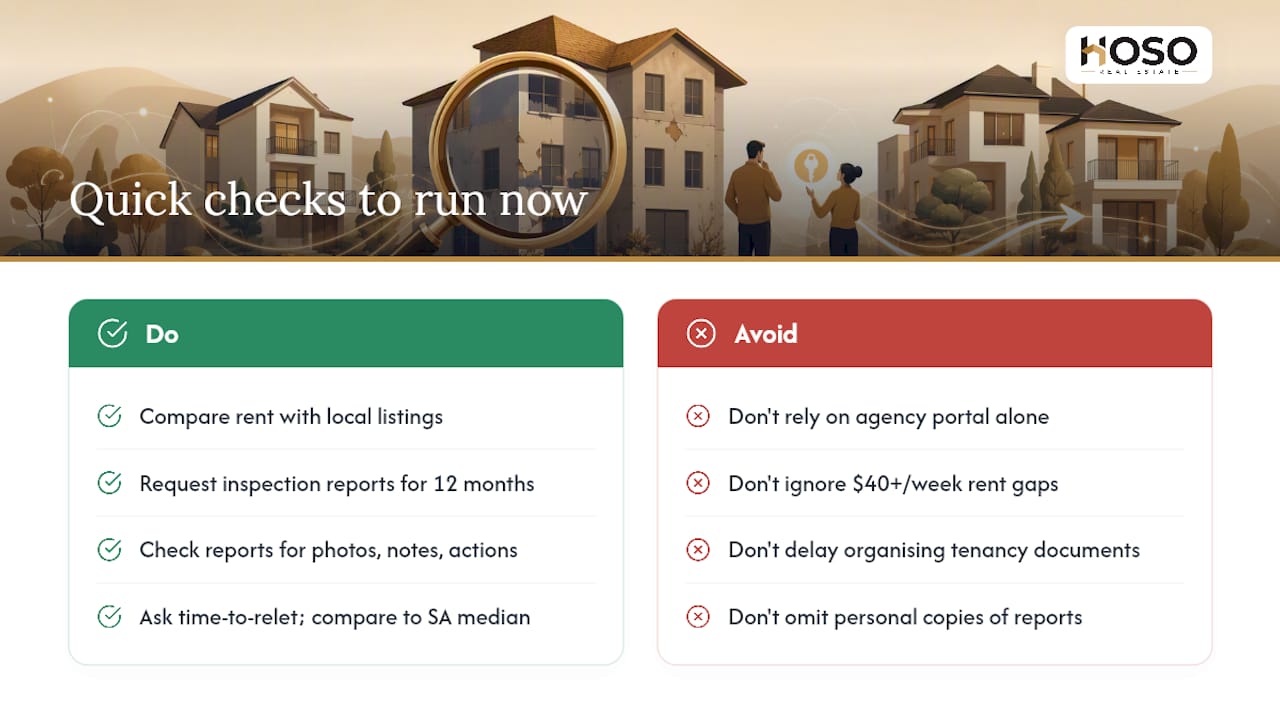
How to run quick checks right now
Compare the current rent to active listings for comparable properties in the same suburb on realestate.com.au or Domain. If comparable properties are advertising $40 or more per week above your current rent, the gap is likely a missed review. Request inspection reports for the past 12 months and check whether they include photographs, condition notes, and follow-up actions. Ask for the time-to-relet figure for the last vacancy and compare it to the SA median.
Pro Tip: Keep a personal copy of every inspection report, entry and exit condition report, and financial statement. Do not rely on the agency's portal as your sole record. If you ever need to present evidence at SACAT, having your own indexed file is the difference between a strong claim and a weak one. Practical guidance on organising tenancy documents is worth reviewing before any dispute arises.
The SACAT annual report housing list data shows that housing list applications are substantial in volume and that listing and finalisation timelines vary, which means disputes that could have been avoided with better documentation instead consume months of a landlord's time and money.
How do losses compound over time?
The dollar impact of poor management is not abstract. The numbers below use conservative assumptions to show what repeated small failures cost over a five-year period.
Worked example: $50/week under-quote and two-week annual vacancy
Assume a property is rented below market rate and experiences longer vacancies than average. The combined losses from under-market rent and extended vacancies can represent a significant amount over several years, even before considering additional costs like repair mark-ups.
That $15,700 figure does not include reletting costs, repair mark-ups, or any bond money lost through poor documentation. It also does not account for the compounding effect: if the rent review had occurred and rent had moved to $540, subsequent reviews would have increased from the higher base.
What compliance and documentation risks does SACAT create for SA landlords?
South Australia's tribunal system, SACAT, handles bond disputes, compensation claims, and tenancy terminations. The outcome of most residential tenancy disputes turns on documentation quality, not on who is morally right.
Why SACAT outcomes depend on paperwork
Common case types in the housing list include bond claims, cleaning disputes, and compensation for damage. A landlord who cannot produce a signed entry condition report with photographs, a matching exit report, and itemised invoices for repair work will struggle to recover costs even when the damage is real. The tribunal cannot award what cannot be evidenced.
A SACAT decision from 2024 (Souter/Bolland matter) illustrates the consequences directly. The case involved disputes over bonds, cleaning, and compensation. Missing invoices, late internal review applications, and weak paperwork left the landlords unable to satisfactorily challenge or reverse the tribunal's consent orders. The Corrigan — Souter/Bolland SACAT decision (2024) is a clear example of how procedural and documentation failures, not the underlying facts, determine the outcome.
Consent orders made at SACAT are binding. Internal review timelines are strict. A landlord who misses the review window because their manager did not act promptly has, in practical terms, no further recourse.
Evidence checklist every SA landlord should maintain:
- Signed entry condition report with timestamped photographs (room by room)
- Signed exit condition report with matching timestamped photographs
- All routine inspection reports with dates, condition notes, and photographs
- Itemised invoices for every repair, with dates and contractor details
- Rent ledger showing payment history for the full tenancy
- Copies of all breach notices issued and responses received
- Bond lodgement confirmation from Consumer and Business Services
Pro Tip: If your manager cannot produce all of the above on request within 48 hours, treat that as a compliance failure. A well-managed property has these documents current and accessible at all times. The SA complaint and SACAT pathway is worth understanding before a dispute arises, not after.
What does good, proactive property management look like?
Proactive management treats the property as an investment asset, not a reactive cost centre. The distinction shows up in scheduled actions, measurable KPIs, and structural accountability.
Core duties of a proactive manager:
- Scheduled rent reviews at least annually, with written market comparisons provided to the landlord
- Planned preventative maintenance (gutters, smoke alarms, hot water systems) on a calendar, not on tenant complaint
- Robust tenant screening using reference checks, rental history, and income verification
- Fast re-marketing when a vacancy is known, with professional photography and multi-portal coverage
- Routine inspections four times per year with written reports and photographs provided to the landlord
KPIs to demand and monitor
| KPI | Green | Amber | Red |
|---|---|---|---|
| Vacancy rate | Below 2% | 2–4% | Above 4% |
| Arrears (% of rent roll) | Below 1% | 1–3% | Above 3% |
| Time-to-relet (weeks) | 1–2 weeks | 2–3 weeks | Above 3 weeks |
| Inspection frequency | 4 per year | 3 per year | Fewer than 3 |
| Repair turnaround (urgent) | — | — | Beyond 48 hours |
A manager who cannot report against these KPIs on request is not measuring performance. That absence of measurement is itself a management failure.
How team structure prevents task drop
Structural fixes such as pod teams or departmentalised services limit the risk of tasks being missed when one person manages too many properties. When a single property manager carries 150 to 200 properties, rent reviews, inspection follow-ups, and maintenance approvals fall through the gaps. A departmentalised structure, where leasing, inspections, maintenance, and financial reporting are handled by dedicated staff, reduces single-point-of-failure risk. Understanding the role of property management in investment helps landlords ask the right structural questions of any agency they consider.
A practical audit checklist to test your property manager
Run this checklist now. It takes one review session and produces a clear picture of whether your manager is performing.
Step-by-step audit
- Request the last 12 months of financial statements and confirm rent received matches the agreed rent for every month
- Identify the date of the last formal rent review and compare the current rent to three comparable active listings in the same suburb
- Request all routine inspection reports for the past 12 months and check for photographs, condition notes, and follow-up actions
- Calculate time-to-relet for the last vacancy (days from lease end to new lease start)
- Confirm the bond is lodged with CBS and that the lodgement amount matches the current bond
- Request the arrears report and check whether any arrears triggered a formal breach notice within the required timeframe
- Ask the manager to provide their vacancy rate and arrears percentage for your property over the past 12 months
Questions to ask at a performance review
- "What is the current market rent for this property, and when did you last formally review it?"
- "What is your average time-to-relet across your portfolio, and how does my property compare?"
- "Can you show me the inspection schedule and the last three reports?"
- "How do you handle maintenance quotes, and do you obtain more than one quote for non-urgent repairs?"
Acceptable answers are specific and documented. Vague responses ("we review rents regularly," "we handle maintenance promptly") without supporting data are not acceptable.
KPI threshold benchmarks
| KPI | Acceptable | Needs attention | Act now |
|---|---|---|---|
| Rent vs market | Within the typical market range | up to $40/week below | More than $50/week below |
| Last rent review | Within 12 months | 12–18 months ago | More than 18 months ago |
| Vacancy duration | 1–2 weeks | 2–4 weeks | More than 4 weeks |
| Inspection frequency | 4 per year | 3 per year | Fewer than 3 |
| Arrears | Zero or resolved | Minor, with action plan | Unresolved, no breach issued |
Comparing managers should use net-rent outcomes, not fee percentages. Ask any prospective manager for their historic vacancy reduction and rent-growth records. A manager who charges more but delivers better net returns is the better financial choice. Reviewing how to manage a rental portfolio gives useful context on what operational discipline looks like in practice.
When and how should you change your property manager in South Australia?
If the audit produces three or more red-flag results, changing managers is the rational next step. The process is straightforward when done methodically.
Decision triggers
- Rent is more than $50 per week below market with no review scheduled
- The last inspection was more than six months ago
- Arrears are unresolved and no breach notice has been issued
- Bond paperwork is incomplete or the bond is not lodged with CBS
- The manager cannot produce inspection reports or financial statements on request
A South Australian case example: what weak documentation cost one landlord
The following is a summary drawn from the 2024 SACAT decision in the Souter/Bolland matter, which illustrates how documentation and procedural failures determine tribunal outcomes.
Case summary: A residential tenancy dispute in South Australia proceeded to SACAT involving bond, cleaning, and compensation claims. The landlord's position was weakened by missing invoices for repair work, incomplete exit condition documentation, and a failure to apply for internal review within the required timeframe. The tribunal made consent orders that the landlord could not subsequently challenge. The full decision is published on AustLII and illustrates how procedural compliance, not just the underlying facts, determines what a landlord can recover.
Three lessons that would have changed the outcome:
- Timely internal review application — within the SACAT-required window would have preserved the right to challenge the consent orders
How to store and present evidence at conciliation or hearing
Keep one indexed digital folder per tenancy. Label files by date and document type (e.g., "2024-03-15 Entry Condition Report," "2024-08-22 Routine Inspection Photos"). Bring printed copies to any conciliation session. SACAT members work through evidence quickly; a disorganised file delays your own case. Organising tenancy documents systematically before a dispute arises is far less costly than reconstructing a file under pressure.
Key takeaways
Poor property management reduces rental income through compounding, largely invisible mechanisms. Addressing them requires a structured audit, measurable KPIs, and a willingness to act when the evidence is clear.
| Point | Details |
|---|---|
| Rent reviews are permanent | A missed review anchors future increases from a lower base; the loss cannot be recovered by catching up later. |
| Vacancy cost is direct | Every week a property sits empty costs the full weekly rent with no offset. |
| Documentation determines SACAT outcomes | Timestamped photos, signed condition reports, and itemised invoices decide what a landlord can recover at tribunal. |
| KPIs reveal performance | Vacancy rate, arrears percentage, time-to-relet, and inspection frequency are the four numbers that tell the real story. |
| HOSO Real Estate | Adelaide landlords can request a management audit to identify income leaks and compliance gaps before they compound. |
Management is asset stewardship, not rent collection
The framing most landlords receive from their agency is that property management is an administrative service. Rent in, maintenance out, statement at month end. That framing is the root of the problem.
A property is a long-term financial asset. The manager's job is to protect and grow its income-producing capacity over time, which requires scheduled rent reviews, preventative maintenance, evidence-based inspections, and compliance discipline. When any of those functions are absent, the asset underperforms. The income loss is real and measurable, and it compounds in ways that are not visible on a monthly statement until the gap has grown large.
Adelaide's rental market has seen meaningful rent movement across corridors including the inner north, inner south, and eastern suburbs. A property that has not been formally reviewed in 18 months is almost certainly below where it should be. That is not a market problem. It is a management problem.
Stop income leaks with HOSO Real Estate's management audit
HOSO Real Estate works with Adelaide landlords and investors who want their property managed as an asset, not administered as a file. The service covers scheduled rent reviews with written market comparisons, routine inspections four times per year with photographic reports, SACAT-ready documentation maintained throughout the tenancy, proactive maintenance coordination with competitive quoting, and clear financial reporting.
For landlords who suspect their current manager is underperforming, HOSO Real Estate offers a management audit to identify rent gaps, documentation shortfalls, and compliance risks before they become tribunal matters. The process is straightforward: review your current rent against market, assess your inspection and documentation history, and identify the steps to close the gap.
To find out where your property stands, visit HOSO Real Estate's services page or contact the team directly to arrange a review.
Useful sources for SA landlords
Authoritative references used in this article:
-
SACAT — Our Service Data: SACAT's own guidance on tenancy dispute types, documentation requirements, and bond claim processes. The starting point for any landlord preparing for a tribunal matter.
-
PIA — Managing an Investment Property: What Most Landlords Get Wrong: Industry commentary on reactive versus proactive management and the KPIs that protect rental income.
-
McLaws — The Hidden Costs of a Poor Property Manager: Legal commentary on why net rental yield, not management fee percentage, is the correct metric for evaluating a manager's performance.