
Location is the single most important non-financial driver of rental demand because it bundles access to jobs, services, amenities, and supply constraints into one address. That bundle determines who wants to live there, how long they stay, and what they'll pay. For investors, that translates directly into vacancy risk, rent growth, and tenant turnover, three variables that shape returns far more than a purchase price ever will.
The main channels worth tracking are:
- Connectivity – transport links and commute times to major employment centres
- Employment anchors – universities, hospitals, CBDs, and industrial precincts
- Housing supply constraints – zoning, planning approvals, and land availability
- Amenity – shops, parks, entertainment, and lifestyle infrastructure
- Safety and schools – crime data and catchment quality
Key Takeaways
Rental demand is driven primarily by access to jobs, services, and amenities, filtered through local supply constraints that determine how much competition exists for that access.
| Point | Details |
|---|---|
| Connectivity drives demand | Only large, city-shaping transport projects materially lift tenant catchments; minor upgrades rarely do. |
| Tenant pool depth matters most | Suburbs anchored by universities, hospitals, or CBDs hold demand better through economic cycles. |
| Supply constraints amplify pricing | Tight zoning and slow approvals near high-demand areas push rents up and vacancy down. |
| Match property to tenant type | Student lets suit higher turnover; family homes near good schools suit longer tenancies. |
| Get a location-led appraisal | HOSO Real Estate assesses tenant pool depth, commute access, and achieved rents before recommending an Adelaide listing strategy. |
Table of Contents
- Why location matters for rental demand and capital growth
- How infrastructure and transport access change rental demand
- Population growth and employment hubs as demand anchors
- How different tenants value location differently
- How supply constraints amplify rental demand
- Metro versus regional rental markets
- How to evaluate a location's rental demand
- What Australian data tells investors about rental demand
- Common misconceptions about location and rental demand
- The bottom line for location-led investing
- HOSO's approach to location checks in Adelaide
- Get a location-informed rental appraisal for your Adelaide property
- Frequently asked questions
- Sources
Why location matters for rental demand and capital growth
Access drives demand, demand shapes pricing and vacancy, and pricing outcomes eventually feed capital growth. That's the causal chain investors need to hold in their heads: a location with strong job access attracts a deeper tenant pool, which tightens vacancy, which lets rents rise faster, which supports valuation growth over time.
Contrast two Adelaide scenarios. An apartment near the CBD fringe, close to universities and hospitals, tends to attract a churn of professionals and students who compete for limited stock, keeping vacancy low even in soft years. A house in an outer commuter suburb with a 45-minute drive to the nearest major employment hub relies far more heavily on broader economic conditions and petrol prices to hold its tenant pool. Both can perform well, but the drivers of capital growth differ substantially between them.

How infrastructure and transport access change rental demand
Large scale connectivity projects, major rail extensions, new motorway links, or university precinct expansions, materially boost the tenant catchment for surrounding suburbs. Smaller upgrades, like a bus route change or a local road widening, rarely move rental demand in any measurable way. Treasury analysis found connectivity and location factors explained roughly 43 to 50% of variation in apartment activity in Melbourne and Sydney, underlining just how much scale matters.
Typical project types and their usual effect:
- Major rail extensions or new stations: strong, durable demand lift
- New CBD motorway links: moderate lift, concentrated near interchanges
- University or hospital precinct expansions: steady, sticky tenant demand
- Local road or bus stop changes: negligible measurable effect
Before you factor a project into your numbers, check its scale, whether it genuinely cuts commute times, and whether delivery is funded or still speculative. Only large, city-shaping investments tend to re-rate a suburb; smaller upgrades usually don't.
Pro Tip: After a major project announcement, watch for rezoning activity and early developer land banking before you watch rents. Rental price movement usually lags planning signals by 12 to 24 months.
Population growth and employment hubs as demand anchors
Consistent population growth and steady jobs growth create a deeper, more resilient tenant pool, which means less vacancy risk across economic cycles. Suburbs anchored by multiple large employers tend to hold demand even when one sector softens.
Look for concentrations of:
- Universities and vocational training campuses
- Hospitals and major health precincts
- CBD office cores
- Airports and logistics precincts
- Large industrial or manufacturing zones
Migration has become a bigger factor since 2021. The return of international students combined with strong net overseas migration has tightened rental markets close to campuses and inner urban precincts, a trend the Reserve Bank has tracked closely through advertised and agreed rent data.
How different tenants value location differently
Tenant type determines which location attributes actually matter, which means matching your property to the right tenant profile is as important as the suburb itself.
- Students prioritise proximity to campus, short commutes, and nearby retail or food precincts
- Young professionals prioritise CBD access, public transport, and lifestyle amenity
- Families prioritise school catchments, parks, and safety over commute time
- Downsizers prioritise walkability, healthcare access, and low-maintenance living
- FIFO and resource workers prioritise airport access and proximity to depots over lifestyle features
These preferences flow straight through to yield and turnover. Student lets often produce higher gross yield but higher turnover and more wear. Family homes near good schools tend to hold tenants for years, reducing vacancy costs and re-letting effort even if the headline yield is lower.
How supply constraints amplify rental demand
Constrained supply in a high-demand location produces stronger rent growth and lower vacancy than demand alone ever could. Location sets the ceiling on who wants to live somewhere; supply settings decide how much competition there is for that same address.
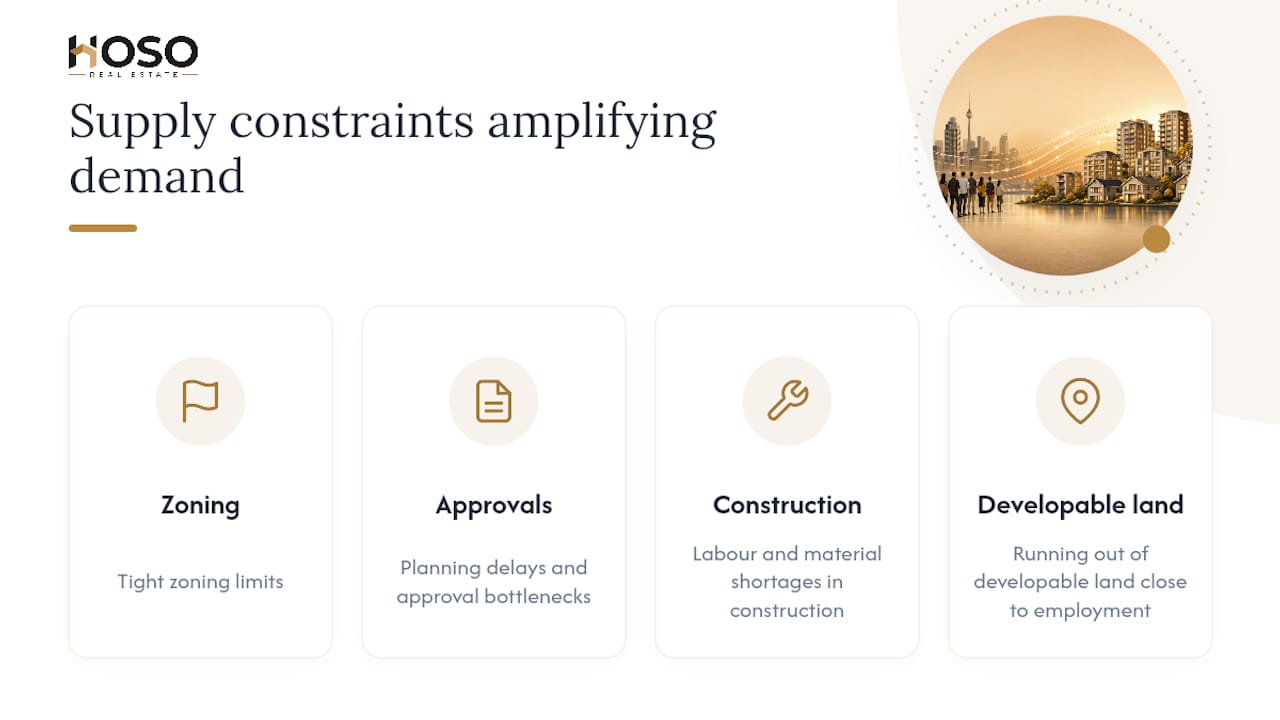
Common constraints include tight zoning limits, slow development approvals, labour and material shortages in construction, and simply running out of developable land close to employment. A parliamentary inquiry into the rental crisis identified planning delays and approval bottlenecks as structural drivers of rental pressure nationwide.
Watch for red flags too: a sudden wave of high-density approvals nearby can flood a micro-market with new stock within a couple of years, while rental homes quietly converting to short-term letting can shrink the available pool without any headline change in vacancy statistics.
Metro versus regional rental markets
Regional markets can offer higher yields, but they carry greater volatility. Metro markets give you a deeper tenant pool and steadier long-term capital growth.
- Impact on rental demand: metro tends to be steadier; regional can spike or slump with a single industry
- Impact on capital growth: metro generally stronger over the medium to long term
- Tenant profile: metro skews professional and student; regional often ties to resources or agriculture
- Supply sensitivity: metro land is harder to release; regional land is often easier and faster
- Time horizon: metro effects play out over years; regional shocks can hit within months
Satellite cities sit in between, offering more affordable entry points with genuine commuter rail or motorway links, though their fortunes stay tied to how reliable that transport connection remains.
How to evaluate a location's rental demand
Judging a suburb's rental strength comes down to checking vacancy, advertised versus achieved rents, tenant anchors, the supply pipeline, and demographic trends, ideally all before you sign a contract.
- Check the current vacancy rate for the specific suburb, not just the broader region
- Compare advertised rents against recently achieved (leased) rents
- Map commute time to the nearest major employment hub
- Review new development approvals and pending supply pipelines
- Identify school catchment zones and their reputation
- Pull local crime statistics for the immediate area
- Scan current rental listings to gauge competition and stock levels
- Weigh rental yield against likely capital growth, not in isolation
- Look for signs of high tenant turnover, like frequent re-listings of the same address
- Check how much of the local stock has shifted to short-stay accommodation
Pro Tip: A big gap between advertised and achieved rent usually signals the market has softened since the listing went up. A short-term spike in advertised rents right after an infrastructure announcement often reverses once the initial excitement fades, so weight sustained trends over a single quarter's numbers.
What Australian data tells investors about rental demand
Household formation has outpaced dwelling completions since 2021, and that mismatch sits behind much of the rental pressure investors are seeing today.
Between the 2016 and 2021 Censuses, Australia recorded an 11.9% rise in total households and a 17.1% jump in single-person households, a demand shock that construction simply hasn't matched. ABS analysis backs this up, showing rent inflation accelerating since 2021 across both inner-city and regional markets as vacancy rates tightened.
For investors, the practical takeaway is to keep an eye on migration figures and household-size trends in your target suburb, and to expect more volatility in regional and rural markets than in established metro precincts.
Common misconceptions about location and rental demand
- Myth: Only yield matters. Reality: yield must be weighed against growth and turnover risk together.
- Myth: Infrastructure news means instant uplift. Reality: only large, funded, well-connected projects move demand.
- Myth: Regional equals safer yield. Reality: regional exposure often ties returns to a single industry.
The bottom line for location-led investing
Prioritise depth of tenant pool, genuine connectivity, tight supply, and a property that matches its likely tenant type. Those four factors do more for your returns than chasing the highest headline yield.
One risk reminder worth keeping close: a suburb reliant on a single industry or employer carries real exposure over a longer holding period, so weigh that against your own investment horizon.
HOSO's approach to location checks in Adelaide
We run a location check before we accept any listing for management, mapping the tenant pool, commute times, and current vacancy trend for that specific street, not just the postcode. One check we always run is a comparison of advertised rents against recently achieved rents in the immediate catchment, which quickly reveals whether a suburb like Prospect or Mile End is holding demand or softening. Case studies and further practitioner insight will be added here over time.
Get a location-informed rental appraisal for your Adelaide property
HOSO Real Estate turns the checklist above into a practical service: rental appraisals, tenant sourcing, and market reporting built around the specific location factors that drive demand for your property, not generic suburb averages. If you're weighing whether your current rent reflects real local demand, or wondering whether a property you're considering will attract the tenant pool you expect, that's exactly the gap a proper appraisal closes.
Practical next steps you can take now:
- Request a rental appraisal for your Adelaide property
- Ask HOSO for a suburb-level demand brief before you buy or relist
- List your property for premium marketing through our property management services
Start with a rental appraisal request and get a clearer picture of where your property sits against real, local tenant demand.
Frequently asked questions
Why does location affect rental demand more than property features? Location sets the size of the available tenant pool by controlling access to jobs, transport, and amenities, while property features only affect which tenant within that pool chooses your listing over another.
How much does a new train line actually lift rents nearby? It depends on scale and delivery certainty. Major rail extensions with genuine commute-time improvements can meaningfully lift demand, but minor transport upgrades rarely shift rents in a measurable way.
Is regional property a safer bet for rental yield? Regional markets often show higher headline yields but carry more volatility, since many regional economies depend heavily on one industry or employer.
What single indicator best predicts future rental demand? No single indicator works alone, but tracking local vacancy rates alongside population and employment growth gives the clearest early signal of where demand is heading.
This article is general information, not a substitute for advice from a qualified financial advisor. Consult a qualified financial professional about your own circumstances before acting on anything here.
Sources
- Why does Australia have a rental crisis, and what can be done about it? | AHURI
- New insights into the rental market | Australian Bureau of Statistics
- New insights into the rental market | Reserve Bank of Australia Bulletin (2023)
- Chapter 4 - Factors underlying the current rental crisis – Parliament of Australia
- Infrastructure investment and housing supply — Treasury (Australia)