

Adelaide's property market is defined by a rare combination of structural economic growth, relative affordability, and some of the tightest rental conditions in Australia. While Sydney and Melbourne dominate national headlines, Adelaide has quietly delivered nearly 80% dwelling value growth over five years, underpinned by population growth and a supply pipeline that has consistently failed to keep pace with demand. The city's identity as a defence and advanced manufacturing hub adds a layer of economic stability that most Australian capital cities cannot match. For investors asking why the Adelaide property market is attractive, the answer sits in its fundamentals, not its hype.
What economic and infrastructure factors support Adelaide's property market?
Adelaide's growth is not cyclical. It is structurally supported by long-term government funding, which separates it from cities relying on short-term construction booms or speculative demand.
The most significant driver is the AUKUS defence pipeline, a programme valued at over $30 billion that is creating a sustained housing demand floor across Adelaide's northern and western corridors. Around 10,000 defence industry jobs are expected to be created over 20 years. That level of employment certainty translates directly into long-term rental demand and price support in suburbs like Osborne, Lefevre Peninsula, and surrounding areas.

Population growth compounds this pressure. Greater Adelaide added 18,600 residents in 2024–25, and housing supply has not matched that intake. The result is a market where vacancy rates remain extremely low and competition for available stock stays elevated.
Beyond defence, major infrastructure projects are reshaping accessibility and liveability across the city:
- The North-South Corridor upgrade is reducing commute times between outer suburbs and the CBD, lifting the investment appeal of previously overlooked corridors.
- New hospital and health precinct developments are anchoring employment in inner and middle-ring suburbs, creating stable tenant pools for nearby rental properties.
- Government-funded technology and defence precincts are concentrating high-income employment in specific geographic zones, which directly supports premium rental demand in those areas.
Pro Tip: Focus your suburb research on properties within 5 kilometres of confirmed infrastructure projects. Employment anchors create durable rental demand that outlasts market cycles.
Adelaide's appeal as a defence-led growth market is increasingly recognised by interstate investors who previously overlooked it in favour of Queensland or Western Australia. That recognition is now showing up in transaction volumes and price growth data.
How does Adelaide's affordability compare for investors?
Adelaide's median house price currently sits at $1,127,500, with 11.6% average annual growth across the metropolitan area. That figure sounds significant, but it remains materially lower than Sydney and Melbourne's median house prices, which gives Adelaide a distinct entry-point advantage for investors with standard borrowing capacity.
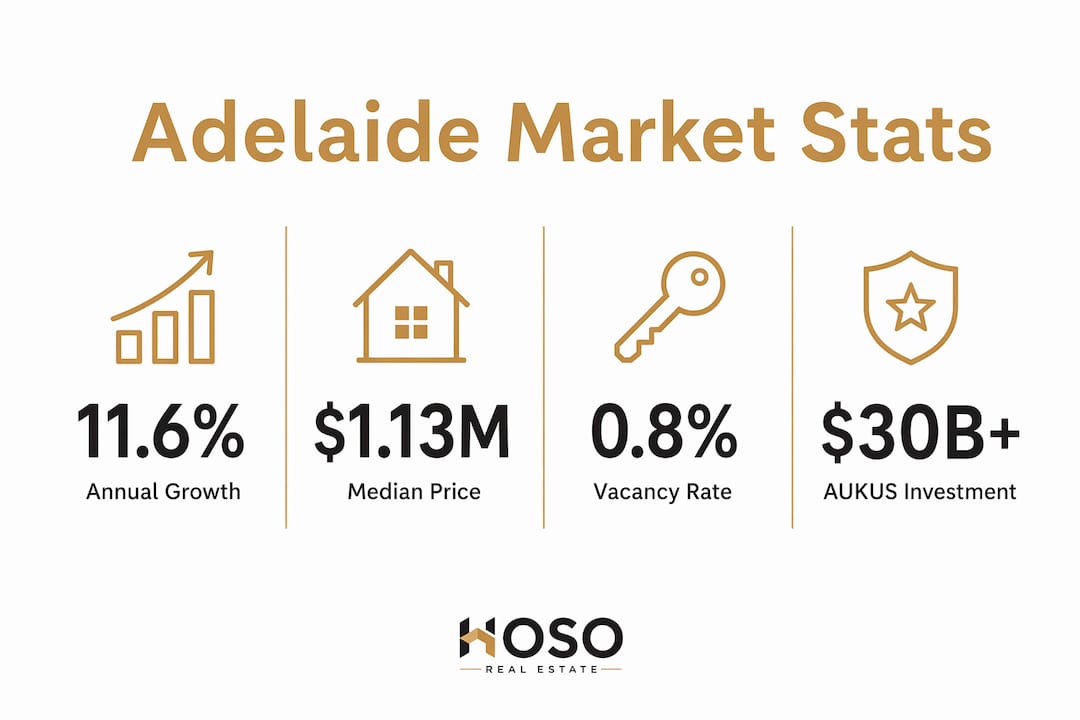
The affordability gap does more than attract first-home buyers. It channels investor demand into specific market segments, particularly units and lower-quartile properties. Median apartment prices rose 12.9% year-on-year to $640,000, driven by both investor activity and buyers priced out of the detached house market.
The segment dynamics are worth understanding in detail:
- Lower quartile units recorded 4.6% growth in just three months, outperforming upper quartile units which grew 1.5% over the same period.
- Borrowing constraints are funnelling demand toward more affordable stock, concentrating price pressure in the sub-$700,000 unit segment.
- Yield compression is occurring in inner suburbs like Norwood, Unley, and Prospect as prices rise faster than rents, reducing gross yields.
- Outer corridors such as Elizabeth, Salisbury, and Davoren Park retain stronger yields, often above 5%, for investors prioritising income over capital growth.
| Segment | Price trend | Yield profile |
|---|---|---|
| Inner suburban houses | Strong capital growth | Compressed yields |
| Lower quartile units | Fastest price growth | Moderate yields |
| Outer northern suburbs | Steady growth | Higher yields (5%+) |
| Premium upper quartile | Slowing growth | Lower yields |
For investors comparing units versus houses, the Adelaide unit market is currently delivering stronger short-term price performance in the affordable segment, while detached houses in growth corridors offer better long-term capital prospects.
What are the rental market dynamics and investment implications?
Adelaide's rental market is one of the tightest in the country. The vacancy rate sits at approximately 0.8%, which is among the lowest of any Australian capital city. That figure means landlords face minimal periods of vacancy and retain strong negotiating power when setting rents.
Tenant demand is driven by two forces. Population growth from interstate migration and skilled worker arrivals linked to defence and technology programmes is filling rental stock faster than new supply can be built. At the same time, high purchase prices are keeping many residents in the rental market longer than they otherwise would.
| Suburb type | Vacancy rate | Gross yield range |
|---|---|---|
| Inner Adelaide (e.g. Norwood, Unley) | Below 1% | 3.5%–4.5% |
| Middle ring (e.g. Prospect, Campbelltown) | Below 1% | 4%–5% |
| Outer northern (e.g. Salisbury, Elizabeth) | Below 1% | 5%–6%+ |
Yield compression in inner suburbs is real. Prices in areas like Norwood and Unley have grown faster than rents, narrowing gross yields. Investors who purchased three to five years ago are sitting on strong capital gains but lower current yields. New entrants to those suburbs need to model carefully before assuming the same returns.
Pro Tip: Request a current rental appraisal before purchasing, not after. Adelaide's rental market moves quickly, and a property's advertised rent can lag the actual achievable rate by $30–$60 per week in high-demand suburbs.
For investors managing a rental portfolio across multiple Adelaide properties, the combination of low vacancy and strong tenant demand creates a stable income base. The risk is not vacancy. The risk is selecting the wrong suburb and accepting yield compression without corresponding capital growth to compensate.
What risks and market nuances should investors consider in 2026?
Adelaide's property market is not without risk. Investors who treat it as a guaranteed growth story without conducting suburb-level analysis are likely to be disappointed.
The key risks in 2026 include:
- Interest rate sensitivity. Rate rises have weighed on buyer demand, particularly for upper quartile properties. Borrowing capacity constraints are real, and investors with high leverage are more exposed to serviceability pressure.
- Cost-of-living pressures. Tenant affordability is not unlimited. Rents have risen sharply, and further increases in some suburbs may face resistance from tenants whose wages have not kept pace.
- Federal budget and tax changes. Potential changes to negative gearing or capital gains tax concessions could shift investor demand quickly. A scenario-based approach to investment modelling is the most defensible position in the current environment.
- Liquidity differences. Some outer suburbs trade infrequently. Selling quickly in a softening market can be difficult, and investors should not assume that strong rental demand equals strong resale liquidity.
- Corridor-specific variation. Conditions vary widely across suburbs. Some northern corridors are outperforming significantly while others are stagnant. Median price data for "Adelaide" as a whole masks this variation.
Market analysts describe the likely 2026 trajectory as an orderly soft landing rather than a sharp correction. That consensus view does not eliminate downside risk, but it does suggest the structural demand drivers remain intact. Investors who rely on listing-level data, including rental yield, vacancy rates, and price-to-rent ratios at the individual property level, are better positioned than those relying on city-wide averages.
The regional growth story also matters here. Adelaide's performance relative to other capital cities has attracted interstate capital, and that flow of external investment adds both upward price pressure and liquidity to the market. It also means that conditions can shift faster than local fundamentals alone would suggest.
Key takeaways
Adelaide's property market is attractive in 2026 because structural demand drivers, including the AUKUS defence programme and population growth, are creating durable housing pressure that affordability-led eastern capital markets cannot replicate.
| Point | Details |
|---|---|
| Defence-led demand floor | The $30 billion-plus AUKUS pipeline supports long-term rental demand in northern and western corridors. |
| Tight rental conditions | A vacancy rate of approximately 0.8% gives landlords strong income stability and low turnover risk. |
| Segment-specific opportunity | Lower quartile units are outperforming, with 4.6% growth in three months versus 1.5% for upper quartile. |
| Affordability advantage | Adelaide's entry price point remains below Sydney and Melbourne, attracting interstate investor capital. |
| Suburb-level analysis required | City-wide medians mask wide variation; yield, vacancy, and corridor selection determine actual returns. |
Adelaide's defence economy changes the investment calculus
What I find most compelling about Adelaide's market right now is not the price growth. It is the source of that growth. Most Australian cities experience property cycles driven by sentiment, credit availability, and population flows that can reverse quickly. Adelaide's current growth has a different engine. The AUKUS defence programme is a 20-year government commitment. That is not a cycle. That is a structural shift.
I have seen investors dismiss Adelaide because its median price growth looks modest compared to Brisbane's peak years. That comparison misses the point. Adelaide is not trying to replicate Brisbane's speculative run. It is building a property market anchored to defence employment, health infrastructure, and a constrained supply pipeline. That combination produces steadier, more predictable returns.
The practical implication is straightforward. Properties near Osborne Naval Shipyard, the new Women's and Children's Hospital precinct, and the North-South Corridor upgrades are not just benefiting from a hot market. They are benefiting from government-funded demand that will persist regardless of interest rate cycles.
The mistake I see investors make is buying on city-wide data and ignoring corridor-specific fundamentals. A property in Davoren Park and a property in Burnside are both "Adelaide," but they serve entirely different tenant profiles and carry entirely different risk-return characteristics. The role of a local property manager in navigating that distinction is undervalued by investors who manage remotely or rely on national data services.
Adelaide rewards investors who do the granular work. Those who do not will find themselves holding assets that underperform the city's headline numbers.
— HOSO
How HOSO Real Estate supports Adelaide property investors
HOSO Real Estate works with landlords and investors across Adelaide who want more than a basic property management service. The team provides rental appraisals grounded in current market data, compliance management aligned with South Australian tenancy law, and landlord advisory that accounts for suburb-level conditions rather than city-wide averages. For investors building or managing a portfolio in Adelaide's current market, local expertise is not optional. Explore HOSO's property services to understand how specialist Adelaide management supports long-term asset performance. Investors can also view current listings to assess active opportunities across the metropolitan area.
FAQ
What is the current median house price in Adelaide?
Adelaide's median house price is currently $1,127,500, with 11.6% average annual growth across the metropolitan area.
Why does Adelaide attract interstate investors?
Adelaide offers lower entry prices than Sydney and Melbourne, a vacancy rate of approximately 0.8%, and structural demand driven by the AUKUS defence programme, making it a stable income and growth market.
Are Adelaide rental yields strong in 2026?
Yields vary by location. Outer northern suburbs such as Salisbury and Elizabeth deliver gross yields above 5%, while inner suburbs like Norwood and Unley show yield compression due to strong price growth.
What is the biggest risk for property investors in Adelaide?
Interest rate sensitivity and potential changes to tax concessions are the primary risks. Investors should use scenario-based modelling and conduct suburb-level analysis rather than relying on city-wide median data.
Is the Adelaide unit market outperforming houses?
Lower quartile units recorded 4.6% growth in three months, outperforming upper quartile units at 1.5% growth. Median apartment prices rose 12.9% year-on-year to $640,000, driven by affordability demand and investor activity.