
Sewerage charges in a South Australian rental always sit with the landlord, no exceptions. Consumption-based water charges can be passed to the tenant, but only if the property is separately metered or the lease agreement says so in writing. Even then, the landlord must hand over a copy of the SA Water bill within 30 days of it being issued, or the tenant is not required to pay.
TL;DR:
- Tenants only pay for water consumption if the property has a separate water meter or the lease explicitly states so, and they must receive the bill within 30 days of issuance.
- Shared meters require a written apportionment method, such as percentage split or pro rata days, clearly included in the lease before tenancy begins to avoid disputes.
- Landlords are responsible for statutory charges like sewerage and emergency levies, which are unaffected by metering or lease clauses.
- Tenants can dispute charges by requesting evidence, including bills and meter readings, and SACAT handles unresolved disputes based on documented proof.
- Installing water-efficient fixtures and recording independent meter reads help avoid high bills and disputes related to leaks or faults.
Table of Contents
- Who pays which parts of an SA water bill
- Shared meters and lease terms: keeping the arrangement fair
- Working out charges: meter reads, billing cycles and the calculator
- Water security rebate and other statutory reductions
- Faults, leaks and excessive usage: who pays when things go wrong
- Invoices, evidence and the 30-day rule
- Disputes and where to get help
- Tenant rights and dispute resolution processes related to water charges
- Examples of common lease clause wording regarding water charges
- Impact of water-efficient appliances or practices on water charges in rentals
- A property manager's view on avoiding water-charge disputes
- How HOSO Real Estate keeps your water billing accurate and defensible
- Sources
- FAQ
Who pays which parts of an SA water bill
The Residential Tenancies Act 1995 s73 draws a firm line between statutory charges and consumption charges. Statutory charges cover sewerage, the emergency services levy component tied to the property, and any council-based statutory charge. These sit with the landlord regardless of what the lease says.
Consumption charges are different. A tenant can be asked to pay for the water they actually use, but only under specific conditions:
- The property has its own separate water meter, or
- The tenancy agreement contains an explicit clause requiring the tenant to pay usage charges
Where neither condition applies, the landlord absorbs the full SA Water bill, including the usage component. This default protects tenants in older properties or shared-meter arrangements from being charged for consumption they can't independently verify or control. For landlords managing a wider portfolio, understanding these landlord obligations in South Australia up front avoids disputes months into a tenancy.
Shared meters and lease terms: keeping the arrangement fair
A property counts as "separately metered" only when SA Water can isolate its consumption from any other dwelling on the same title. Granny flats, subdivided homes, and some strata townhouses often share a single meter, and that changes the entire billing conversation.
Where one meter serves multiple residences, the lease needs a specific written term explaining how usage will be apportioned. Two methods are common:
- Percentage split by property — each dwelling pays a fixed share based on floor size, bedroom count, or occupancy, agreed in writing before the tenancy starts.
- Pro rata by days — used when tenancies start or end at different times, splitting the bill according to how many days each tenancy overlapped the billing period.
Whichever method applies, it must be written into the lease, not verbally agreed. Verbal apportionment arrangements rarely survive a SACAT hearing.
Pro Tip: If you manage a subdivided property with a shared meter, get the apportionment formula in writing before the first tenant moves in. Retrofitting it later almost always ends in a dispute.
Working out charges: meter reads, billing cycles and the calculator
SA Water's billing cycle almost never lines up neatly with a tenancy's start or end date, which is exactly why meter readings need to be recorded independently of the SA Water invoice. Best practice looks like this:
- Record the meter reading on the entry inspection report, with a photo, on the day the tenant takes possession
- Record it again on the exit inspection report when the tenant vacates
- When a bill spans dates before and after a tenancy, apportion usage pro rata by the number of days the tenant occupied the property within that billing period
- Use SA Water's usage calculator to estimate the tenant's likely charge using SA Water's current prices, cross-checked against the invoice
A worked example: where a bill covers a period longer than the tenancy, the tenant's liability is calculated proportionally based on the number of days occupied during that billing period, not the full invoice.
Water security rebate and other statutory reductions
Section 73 of the Residential Tenancies Act imposes a mandatory step that catches many landlords out: any consumption amount charged to a tenant must first be reduced by the water security rebate, or a proportionate share of it where multiple residences sit on one title.
- Calculate the tenant's raw usage charge first, then deduct the rebate amount applied to that billing period
- Where several tenancies share a title that received one rebate, apply it proportionately, typically on the same pro rata days basis used for usage apportionment
- If deducting the rebate brings the amount below zero, the tenant owes nothing, the figure does not go negative
- Document the calculation alongside the invoice copy given to the tenant
Skipping this step is one of the more common compliance failures HOSO Real Estate sees in landlord-managed properties, and it's an easy one for SACAT to rule against.
Faults, leaks and excessive usage: who pays when things go wrong
A burst pipe or a failed toilet cistern can turn a modest quarterly bill into a shock invoice, and the law is specific about who absorbs that cost. Landlords are liable for excessive water charges caused by a fault in infrastructure, equipment, or fixtures, provided the tenant notified them as soon as practicable after noticing the problem.
That last condition matters. If a tenant notices a running toilet or dripping tap and says nothing for weeks, the landlord can reasonably argue the tenant contributed to the excess.
- Tenant notices unusual water flow, a wet patch, or a spike in noise from pipework
- Tenant reports it to the landlord or managing agent immediately, in writing where possible
- Landlord arranges inspection and repair, and checks the meter before and after the fix
- If SA Water infrastructure itself is at fault (mains, meter, or supply pipe), the claim shifts to SA Water rather than the landlord
Pro Tip: Keep every maintenance report tied to a date-stamped tenant notification. It's the single piece of evidence that decides these disputes at SACAT.
Invoices, evidence and the 30-day rule
A landlord can only pass on consumption charges if a copy of the SA Water bill detailing usage accompanies the request. Miss the 30-day window from the invoice's issue date, and the tenant is not obliged to pay it at all.
Before issuing any water charge to a tenant, check you have:
- A copy of the actual SA Water bill, not just a summary figure
- Entry and exit meter readings from the inspection reports
- Written confirmation of the apportionment method if the property shares a meter
- A record of when the bill was provided to the tenant, to prove the 30-day deadline was met
Disputes and where to get help
If a tenant queries a water charge, the first call depends on what's being disputed. SA Water can confirm bill details and usage history, but it doesn't hold individual tenant accounts and it doesn't take tenancy-specific meter readings, that responsibility sits with the landlord or agent.
- Contact SA Water for billing data and consumption history on the account
- Contact Consumer and Business Services (CBS) for tenancy fact sheets and general guidance on rights and obligations
- If the dispute can't be resolved directly, apply to SACAT for a binding decision
- Prepare inspection reports, bill copies, and written communications before lodging with SACAT, incomplete evidence is the most common reason claims stall
SACAT can order repayment, dismiss a claim, or make a binding determination on liability, but it can't waive statutory rebate requirements or override the Act itself.
Tenant rights and dispute resolution processes related to water charges
Tenants in South Australia have a clear set of protections built into how water charges are administered, and most disputes trace back to one of these being overlooked. A tenant cannot be charged for consumption unless the property is separately metered or the lease says so explicitly. A tenant cannot be charged without receiving a copy of the actual SA Water bill. And a tenant cannot be charged the full rebate-inclusive amount, the rebate deduction is mandatory, not optional.
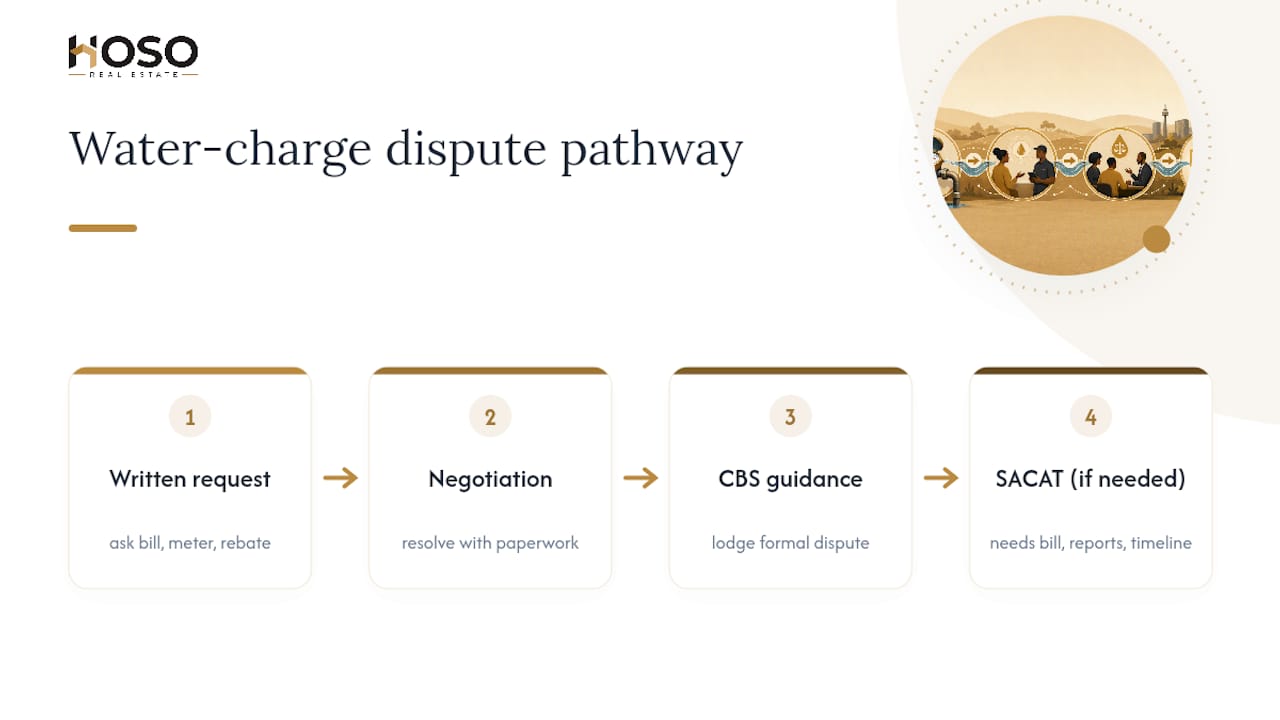
Where a tenant believes they've been charged incorrectly, the sensible first step is a written request to the landlord or agent asking for the supporting documents, the bill copy, the meter readings, and the rebate calculation. Most disputes resolve at this stage once the paperwork is laid out plainly.
If the landlord can't produce that evidence, or the tenant still disagrees with the apportionment method, CBS fact sheets set out the process for lodging a formal dispute. SACAT becomes the venue only when direct negotiation and CBS guidance haven't resolved the disagreement. Tenants should be aware that SACAT applications need supporting evidence, not just a disagreement about the amount, applications backed by inspection reports, bill copies, and clear timelines are resolved far faster than ones without.
One point tenants frequently misunderstand: disputing a water charge doesn't put the whole tenancy at risk. Water billing disputes are handled as a discrete matter, separate from rent payment obligations or lease renewal decisions, provided the tenant continues paying rent as normal while the water charge is contested.
Examples of common lease clause wording regarding water charges
Lease clauses covering water charges vary in quality, and vague wording is where most future disputes are seeded. A clause that simply states "tenant to pay water usage" isn't enough on its own, it needs to specify the metering arrangement and the calculation method to be enforceable in practice.
A stronger clause typically reads along these lines: "The tenant will be responsible for water consumption charges as measured by the separate water meter servicing this property, calculated in accordance with the SA Water invoice provided to the tenant within 30 days of issue, and reduced by any applicable water security rebate." That single sentence covers metering status, the invoice requirement, and the rebate deduction in one place.
Where a property shares a meter with another dwelling, the clause needs an apportionment formula written in: "Where the property shares a water meter with [address/description], the tenant's consumption charge will be calculated as [X]% of the total metered usage for the billing period, or on a pro rata basis according to days of occupancy within that period."
Clauses that omit the metering status entirely, or that simply say "tenant pays all water charges" without qualification, tend to fail scrutiny at SACAT because they conflict with the statutory default in s73. A lease clause can allocate consumption charges to a tenant, but it cannot override the landlord's fixed responsibility for sewerage and statutory charges, no matter how the clause is worded.
Impact of water-efficient appliances or practices on water charges in rentals
Water-efficient fixtures change the consumption side of the ledger directly, and in a separately metered property, that saving flows straight to whoever pays the usage charge. A dual-flush toilet, a WELS-rated shower head, and a front-loading washing machine can meaningfully reduce a household's quarterly usage compared with older fittings, which matters most in properties where the tenant bears consumption costs under the lease.
For landlords, installing water-efficient appliances during a vacancy period or a scheduled upgrade does more than reduce disputes over "unusually high" bills, it also reduces the chance that a fixture fault (like a worn toilet valve) goes unnoticed and drives up usage before anyone spots it. Efficient fixtures tend to fail more visibly and are cheaper to replace, which shortens the gap between a fault occurring and it being reported.
Tenant behaviour matters just as much as the fixtures themselves. Shorter showers, full loads in the washing machine and dishwasher, and prompt reporting of drips or running toilets all affect the final consumption figure a landlord is entitled to charge for, where a charge applies at all. In shared-meter properties, one household's water-heavy habits can inflate a bill apportioned across multiple tenancies, which is exactly why the apportionment method in the lease needs to be fair and clearly documented rather than assumed.
A property manager's view on avoiding water-charge disputes
Most water billing disputes trace back to missing paperwork, not bad faith. Meter reads on every entry and exit inspection, a properly worded lease clause, and a tenant induction that covers what to do about leaks solve most of it before it starts. Factoring water into the rent removes the friction entirely for landlords who'd rather not administer it line by line.
— HOSO
How HOSO Real Estate keeps your water billing accurate and defensible
Chasing down meter reads, checking rebate calculations, and proving a 30-day invoice deadline was met isn't where most landlords want to spend their time, and getting any one of those wrong can mean a charge you can't legally recover. HOSO Real Estate's property management services build meter readings into every entry and exit inspection as standard, keep the documentation SACAT expects on file, and handle tenant communication on maintenance faults before they turn into disputed usage claims. That's the difference between a portfolio where water billing runs quietly in the background and one where every quarterly bill is a potential argument. If you're weighing up whether your current arrangement is exposing you to unrecoverable charges or disputed claims, a rental appraisal with HOSO Real Estate is the straightforward next step, get in touch and we'll walk through exactly where your current setup stands.
Sources
- Sa
- I'm a tenant. What are my responsibilities? — SA Water
- Energy and water charges — Consumer and Business Services (CBS)
- Residential Tenancies Act 1995 — s73 (statutory charges)
FAQ
What water charges do tenants pay in SA?
Tenants pay only consumption-based water usage charges, and only when the property is separately metered or the lease agreement specifically requires it. Sewerage and other statutory charges always remain the landlord's responsibility.
Do tenants pay a water bill in Australia?
In South Australia, tenants don't hold their own SA Water account, the bill goes to the landlord or managing agent, who may then pass on eligible usage charges. Rules vary between states, so this answer applies specifically to South Australian tenancies under the Residential Tenancies Act.
How much would 1,000 litres of water cost?
Current SA Water usage prices are set out on SA Water's own pricing pages and change periodically, so the exact cost should be checked directly against your current bill or SA Water's usage calculator rather than a fixed figure quoted here.
What are the current SA water supply charges for residential purposes?
Residential water supply charges in South Australia are set by SA Water and detailed on each property's invoice, split between the fixed supply component and the usage-based component. For a rental property, only the usage component may ever be passed to a tenant, and only under the conditions set out in the lease and the Act.
What happens if my landlord doesn't give me a copy of the water bill?
If your landlord or agent doesn't provide a copy of the SA Water invoice within 30 days of it being issued, you're not required to pay that water charge. This rule exists specifically to stop landlords charging tenants without proof of actual usage.